



18,99 €
Mehr erfahren.
- Herausgeber: John Wiley & Sons
- Kategorie: Geisteswissenschaft
- Sprache: Englisch
The war on terror is a lost cause. As the war heads towards its second decade, American security policy is in disarray – the Iraq War is a disaster, Afghanistan is deeply insecure and the al-Qaida movement remains as potent as ever with new generations of leaders coming to the fore.
Well over 100,000 civilians have died in Iraq and Afghanistan, many tens of thousands have been detained without trial, and torture, prisoner abuse and rendition have sullied the reputation of the United States and its coalition partners.
Why We’re Losing the War on Terror examines the reasons for the failure, focusing on American political and military attitudes, the impact of 9/11, the fallacy of a New American Century, the role of oil and, above all, the consummate failure to go beyond a narrow western view of the world.
More significantly, it argues that the disaster of the war may have a huge if unexpected bonus. Its very failure will make it possible to completely re-think western attitudes to global security, moving towards a sustainable policy that will be much more effective in addressing the real threats to global security – the widening socio-economic divide and climate change.
Sie lesen das E-Book in den Legimi-Apps auf:
Seitenzahl: 269
Veröffentlichungsjahr: 2013
Ähnliche
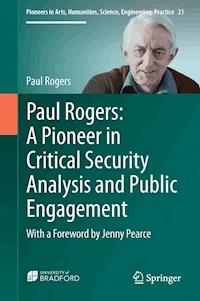



















Why We’re Losing the War on Terror
Why We’re Losing the War on Terror
PAUL ROGERS
polity
Copyright © Paul Rogers 2008
The right of Paul Rogers to be identified as Author of this Work has been asserted in accordance with the UK Copyright, Designs and Patents Act 1988.
First published in 2008 by Polity Press
Polity Press
65 Bridge Street
Cambridge CB2 1UR, UK.
Polity Press
350 Main Street
Malden, MA 02148, USA
All rights reserved. Except for the quotation of short passages for the purpose of criticism and review, no part of this publication may be reproduced, stored in a retrieval system, or transmitted, in any form or by any means, electronic, mechanical, photocopying, recording or otherwise, without the prior permission of the publisher.
ISBN-13: 978-0-7456-4562-9
A catalogue record for this book is available from the British Library.
Typeset in 10.25 on 13 pt FF Scala
by Servis Filmsetting Ltd, Manchester
Printed and bound in Great Britain by MPG Books Ltd, Bodmin, Cornwall
The publisher has used its best endeavours to ensure that the URLs for external websites referred to in this book are correct and active at the time of going to press. However, the publisher has no responsibility for the websites and can make no guarantee that a site will remain live or that the content is or will remain appropriate.
Every effort has been made to trace all copyright holders, but if any have been inadvertently overlooked the publishers will be pleased to include any necessary credits in any subsequent reprint or edition.
For further information on Polity, visit our website: www.polity.co.uk
Contents
Acknowledgements
Preface: Lost Cause or Second Chance?
Part I Context
1 The Political Context
2 The US Military Posture
3 Oil and the War on Terror
Part II Events
4 From Kabul to Baghdad
5 Baghdad and Beyond
Part III Consequences
6 Towards the Long War
7 Sustainable Security
Notes
Index
Acknowledgements
Although I take full responsibility for this book, it does arise, in part, from many discussions in recent years. These include frequent lectures at defence colleges and work with a wide range of political and non-governmental organizations, especially a close involvement with Open Democracy and Oxford Research Group. It has been particularly helpful to be working at Bradford University’s Department of Peace Studies – the extraordinary range of staff and students, drawn from more than forty countries, has provided an immensely experienced and thoroughly stimulating environment. Finally, I would like to thank Louise Knight of Polity for originally suggesting that I have a go at writing this book, and Louise and her colleagues, especially Emma Hutchinson and Gail Ferguson, for their help in seeing it through to completion.
Paul Rogers,
Bradford,
July 2007
Preface: Lost Cause or Second Chance?
As the Iraq War entered its fifth year in March 2007, the United States was engaged in a new effort to contain the insurgency. Following numerous predictions from the Bush administration since the start of the war that military forces would soon be scaled down, the reverse was happening, with a ‘surge’ of 30,000 troops taking the total deployment in Iraq to over 160,000. As this got under way, the US Department of Defense also announced an increase in US troop numbers in Afghanistan, where close to 30,000 troops were deployed with forces from other NATO states in an effort to counter a Taliban revival across much of southern Afghanistan.
The wars in both countries showed no sign of easing and constituted a predicament for the United States that was in marked contrast to the expectations five years earlier. Then, a ‘war on terror’ had been declared in response to the 9/11 atrocities. The aims of that war had evolved over a few months from an initial operation to terminate the Taliban regime in Afghanistan and cripple the al-Qaida movement to a much larger endeavour that took in an ‘axis of evil’ of three rogue states, Iraq, Iran and North Korea. All of these were seen as having entirely unacceptable regimes that both supported terrorism and were bent on developing weapons of mass destruction.
In early 2002, expectations in Washington were high that post-Taliban Afghanistan would be a stable pro-western state that would enable the United States to increase its influence in the region, both by a direct involvement in the country and also through improved links with several Central Asian states. Having lost its main area of operations, the al-Qaida movement had been dispersed and there was every hope that Osama bin Laden and other leaders would soon be detained or killed. Furthermore, there was a confident expectation within the Bush administration that the Saddam Hussein regime in Iraq could be terminated, if need be by military force. A new pro-western government espousing liberal-market economics would have an excellent relationship with Washington, and American influence in the oil-rich region of the Persian Gulf would be substantially enhanced.
Even more valuable would be the indirect pressure that this would put on the regime in Tehran. With Afghanistan to the east and Iraq to the west both experiencing regime change, and with pro-western governments in power, Iran’s position in the region would be much diminished, quite possibly rendering regime change in Tehran unnecessary. More generally, the robust and single-minded response to the 9/11 attacks could well set in motion regime change across the Middle East, ushering in a period of enhanced pro-western governance. This, in turn, would be an important step in achieving the ideal of a New American Century, a concept beloved of the neoconservatives and assertive realists who were so prominent in the Bush administration.
Instead of realizing these dreams, the first six years of the war on terror have shown the idea of the New American Century boosted by the war on terror to be something of a lost cause. In the two wars, over 3,500 US troops have been killed and more than 25,000 seriously wounded, many of the latter maimed for life. The war in Afghanistan shows no sign of ending, with record opium poppy crops supporting an illicit economy that helps fuel the insurgency. In Iraq there have been at least 100,000 civilians killed and close to four million Iraqis are refugees. A bitter anti-American mood is evident across the Middle East and beyond, and the much-vaunted coalition of like-minded states in Iraq is reduced to a rump – a few thousand troops, many of them British, remain there but most countries have quietly withdrawn. Even in the United States, efforts to link Iraq with the wider war on terror have proved increasingly difficult, and the Republican Party lost control of Congress in November 2006 following political campaigning in which Iraq loomed large. Most surprising of all, the al-Qaida movement has proved unexpectedly resilient, having dispersed from its original bases in Afghanistan to function as a near-virtual entity, even if it does have distinct centres in western Pakistan.
This book is concerned with a preliminary analysis of the early years of the war on terror and why the policies adopted by the United States and its closest coalition partners have failed to achieve their aims. It attempts to do so in three phases. Part I examines the context of the period, starting with an assessment of the relevant features of US politics in the years leading up to 9/11. This covers the particular outlook of the Bush administration in relation to foreign and defence policy, and seeks to examine the extent to which the neoconservative tendency was particularly relevant in determining the response to 9/11. It also explores the military context by reviewing the major changes in the US military posture during the 1990s. By the start of the new century, the United States was clearly the world’s sole superpower and was deploying military forces of unparalleled capability. It was the only country remotely capable of fighting the global war on terror in the manner envisaged, and its capabilities did much to ensure precisely how and where that war might be fought.
Finally, Part I engages with the highly relevant issue of US oil security and the significance of the Persian Gulf reserves – easily the largest in the world. The argument is not that the United States went into Iraq to ‘grab’ that country’s oil, even though Iraq did have reserves that were at least four times larger than the entire US domestic reserves, including Alaska. At the same time, it most certainly is argued that the sixty-year history of US military concern with the security of the Persian Gulf is highly relevant in understanding recent operations.
Part II reviews the developments in Afghanistan and Iraq, and also the attempts to counter the al-Qaida movement, setting the aims of the operations against the outcomes so far and offering an analysis of some of the main reasons why the outcome of the war on terror is proving to be so different to the early expectations.
Finally, Part III looks at the consequences of US policy and then seeks to assess whether other policies might have been, and might still be, more appropriate. It does so with specific reference to Iraq, Afghanistan and the al-Qaida movement, but goes beyond this to question whether the failures of recent years might actually prompt a more fundamental reassessment of a western security posture that might best be described as a ‘control paradigm’. In particular, is this posture in any way appropriate to a global system in which the major security issues of the next few decades are likely to arise from a dangerously widening socio-economic divide interacting with environmental constraints, especially climate change? Would it be more appropriate to move towards a ‘sustainable security’ paradigm and, if so, might the failure of the war on terror make it more likely that such a change will come about?
Sustainable security is concerned with developing a security outlook that recognizes the centrality of a human security concept rooted in justice and emancipation, accepts that global issues such as socio-economic divisions and environmental constraints require a common security approach more than a state-centric model, and also accepts the requirement to ensure that policies adopted are sustainable in that they do not create new forms of insecurity in responding to short-term predicaments. This book concludes by arguing that this is the appropriate model for the future and that the very failure of the control paradigm that has been at the centre of the war on terror does at least mean that space has opened up for the vigorous pursuit of alternatives. That will do nothing to redress the violence, suffering and misery occasioned by the conduct of the war, but it might at least help prevent even greater problems in the future.
PART I
Context
CHAPTER ONE
The Political Context
History repeated
Before the election of President George W. Bush in November 2000, oppositional politics in the United States in the late 1990s bore some striking similarities to the politics of the late 1970s. In each period, powerful Republican groups were advocating major changes in direction in US foreign and security policy against incumbent Democrat administrations; on each occasion these groups achieved their aims and each time they were able to move into positions of considerable authority and influence.
In the late 1970s, President Jimmy Carter was facing vocal and determined opposition to his relatively liberal foreign policy, especially concerning his relations with the Soviet Union. Although the Soviet leadership was increasingly moribund, the detente of the early 1960s had long been replaced by growing tensions made worse by the development of new military technologies, not least highly accurate multi-warhead nuclear missiles. While the United States could not claim to be behind the Soviets in terms of technology, major claims were made by right-wing groups that the Soviet Union was narrowing the US technological lead while producing new nuclear and conventional weapons at a far higher rate.
Lesen Sie weiter in der vollständigen Ausgabe!
Lesen Sie weiter in der vollständigen Ausgabe!
Lesen Sie weiter in der vollständigen Ausgabe!
Lesen Sie weiter in der vollständigen Ausgabe!
Lesen Sie weiter in der vollständigen Ausgabe!
Lesen Sie weiter in der vollständigen Ausgabe!
Lesen Sie weiter in der vollständigen Ausgabe!
Lesen Sie weiter in der vollständigen Ausgabe!
Lesen Sie weiter in der vollständigen Ausgabe!
Lesen Sie weiter in der vollständigen Ausgabe!




