


3,99 €
Mehr erfahren.
- Herausgeber: Sybil Wolfe
- Kategorie: Religion und Spiritualität
- Sprache: Englisch
LEARN HOW TO SUCCESSFULLY CAST SPELLS AND GIVE ACCURATE READINGS
Are you curious about the world of witchcraft?
Do you want to step into a world unlike any other?
Would you like to peek into the future and see what it beholds?
It can be really intimidating to try to learn about something new, especially if it seems like there's a lot of jargon and mystery involved.
Wicca and Tarot is the perfect place for beginners. to start their journey!
Learn more about modern witchcraft and start your journey into the craft. This book includes all the tools you need to get started on Tarot and Wicca magic, as well as a starter kit that will teach you everything you need to know about Herbal, Candle, and Crystal Magic.
Perform readings like a pro and cast amazing spells in no time!
With this book, you’ll be able to:
- Uncover the mysteries of the future!
- Perform accurate and meaningful tarot readings for yourself and others around you.
- Unleash the secrets of the Arcana!
- Get a mini encyclopedia with everything about Wiccan Magick.
- Learn about magical traditions!
- Try out different forms of magic and find what suits you best.
- Find exercises so you can practice your readings more often.
- Discover the rich history of witchcraft.
- Find information that comes from actual witches!
Venture into the unknown.
SCROLL UP, GET THE BOOK, AND GET STARTED ON YOUR PATH AS A MODERN WITCH!
Das E-Book können Sie in Legimi-Apps oder einer beliebigen App lesen, die das folgende Format unterstützen:
Veröffentlichungsjahr: 2023
Ähnliche
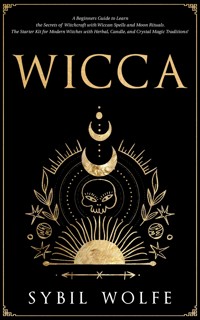
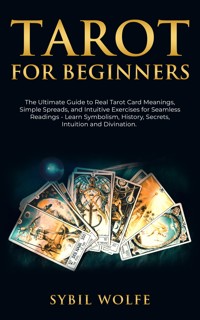







Wicca & Tarot Bundle
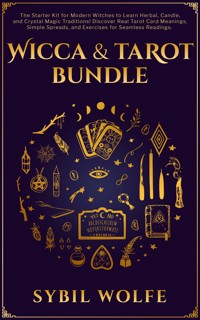
The Starter Kit for Modern Witches to Learn Herbal, Candle, and Crystal Magic Traditions! Discover Real Tarot Card Meanings, Simple Spreads, and Exercises for Seamless Readings.
Sybil Wolfe
Copyright
Copyright © 2022 by Sybil Wolfe
All rights reserved.
It is not legal to reproduce, duplicate, or transmit any part of this document in either electronic means or in printed format. Recording of this publication is strictly prohibited and any storage of this document is not allowed unless with written permission from the publisher except for the use of brief quotations in a book review.
Contents
Introduction - Wicca
1.
Modern Wicca: An Initiation
What is Wicca?
The Core Tenets of Wicca
Wicca vs. Witchcraft
The Diversity of Witches
Witchcraft Myths Busted
2.
A Brief History Of Witchcraft
3.
The Nature Of Magick And The Magick Of Nature
The Source of Magick
Wiccan Divinity: Out of One, Many
The Four Elements
The Wheel of the Year
The Cycles of the Moon
4.
Free Goodwill
5.
Ritual Magick and Ceremonial Tools
Wiccan Tools and Symbols
Incantation: The Magick Words
Spellcasting Ingredients
The Sacred Circle
6.
Mini-Encyclopedia of Magickal Symbols and Correspondences
Deities
Animals
Colors
Crystals and Stones
Flowers, Herbs, and More
7.
Starter Spellbook for the New Witch
Spells for Romance & Friendship
Spells for Success & Abundance
Spells for Protection & Self-Care
Final Words - Wicca
Introduction - Tarot for Beginners
8.
Demystifying The Tarot
Tarot 101
The Key to Card Reading
What You Stand to Gain
Tarot Myths Busted
9.
The History Of The Cards
Only a Parlor Game…
The Tarot of Marseilles
The Rider-Waite Legacy
The Thoth Deck
10.
A Practice Of Your Own
The Essential First Step: Your Tarot Journal
It’s All in the Cards: Your Tarot Deck
Developing Your Practice
11.
The Art Of The Spread
Single-Card “Spreads”
Three-Card Spreads
Four or More Cards
12.
Arcane Secrets: The Symbolism In The Cards
Spiritual Symbolism
Archetypes
The Significance of Color
Changing Times, Changing Symbols
Personal Correspondences
13.
The Cards Of The Major Arcana
How to Use This Guide
14.
The Cards Of The Minor Arcana
The Suit of Wands
The Suit of Cups
The Suit of Swords
The Suit of Pentacles
Final Words - Tarot for Beginners
Introduction - Wicca
Hailandwelcome,new witches! I’m so glad you’re here.
There has never been a time in history when more souls have been called to the craft. I see it every day: young women (and men and nonbinary people, too) searching for meaning in a world devoid of any connection to our Earth Mother, their spirits languishing in a society that denigrates and abuses the divine feminine, attempting to snuff out the light inside of us. If you’re curious about how moon magick and intuitive manifestation can help you better your life and your connection to your own divinity, look no further than this small tome.
I myself had the luck of being born a hereditary witch, and I’ve been practicing magic all of my life. I grew up in metaphysical shops, where I learned to use candles, crystals, and herbs as tools for manifestation. I’ve joined and formed covens, read every book on Wicca I could get my hands on, and spent years refining my particular brand of the craft.
I am writing this book because I’m called to share all that I’ve learned with this new generation of witches. Some in the older generations believe that these secrets should not be shared so readily, but I fervently disagree. The fact that you are reading or listening to this book is all the proof I need that you are a compassionate and intuitive soul, deserving of all the tools you need to manifest your best self.
In these pages, I’ve used clear, no-nonsense explanations to introduce you to Wicca, its history, and the secrets of its ritual magick. You’ll learn all about the phases of the moon, the incantations that bring spells to life, and how to harness the magic in the changing of the seasons. I’ve included nine of my most-loved spells and rituals straight from my own grimoire, specially chosen for the new practitioner, and a mini-encyclopedia of magickal correspondences, so you can begin to intuitively craft your own spells, as well.
All the tools you need are on these pages. The only thing stopping you from making your life into the one you most desire is yourself.
So! Let’s begin, shall we?
Modern Wicca: An Initiation
Icanteachyou all you need to know to harness magick as a new witch. But before you learn to cast your first spells, you must first understand where the magick comes from and how to harness it. There is a long, long history of witches who have come before you and built a wealth of occult knowledge, within which you’ll find all that you seek and more. Here’s a crash course on Wicca 101—or an “initiation,” if you will!
What is Wicca?
Wicca is a form of modern paganism whose practitioners are called witches and who use spiritual symbolism and magickal rites to manipulate the energies of the Universe. That power of manipulation and manifestation—the ability to harness energy in the form of magick—is what makes a witch, a witch.
Wicca, to most, is less an organized religion and more an intimate spiritual practice. Wiccan beliefs and practices are largely inspired by Western European folk magick and old religions, but Wicca also acknowledges spiritual symbols that cross cultures and pantheons, borrowing from pre-Christian belief systems around the world. Wiccan practitioners are a wildly diverse bunch who perform magick in numerous ways, from ornate, sacred ritual rites honoring gods and goddesses to simply stirring a little bit of magick into their morning tea. Still, witches are all united by our reverence for the divinity in nature and our powers of manifestation.
The Core Tenets of Wicca
Because Wicca is deeply personal in nature, no two practitioners hold exactly the same beliefs and traditions. Once, the word “Wicca” meant something very specific, referring to a set of rites that were kept secret from all but the initiated, and there is more on this in Chapter 2. Over the years, however, Wicca has evolved into many different disciplines with many different practices. Within these disciplines—and even within various covens within these disciplines—an individual Wiccan’s core beliefs may vary greatly.
The vast majority of Wiccans, however, are united by the following four main tenets.
Divinity is in nature: Wicca and witchcraft are Earth-based practices. While Wiccans may disagree about what exactly divinity is, we all accept that it resides in nature. I’ll go into depth about how witches revere and work with nature in Chapter 3.We have the power to shape our realities: Witchcraft is at the heart of Wicca, and in its simplest form, it is the process through which witches manipulate reality. Wiccan sects and solitary practitioners often have different ideas about what makes someone a witch, but they all agree that a witch holds the power to manifest his or her reality through magick.Do unto others: Yes, the golden rule is a core tenet of Wicca, as it is in many systems of belief. In fact, we call it the Wiccan Rede, and while translations differ slightly, they boil down to this: “Harm none and do what you will”. This means that any kind of energetic manipulation is fair game in witchcraft, as long as the witch does not seek to cause harm to another person. Essentially, Wiccans are good witches!You reap what you sow: While this is the most controversial of the tenets, it is nonetheless an integral part of Wicca. It is the belief that, when a witch sends harmful, violent, or vengeful energy into the universe, she will receive this negativity back thrice. Wiccans call this the Rule of Three or the Three-Fold Law, and while it also means that the good you send into the universe comes back to you three times, we typically reference this rule as an incentive not to hex an ex or curse a boss. However deserving of retribution a wrongdoer may be, the Wiccan trusts Karma to dole out justice.Witches who don’t follow these four core beliefs are unlikely to consider themselves Wiccans—yes, I know; it’s confusing! Let’s take a look at the distinction.
Wicca vs. Witchcraft
Put simply: all Wiccans are witches, but not all witches are Wiccans.
As you’ll learn in the next chapter, Wicca is a relatively new concept intended to unify and popularize esoteric witchcraft practices throughout Western Europe, so witchcraft actually predates Wicca by millennia. Additionally, while Wicca draws its inspiration primarily from Western European paganism, witches, shamans, and other magick users have existed in cultures around the world, throughout human history.
In today’s world, “traditional witchcraft” can look a lot like Wicca, and it can be hard to know where one ends and the other begins. Two witches may practice the same rituals, cast the same spells using the same herbs, and call on the same deities, while one calls herself a Wiccan and the other does not.
So how can we tell them apart? To some extent, it comes down to personal preference whether you identify with Wicca or not. Wicca represents a more formalized spiritual system, which some choose to reject in favor of their own religions and deities or a lack thereof. (Yes, there are Christian witches, and atheist witches, too.) Those who do not follow the Wiccan rede and the Rule of Three are likely not to identify with Wicca, even if they practice in such a way that their witchcraft looks essentially the same as mine.
For simplicity’s sake, throughout this book, I’ll use the terms Wiccan and witch interchangeably.
Neopaganism and the Occult
Wicca and modern witchcraft are part of the larger overall occult movement, which has been growing in popularity over the last few centuries but positively exploded in our culture around the 1960s. “Occult” refers to supernatural or mystical phenomena outside of mainstream organized religion, and experiences, like magick, that cannot yet be explained by science. Witchcraft, Voodoo, ouija boards, tarot cards, astrology, numerology—these are all considered occult practices. While many witches have an interest in the occult, these practices are not, by definition, a part of Wicca. Instead, you might think of astrology, for example, as witchcraft’s cousin.
Neopaganism refers to the modern resurgence of Earth-based, polytheistic, and pantheistic religions, of which Wicca is but one. Modern druids are also neopagans. Feraferia is another example of a neopagan movement, in which Hellenistic Greek rites are revived for the modern practitioner.
The Diversity of Witches
So you can see that witchcraft is, by its nature, a diverse practice. Here is just a sampling of some of the specific disciplines or types of witchcraft you may come across.
Gardnerian Wiccan: These witches are strict adherents to the original tenets of Wicca. We’ll cover many Gardnerian concepts in this book, as they are the basis for modern Wiccan tradition, but we’ll also draw heavily from eclectic practices.Traditional or folk witch: These witches reject Gardnerian Wicca, instead claiming an older source for their beliefs and practices. Because Wicca was founded on many of these same concepts and symbols, traditional witchcraft and Wicca can look indistinguishably similar. Folk witchcraft is a more focused type of traditional witchcraft, in which adherents follow practices specific to a geographic area (such as Ireland or the Appalachian Mountains), handed down through generations.Green witch: A green witch is highly in tune with nature. She likely follows the Wheel of the Year (which I’ll cover in Chapter 3) and uses herbs, flowers, and crystals in her magick. Green witches are not united by any particular credo—any witch who calls herself a green witch is a green witch. Green witchcraft has seen increased popularity in recent years as a way to reconnect with the Earth in our fast-paced, digital world.Devotional witch: A witch whose practice regularly involves calling on and working with deities is called a devotional witch. A devotional witch may follow a certain pantheon (e.g., worshiping all Celtic-Gaelic gods and goddesses), an eclectic pantheon (e.g., choosing and even swapping out deities from many different pagan religions), or a single god or goddess (e.g., followers of Hekate). Kitchen witch: A kitchen witch practices the magick of home and hearth. She’s very similar to a green witch, in that she likely uses a lot of herbs and natural ingredients in her spells—but for a kitchen witch, a spell might be a recipe for a loaf of bread! A kitchen witch infuses magick into cooking, cleaning, and everything she does in her home.Eclectic witch: An eclectic witch doesn’t prescribe to one particular path. Most of us, in truth, are eclectic witches—we borrow symbols and practices from a variety of disciplines to make our witchcraft and spirituality unique to us.Hereditary witch: A witch who is born into the practice of witchcraft is a hereditary witch. Most often, this refers to a witch whose mother and/or father practiced the craft, but in a broader sense, it can refer to a history of witchcraft further back down the family line.Solitary witch: A solitary witch is any witch who practices outside of a coven. In the past, initiation into a coven was one of the few ways to discover and learn witchcraft, but many witches these days are solitary practitioners. Even those of us who belong to a coven typically practice witchcraft alone, as well.This list is by no means exhaustive, and these types of witches aren’t mutually exclusive, either. For example, I would consider myself a green witch, a devotional witch, and a hereditary witch.
Don’t feel any pressure to define which type of witch you are. Instead, as you get into your practice, you’ll see what you gravitate toward, and you can use these categories as a means to further your study and meet witches on a path similar to yours.
The Witches’ Coven
A group of witches who practice together is called a coven. A coven is drawn together typically by shared beliefs and practices, and they will gather together to perform group rituals—especially at the Sabbats and Esbats I’ll cover in Chapter 3—amplifying each witch’s individual power towards a common magickal goal.
Like the witches who comprise them, covens come in all shapes and sizes. Traditional Wicca lays out rules for the organization of and initiation into a coven, but in eclectic practices, we are free to create our own, much like a chosen family. (To be sure, I think of my coven mates as my sisters!)
A coven may or may not have a High Priestess. This witch leads the coven’s rituals, initiates others into the coven formally, and, traditionally, speaks for the Goddess when the coven draws down the moon. In my coven, we don’t prescribe to a hierarchy; instead, we each take turns leading the rituals that are most important to us.
If you don’t have a coven, it’s nothing to worry about—many of the most powerful witches today are solitary practitioners. But if you’d like to join or start a coven, check out your local metaphysical store or get involved in an online witchcraft community. The best covens, rather than being secret societies you must find and be initiated into, manifest naturally when two or more witches come together out of the simple desire to share in each other’s magick.
Witchcraft Myths Busted
“Witchcraft is devil worship.” Okay, I have to admit, the lines are a little bit blurry here, and I understand where the confusion comes from. Let’s break it down:
Wicca is not a Satanic practice, and Wiccans do not worship the devil. That much is a fact. The confusion comes in around the time of the witch hunts, which began in Europe long before the Salem witch trials of fame. Witchcraft was seen as heretical by the Christian Church, and it was these Christians who equated earth magick with devil worship.
This association between witchcraft and the devil is still proliferated today in popular culture. In truth, the vast majority of witches are pagans whose belief system predates not only the devil but Christianity altogether. While some witches may also be Satanists, these witches are decidedly not Wiccans.
“A witch is born, not made. You have to have a certain birthright to practice witchcraft.” Incorrect. A witch is defined by her belief in herself and her powers of manifestation. While hereditary witches are a thing, you don’t need to have another witch in your family line to practice Wicca.
“Only women can be witches.” Not so! Witchcraft honors the divine feminine, but plenty of witches are men and non-binary people. While the word “witch” has a feminine connotation in our culture at large, in Wicca, all practitioners of witchcraft may call themselves witches, regardless of gender.
“Witchcraft isn’t real.” Wicca is officially recognized as a religion by the United States government, and I’ve met (and performed rituals with) enough practitioners in my life to know that witches themselves are very real. If you don’t believe in magick, well, I won’t take it upon myself to convince you. Try for yourself and see.
We’re almost to the magick, I promise! First, though, let us take a look back in time at the history of witchcraft and the origins of Wicca. The truth may surprise you.
A Brief History Of Witchcraft
Witchesareasold as the imagination of mankind. It seems in nearly every ancient culture, we have evidence of sacred and revered magick users—those who bend reality to their will, be it through animism or herbalism. A witch, however, as the concept calls to our minds today—a feared woman who practices arcane magick, for good or evil, with or without a pointy hat and broom—perhaps began with ancient Greece.
Alright, I’ve covered the basics and doled out the history lessons; it’s time to talk magick. But before we can get into the nitty-gritty of spellwork, we must answer the essential question: what is magick?
Homer’s Odyssey, written about 800 B.C.E., describes the witch Circe, who lives alone on an island where she harvests magickal herbs and turns men into animals. Older still is Hekate, Greek goddess of witchcraft, and a Titan who predates Olympia. These classical Greek influences, combined with European folk magick and more than a dash of the Christian fear of heresy, came together to create the same puritanical connotation of witch that fueled the witch hunts of the middle ages and onward.
The full history of witchcraft is long and meandering; it could fill volumes. For the sake of this small tome, we’ll cover the history of Wicca, specifically, and touch on the ancient religions from which Wicca and many other forms of magick were crafted. And, of course, we’ll have to talk about the witch trials—and how that cultural memory has led to the witchcraft boom of today.
The Modern Origins of Wicca
Keeping in mind that witchcraft and Wicca are not synonymous—remember that all Wiccans are witches, but not all witches are Wiccans—are you surprised to learn that Wicca is less than one hundred years old? Wicca isn’t so much an old practice as a modern interpretation of old practices.
Gerald Gardner, an Englishman and occultist who traveled the world and joined a witch’s coven in England before founding his own, first gave name to Wicca with his 1952 book, Witchcraft Today. Gardner is considered the founder of Wicca, but he took much inspiration from feminist and anthropologist Margaret Murray, who wrote The Witch-Cult in Western Europe in 1921, chronicling her research into the surviving remnants of folk magick among European witches. Much of Murray’s research was later discredited by future anthropologists, but nevertheless, Gardner continued her work, aiming to unite the beliefs of various covens across Europe into one practice: Wicca, meaning “wise people”.
In addition to the time he spent with witches in England and the work of Margaret Murray, Gardner was similarly inspired by another famed occultist, Aleister Crowley of the Order of the Golden Dawn, who also founded his own occult spiritual practice, Thelema. Gardner borrowed heavily from Crowley’s own rituals when he wrote his Book of Shadows during the 1940s and 50s. Initiates to Gardner’s Wicca copied his book of shadows down by hand to create a spellbook of their own, and this is still practiced by witches who begin their grimoires today.
Wicca drew many followers to Gardner, and later, most of these followers split off from his coven to form covens of their own. This is how Wicca began to evolve, branching out into many different practices and beliefs as we saw in Chapter 1. Some witches today reject the teachings of Gardner and those who came after him, claiming older origins, but in truth, most of us owe our very knowledge of ritual witchcraft to him. While witchcraft existed long before Gardner, his publications certainly propelled the popularity of witchcraft as a modern spiritual practice.




