


1,99 €
Niedrigster Preis in 30 Tagen: 1,99 €
Niedrigster Preis in 30 Tagen: 1,99 €
Mehr erfahren.
- Herausgeber: DigiCat
- Kategorie: Geisteswissenschaft
- Sprache: Englisch
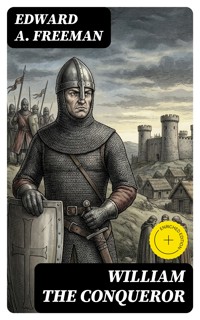
In "William the Conqueror," Edward A. Freeman delivers a comprehensive examination of one of history's most pivotal figures, exploring the life and reign of William I of England. Freeman's meticulous narrative combines biographical detail with socio-political analysis, set against the backdrop of 11th-century Europe. The book interlaces historical fact with vibrant prose, eschewing dry academic language for a style that reflects Freeman's deep passion for history, making it accessible yet intellectually rigorous. His exploration delves into William's strategies, battles, and the socio-cultural transformations sparked by the Norman Conquest, contributing to a richer understanding of medieval England's fabric. Edward A. Freeman was a prominent historian and advocate of rational historical analysis. His extensive educational background and engagement with contemporary historians influenced his approach to writing this biography. Freeman's dedication to uncovering the nuances of the past stemmed from a desire to inform readers about the significance of historical events and figures, particularly those whose legacies have dramatically shaped the course of nations. His scholarly work reflects a commitment to vibrant storytelling grounded in thorough research. This book is an essential read for those interested in understanding the formidable impact of William the Conqueror on Britain's history. Freeman's expert insights and compelling narrative invite readers to appreciate the complexities of conquest and governance, making it a vital resource for both scholars and history enthusiasts alike. In this enriched edition, we have carefully created added value for your reading experience: - A succinct Introduction situates the work's timeless appeal and themes. - The Synopsis outlines the central plot, highlighting key developments without spoiling critical twists. - A detailed Historical Context immerses you in the era's events and influences that shaped the writing. - A thorough Analysis dissects symbols, motifs, and character arcs to unearth underlying meanings. - Reflection questions prompt you to engage personally with the work's messages, connecting them to modern life. - Hand‐picked Memorable Quotes shine a spotlight on moments of literary brilliance. - Interactive footnotes clarify unusual references, historical allusions, and archaic phrases for an effortless, more informed read.
Das E-Book können Sie in Legimi-Apps oder einer beliebigen App lesen, die das folgende Format unterstützen:
Veröffentlichungsjahr: 2022
Ähnliche












William the Conqueror
Table of Contents
Introduction
At the heart of Edward A. Freeman’s William the Conqueror lies the tension between the shock of foreign conquest and the stubborn endurance of English institutions, a drama in which a Norman duke seeks a kingly title not merely by the sword but by claims of right, and in which the making of medieval England unfolds as a contest between force and law, novelty and tradition, the cross-Channel world of Normandy and the older polity of the island realm, inviting readers to weigh how power reorders a society without erasing the identities and customs that preceded it.
Freeman’s book is a historical biography written in the late nineteenth century by a leading Victorian historian, focusing on the eleventh-century worlds of Normandy and England during the crisis that reshaped kingship and law. Composed in the scholarly milieu that prized close reading of chronicles and constitutional development, it offers a concise, rigorously argued life of William set against the political geography of his age. The setting ranges from the ducal court to contested English shires, anchoring events in places and institutions rather than legend. Readers encounter a work of nonfiction that balances narrative momentum with careful attention to sources and context.
The premise follows William from his emergence as Duke of the Normans into the escalating disputes over the English succession, laying out how competing obligations, oaths, and customs frame the struggle for a crown. Freeman guides readers through this terrain with a voice that is measured yet decisive, explaining institutions before narrating events, and pausing to weigh testimony when accounts diverge. The prose favors clarity over flourish, with arguments built step by step and signposted with care. The tone is serious, occasionally stern, but always intent on helping the reader see how personal ambition and public law interact in medieval politics.
Among the book’s central themes are legitimacy and consent, the uneasy marriage of feudal obligation with older English customs, and the interplay between ecclesiastical reform and secular authority. Freeman repeatedly asks what makes a king lawful, distinguishing between naked victory and title grounded in tradition and recognition. He also stresses the endurance of English institutions under new rulers, arguing that administrative continuity accompanies dynastic change. Questions of identity—Norman, English, and the hybrid culture that emerges—run throughout, as do reflections on geography, fortification, and the control of roads and ports. The result is a portrait of power that is structural as well as personal.
Because it is a product of Victorian scholarship, the book foregrounds evidence and argument with an almost judicial patience, inviting readers to follow the weighing of chronicles, law codes, and diplomatic claims. Freeman identifies where testimony is late or partisan and marks the limits of what can be known, modeling a disciplined skepticism that rewards attentive reading. At the same time, he writes with conviction, framing debates so that institutional logic—not romantic anecdote—drives the narrative. The method yields a biography that doubles as a primer in historical reasoning, showing how to move from sources to conclusions without masking the steps between.
For contemporary readers, the book matters not only as a life of a pivotal ruler but as an inquiry into how states justify authority and knit diverse peoples into a functioning order. Its analysis of conquest, legal continuity, and accommodation speaks to present debates about legitimacy, constitutional change, and cultural integration. It also serves as a case study in how historical narratives are constructed, making visible the assumptions and choices that shape collective memory. Engaging with Freeman thus offers a double perspective: on eleventh-century transformation and on nineteenth-century historical craft, a reminder that methods and interpretations themselves carry histories worth examining.
Approached as biography, institutional study, or intellectual artifact, William the Conqueror rewards patient reading with a clear map of problems and a steady guide through competing claims. Freeman sets the stage with enough depth to let readers draw their own judgments about character and policy without relying on dramatic revelation. The book equips newcomers with the scaffolding needed to understand medieval governance while offering seasoned readers a concentrated synthesis. In tracing the boundary between might and right, it opens a space to consider how enduring communities absorb upheaval, preparing the reader to meet the unfolding story with informed, critical attention.
Synopsis
William the Conqueror, by Edward A. Freeman, offers a compact historical study of the Norman duke who became king of England, drawing on the author’s broader research into the Norman Conquest. Written for the Twelve English Statesmen series, the book blends narrative with constitutional analysis, tracing the arc from ducal beginnings to English kingship while weighing legal claims, institutions, and social change. Freeman structures his account to show how personal rule, military success, and the machinery of law intersected. He uses chronicles and documentary evidence to frame questions of authority, legitimacy, and continuity that inform his reading of eleventh‑century politics and governance.
Freeman begins with Normandy, outlining the political landscape that shaped William’s upbringing and rule as duke. He emphasizes the challenges of minority government, factional conflict, and the consolidation of ducal power that made Normandy a disciplined principality. In this setting, William’s methods of securing loyalty, administering justice, and commanding military forces emerge as central themes. The portrait is not romanticized: the emphasis falls on the institutional habits and alliances that stabilized Normandy and projected force beyond it. By mapping these foundations, Freeman prepares the reader to see later events in England as an extension of established Norman practice rather than a sudden transformation.
He then turns to the English succession crisis that followed the death of King Edward, presenting the competing claims and the customs that governed kingship. The claims of Harold and William are examined in terms of oath, designation, election, and the consent of leading men. Freeman treats papal support and international diplomacy as factors that shaped perceptions of right without alone determining outcomes. The argument highlights how norms of law and counsel mattered alongside battlefield results. The invasion of 1066 appears not as a mere raid for plunder, but as a bid to enforce a claim through recognized forms as well as force.
The narrative of the 1066 campaign centers on preparation, logistics, and the disciplined cohesion of Norman, Breton, and allied contingents. Freeman’s account of the decisive engagement stresses leadership, tactical steadiness, and the interplay of chance with design, while avoiding sensationalism. After victory, he marks the careful progression from military advantage to political settlement, culminating in coronation and the securing of London. Here the book’s constitutional interest comes to the fore: the new king is shown acting within familiar English frameworks of shire, court, and counsel, so that conquest is routed through legal ceremony and administrative continuity rather than abrupt institutional rupture.
Consolidation follows, with attention to landholding, castles, and the reshaping of the aristocracy. Freeman underscores how tenure and service were reorganized without erasing the older structures of shire and hundred. The Domesday survey illustrates the penetrating reach of royal inquiry and revenue, while episcopal reforms under new leadership align the English Church more closely with continental norms. Relations between crown and church are presented as mutually reinforcing instruments of order. The result, in Freeman’s reading, is a kingship strengthened by selective adoption of feudal forms yet anchored in earlier English law, enabling royal authority to supervise lords rather than be eclipsed by them.
Resistance within England and pressures on the borders receive sustained treatment. Northern and regional uprisings, and the harsh measures they provoked, are set against the demands of guarding a continental duchy and managing rivals in France and neighboring principalities. Freeman emphasizes the double burden of a ruler who must be both an English king and a Norman duke, explaining how this duality shaped policy, appointments, and travel. The picture is of a government that responds to crisis with firmness while seeking durable settlements. In this context, campaigns, treaties, and foundations are tools for knitting together a composite realm under increasingly centralized direction.
In closing, Freeman assesses the longer trajectory of the Conquest as a turning point that bound England more tightly to Western Christendom while preserving key lines of institutional continuity. He presents the blending of Norman and English elites, the growth of royal justice, and the articulation of ecclesiastical order as legacies more consequential than any single battle. The book’s significance lies in its concise synthesis of constitutional history with biography, distilling the author’s larger scholarship for a wide readership. Even as modern debates have refined its conclusions, the study endures as a clear statement of questions about legitimacy, governance, and nation‑making.
Historical Context
Edward A. Freeman’s William the Conqueror examines an eleventh-century world divided between Anglo-Saxon England and ducal Normandy. England’s political order rested on kingship advised by the witenagemot, earldoms, shires and hundreds, royal writs, and a church closely intertwined with royal authority. Normandy combined ducal lordship with a network of castles, knight-service, and monastic patronage. Both realms bore the legacy of the Viking Age: Scandinavian settlement in England and Scandinavian ancestry reshaped in Normandy by Frankish language and law. Legal codes from kings like Cnut and Edward the Confessor, and a robust coinage and administrative geography, frame the institutional backdrop to Freeman’s study.
Edward the Confessor’s childless death in January 1066 precipitated a succession crisis central to Freeman’s narrative. Competing claims arose from Harold Godwinson, elected and crowned in London; William, duke of Normandy, asserting a designated succession and an oath; and Harald Hardrada of Norway, invoking dynastic agreements. The military and institutional contrast mattered: England fielded the fyrd and housecarls under a royal writ system, while Normandy excelled in mounted warfare and castle-building. The papal reform movement, culminating in Alexander II’s support for William’s claim, gave the Norman bid religious sanction, linking conquest, ecclesiastical reform, and ideas of legitimate authority.
Freeman situates William’s reign within a program of consolidation that reshaped, but did not erase, English institutions. Land redistribution to Norman followers was later surveyed in Domesday Book (1086), a fiscal and tenurial inquest of exceptional scope. Castles multiplied as instruments of control, and feudal tenures defined obligations, yet shire courts, sheriffs, and much customary law endured. The English church was reorganized under Archbishop Lanfranc, with councils enforcing clerical discipline and stronger metropolitan authority. Royal charters and writs continued, some early acts issued in Old English alongside Latin, underscoring continuity of government amid transformation—a tension central to Freeman’s interpretation.
The book’s events unfold against a broader European landscape that clarifies Norman capabilities and horizons. Norman adventurers were simultaneously establishing principalities in southern Italy and Sicily, demonstrating a martial, ecclesiastically allied culture adaptable across frontiers. Capetian France remained decentralized, constraining ducal ambitions at home while fostering cross-Channel ventures. The papacy’s Gregorian Reform pressed for clerical discipline and asserted spiritual authority, shaping alliances and legitimations. Scandinavian kings still projected force into the North Sea. These currents inform Freeman’s emphasis on William as a ruler navigating Latin Christendom’s institutions—ducal lordship, papal sanction, and monastic networks—while asserting royal power in a consolidated kingdom.
Freeman wrote within Victorian Britain’s professionalizing historical scholarship. Educated in classical and medieval sources, he worked alongside William Stubbs, whose Constitutional History of England framed institutions as evolving through law and precedent. Freeman’s own multi-volume History of the Norman Conquest (1867–1879) and later Reign of William Rufus established his authority on the period. William the Conqueror (1888) appeared in John Morley’s Twelve English Statesmen series, designed to present political biography as national instruction. The series’ accessible scale and didactic purpose encouraged Freeman to condense documentary debates while foregrounding constitutional themes and the interplay of monarchy, nobility, and church.
Methodologically, Freeman championed close reading of primary texts—the Anglo-Saxon Chronicle, charters and writs, Domesday Book, and Norman narratives such as William of Poitiers, William of Jumièges, and Orderic Vitalis—tested against place-names, architecture, and topography. He visited sites in England and Normandy to correlate chronicles with terrain and buildings, foregrounding Romanesque fabric as evidence of policy and power. In public debates he criticized rhetorical or anecdotal history and insisted on verifiable citation. This apparatus shapes the book’s measured judgments about dates, battles, and law, and its recurrent attention to the languages, offices, and courts that structured governance.
Freeman’s interpretive emphasis is institutional continuity under a conquering dynasty. He stresses that shires, hundreds, and the office of sheriff persisted; royal government retained the writ and geld; and early royal acts could appear in Old English as well as Latin. While recording the scale of land transfers and castle-building, he rejects the later myth of an unqualified “Norman yoke,” arguing instead for fusion of peoples and law under strong kingship. He treats coronation and consent as markers of legitimate rule and reads ecclesiastical reforms under Lanfranc as complementing, not displacing, existing structures—positions that inform his portrayal of William’s statecraft.
The biography also reflects its nineteenth-century moment by making medieval politics serve civic education. Freeman’s balanced appraisal of conquest—admiring administrative order yet attentive to resistance, legal claims, and ecclesiastical negotiation—echoes Victorian liberal concerns with continuity, the rule of law, and responsible kingship. Composed for a broad audience, it distills a contested historiography into a clear narrative grounded in records and sites. In doing so, the book helped fix 1066 as a turning point that nevertheless preserved English institutions, an interpretation that both reinforced national identity and critiqued simplistic tales of rupture, aligning medieval precedent with modern constitutional ideals.




