


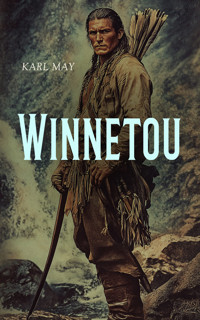
0,99 €
Mehr erfahren.
- Herausgeber: e-artnow
- Kategorie: Für Kinder und Jugendliche
- Sprache: Englisch
In "Winnetou," Karl May weaves a captivating narrative that explores the friendship between a German traveler, Old Shatterhand, and the noble Apache chief, Winnetou. This seminal work, published in the 19th century, intertwines themes of cultural reconciliation, exploration, and adventure, all conveyed through May's richly descriptive prose and engaging dialogue. The novel's literary style reflects the burgeoning Romanticism of its time, which emphasized the importance of nature and the individual's connection to it, while also serving as a critique of colonial attitudes prevalent in May's day. Karl May, born in 1842 in what is now Germany, led an adventurous life that spanned from humble beginnings to becoming one of the most translated authors in the world. His fascination with Native American culture, instigated by extensive research and the reading of travel literature, culminated in the creation of Winnetou and the exploration of themes such as nobility and honor. Despite never having set foot in the American West, May's imaginative prowess and foundational experiences as a young man set the stage for this powerful saga. "Winnetou" is a must-read for those interested in the intersection of adventure literature and cultural representation. May's portrayal of Native American themes offers a rich tapestry of understanding and empathy, making it not only an entertaining tale of adventure but also a timeless exploration of friendship and cross-cultural relationships. Readers will find themselves drawn into the expansive landscapes of the Wild West, imbued with profound reflections on humanity. This translation has been assisted by artificial intelligence.
Das E-Book können Sie in Legimi-Apps oder einer beliebigen App lesen, die das folgende Format unterstützen:
Veröffentlichungsjahr: 2025
Ähnliche









Winnetou
Table of Contents
Introduction .
Whenever I think of the Indian, the Turk comes to mind; however strange it may seem, this has its justification.However little there may be in common between the two, they are similar in this respect: we have come to terms with them, albeit with the one less than with the other: we hardly speak of the Turk other than as of the "sick man", while anyone whois familiar with the circumstancesmust describe the Indian as the "dying man ".
Yes, the red nation is dying! From Tierra del Fuego to far beyond the North American lakes, the huge patient lies stretched out, cast down bya relentless fate that knows no mercy.He has fought it with all his might, but in vain; his strength has faded more and more; he has only a few breaths left to take, and the convulsions that move his naked body from time to time are the spasms that announce the nearness of death .
Is he to blame for his untimely death? Does he deserve it ?
Ifit is right that everything that liveshas a right to life, and this applies equally to the whole as well as to the individual, then the red man has the right to exist, no less than the white man, and may well claim the rightto develop according to his individuality in a social and state context. Of course, some claim that the American Indian does not possessthenecessary state-formingcharacteristics. Is that true? I say: no! But I do not want to make any assertions, since it is not my intentionto writea scholarly treatise on this subject. The white man found timeto developnaturally; he gradually developed from a hunter to a shepherd, and from there to an agriculturist and industrialist; many centuries have passed since then; but the red man did not find this time, because it was not granted to him. He is supposed to make a giant leap from the first and lowest stage, that is, as a hunter, to the highest, and when this was demanded of him, it was not considered that he would fall andbe fatally injured .
It is a cruel law that the weaker must yield to the stronger; but since itappliesthroughout all creation and in all earthly nature, we must assume thatthis crueltyiseither only apparent orcapable of Christian mitigation, because the eternal wisdomthat gave this law is also eternal love. Can we claim that such a mitigation has taken place in relation to the dying Indian race ?
It was not only a hospitable reception, butalmost divine worship that the first "pale-faced" people found among the Indians. What reward did the latter get for it? Undeniably, the land they inhabited belonged to them; it was taken from them. What rivers of blood flowed and what cruelties occurred is known to anyone who has read the history of the "famous" conquistadors. Later, the same model was followed. The white man came with sweet words on his lips, but at the same time with a sharpened knife in his belt and a loaded gun in his hand. He promised love and peace and gave hatred and blood. The Red Man had to give way, step by step, farther and farther back. From time to time he was granted "eternal" rights to "his"territory, but after a short time he was chased out of it again, further and further. They "bought" his land from him, but either didn't pay him at all or paid him with worthless barter goods that hecouldn't use. But the creeping poisonof "fire water" was taught to him all the more carefully, along with smallpox and other, much worse andmore disgusting diseases, which decimated entire tribes anddepopulated entire villages. If the red man wanted to assert his rights, he was answered with gunpowder and lead, and he had to retreat in the face of the superior weapons of the white man. Embittered by this, he took revenge on the individual pale face he encountered, and the consequences of this were always formalmassacres, which were carried out among the red men.Thus he, originally a proud, bold, brave, truthful, sincere hunter who was always loyal to his friends,has become a secretive,suspicious, lying person, through no fault of his own, because it is not he, but the white man who is to blame .
The wild herds of mustang, from whose midst he once boldly took his riding horse, wherehavetheygone? Where can you see the buffaloes that fed him when they populated the prairies by the millions? What does he live on today? The flour and meat that is delivered to him? Look at how much gypsum and other beautiful things are in this flour; whocan enjoyit! And if a tribe is once awarded a hundred "extra fat" oxen, thesehave turned intotwo or three old, emaciated cows, from which hardly a vulturecan snatch a bite. Or should the red man live by agriculture? Can he count on a harvest, he who has no rights, who is being pushed further and further away, who is not allowed a permanent place ?
What a proud and beautiful figure he used to be, flying over the wide savannah, his mustang's mane blowing around him, and how miserable and degenerate he looks now in the rags thatcannot coverhis nakedness! He who once, in the flush of his strength, went at the terrible gray bear with his fists, nowcreeps like a mangy dog inthe shadows, hungry, begging or stealing a scrap of meat !
Yes, he has become a sick man, a dying man, and we stand compassionately by his miserable bedside to close his eyes. Standing at a deathbed is a serious matter, but a hundred times more serious when that deathbed is that of an entire race. Many, many questions arise, especially: What could this race have achieved if it had been granted the time and space to develop its inner and outer strengths and talents? What unique cultural forms will humanity lose as a result of this nation's demise? This dying man could not be assimilated because of his character; did he have to be killed for that reason, and cannot he be saved? If the bison is allowed a sanctuary up there in the national park of Montana and Wyoming so that it does not become extinct, why not also the former, rightful master of the land, a place where he can live safely and grow spiritually ?
But what use are such questions in the face of death, which cannot be averted! What good are reproaches when nothing can be done at all! I can only complain, but change nothing; I can only grieve, but not call back a dead man to life. Me? Yes, me! After all, I got to know the Reds over a period of many years and among them one who lives brightly, highly and gloriously in my heart, in my thoughts. He, the best, most loyal and self-sacrificing of all my friends, was a true type of the race from which he sprang, and just as it perishes, so did he perish, wiped out of life by the murderous bullet of an enemy. I loved him as I have not loved another human being, and still love the perishing nation of which he was the noblest son. I would have given my life to save his, just as he risked his a hundred times for me. This was not granted to me; he passed away, as always, being a savior to his friends; but he shall only have died physically and shall live on in these pages, as he lives in my soul, he, Winnetou, the great chief of the Apaches. It is to him that I wish to erect the monument he so richly deserves. And if the reader, who sees it with his mind's eye, then passes a fair judgment on the people of whom the chief was a true reflection, I shall be richly rewarded .
The author .
Chapter One. A greenhorn .
Dear Reader, do you know what the word greenhorn means? It is a highly annoying and disrespectful term for the person to whom it is applied .
Green means green, and horn refers to a horn. A greenhorn is therefore a person who is still green, i.e. new and inexperienced in the country, and has to cautiously extend his feelers if he does not want to expose himself to the danger of being laughed at .
A greenhorn is a person who does not get up from his chair when a lady wants to sit on it; who greets the master of the house before bowing to the mistress and miss; who, when loading the rifle, pushes the cartridge the wrong way into the barrel or first pushes the wad, then the bullet and finally the powder into the muzzle-loader. A greenhorn speaks either no English at all or a very pure and affected English; Yankee English or even the backwoods idiom is an abomination to him; it does not enter his head and much less his tongue. A greenhorn thinks a racoon is a possum and a reasonably pretty mulatto is a quadroon. A greenhorn smokes cigarettes and detests the tobacco juice-spitting sir. A greenhorn runs when he has been slapped by Paddy, taking his complaint to the justice of the peace, instead of, as a real Yankee should do, simply shooting the guy on the spot. A greenhorn mistakes a turkey track for a bear track and a slim sports yacht for a Mississippi steamer. A greenhorn is embarrassed to put his dirty boots on the knees of his fellow passenger and to slurp his soup with the snort of a dying buffalo. A greenhorn carries a sponge the size of a giant pumpkin and ten pounds of soap with him to the prairie for the sake of cleanliness, and in addition a compass that already on the third or fourth day points in all possible directions, but never more to the north. A greenhorn notes eight hundred Indian expressions, and when he meets the first Red Indian, he notices that he has sent these notes home in the last envelope and saved the letter for them. A greenhorn buys gunpowder and when he wants to fire the first shot, he realizes that he has been given ground charcoal. A greenhorn has studied astronomy for ten years but can look at the starry sky just as long without knowing what time it is. A greenhorn puts the bowie knife in his belt in such a way that when he bends down, he stabs the blade into his thigh. A greenhorn builds a campfire in the Wild West so big that it blazes as high as a tree, and then wonders how the Indians could discover and shoot him. A greenhorn is just a greenhorn, and I was one back then, too .
But don't think that I had the conviction or even the slightest idea that this insulting term applied to me! Oh no, because it is precisely the most outstanding peculiarity of every greenhorn to consider all other people, but only not himself, to be "green ".
I, on the contrary, believed that I was an extraordinarily clever and experienced person; after all, I had, as they say, studied and never been afraid of an exam! That life is the real and proper university, where students are tested daily and hourly and have to pass before Providence, my youthful mind did not want to think about that at the time. Unpleasant circumstances at home and an, I might say, innate urge to be active had driven me across the ocean to the United States, where the conditions for an ambitious young person to get ahead were far better and more favorable then than they are today. I would have found good employment in the eastern states, but I was drawn to the west. I worked for short periods in a variety of jobs and earned enough to arrive in St. Louis with enough material possessions and a cheerful disposition. There, luck led me to a German family where I found temporary shelter as a tutor. Mr. Henry, a unique character and gunsmith, who practiced his trade with the dedication of an artist and called himself Mr. Henry, the Gunsmith, with patriarchal pride, was a member of this family .
This man was an extraordinary philanthropist, although he seemed the opposite, since he did not associate with any human being except the family mentioned, and even treated his customers so curtly and brusquely that they only came to him because of the quality of his goods. He had lost his wife and children in a terrible event that he never spoke of, but I suspected from some of his remarks that they had been murdered in a robbery. This had made him rough on the outside; he might not have known it, but he was actually a perfect brute; but the core was mild and good, and I often saw his eye welling up when I talked about my home and my loved ones, to whom I was and still am very close .
Why he, the old man, showed such a preference for me, the young, foreign man, I did not know until he told me. Since I had arrived, he came more often than before, listened to the lessons, took me aside when they were over and finally even invited me to visit him. No one else had ever been granted such a privilege, and I therefore took care not to exploit the permission granted to me. However, this restraint did not seem to please him at all; I still remember today the angry face he showed me one evening when I came to him, and the tone in which he received me, without replying to my "good evening ":
"Where were you yesterday, sir ?"
"At home ."
"And the day before yesterday ?" "
"At home, too ."
"Don't lie to me !"
"It's true, Mr. Henry ."
"Pshaw! Young green birds like you don't stay in their nests; they stick their beaks in everywhere, except where they belong!"
"And where do I belong, if you please to tell me ?"
"To me, understand! I've wanted to ask you something for a long time ."
"Why haven't you ?"
"Because I didn't want to. Do you hear ?"
"So when do you want to?"
"Today, perhaps ."
"So you may ask me, if you wish," I said, sitting down on the bench where he was working .
He looked at me in amazement, shook his head disapprovingly and exclaimed :
"Confound you! As if I, a man of the world, had to ask a greenhorn like you for permission to talk to him!"
"Greenhorn?" I replied, frowning, feeling quite offended. "I will assume, Mr. Henry, that this word came out unintentionally and just like that !"
"Don't flatter yourself, sir! I spoke with full deliberation; you are a greenhorn, and what a greenhorn! You have the contents of your books well in your head, that's true. It's quite amazing what you people over there have to learn! This young person knows exactly how far away the stars are from here, what King Nebuchadnezzar wrote on bricks and how heavy the air weighs, which he cannot see! And because he knows this, he imagines himself to be a clever fellow! But stick your nose into life, you understand me, stick it into life for about fifty years; then you will, just maybe, learn what real cleverness consists of! What you know so far is nothing, absolutely nothing. And what you can do so far is even less. You can't even shoot!"
He said this in an extraordinarily contemptuous tone and with such certainty that it sounded as if he were absolutely sure of his case .
"Not shooting? Hm!" I replied, smiling. "Is this perhaps the question you wanted to ask me ?"
"Yes, that's the question. Now answer me!"
"Put a good rifle in my hand and I'll answer, otherwise not ."
Then he put down the gun barrel on which he was working, stood up, came close to me, fixed me with astonished eyes and exclaimed :
"A gun in the hands of a gentleman? Not on your life! My guns only go into hands like that, in which I can put them honorably !"
"I have such," I nodded to him .
He looked at me again, this time from the side, sat down again, started working on the barrel again, and grumbled to himself :
"What a greenhorn! His impertinence could really infuriate me !"
I let him be, for I knew him, and took out a cigar and lit it. Then there was silence between us for about a quarter of an hour. But he could not stand it any longer; he held the barrel up to the light, looked through it and remarked :
"Shooting is harder than looking at the stars or reading old bricks from Nebuchadnezzar. Understand? Have you ever held a rifle?"
"I think ."
"When?"
"A long time ago and often ."
"Have you ever aimed one and pulled the trigger ?"
"Yes ."
"And did it hit ?"
"Of course!"
Then he quickly lowered the barrel he had checked, looked at me again and said ,
"Yes, it hit something, but what ?"
"The target, of course ."
"What? Are you seriously trying to pull that one over on me ?"
"Assert, but not bind; it is true ."
"Confound you, sir! I can't make you out. I am sure you would shoot a wall if it were twenty yards high and fifty yards long, and yet you look so earnest and confident about it that it makes one's bile run over. I am not a boy to whom you give lessons, mind! A greenhorn and bookworm like you wants to be able to shoot! He has even rummaged through Turkish, Arabic and other stupid tomes and claims to have found time to shoot! Take the old gun from the back there and point it as if you wanted to take aim! It's a bear gun, the best I've ever held in my hands ."
I went over, took the rifle down and aimed it .
"Hello!" he exclaimed, jumping up. "What is this? You handle this gun like a light walking stick, and yet it is the heaviest rifle I know! Do you have such physical strength ?"
Instead of an answer, I took him by the buttoned-up jacket and the waistband of his trousers and lifted him up with my right arm .
"Thunder-storm!" he cried out. "Let me go! You are much stronger than my Bill ."
"Your Bill? Who is he ?"
"He was my son, never mind about that! He is dead, like the others. He promised to become a brave fellow, but was wiped out with them during my absence. You are similar to him in build, have almost the same eyes and the same line around your mouth; that's why I'm saying this to you, it's none of your business!"
His face was filled with the expression of deep sorrow; he ran his hand over it and then continued in a cheerful tone :
"But, sir, with your muscle power, it's a shame you've thrown yourself at books like that. You should have exercised yourself !"
"I did ."
"Really?"
"Yes ."
"Boxing ?"
"We don't do that over in our country. But I do gymnastics and wrestling ."
"Riding?"
"Yes ."
"Fencing?"
"I used to teach it ."
"Man, it doesn't cut !"
"Do you want to try ?"
"Thank you; I've had enough of that! I must work, anyway. Sit down again!"
He returned to his bench, and I did the same. The conversation that followed was a most monosyllabic one; Henry seemed to be preoccupied with something important. Suddenly he looked up from his work and asked :
"Have you been doing mathematics ?"
"It was one of my favorite subjects ."
"Arithmetic, geometry?"
"Of course."
"Surveying?"
"I loved it. I often went out with the theodolite without needing to ."
"And can you measure, really measure ?" "Yes. I have often taken part in both horizontal and height measurements, although I don't want to claim that I consider myself a fully trained surveyor."
"Yes. I have often participated in both horizontal and height measurements, although I do not want to claim that I consider myself a fully trained geodesist ."
"Well, very good, very good!"
"Why do you ask about that, Mr. Henry?"
"Because I have a reason to do so. I see! You don't need to know now; you'll find out soon enough. But I need to know first, yes, I need to know whether you can shoot ."
"So put me to the test !"
"I will; yes, I will; you can rely on that. When do you start teaching tomorrow morning?"
"At eight o'clock ."
"Come to my place at six. I want to go up to the shooting range where I can test fire my rifles ."
"Why so early?"
"Because I don't want to wait any longer. I'm eager to show you that you're a greenhorn. Now enough of that, I have other things to do that are far more important ."
He seemed to have finished with the rifle and took a polygonal piece of iron out of a box, the corners of which he began to file. I saw that each surface had a hole .
He was so absorbed in this work that he seemed to have quite forgotten my presence. His eyes sparkled, and when he looked at his work from time to time, I saw that he did so, I might almost say, with an expression of love. This piece of iron must have great value for him. I was curious to know why; so I asked him :
"Is that to be a part of a gun, too, Mr. Henry?"
"Yes," he answered, as if he had remembered me .
"But I don't know of any kind of gun that has a part like that ."
“Believe it. It’s yet to come. It will probably be the Henry system.”
"Ah, a new invention?"
"Yes."
"Then I apologize for asking! It's a secret, of course ."
He looked into all the holes for a long time, turned the iron in different directions, held it a few times to the rear end of the barrel that he had put down earlier, and finally said :
"Yes, it is a secret; but I trust you, because I know you are discreet, although you are a downright, proper greenhorn; so I will tell you what it is to be. It will be a repeating rifle, a repeating rifle with twenty-five shots ."
"Impossible!"
"Shut your trap! I'm not stupid enough to take on something that's impossible ."
"But then you would need chambers for twenty-five shots!"
"I do!"
"But they would be so large and unwieldy that they would be a nuisance ."
"Just one chamber; it's quite handy and doesn't bother anyone. This iron is the chamber ."
"Hm! I don't know anything about your business; but how about the heat? Does the barrel get too hot?"
"Not a chance. The material and the treatment of the barrel are my secret. By the way, is it always necessary to fire all twenty-five shots in quick succession?"
"Hardly ."
"So! This iron becomes a bullet that moves eccentrically; twenty-five holes in it contain just as many cartridges. With each shot, the bullet moves further, the next cartridge up the barrel. I have been working on this idea for many years; I did not want to succeed; but now it seems to be working out. I already have a good reputation as a gunsmith, but then I will become famous, very famous, and make a lot and a lot of money ."
"And a guilty conscience to go with it!"
He looked at me in amazement for a while and then asked :
"A guilty conscience? How so ?"
"Do you think that a murderer does not need to have a guilty conscience ?"
"Zounds! Are you trying to say that I am a murderer ?"
"Not yet ."
"Or become a murderer?"
"Yes, because abetting murder is just as bad as the murder itself ."
"Damn you! I will take good care not to aid in a murder ."
"Not for a single one, of course, but even for mass murder ."
"What do you mean? I don't understand you ."
"If you make a rifle that fires twenty-five times and give it to any thug, there will soon be a horrible killing over on the prairies, in the jungles and canyons of the mountains; the poor Indians will be shot down like coyotes, and in a few years there will be no more Indians. Do you want that on your conscience ?"
He stared at me and didn't answer .
"And," I continued, "if everyone can get this dangerous rifle for money, you will indeed sell thousands in a short time, but the mustangs and the buffaloes will be exterminated and with them every kind of game whose meat the redskins need to live. A hundred and a thousand scavengers will arm themselves with your rifle and go west. The blood of men and animals will flow in streams, and very soon the areas on both sides of the Rocky Mountains will be depopulated of every living creature ."
"Death!" he exclaimed. "Have you really only just come over from Germany ?"
"Yes ."
"And never been here before ?"
"No."
"And you have never been here before, in the Wild West ?"
"No."
"So a complete greenhorn. And yet this greenhorn talks as if he were the great-grandfather of all Native Americans and had been living here for a thousand years and still lived today! Male, don't even think about trying to persuade me! And even if everything were as you say, it would never occur to me to set up a rifle factory. I am a lonely man and want to remain lonely; I have no desire to deal with a hundred or even more workers ."
"But you could take out a patent on your invention and sell it to make money ?"
"You just wait and see, sir! So far I have always had what I needed, and I think that I will continue to do so in the future without a patent. Now, get along home! I don't feel like listening to a fledgling bird that has yet to learn how to whistle or sing ."
It never occurred to me to take offense at his coarse expressions; he was like that, and I knew full well how he meant it. He had grown fond of me and was quite willing to help me in every way he could. I gave him my hand and left after he had shaken it firmly .
I had no idea how important this evening would be for me, nor did it occur to me that this heavy bear-killer, which Henry called an old gun, and the still unfinished Henry rifle, would play such a big role in my later life. But I was looking forward to the next morning, because I had already shot a lot and well and I was completely convinced that I would pass in front of my old, strange friend .
I arrived punctually at his house at six o'clock in the morning. He was already waiting for me, shook my hand, and said, with an ironic smile crossing his old, good, rough features :
"Welcome, sir! You look quite confident of victory, don't you? Do you think you will hit the wall I mentioned last night ?"
"I hope so ."
"Well, we'll see about that right away. I'll take a lighter rifle with me, and you carry the bear gun; I don't want to lug around such a heavy load ."
He strapped on a light, double-barreled rifle, and I took the "old gun" that he didn't want to carry. When he arrived at his shooting range, he loaded both rifles and fired two shots from the rifle himself. Then it was my turn with the bear gun. I did not know this rifle yet and therefore only hit the edge of the black in the target with the first shot; the second shot was better; the third shot hit the exact center of the black, and the next bullets all went through the hole that the third had made. Henry's astonishment increased with each shot; I also had to try the rifle, and when it had the same success, he finally exclaimed :
"Either you have the devil, sir, or you were born to be a frontiersman. I have never seen such shooting in my life !"
"I'm not a devil, Mr. Henry," I laughed. "I wouldn't know anything about such a compact ."
"Then it is your task and even your duty to become a westman. Don't you fancy it ?"
"Why not!"
"Well, we'll see what we can do with the greenhorn. So you can ride, too?"
"In a pinch ."
"In a pinch?" Hm! So you're not as good as you are at shooting?"
"Pshaw! What is riding further! Mounting is the most difficult. Once I'm up, no horse can get me down ."
He looked at me inquiringly to see whether I had spoken seriously or in jest; I made a most unselfconscious face, and so he said :
"Do you really think so? Do you want to hold on to the mane? You are mistaken. You said quite correctly: getting up is the most difficult part, because you have to do it yourself; getting down is much easier: the horse takes care of that, and that's why it's much, much faster ."
"But with me, the horse doesn't do it !"
"Is that so? We'll see! Would you care to demonstrate?"
"Gladly ."
"Come on, then! It's only seven o'clock, and you still have an hour to spare. We'll go to Jim Korner, the horse dealer; he has a red horse that will do you good."
We returned to the city and went to the horse dealer, who had a large riding yard surrounded by stables. Korner came over himself and asked what we wanted .
"This young sir claims that no horse can throw him," Henry answered. "What do you think of that, Mr. Korner? Would you let him climb onto your gray ?"
The dealer gave me a scrutinizing look, then nodded with satisfaction and replied :
"The bone structure seems good and elastic; besides, young people don't break their necks as easily as older people. If the gentleman wants to try the horse, I have no objection."
He gave the order, and presently two of the servants brought the horse from the stable. He was very restless and tried to break loose. My old Mr. Henry was afraid for me; he begged me to give up the attempt; but, first of all, I was not at all afraid, and secondly, I now regarded the matter as a matter of honor. I had a whip and spurs put on, and then, after a few unsuccessful attempts on my part, the horse allowed me to mount. As soon as I was up, the servants hurried away, and the white horse leaped into the air with all four feet, and then a second time to the side. I kept the saddle, although I was not yet in the stirrups, but hurried to get in. As soon as I did, the horse began to buck; when this did not work, he went to the wall to throw me off, but the whip quickly brought him away from it. After that, there was a nasty fight between rider and horse that was almost dangerous for me. I summoned up all my limited skill and insufficient practice, which was all I had at the time, and the strength in my thighs, which ultimately made me the victor. When I dismounted, my legs trembled with exertion; but the horse was dripping with sweat and frothing up large, heavy flakes; it now obeyed every push and pull .
The dealer was worried about his horse; he had it wrapped in blankets and led slowly back and forth; then he turned to me :
"I wouldn't have thought that, young man; I thought you would be lying on the ground by the first jump. Of course, you won't have to pay anything, and if you want to do me a favor, come back and tame the beast completely. I don't mind spending ten dollars, because it's not a cheap horse, and if it learns to obey, I'll make a deal ."
"If it is convenient for you, it will be a pleasure for me," I replied.
Henry had said nothing since I had dismounted, but had just looked at me, shaking his head. Now he clapped his hands together and exclaimed :
"This greenhorn is truly an extraordinary, or rather unusual greenhorn! He pushed the horse half to death instead of letting himself be thrown into the sand! Who taught you that, sir?"
"Chance, which gave me a half-wild Hungarian horse that nobody wanted to ride. I tamed him little by little, but almost risked my life in the process."
"Thank you for such creatures! I praise my old upholstered chair, which doesn't mind me sitting on it. Come on, let's go. I've become quite dizzy. But I have not seen you shoot and ride for nothing; you can count on that."
We went home, he to his own and I to my lodgings. During this day and the next two, he did not show himself, and I had no opportunity to seek him out either; but on the following day he came to see me in the afternoon; he knew that I had time off then .
"Would you like to take a walk with me?" he asked .
"Where to?"
"To a gentleman who would like to meet you ."
"Why me?"
"You can guess why: because he hasn't seen a greenhorn yet ."
"I'll go with you; he shall know us ."
Henry had such a clever, enterprising look on his face today, and knowing him, I suspected he had some surprise in store. We strolled through a few streets and then he led me into an office with a large glass door. He entered so quickly that I could no longer read the gold lettering on the glass, but I thought I saw the two words "Office" and "surveying." It soon turned out that I was not mistaken .
Three gentlemen were sitting there, who received him very kindly and me politely and with curiosity that could not be hidden. Maps and plans were lying on the tables; in between there were all kinds of measuring instruments. We were in a geodetic office .
It was unclear to me what my friend's purpose in this visit was; he had no business and no inquiries to bring up; he seemed to have come only for the sake of a friendly chat. This conversation soon became very lively, and it could not be noticed that it finally extended to the objects that were here; I was glad about that, because then I could participate better than if we had been talking about American things or circumstances that I did not yet know .
Henry seemed to be extremely interested in surveying today; he wanted to know everything, and I was happy to be drawn so deeply into the conversation that I always only had to answer questions, explain the use of the various instruments and describe the drawing of maps and plans. I was really a capable greenhorn, because I didn't see the intention. It was only when I had spoken about the nature and differences of recording by coordinates, the polar and diagonal methods, the perimeter measurement, the repetition method, the trigonometric triangulation and made the remark that the three gentlemen secretly winked at the gunsmith that the matter became conspicuous to me, and I stood up from my seat to indicate to Henry that I wished to leave. He did not refuse, and we were now dismissed, I even more cordially than our reception had been .
When we had walked so far that we could no longer be seen from the office, Henry stopped, put his hand on my shoulder and said, his face glowing with bright satisfaction :
"Sir, man, human being, youngster, greenhorn, but have you done something for me to be happy about! I'm downright proud of you!"
"Why?"
"Because you exceeded my recommendation and the expectations of these people !"
"Recommendation? Expectation? I don't understand you ."
"You don't have to. It's a very simple matter. You recently claimed to know something about surveying, and to find out if it was just a tall tale, I took you to these gentlemen, who are good friends of mine, and let them test you. It's a very healthy tooth, because you've fought your way out of a very honorable situation."
"A pack of lies? Mr. Henry, if you think me capable of such things, I will never come to see you again!"
"Don't let them laugh at you! You won't deprive me of the joy that seeing you gives me, just because of the resemblance to my son! Have you perhaps been to the horse dealer's?"
"Every day in the morning ."
"And did you ride the red horse ?"
"Yes ."
"Is the horse any good?"
"I hope so. But I doubt whether the man who buys him will get on with him as well as I have. He has only got used to me, and throws everyone else off ."
"I am delighted, mightily delighted; it seems to wear only greenhorns, then. Come with me down this side street! Over there is a splendid dining-house, where you can eat very well and drink even better. The exam that you passed so admirably today must be celebrated."
I could not understand Henry; he was quite a changed man. He, the lonely, reserved man, wanted to eat in a dining-house! His face, too, was different from what it usually was, and his voice sounded brighter and happier than usual. He had said "exam." The word struck me, but here it could be a quite meaningless expression .
From that day on, he visited me daily and treated me like a dear friend whom one might soon lose. But he did not allow me to feel proud of this favoritism ; he always had a damper ready, which consisted of the fatal word "greenhorn."
Strangely enough, at the same time, the behavior of the family I was working for had also changed. The parents were visibly more attentive to me, and the children had become more affectionate. I caught them secretly looking at me in ways I couldn't understand; I would have liked to call them loving and even regretful .
About three weeks after our strange visit to the office, the lady asked me not to go out on the evening of my day off, but to have supper with the family. She said the reason for this invitation was that Mr. Henry was coming and that she had also invited two gentlemen, one of whom was called Sam Hawkens and was a famous Westerner. As a greenhorn, I had not yet heard this name, but I was looking forward to meeting the first real and even famous Westerner .
Since I was a housemate, I didn't have to wait for the bell to ring, but rather went to the dining room a few minutes early. To my amazement, I saw that the table was not set in the usual way, but as if for a party. Little five-year-old Emmy had been alone in the room, dipping her finger into the berry compote to snack. She quickly withdrew it when I entered and quickly wiped it on her fair blonde hairdo. When I raised mine in a punishing manner, she came bounding up to me and whispered a few words to me. To make up for her offense, she shared with me the secret of the last days, which had almost broken the little heart. I thought I had misunderstood; but she repeated the same words at my request: "Your farewell feast ."
My farewell feast! It could not possibly be! Who knows what misunderstanding had led the child to this mistaken belief? I smiled to myself. Then I heard voices in the parlor; the guests were arriving, and I went over to greet them. They had all three arrived at the same time, as I later learned. Henry introduced a young, somewhat dull and awkward-looking man as a Mr. Black and then Sam Hawkens, the Westman .
The Westmann! I openly admit that I, as my eye rested in amazement on him, may not have looked very clever. I had not seen such a figure before; later, of course, I got to know quite different ones. If the man himself was striking enough, this impression was heightened by the fact that he stood here in the fine parlor exactly as he would have stood outside in the wilderness, namely, without removing his hat and with his rifle in his hand. Imagine the following appearance :
From under the wistfully drooping brim of a felt hat, whose age, color and shape would have caused even the keenest thinker some headaches, a nose of almost frightening dimensions looked out between a forest of tangled, black whiskers, which could have served as a shadow-caster for any sundial. Due to this enormous growth of the beard, only the two small, clever eyes were noticeable among the other parts of the face, which seemed to be endowed with extraordinary mobility and rested on me with an expression of roguish cunning. The man looked at me just as intently as I looked at him; I later learned the reason why he was so interested in me .
This upper part rested on a body that remained invisible down to the knees and was stuck in an old buckskin hunting jacket that had obviously been made for a significantly larger person and gave the little man the appearance of a child who had once put on his grandfather's dressing gown for fun. Two scrawny, sickle-shaped legs stuck out of this more than ample covering, which were stuck in frayed leggings that were so old that they must have grown the little man two decades ago, and which allowed a comprehensive view of a pair of Indian boots, in which the owner could have found space in full person if necessary .
In his hand, this famous "Westman" carried a rifle that I would have handled with extreme caution; it looked much more like a club than a rifle. At that moment, I couldn't imagine a bigger caricature of a prairie hunter, but it wasn't long before I fully recognized the value of this original man .
After looking me over carefully, he asked the gunsmith in a thin voice that sounded like a child's :
"Is this the young greenhorn you were telling me about, Mr. Henry?"
"Yes," he nodded .
"Well! I like him already. I hope Sam Hawkens will like him too, hihihihi!"
With this fine, very peculiar laugh, which I heard a thousand times more from him later, he turned to the door, which opened at that moment. The master and mistress of the house entered and greeted the hunter in a way that suggested they had seen him before. This had happened behind my back. Then they invited us to enter the dining room .
We followed this request, with Sam Hawkens, to my astonishment, not taking off his gun at all. Only when we were shown to our seats at the table did he say, pointing to his old rifle , "
"A real Westerner never lets his rifle out of his sight, and I certainly don't let my brave Liddy out of mine. Hang it there on the curtain rosette ."
So he called Liddy his rifle! Later, of course, I learned that it is the habit of many Westerners to treat their rifles like living beings and give them names. He hung it in the mentioned place and wanted to add the famous hat; when he took it off, to my horror, all his hair stuck to it .
It was truly a frightening sight, his skinless, blood-red skull. The lady screamed loudly, and the children shrieked as loud as they could. But he turned to us and said calmly :
"Don't be alarmed, milady and mes'shers; it's nothing, really!" I had worn my own hair, by rights, and honestly, from infancy, and no lawyer dared dispute me, until one or two dozen Pawnees got over me and tore it out of my head, skin and all. It was a confoundedly disturbing sensation for me, but I survived it happily, hihihihi! Then I went to Tekama and bought a new scalp, if I'm not mistaken; it was called a wig and cost me three thick bundles of beaver pelts. But it doesn't matter, because the new skin is much more practical than the old one, especially in summer; I can take it off when I sweat, hihihihi."
He hung his hat on his gun and put his wig back on his head. Then he took off his coat and threw it over a chair. This coat had been patched and repaired many, many times, with one piece of leather sewn onto another, and as a result, this garment had become so stiff and thick that hardly an Indian arrow could get through it .
Now we saw his thin, crooked legs completely. His upper body was in a leather hunting vest. He had a knife and two pistols in his belt. When he reached his chair at the table again, he cast a sly glance first at me and then at the lady of the house and asked :
"Before we go to dinner, won't the lady tell the greenhorn what it is, if I'm not mistaken ?"
The expression "if I'm not mistaken" had become a familiar saying for him. The lady nodded, turned to me, pointed at the younger guest and said :
"You may not know that Mr. Black here is your successor, sir ."
"My successor?" I exclaimed, quite taken aback .
"Yes. Since we are celebrating your farewell from us today, we were forced to look for a new teacher ."
"My resignation ?"
Today I praise the fate that I was not photographed at that moment, because I must have looked like the personification of amazement .
"Yes, your resignation, sir," she nodded with a benevolent smile, which I did not find appropriate, because I myself was not at all in the mood for smiling. She added, "It should have been terminated, but we do not want to stand in the way of you, whom we have grown so fond of, to seize your luck as soon as possible. We are deeply sorry to see you go, but we give you our best wishes. Leave tomorrow in the name of God!"
"Leave? Tomorrow? Where to?" I stammered .
Then Sam Hawkens, who was standing next to me, slapped me on the shoulder and answered, laughing :
"Where? To the Wild West with me. You passed your exam brilliantly, hihihihi! The other surveyors are leaving tomorrow and can't wait for you; you have to come with us without fail. Me and Dick Stone and Will Parker, we're hired as guides, up the Canadian and into New Mexico. Don't think for a moment that you want to stay here and be a greenhorn!"
Then it dawned on me. It had all been a set-up! Surveyor, field surveyor, maybe even for one of the big railroads that were being planned. What a happy thought! I didn't need to ask; I received the information unsolicited, because my old, good Henry came up to me, took me by the hand and said :
"I told you before why I like you. You are here with good people, but a position as a tutor is not for you, sir, not at all. You must go to the West. That is why I approached the Atlantic and Pacific Company and had you examined without you knowing it. You passed with flying colors. Here is the installation ."
He handed me the document. When I glanced at it and saw my probable income listed, my eyes welled up. But he continued :
"There will be riding, so you need a good horse. I bought the red horse that you broke in yourself; it's yours. And you need weapons too; I'll give you the bear-killer, the old, heavy gun that I don't need, but with which you can hit the bull's-eye with every shot. What do you say to that, sir?"
I didn't say anything at first; then, when I found my voice again, I wanted to reject the gifts, but I didn't succeed. These good people had decided to make me happy, and it would have deeply offended them if I had persisted in my refusal. To cut short any further discussion, at least for the time being, the lady took a seat at the table, and the rest of us were forced to follow her example; we ate, and the subject could not be taken up again immediately .
It was only after dinner that I learned what I needed to know. The railroad was to go from St. Louis through Indian Territory, New Mexico, Arizona and California to the Pacific Coast, and the plan had been made to have this long route explored and surveyed in individual sections. The section that fell to me and three other surveyors under a senior engineer was located between the headwaters of the Rio Pecos and the southern Canadian. The three proven guides Sam Hawkens, Dick Stone and Will Parker were to take us to where we would find a whole band of brave Westerners to take care of our safety. Of course, we were also protected by the fort crews. I was only told about this today, which was a little late, but I was relieved to hear that I would be fully equipped down to the last detail. There was nothing left for me to do but introduce myself to my colleagues, who were waiting for me at the senior engineer's residence. I went there accompanied by Henry and Sam Hawkens and was greeted most cordially. They knew that I had been supposed to be surprised and so could not hold my lateness against me .
When I had said goodbye to the German family the next morning, I went to Henry. He cut off my words of thanks by interrupting me with a hearty handshake in his rough manner :
"Shut your trap, sir! I only sent you out so that my old gun could have a say in the matter once again. When you return, come and see me and tell me what you have experienced and seen. Then it will become clear whether you are still what you are today and yet do not want to believe, namely a greenhorn, as the book says!"
With that, he pushed me out the door, but before he closed it, I saw that he had tears in his eyes .
Chapter two. Kleki-petra .
We were almost at the end of the magnificent North American fall and had been working for over three months, but had not yet solved our task, while most of the other sections had already returned home. There were two reasons for this .
The first reason was the fact that we had a very difficult area to work in. The railroad was to follow the course of the southern Canadian through the prairies; the direction was therefore predetermined as far as the headwaters of the river, while from New Mexico on it was also dictated by the location of the valleys and passes. However, our section lay between the Canadian and New Mexico, and we first had to discover the appropriate direction. This required time-consuming rides, strenuous hikes and many comparative measurements before we could start the actual work. All this was made even more difficult by the fact that we were in a dangerous area, because the Kiowa, Comanche and Apache Indians were around, who did not want to know about a railroad through the terrain that they claimed as their own. We had to be extremely careful and always on our guard, which of course made our work extremely difficult and slowed us down .
With respect to these Indians, we had to refrain from hunting for food, for we would have attracted the redskins. Instead, we obtained everything we needed from Santa Fé by ox-wagon. Unfortunately, this transportation was also very unreliable and we repeatedly had to stop our progress to wait for the wagons to arrive .
The second cause was the composition of our company. I mentioned that I was very warmly welcomed in St. Louis by the senior engineer and the three surveyors. The reception I received from them led me to expect good and successful cooperation; but unfortunately I was mistaken .
My colleagues were real Yankees who saw in me the greenhorn, the inexperienced Dutchman, taking the latter word as an insult. They wanted to make money without asking too many questions about whether they were really fulfilling their duties conscientiously. As an honest German, I was a stumbling block to them, and they soon withdrew the favor they had initially shown me. I did not let them dispute this and did my duty. It had not been long before I remarked that their knowledge was actually not very extensive; they threw the most difficult work at me and made life as easy as possible for themselves. I had no objection to this, because I have always been of the opinion that the more you have to accomplish, the stronger you become .
Mr. Bancroft, the senior engineer, was the most knowledgeable of them; unfortunately, however, it turned out that he loved brandy. Some barrels of this pernicious drink had been brought from Santa Fé, and since then he had been much more concerned with the brandy than with the measuring instruments. It happened that he would lie on the ground, completely drunk, for half a day. Riggs, Marcy and Wheeler, the three surveyors, had had to pay for the schnapps along with me, and they drank with him in a race to not fall short. It is not surprising that these gentlemen were often not in the best condition. Since I didn't drink a drop, I was naturally the working man, while they kept themselves in constant alternation between drinking and sleeping off their intoxication. Wheeler was still my favorite of them, for he had enough sense to realize that I was working hard for them without being obliged to do so in the least. It goes without saying that our work suffered under these circumstances .
The rest of the party left no less to be desired. When we arrived at the section twelve "Westmen" were waiting for us. As a newcomer, I had a great deal of respect for them at first, but I soon realized that I was dealing with people of a very low moral character .
They were to protect us and help us with our work. Fortunately, for a full three months nothing happened that would have given me cause to seek their dubious protection, and as for their assistance, I could justifiably claim that the twelve greatest idlers in the United States had come together here .
How sad it must be under such circumstances with the discipline !
Bancroft was the commanding officer by name and by order, and he also behaved quite like one, but no one obeyed him. When he gave an order, people laughed at him; then he swore like I have rarely heard a person swear, and went to the brandy barrel to reward himself for this effort. Riggs, Marcy and Wheeler did not act much differently. Now I would have had every reason to take control of the reins, and I did so, but in such a way that it was not noticed. Such young and inexperienced people could not possibly be considered full by such people. If I had been foolish enough to speak in a commanding tone, the result would certainly have been a resounding laugh. No, I had to proceed quietly and cautiously, much like a clever woman who knows how to guide and direct her unruly husband without him suspecting it. I was called a greenhorn by these half-wild, hard-to- -reined Westerners probably ten times a day, and yet they unconsciously followed me by letting me think that they were following their own will .
In this I had the excellent support of Sam Hawkens and his two companions, Dick Stone and Will Parker. These three men were thoroughly honest and, as far as I could see from little Sam when we first met in St. Louis, experienced, clever and bold West runners whose names had a good reputation far and wide. They mostly stuck with me and withdrew from the others, but in such a way that they could not feel offended. Despite his peculiarities, Sam Hawkens was particularly good at getting what he wanted from the unruly company, and often when he asserted himself in his half-stern, half-humorous way, it was always to help me get what I wanted .
A relationship had quietly developed between him and me, which I would best describe as suzerainty, overlordship. He had taken me under his protection, and as a person whom one does not need to ask whether he agrees with it. I was the greenhorn and he was the experienced westman, whose words and deeds had to be infallible for me. Whenever time and opportunity allowed, he gave me theoretical and practical instruction in everything you need to know and be able to do in the Wild West. And if I have to tell the truth today, that I later went through the high school at Winnetou's side, I must honestly admit that Sam Hawkens was my elementary teacher. He even made me a lasso with his own hands and allowed me to practice throwing this dangerous weapon at his own little person and his horse. When I had brought it so far that the noose caught its target without fail with every throw, he was very happy and exclaimed :
"Well done, my young sir; that's right! But don't let




