


0,49 €
Mehr erfahren.
- Herausgeber: Booksell-Verlag
- Kategorie: Lebensstil
- Sprache: Englisch
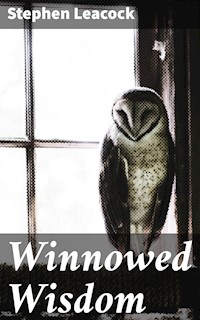
In "Winnowed Wisdom," Stephen Leacock showcases his exceptional wit and humor through a collection of essays that delve into the absurdities of everyday life. The book masterfully combines satire and keen observation, reflecting Leacock's astute insights into human nature and society in the early 20th century. Written in a light-hearted, engaging style, Leacock's prose offers both charm and intellectual stimulation, making it accessible while inviting deeper contemplation on the peculiarities of existence and common sense. This work is among his best, standing out in a literary context dominated by realism and naturalism, as it boldly embraces humor as a lens through which to view life'Äôs complexities. Stephen Leacock (1869-1944) was a Canadian humorist, teacher, and political economist, whose sharp intellect and personal experiences deeply informed his writing. Often regarded as one of the foremost humorists of his time, Leacock's diverse background, from his academic endeavors to his rich understanding of social dynamics, provided the perfect foundation for the satirical genius evident in "Winnowed Wisdom." His unique perspective shaped the way he portrayed the trivialities and grand themes of human experience. I highly recommend "Winnowed Wisdom" to readers seeking a delightful blend of humor and wisdom. Ideal for those who appreciate wit interwoven with insightful commentary, this collection is an enlightening journey that will entertain and provoke thought, making it a timeless addition to any literary repertoire.
Das E-Book können Sie in Legimi-Apps oder einer beliebigen App lesen, die das folgende Format unterstützen:
Veröffentlichungsjahr: 2021
Ähnliche




Winnowed Wisdom
Table of Contents
I
The Outlines of Everything
Designed for Busy People at Their Busiest
A Preface to the Outlines
Within recent years it is becoming clear that a university is now a superfluous institution. College teaching is being replaced by such excellent little manuals as the "Fireside University Series," the "World's Tiniest Books," the "Boys Own Comic Sections," and the "Little Folks Spherical Trigonometry." Thanks to books such as these no young man in any station of life need suffer from an unsatisfied desire for learning. He can get rid of it in a day. In the same way any business man who wishes to follow the main currents of history, philosophy and radio-activity may do so while changing his shirt for dinner.
The world's knowledge is thus reduced to a very short compass. But I doubt if even now it is sufficiently concentrated. Even the briefest outlines yet produced are too long for the modern business man. We have to remember that the man is busy. And when not busy he is tired. He has no time to go wading through five whole pages of print just to find out when Greece rose and fell. It has got to fall quicker than that if it wants to reach him. As to reading up a long account, with diagrams, of how the protozoa differentiated itself during the twenty million years of the pleistocene era into the first invertebrate, the thing is out of the question. The man hasn't got twenty million years. The whole process is too long. We need something shorter, snappier, something that brings more immediate results.
From this point of view I have prepared a set of Outlines of Everything covering the whole field of science and literature. Each section is so written as to give the busy man enough and just exactly enough of each of the higher branches of learning. At the moment when he has had enough, I stop. The reader can judge for himself with what accuracy the point of complete satiety has been calculated.
Volume One--The Outline of Shakespeare
Designed to make Research Students in Fifteen Minutes. A Ph.D. degree granted immediately after reading it.
1. Life of Shakespeare. We do not know when Shaksper was born nor where he was born. But he is dead.
From internal evidence taken off his works after his death we know that he followed for a time the profession of a lawyer, a sailor and a scrivener and he was also an actor, a bartender and an ostler. His wide experience of men and manners was probably gained while a bartender. (Compare: Henry V, Act V, Scene 2. "Saynow, gentlemen, what shall yours be?")
But the technical knowledge which is evident upon every page shows also the intellectual training of a lawyer. (Compare: Macbeth, Act VI, Scene 4. "What is there in it for me?") At the same time we are reminded by many passages of Shakspere's intimate knowledge of the sea. (Romeo and Juliet. Act VIII, Scene 14. "How is her head now, nurse?")
We know, from his use of English, that Shagsper had no college education.
His Probable Probabilities
As an actor Shicksper, according to the current legend, was of no great talent. He is said to have acted the part of a ghost and he also probably took parts as Enter a citizen, a Tucket sounds, a Dog barks, or a Bell is heard within. (Note. We ourselves also have been a Tucket, a Bell, a Dog and so forth in our college dramatics days. Ed.)
In regard to the personality of Shakespere, or what we might call in the language of the day Shakespere the Man, we cannot do better than to quote the following excellent analysis done, we think, by Professor Gilbert Murray, though we believe that Brander Matthews helped him a little on the side.
"Shakespere was probably a genial man who probably liked his friends and probably spent a good deal of time in probable social intercourse. He was probably good tempered and easy going with very likely a bad temper. We know that he drank (Compare: Titus Andronicus, Act I, Scene I. "What is there to drink?"), but most likely not to excess. (Compare: King Lear, Act II, Scene I. "Stop!" and see also Macbeth, Act X, Scene 20. "Hold! Enough!") Shakespere was probably fond of children and most likely of dogs, but we don't know how he stood on porcupines.
"We imagine Shakespeare sitting among his cronies in Mitre Tavern, joining in the chorus of their probable songs, and draining a probable glass of ale, or at times falling into reverie in which the majestic pageant of Julius Caesar passes across his brooding mind."
To this excellent analysis we will only add. We can also imagine him sitting anywhere else we like--that in fact is the chief charm of Shakesperian criticism.
The one certain thing which we know about Shakespere is that in his will he left his second best bed to his wife.
Since the death of S. his native town--either Stratford upon Avon or somewhere else--has become a hallowed spot for the educated tourist. It is strange to stand today in the quiet street of the little town and to think that here Shakespeare actually lived--either here or elsewhere--and that England's noblest bard once mused among these willows--or others.
Works of Shakespeare
Our first mention must be of the Sonnets, written probably, according to Professor Matthews, during Shakesbur's life and not after his death. There is a haunting beauty about these sonnets which prevents us from remembering what they are about. But for the busy man of today it is enough to mention, "Drink to Me Only With Thine Eyes," "Rock Me to Sleep Mother," "Hark, Hark the Dogs do Bark." Oh, yes, quite enough. It will get past him every time.
The Historical Plays
Among the greatest of Shakespeare's achievements are his historical plays,--Henry I, Henry II, Henry III, Henry IV, Henry V, Henry VI, Henry VII and Henry VIII. It is thought that Shakespeare was engaged on a play dealing with Henry IX when he died. It is said to have been his opinion that having struck a good thing he had better stay with it.
There is doubt as to authorship of part, or all, of some of these historical plays. In the case of Henry V, for example, it is held by the best critics that the opening scene (100 lines) was done by Ben Jonson. Then Shakespeare wrote 200 lines (all but half a line in the middle) which undoubtedly is Marlowe's.
Then Jonson, with a little help from Fletcher, wrote 100 lines. After that Shakespear, Massinger and Marlowe put in 10 lines each. But from this point the authorship is confused, each sticking in what he could.
But we ourselves are under no misapprehension as to what is Shakespeare's and what is not. There is a touch which we recognize every time. When we see the real Shakespeare, we know it. Thus, whenever it says "A Tucket Sounds, Enter Gloucester with Hoboes," we know that Shakespeare, and only Shakespeare, could have thought of that. In fact Shakespeare could bring in things that were all his own, such as:--"Enter Cambridge followed by An Axe." "Enter Oxford followed by a Link." His lesser collaborators could never get the same niceness of touch. Thus, when we read, "Enter the Earl of Richmond followed by a pup," we realize that it is poor work.
Another way in which we are able to test whether or not a historical play is from Shakespeare's own pen is by the mode of address used by the characters. They are made to call one another by place designations instead of by their real names. "What says our brother France?" or "Well, Belgium, how looks it to you?" "Speak on, good Burgundy, our ears are yours." We ourselves have tried to imitate this but could never quite get it; our attempt to call our friends "Apartment B, the Grosvenor," and to say "Go to it, the Marlborough, Top Floor No. 6" has practically ended in failure.
The Great Tragedies
Every educated person should carry in his mind an outline idea of the greatest of Shakespeare's tragedies. This outline when reduced to what is actually remembered by playgoers and students is not difficult to acquire. Sample:
Hamlet (not to be confused with Omelette which was written by Voltaire). Hamlet, Prince of Denmark, lived among priceless scenery and was all dressed in black velvet. He was deeply melancholy. Either because he was mad, or because he was not, Hamlet killed his uncle and destroyed various other people whose names one does not recall.
The shock of this drove Ophelia to drown herself, but oddly enough when she threw herself in the water she floated, and went down the river singing and shouting. In the end Hamlet killed Laertes and himself, and others leaped into his grave until it was quite full when the play ends. People who possess this accurate recollection rightly consider themselves superior to others.
Shakespeare and Comparative Literature
Modern scholarship has added greatly to the interest in Shakespeare's work by investigating the sources from which he took his plays. It appears that in practically all cases they were old stuff already. Hamlet quite evidently can be traced to an old Babylonian play called Humlid and this itself is perhaps only a version of a Hindoo tragedy, The Life of William Johnson.
The play of Lear was very likely taken by S. from the old Chinese drama of Li-Po, while Macbeth, under the skilled investigation of modern scholars, shows distinct traces of a Scottish origin.
In effect, Shakespeare, instead of sitting down and making up a play out of his head, appears to have rummaged among sagas, myths, legends, archives and folk lore, much of which must have taken him years to find.
Personal Appearance
In person Shakespeare is generally represented as having a pointed beard and bobbed hair, with a bald forehead, large wide eyes, a salient nose, a retreating chin and a general expression of vacuity, verging on imbecility.
Summary
The following characteristics of Shakespeare's work should be memorized--majesty, sublimity, grace, harmony, altitude, also scope, range, reach, together with grasp, comprehension, force and light, heat and power.
Conclusion: Shakespeare is a very good writer.
Volume Two--The Outline of Evolution
Specially Revised to Suit Everybody, and Particularly Adapted for the Schools of Tennessee.
It seems that recently there has been a lot of new trouble about the theory of evolution in the schools. Either the theory is being taught all wrong or else there is something the matter with it. For years it had seemed as if the doctrine of Evolution was so universally accepted as to lose all its charm. It was running as a close second to Spherical Trigonometry and Comparative Religion and there was no more excitement about it than there is over Anthropology.
Then suddenly something seems to have happened. A boy in a Kansas public school threw down his book and said that the next time he was called a protozoon he'd quit the class. A parent in Ostaboola, Oklahoma, wrote to the local school board to say that for anyone to teach his children that they were descended from monkeys cast a doubt upon himself which he found intolerable. After that the wave of protest swept through the colleges.
The students marched in processions carrying banners with the motto "Are we baboons? Rah, Rah, Apes!" The Rotary Clubs of town after town voted by a standing vote that they were unable to support (or to understand) the doctrine of biological biogenesis, and they wanted it taken away.
The Woman's Culture Club of Winona, Utah, moved that the name of Charles Darwin be changed in the text books of the state to that of W. J. Bryan. The Anti-Saloon League voted that the amount of Darwinianism that should be licensed in the schools should not be more than one-half of one per cent.
It is to meet this difficult situation that the present outline of Evolution has been prepared. It is intended so to revise and modify the rigid character of the theory as to make it acceptable to everybody.
The obvious beginning of the matter is to present the theory of evolution as it stood before the trouble began in Tennessee. Each of us at that time carried in his head an outline, a little bit hazy, but still usable, of the Doctrine of Evolution as we remembered it from our college training.
Outline of Evolution as Dimly Recalled from College Education
We are all descended from monkeys. This descent, however, took place a long time ago and there is no shame in it now. It happened two or three thousand years ago and must have been after and not before the Trojan war.
We have to remember also that there are several kinds of monkeys. There is the ordinary monkey seen in the street with the hand organ (communis monacus), the baboon, the giboon (not Edward,) the bright, merry, little chimpanzee, and the hairy ourang-outang with the long arms. Ours is probably the hairy ourang-outang.
But the monkey business is only part of it. At an earlier stage men were not even that. They probably began as worms. From that they worked up to being oysters; after that they were fish, then snakes, then birds, then flying squirrels, and at last monkeys.
The same kind of change passed over all the animals. All the animals are descended from one another. The horse is really a bird, and is the same animal as the crow. The differences between them are purely superficial. If a crow had two more feet and no feathers it would be a horse except for its size.
The whole of these changes were brought about by what is called the Survival of the Fittest. The crookedest snake outlived the others. Each creature had to adapt itself or bust.
The giraffe lengthened its neck. The stork went in for long legs. The hedgehog developed prickles. The skunk struck out an independent line of its own. Hence the animals that we see about us--as the skunk, the toad, the octopus, and the canary--are a highly selected lot.
This wonderful theory was discovered by Charles Darwin. After a five-year voyage in the Beagle as a naturalist in the Southern Seas, Darwin returned to England and wrote a book called Sartor Resartus which definitely established the descent of mankind from the avoirdupois apes.
One must admit that in this form the theory does not seem calculated to give any great offense to anybody. One must therefore suppose that the whole of the present bitter controversy arose out of what Darwin himself must have written. But this is obviously not so. I have not actually before me the text of Darwin's own writings, but I recall the general run of what he wrote with sufficient accuracy to reproduce it here.
Darwin's Own Statement
Personal Recollection of the Work of the Great Naturalist
"On the Antilles the common crow, or decapod, has two feet while in the Galapagos Islands it has a third. This third foot, however, does not appear to be used for locomotion, but merely for conversation. Dr. Anderson of H.M.S. Unspeakable during his visit to the Galapagos Islands in 1834 saw two crows sitting on a tree. One was, apparently, larger than the other. Dr. Anderson also saw a lizard at Guayaquil in Ecuador which had lost one toe. In fact, he had quite a good time.
"It would be too much to say that the crow and the lizard are the same bird. But there seems little doubt that the apex cervicus of the lizard is of the same structure as the rudimentary dorsal fin of the crow. I put forward this statement however with the modesty which it deserves and am only led to it with deep reluctance and with a full sense of its fatal character.
"I may say that I myself while off the Oesophagus Islands in H.M.S. Impossible in the year 1835 saw a flock of birds of the kind called by the sailors "bum-birds," which alighted on the masts and held on by their feet. In fact, I saw a lot of interesting things like that.
"While I was in the Beagle, I recall that on one occasion we landed on the Marquesas Islands where our captain and his party were entertained by the chief on hams and yams. After the feast a group of native women performed a hula-hula dance during which I wandered out into the woods and secured a fine collection of toads.
"On the next island--while the captain and his officers were watching a hitchi-kitchi dance--I picked up some admirable specimens of lizards and was fortunate enough to bring back a pocketful of potato bugs."
After reading this plain account as quoted, or at least as remembered, direct from Darwin, one must admit that there is no reason to try to rob him of his discoveries.
But to make the case still plainer, let us set alongside of this a clear simple statement of the Theory of Evolution as it is now held by the scientists in our colleges. I have before me the enunciation of the doctrine as stated at the request of the press by a distinguished biologist during the height of the present controversy. What he says runs, as follows--or very nearly as follows:
"All controversy apart, we must at least admit the existence of a continuous morphological protoplasmic differentiation--"
That seems to me a fair, manly statement of a plain fact.
"Cytology is still in its infancy--"
This is too bad, but it will grow.
"But at least it involves the admission of a primitive conformity which removes any a priori difficulty in the way of evolution."
So there we are. After that one would think that the Tennessee schools would have no further difficulty about the thing.
The Time of Evolution
But even if we reach a definite conclusion as to the nature of the process by which life gradually appeared and assumed higher and higher forms, the question still remains--over how great a period did the process last? What time element must be interposed? In other words as Henri Bergson once stated it with a characteristic flash of genius, "How long did it take?"
The earlier estimates of evolutionary scientists placed the age of man at about 500,000 years. This was ridiculously low. You can't evolve any kind of real man in that time. Huxley boldly raised the figures to 1,000,000. Lord Kelvin, amid unusual applause, put it up to 2,000,000 years. The cheers had hardly died away when Sir Ray Lankester disturbed the whole universe by declaring that man was 4,000,000 years old. Two years later a professor of the Smithsonian Institute raised it to 5,000,000. This estimate was seen and raised to 10,000,000 years. This again was raised from year to year amid universal enthusiasm.
The latest advices are that a student in Schenectady Technical High School places the age of man at 100,000,000 years. For a rough working estimate, therefore, the business man will not be far wrong in assuming (for practical purposes) that the age of man is anything from 100,000,000 to 1,000,000,000. Night watchmen are perhaps a little older.
Postscript: Up-to-Date Corrections of the Darwinian Theory
A still more cheerful light is thrown on the evolution controversy by the fact that modern biologists do not entirely hold with the theory of Charles Darwin. I find on inquiry that they are prepared to amend his evolution doctrine in a variety of points.
It seems that Darwin laid too much stress on what he called natural selection and the survival of the fittest. The modern biologist attaches no importance to either of these. It seems also that Darwin overestimated very much the part played by heredity. He was moreover mistaken in his idea of the changes of the species. It is probable, too, that his notion of a monkey is inadequate. It is doubtful also whether Darwin ever actually sailed on the Beagle. He may have been in the Phineas Q. Fletcher of Duluth. Nor is it certain that his name was Darwin.
Volume Three--The Business Outline of Astronomy
The world or universe in which we do our business consists of an infinite number, perhaps a hundred billion, perhaps not, of blazing stars accompanied by comets, dark planets, asteroids, asterisks, meteors, meteorites and dust clouds whirling in vast circles in all directions and at all velocities. How many of these bodies are habitable and fit for business we do not know.
The light emitted from these stars comes from distances so vast that most of it is not here yet. But owing to the great distance involved the light from the stars is of no commercial value. One has only to stand and look up at the sky on a clear starlight night to realize that the stars are of no use.
Practically all our efficient light, heat and power comes from the sun. Small though the sun is, it gives out an intense heat. The business man may form some idea of its intensity by imagining the entire lighting system of any two great American cities grouped into a single bulb; it would be but little superior to the sun.
The earth revolves around the sun and at the same time revolves on its own axis, the period of its revolution and the rising and setting of the sun being regulated at Washington, D.C. Some years ago the United States government decided to make time uniform and adopted the system of standard time; an agitation is now on foot--in Tennessee--for the lengthening of the year.
The moon, situated quite close to the earth but of no value, revolves around the earth and can be distinctly seen on a clear night outside the city limits. During a temporary breakdown of the lighting plant in New York city a few years ago the moon was quite plainly seen moving past the tower of the Metropolitan Life building. It cleared the Flatiron building by a narrow margin. Those who saw it reported it as somewhat round but not well shaped, and emitting an inferior light which showed that it was probably out of order.
The planets, like the earth, move around the sun. Some of them are so far away as to be of no consequence and, like the stars, may be dismissed. But one or two are so close to the earth that they may turn out to be fit for business. The planet Mars is of special interest inasmuch as its surface shows traces of what are evidently canals which come together at junction points where there must be hotels. It has been frequently proposed to interest enough capital to signal to Mars, and it is ingeniously suggested that the signals be sent in six languages.
Volume Four--Outline of Recent Advances in Science
Specially Designed for Members of Women's Culture Clubs, and Representing Exactly the Quantity of Information Carried Away From Lectures on Scientific Progress
Einstein's Theory of Relativity: Einstein himself is not what one would call a handsome man. When seen by members of the Fortnightly Women's Scientific Society in Boston he was pronounced by many of them to be quite insignificant in appearance. Some thought, however, that he had a certain air of distinction, something which they found it hard to explain but which they felt. It is certain that Einstein knows nothing of dress. His clothes appear as if taken out of the rag bag, and it is reported by two ladies who heard him speak at the University of Pennsylvania on the measurement of rays of light that he wore an absolutely atrocious red tie. It is declared to be a matter of wonder that no one has ever told him; and it is suggested that some one ought to take hold of him.
Einstein is not married. It has been reported, by members of the Trenton (New Jersey) Five O'clock Astronomical Investigation Club that there is a romance in his life. He is thought to have been thrown over by a girl who had a lot of money when he was a poor student, and it was this that turned his mind to physics. It is held that things work that way. Whether married or not he certainly behaved himself like a perfect gentleman at all the clubs where he spoke. He drinks nothing but black coffee.
Einstein's theories seem to have made a great stir.




