


Erhalten Sie Zugang zu diesem und mehr als 300000 Büchern ab EUR 5,99 monatlich.
- Herausgeber: IVP
- Kategorie: Religion und Spiritualität
- Sprache: Englisch
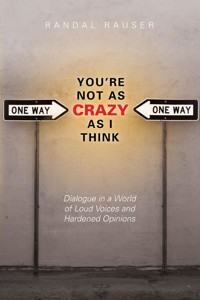
Would you choose God over truth?If we Evangelicals are known for anything, we are mostly known for our opinions—opinions we are not afraid to express and express with much gusto and volume. But what if passion for truth is found not in the loudest voice and most unshakable convictions, but rather in the resolve to listen to and learn from others? What if that passion is found in a willingness to rethink our most cherished beliefs? What if it is found in a refusal to embrace simple black and white categories when the world offers a bewildering array of gray? What if it is found when we refuse to dismiss those who disagree with us as simply stupid or wicked? What if it is found when we seek to learn from others through open and honest dialogue? In You're Not As Crazy As I Think, Randal Rauser presents a very different picture of the passionate pursuit of truth from those who seek to stand on unassailable and unquestionable foundations. This pursuit begins as we rethink not only our truth paradigm but learn how to listen, to hear, and learn from groups so often marginalized by our biases. Could it be that those who we have dismissed or ignored, like liberal Christians, Darwinists, atheists, and animal-rights activists, are not that stupid or wicked after all? Could it be that they might even have something important to share about the truth?
Sie lesen das E-Book in den Legimi-Apps auf:
Seitenzahl: 347
Veröffentlichungsjahr: 2012
Das E-Book (TTS) können Sie hören im Abo „Legimi Premium” in Legimi-Apps auf:
Ähnliche











YOU’RE NOT ASCRAZY AS I THINK
Dialogue in a World of Loud Voices and Hardened Opinions
InterVarsity Press P.O. Box 1400 Downers Grove, IL 60515-1426 World Wide Web: www.ivpress.com E-mail: [email protected]
All rights reserved. No part of this book may be reproduced in any form without written permission from InterVarsity Press.
InterVarsity Press® is the book-publishing division of InterVarsity Christian Fellowship/USA®, a movement of students and faculty active on campus at hundreds of universities, colleges and schools of nursing in the United States of America, and a member movement of the International Fellowship of Evangelical Students. For information about local and regional activities, write Public Relations Dept. InterVarsity Christian Fellowship/USA, 6400 Schroeder Rd., P.O. Box 7895, Madison, WI 53707-7895, or visit the IVCF website at www.intervarsity.org.
ISBN: 978-0-8308-5979-5
Copyright © 2011 by Randal Rauser
Scripture taken from the HOLY BIBLE, TODAY’S NEW INTERNATIONAL VERSION® TNIV® Copyright © 2001, 2005 by Biblica, Inc.™. Used by permission of Biblica, Inc.™. All rights reserved worldwide.
Contents
Acknowledgments
1. Who Needs Truth When You’ve Got Jesus?
2. Truth Is Who You Are
3. If Jesus Were Not The Truth, He’d Be The first Person To Tell You To Look Elsewhere
4. Not Everything Is Black And White
5. Those I Disagree With Are Probably Not Ignorant, Idiotic, Insane, Or Immoral
6. This Conversation could Change Your Life
7. Not All Liberal Christians Are Heretics
8. Not All Darwinists Are Monkeys
9. Not All Animal Rights Activists Are Wackos
10. Not All Atheists Are Fools
ConclusionTruth Is Enough
ACKNOWLEDGMENTS
With some trepidation I traveled to Calgary, Alberta, in February 2009 to deliver an address to the Association of Christian Schools International (ACSI) Alberta Educator Convention, which was evocatively titled “Brainwashed? On the Challenge of Christian Education.” Though I may have heralded some reservations going in, the challenging and engaging discussion that followed convinced me of the need to write the present book. And so I extend my thanks to all those who were present at that talk and shared their well-considered opinions and questions. Next, thanks to Biblica Publishing and in particular to publisher Volney James, who readily issued a contract and provided encouragement throughout the writing and editorial process, and to the editorial work of Bette Smyth. Thanks also go to my wife, Rae Kyung (Jasper), and daughter Jamie, who showed eminent patience throughout the writing process (to the point where I even dared to bring my netbook to the dinner table!). Finally, thanks to Anne Rauser (my mom) and to Rick Rauser (my brother), who both read the entire manuscript and offered many helpful comments.
For Rick Brother, Friend,
1
WHO NEEDS TRUTH WHENYOU’VE GOT JESUS?
Woody Allen’s film Crimes and Misdemeanors tells the disturbing story of ophthalmologist Judah Rosenthal (Martin Landau). Although Rosenthal has a serene life, it begins to unravel when he has an affair with a flight attendant. Rosenthal thinks he can lead a comfortable double life—until his mistress resolves to tell his wife of the affair in a move that will ensure the destruction of his family. When all attempts to keep her from talking fail, Rosenthal resorts to hiring a contract killer in order to have her murdered. After the dark deed has been completed, he surreptitiously returns to her apartment. As he gazes on her lifeless body, the gravity of his crime begins to sink in. Some weeks later the growing guilt Rosenthal struggles with drives him back to the home of his youth in search of some kind of solace and guidance. As he wanders through the house, he pauses at the dining room while memories of a busy Passover Seder from his childhood begin to flood back. As the scene unfolds in his memory, Rosenthal’s father, Sol, is dutifully leading the service when his secular aunt May rudely interrupts the “mumbo jumbo” proceedings. May’s condescending dismissal of Sol’s piety prompts a debate among the guests concerning the rationality of belief in God in the modern world. When one of the men at the table asks Sol what he would say if it turned out that his faith was wrong, Sol resolutely replies that even if he is wrong, he will still have lived a better life than the unbeliever. This prompts an indignant retort from May: “Wait a minute. Are you telling me that you prefer God to the truth?” Sol’s answer is instant and resolute: “If necessary I will always choose God over truth!”1
I believe that this little story provides a sobering parable for the state of much of contemporary evangelicalism. The dining room table represents the public square of debate and discourse, a table that bustles with the views of secularists, atheists, humanists, Muslims, pluralists, Buddhists, and many others. Evangelicals have long seen their role at the table in much the same way that Sol views his, as defenders of the one truth against a world of error and skepticism. In the midst of the cacophony of civil and uncivil exchange, the evangelical soldiers on. Even as he faces critique and occasionally even mockery, still he strives valiantly to defend the gospel. The commitment of evangelicals to this fight has occasionally waned as they have been drawn by the lure of more worldly pursuits.2 However, in the last decade a number of evangelical voices have expressed a renewed dedication to the importance of truth for the wider community. For evidence of this trend, consider the spate of recent books evangelicals have published on truth in the last decade, including The Truth War; Culture Shift: Engaging Current Issues with Timeless Truth; Total Truth; Evangelical Truth; Time for Truth; Truth Decay; Whatever Happened to Truth; The Wedge of Truth; Truth and the New Kind of Christian; and (my favorite title) True Truth.3 And to cap it off, in 2006 Focus on the Family released a complete worldview curriculum entitled Focus on the Family’s The Truth Project®, a watershed of unprecedented scope and ambition intended to ignite the church’s passion for truth. All told, the evidence suggests that evangelicals are showing clear signs of Sol’s dedication to standing for the truth.
But what about the negative side of Sol’s witness? Is there evidence that evangelicals have abandoned the virtuous pursuit of truth for the sake of defending their own beliefs, true or not? Certainly this appears to be the widespread assumption among non-evangelicals, as Joel Kilpatrick suggested in his satirical book A Field Guide to Evangelicals and Their Habitat: “The purpose of evangelical education, like the purpose of Fox News, is to dispense with contradictory ideas with as little thought as possible, resulting in eighteen-year-old biblically literate virgins who vote Republican.”4 Whether or not this is a fair characterization of evangelical education, Kilpatrick’s satirical description accurately reflects a common perception about it. Despite all this talk of truth among evangelicals, many others at the table suspect that they are really more concerned with perpetuating their own sectarian ideology.5 So despite the fact that evangelicals loudly proclaim their fidelity to truth, critics suspect that they reflect nothing more than Sol’s misguided piety: “If necessary I will always choose God over truth!”
Even if people have the impression that evangelicals are willing to sacrifice truth for the sake of their beliefs, surely the deeper question is to ask whether this is in fact true. In this book I will argue that it is indeed often true, certainly more so than evangelicals are typically willing to admit. Time and again we have revealed ourselves to be more interested in defending and perpetuating our beliefs on a given issue than in discerning where the truth really lies. Often we have preferred to secure our present beliefs against challenge rather than to embrace the open risk of real dialogue. Even if we would never come out and say that we choose anything, even God, over truth (after all, what would that even mean?), our actions often suggest otherwise. As a result, actions that may have been intended to secure the faith from attack instead undermine our witness to others gathered at the table, leaving them to conclude that we are not that serious about truth after all but are simply pushing an “agenda.” And this ultimately leaves the evangelical’s stance looking as ironic and pathetic as the beleaguered rabbi in Allen’s film.
This brings me to the second part of my thesis. If we have often shown ourselves to be less than diligent pursuers of truth, the solution is straightforward, if not simple: we need to be doers of the truth and not hearers only. And this means developing the character and traits that always seek after truth in all things. With that in mind, my goal in this book can be stated as follows: to challenge evangelicals, other Christians, and everybody else to develop characters of truth that are in harmony with their proclamations of truth. At a pluralist table crowded with various opinions, where reasoned civil discourse is often trumped in favor of quick sound bites, we need now more than ever to be faithful disciples of truth.
Since it is important to keep this kind of discussion grounded in concrete reality, I will link my frequent engagement with evangelical attitudes toward truth with respect to a very real, even if fictional, evangelical who embodies both the nobler characteristics and attendant weaknesses of the tradition. His name is Ted, and he is a forty-something evangelical who lives somewhere in the Bible Belt, USA. Ted converted to Christ while attending a university twenty years ago; he is married, has two children in college, and owns his own sporting goods shop. Ted regularly takes the family out to Dairy Queen after Tuesday night Bible study, ushers twice a month, and is a genuinely nice guy. He also reads widely, especially in areas like apologetics and evangelism. While he loves his work, he views his primary calling as that of an evangelist, though his style is typified more by soft conversations that lead into matters of eternal significance than by in-your-face questions like “Do you know where you’d go if you died tonight?” Ted may love sports, his country, and his family, but he’ll tell you that he loves the truth most of all. All this is important because, far from being a caricature of our weakest link, Ted is a thoughtful, educated, and amiable Christian. Indeed, he is just the kind of individual most pastors would love to recruit as a deacon or adult Sunday school teacher (Ted is both). So, to the extent that Ted comes up short in the rigorous pursuit of truth, it is a reflection on, and indictment of, the wider evangelical community. With this in mind we will often return to consider Ted’s opinions at various points in the book. But before we get started, I will take a few moments to provide a brief overview of the road ahead.
Getting Serious about Truth
Our inquiry into truth shall unfold in two parts. In chapters two through six we will seek to identify core assumptions and practices that tend to inhibit our pursuit of the truth, as well as those that aid us in realizing the pursuit of truth. This will provide the foundation for the series of four dialogues that we will undertake in chapters seven through ten.
The discussion shall commence in chapter two, “Truth Is Who You Are,” where we will begin by considering the concept of truth as a quality that applies not only to statements but also to persons. Sadly, evangelicals have often had the wrong idea about what a character formed by truth looks like. For instance, they have often located the truthful character in the voice that speaks with the greatest passion, conviction, and simplicity or clarity of vision. But if we have passion, conviction, and simplicity without the subtler virtues to be examined in chapters three through six, our advocacy for truth could be subverted even with the best of intentions. And this would leave us perilously close to Sol’s dogged defense of his beliefs.
It can be unsettling to admit that our grasp of truth is always a work in progress. Especially disconcerting is the notion that part of the commitment to pursuing truth is the willingness to rethink even our core fundamental beliefs. Interestingly, the Christian might worry that this willingness to pursue truth wherever it leads could constitute a form of betrayal. After all, aren’t we to treat Christ as supreme over all other things? So how could we countenance the possibility of rethinking—or even rejecting—the very individual who demands our supreme commitment? If we believe that Jesus is the truth, then how could we consider the possibility of rejecting Jesus as an act of fidelity to the truth? While I readily understand Ted’s reservations at this point, my response shall come in chapter three: “If Jesus Were Not the Truth, He’d Be the First Person to Tell You to Look Elsewhere.”
We all have a built-in tendency to retain and protect our beliefs even when the evidence begins to mount against them. One way to protect our beliefs in the teeth of such challenges is by reducing the often bewildering patina of reality to a stark range of either/or positions like good or evil, right or wrong, and true or false, while stressing that our beliefs are the good, right and true. Like most Christians, Ted is also prone to lapse into these simplistic binary opposites. So Ted often protects his beliefs by assuming that his own position is the completely good, right, and/or true one, while the opposing view is completely evil, wrong, and/or false. Unfortunately, reality is rarely this simple, and to insist that it is will inevitably lead to a range of distortions. In chapter four, “Not Everything Is Black and White,” I will argue that these kinds of binary oppositions are indefensibly oversimplified and inhibit critical thinking. The person who has a character formed by truth will forgo such oversimplified distortions and instead embrace the inevitable complexity and ambiguity of truth.
When Ted views issues in black-and-white terms and assumes that the evidence unequivocally supports his position, he is left with a practical problem: How can he explain the fact that decent, rational people continue to disagree with him? When boiled down to essentials, the answer seems to be that such disagreement must arise from some serious intellectual or moral deficit on the part of the detractor: that is, if truth really is this simple, then the person who continues to disagree with Ted (or you or me, for that matter) is either ignorant of the relevant evidence or aware of it but maliciously refusing to acknowledge it. While this may be true in some exceptional cases (there are a few crazy and wicked people out there), it surely is an implausible way to explain most cases of ongoing disagreement. Or so I shall argue in chapter five, “Those I Disagree with Are Probably Not Ignorant, Idiotic, Insane, or Immoral.”
While Ted loves to engage others in discussions of truth, rarely does he enter a conversation with a real openness to being converted by the other. When he asks people to share their opinions, he listens politely, but he doesn’t listen well. Truth be known, he really cannot wait for them to finish so that he can share his perspective, the right perspective. Let’s not judge Ted too harshly here, for it surely is hard to listen to others share their beliefs when you are convinced that they are plain wrong and that you are perfectly right. But what happens when we admit that disagreement arises not only because of an intellectual or moral deficit on the part of our detractors? What if we admit that sometimes they may have good reasons to disagree with us? Let’s go further: Could it be (dare we think it?) that the reasons they have for their position might sometimes be at least as legitimate as the reasons we have for ours? Perhaps even more so? In chapter six, “This Conversation Could Change Your Life,” we will consider how a truthful character commits us to the hospitality and vulnerability of openly listening to others.
Truth in Conversation
By now it should be clear that commitment to the truth means much more than a dogged adherence to the set of statements we happen to believe. A commitment to truth is also a character-forming commitment to know reality as it is revealed in the world and our interaction with others. So, a close-minded refusal to hear the truth in others is incompatible with being people of truth. The real person of truth is one who expresses a genuine willingness to listen to the other as an equal conversation partner. That is precisely what we will begin to do in the second section as we engage in a series of conversations with four groups that are often marginalized by evangelicals: liberal Christians, Darwinists, animal rights activists, and atheists.
We will begin with Ted’s hostility toward so-called liberal Christians. For Ted, much of that hostility is directed at St. Joseph’s, the small Episcopalian church that he passes every day on his way to work. Ted takes a certain pride in the striking contrast between that tiny communion and the gigantic and ostentatious suburban evangelical church that he attends, with its sprawling campus, sparkling café, and spectacular fountains. While St. Joe’s is the frequent butt of Ted’s jokes, beneath the humor lies deep puzzlement at, and even hostility toward, the Christian liberalism that it represents. Ted has heard that St Joe’s counts the local abortion doctor and a number of practicing gays among its congregants. And Ted has doubts about its priest (or priestess?), a woman with short hair he saw at last year’s missions conference. After hearing her open the morning session by reading a prayer out of a book, Ted whispered to his friend: “Is it any surprise that St. Joe’s is dead? They can’t even pray in their own words.” But is that a fair assessment of St. Joe’s specifically and liberal Christianity more generally? We shall explore this question in chapter seven, “Not All Liberal Christians Are Heretics.”
While Ted harbors some antipathy toward St. Joseph’s, the controversies raised by liberal Christianity have never entered his comfortable home. But another issue blew up this past Thanksgiving at the dinner table. Mark, Ted’s son, had returned from his first semester of college just hours before. Suddenly, right there over turkey and gravy, the boy started spouting off nonsense about how the scientific evidence shows that we are descended from monkeys. And to make matters worse, the kid then had the nerve to suggest that this ridiculous theory of evolution didn’t contradict the Bible. “I’m not descended from a monkey!” Ted snapped back. “And I’m not going to let an evolutionist make me into one.” So shaken was Ted at Mark’s flirtation with Charles Darwin that he even declined his usual second helping of pumpkin pie. While this conflict may have led to a rather icy Thanksgiving, Ted and Mark are not alone. Indeed, this same debate over origins has wreaked havoc at many Thanksgiving tables as Christian students have returned from universities with newly discovered ideas that challenge the deeply held convictions of their parents. We will enter into the thick of this debate in chapter eight as we consider the claim that “Not All Darwinists Are Monkeys.”
Even if Mark is entertaining some pretty wild ideas, Ted is confident that the boy will sort himself out soon enough. (The creationist book that Ted slipped into Mark’s suitcase before he headed back to school should help.) In the meantime, Ted has a wonderful and supportive neighborhood. Just across the street there is a great Baptist family and a fine young Pentecostal couple. And even if the neighbors on the north side are Mormons, they’re decent enough folk. Indeed, they even lent Ted’s family their motor home for a trip to the Grand Canyon last summer. Unfortunately, things are not quite as congenial with the neighbors on the south side. Both of them are animal rights wackos, who, according to Ted, “care more about an unborn eaglet than an unborn baby.” Their sense of moral superiority is so overbearing that Ted’s wife has even become uncomfortable wearing the fur he bought her for their fifteenth anniversary (a fact that Ted deeply resents). And you cannot imagine their sanctimonious glances over the fence every time Ted invites his small group from church over for a backyard barbeque. Still, he must admit to getting a certain wicked satisfaction in cutting into a juicy steak, knowing that those tofu-eating nut jobs are silently glaring from their patio. With so much enmity, is it possible to save Ted’s relationship with his animal-loving neighbors? Even if Ted cannot convince them to try a piece of his triple-A prime rib, might they persuade him to sample a cube of their tofu? We’ll turn to address this topic in chapter nine, “Not All Animal Rights Activists Are Wackos.”
Liberal Christians, Darwinists, and animal rights activists—this is a pretty ignominious list for your average conservative, Bible-believing Christian. But every one of them would probably have a better image than our last interlocutor: the atheist. And this is hardly surprising. After all, while these other groups take a stand on a relatively peripheral issue, the atheist denies the most basic Christian confession of all: the existence of God. If you want Ted’s opinion on atheism, ask him about the fellow he interviewed last fall for a sales position at his sporting goods store. The interview with this fellow—Osman was his name—started out with promise, given his impeccable resumé and clean-cut image. But things quickly began to go downhill when Ted inquired about one entry on Osman’s resumé under “community service”: his role as volunteer secretary for a local freethinker society. As soon as Osman explained that he was an atheist, Ted immediately determined to throw his application into the trash. What else could he do? After all, the Bible declares the atheist a fool (Psalm 14:1), and one of the few things more foolish than being a fool is hiring one. Case closed? Or is it just possible that not all atheists are fools? That question shall occupy us in chapter ten.
Coda
In each of these four conversations we are seeking to develop the disciplines of charity that go with a character formed by truth. In each case the modus operandi involves a resolution to engage with the other—the liberal, the Darwinist, the animal rights activist, and the atheist—as an equal partner in dialogue and so to treat each one as a person we can learn from and need to listen to. Given the overriding human penchant for responding defensively to those we disagree with, this discipline of listening is an uncommon, even revolutionary, notion.
If you’d like a metaphor for the unfolding conversation, I would suggest that we switch from the roundtable of debate to the battlefield. But not just any battlefield. I am thinking in particular of the 2005 film Joyeux Noël, which tells the incredible story of the spontaneous Christmas 1914 truce in World War I that arose on the battlefield between German, Scottish, and French troops. The cease-fire began in an impromptu way on Christmas Eve when some of the Scots pulled out their bagpipes and began to lead their fellow soldiers in some festive carol singing. Then from the opposite end of the battlefield the voice of a German opera star responded with a haunting rendition of “Adeste Fideles” that rang out over the wasteland of frozen mud and barbed wire. These modest gestures of common humanity in a time of unremitting hostility culminated on Christmas Day with the officers of both sides laying down weapons and meeting together to formalize a temporary cease-fire and share a holiday of peace on earth, goodwill toward men.
As promising as the story is, the end of Joyeux Noël is bittersweet, for once the holiday is over the cease-fire goes with it as the soldiers return to their respective ditches and resume the senseless battle. At that point we must part ways with the illustration, for I am not calling for a temporary cease-fire on the battlefield of ideas followed by a return to the comfortable confines of the close-minded defense of party lines, of all against one and one against all. Rather, I am calling for an enduring truce based on a mutually shared desire to know the truth. It is a truce that we adopt not because we are weak or cowardly or lacking in the courage of our convictions. Rather, it is a truce rooted in the fact that our deepest conviction ought to be the desire to know the truth, as well as the willingness to see this same conviction in our “enemies.” For too long we have objectified the dissenting voice at the other end of the battlefield as nothing more than a target of conquest. But what if we lowered our rhetorical guns and climbed out of the ditch of our entrenched opinions to join the “enemy” on the field of common humanity, united in our love for and pursuit of the truth? This book offers the first modest steps toward just such a grand vision.
1. For an astute discussion see Sander H. Lee, “If Necessary I Will Always Choose God over Truth!” Woody Allen’s Angst: Philosophical Commentaries on His Serious Films (Jefferson, NC: McFarland, 1997), 255–89.
2. For a discussion see David Wells, No Place for Truth, or, Whatever Happened to Evangelical Theology? (Grand Rapids, MI: Eerdmans, 1993).
3. See John MacArthur, The Truth War: Fighting for Certainty in an Age of Deception (Nashville: Thomas Nelson, 2007); Albert Mohler, Culture Shift: Engaging CurrentIssues with Timeless Truth (Colorado Springs, CO: Multnomah Books, 2008); Nancy R. Pearcey, Total Truth: Liberating Christianity from Its Cultural Captivity (Wheaton, IL: Crossway Books, 2004); Evangelical Truth: A Personal Plea for Unity, Integrity & Faithfulness (Downers Grove, IL: InterVarsity Press, 1999); Os Guinness, Time for Truth: Living Free in a World of Lies, Hype, and Spin (Grand Rapids, MI: Baker, 2002); John Stott, Douglas R. Groothuis, Truth Decay: Defending Christianity against the Challenges of Postmodernism (Downers Grove, IL: InterVarsity Press, 2000); R. Albert Mohler et al, Whatever Happened to Truth (Wheaton, IL: Crossway, 2005); Philip E. Johnson, The Wedge of Truth: Splitting the Foundations of Naturalism (Downers Grove, Il: InterVarsity Press, 2002); R. Scott Smith, Truth and the New Kind of Christian (Wheaton, IL: Crossway, 2005); Art Lindsley, True Truth: Defending Absolute Truth in a Relativistic World (Downers Grove, IL: InterVarsity Press, 2004).
4. A Field Guide to Evangelicals and Their Habitat (New York: Harper SanFrancisco, 2006), 131.
5. In his incendiary book American Fascists: The Christian Right and the War on America, Chris Hedges warned that homeschooled evangelical children “are taught, in short, to obey. They are discouraged from critical analysis, questioning and independent thought. And they believe, by the time they are done, a host of myths designed to destroy the open, pluralist society” (New York: Free Press, 2006), 26.
2
TRUTH ISWHO YOU ARE
A few years ago, back when Dan Brown’s The Da Vinci Code was at the height of its popularity, I delivered a number of public lectures critiquing the book’s tendentious historical claims. Near the beginning of one of those lectures, just as I was starting to explain how historians reconstruct the past, a hand went up in the audience. Given that I had hardly said anything at this point, I was a bit surprised to see a question so early. But I was even more surprised when the young man then blurted his question out abruptly: “What is truth?” Judging by some of the confused glances from others in the audience, I suspected that many people did not appreciate the relevance and/or depth of the question. After all, they had come to hear about The Da Vinci Code, not some highfalutin, philosophical expostulations on the nature of truth. But even if we might have questioned whether this was the most appropriate moment for the young man’s query, I had little doubt that this would be the most profound and far-reaching question to be asked that morning. And this is hardly surprising, for it is a question with an impeccable historical pedigree, since it is the very same query that Pilate memorably posed to Jesus two millennia ago (John 18:38), and it has attracted the interest of thoughtful people ever since.
The nature of truth is so important that we will devote this chapter to the concept. In particular, we shall focus on how truth is both a relationship that correct statements bear to reality and a relationship that we bear to Jesus Christ. This means that we need to seek not only to acquire beliefs that are true but also to be truthful people. Unfortunately, when we look for others who might be trustworthy guides for truth, we are often drawn more to style than substance. This becomes evident when we identity a truthful character simply with passion, conviction, and a simplicity of vision. These characteristics can be valuable so long as they come with the characteristics to be examined in chapters three through six. However, apart from those virtues they can lead people to emulate a combative warlike ethos that quickly becomes the enemy of truth.
Seeking the Truth about Truth
My guess is that the man who asks, “What is time?” at a cuckoo clock convention would not be particularly well received by those gathered to hear about the latest advances in pipes and pendulums. So it is for the man who dares to ask, “What is truth?” at a Da Vinci Code lecture. And yet, this seemingly abstract and impractical question is important, and we overlook it at our peril. Indeed, a person’s view of truth is like the rudder on a large ship: it may lie beneath the surface most of the time, but it determines the direction of the massive vessel. For that reason, in this chapter we will pull the liner into dry dock for a closer inspection.
Let’s begin with the basics. When we inquire into the nature of truth, we find ourselves in the company of many of history’s great philosophical minds. The ancient Greek philosopher Aristotle provided an enormously influential definition of truth more than 2,400 years ago when he wrote the following: “ To say of what is, that it is, and of what is not, that it is not, is true.”1 While Aristotle probably didn’t win any poetry contests with this definition, at least it has the virtue of being to the point and containing more good sense than the more extreme postmodernists: truth consists in speaking accurately of the way things are. This has been called the correspondence theory of truth because it roots truth in the correspondence between a statement and the state of affairs that the statement describes. More tersely, truth is the property of statements that accurately describe reality. For instance, the statement “it is sunny out” is true if and only if it is sunny out. And the statement that “there are more existentialist philosophers in Paris, France, than in Paris, Texas,” is true if and only if there are more existentialist philosophers in Paris, France, than in Paris, Texas.2
The understanding of truth as a statement that corresponds with reality is straightforward and accords well with common sense and common usage for the word true. Consider a world-renowned philosopher of truth on her way to deliver a lecture at a university theater. After becoming lost, she approaches two students and tentatively asks them: “Is it true that the theater is behind this parking garage?” While this great philosopher might have written hundreds of highly technical pages on the concept of truth, nonetheless, in this unguarded moment she is concerned with truth in the basic way described by Aristotle and most people in the street. That is, she wants to know that her statement correctly describes (or corresponds to) reality. In other words, she wants to know whether the theater is in fact behind the parking garage.
I believe that correspondence truth is fundamentally correct so far as it goes (more on that “so far as it goes” qualification momentarily). That is, I believe that a statement is true if and only if it correctly describes reality. It is important that we begin with common agreement on this point since this basic correspondence understanding of truth, as obvious as it may seem, has come under attack in recent decades. A number of people have charged that correspondence is uninformative or even meaningless. However, neither of these charges seems to me to be plausible. Others have warned that a correspondence understanding of truth will lead to a general skepticism (the view that we cannot know anything about the world), but in my opinion the problem here lies not with correspondence truth but rather with a person’s theory of knowledge. In sum, none of these objections are especially convincing.
The other major way to argue against correspondence is by proposing another more plausible theory of truth. For instance, some people have argued that truth should be understood to consist in consensus: that is, truth is what everybody agrees with. Another popular suggestion is that truth is really a pragmatic concept: put bluntly, truth is what works. But such suggestions have things backward. The statement that “there are more existentialist philosophers in Paris, France, than in Paris, Texas,” is not true because most everybody agrees with it. Rather, most everybody agrees with it because it is true. And the statement “the theater is behind the parking garage” is not true because it is pragmatically useful to direct me to the theater. Rather, it is pragmatically useful to direct me to the theater because it is true. In each case correspondence is always more likely an explanation of truth than the competing theories. Indeed, a little reflection shows that noncorrespondence theories, like consensus and pragmatism, depend implicitly on the correspondence notion of truth. For instance, people who argue that truth is what works do not think that the statement “truth is what works” is itself true because it works. Rather, they believe that this statement accurately describes (or corresponds to) the nature of truth. 3 Thus, try as some may, we cannot get away from correspondence.
As implausible as noncorrespondence conceptions of truth may be, these views have impacted the church in several subtle ways. For instance, consider that many evangelicals hold to a method of small-group Bible study that implies a sort of consensus approach to truth. English writer Harry Blamires observed the rise of this trend in England fifty years ago:
I have known educated people, professing Christians, who purposely gathered together for religious discussion men and women representing the widest possible varieties of religious conviction. This was fair enough. But unfortunately their aim, as they put it, was to get everyone to make his “individual contribution” (how fraught with error this phrase can be) so that collectively they might arrive at the truth. Now there is much to be said, socially and intellectually, for bringing together people of different outlooks and beliefs; but there is no rational basis for the notion that by mixing a number of conflicting views you are likely to arrive at the truth. You cannot construct truth from a mass of dissonant and disparate material. You cannot construct truth at all: you can only discover it. And the more noisily opinionated people intervene with their contributions, the less likely you are to discover it.4
In my experience many small groups in North America today evince a similar method of studying the Bible: that is, they proceed around the room and pool opinions on the text. Typically in groups like this the leader’s role consists of little more than asking each person, “What does this passage mean to you?” with no attempt to discern the objective meaning of the text. Blamires responded to this disturbing trend by affirming the objective status of truth: “Truth is more like a rock than a pudding—a rock which you lay bare by scraping away the soil.”5 We too need to fight against noncorrespondence conceptions of truth.
At this point, the only remaining reason a Christian might have to reject correspondence is if it contradicts Scripture. But, on the contrary, a quick look supports the conclusion that, far from rejecting correspondence, Scripture actually assumes it. To begin with, we can consider Joseph’s words to his brothers after they came to Egypt, seeking grain for their family. Prior to revealing his identity as their long-lost sibling, Joseph resolved to keep all but one of his brothers in prison “so that your words may be tested to see if you are telling the truth” (Genesis 42:16). In short, Joseph was testing them to ensure that their testimony of their circumstances accurately represented reality. There are many other places in Scripture where the correspondence understanding of truth is assumed. For instance, we read in 1 John 1:8: “If we claim to be without sin, we deceive ourselves and the truth is not in us.” Here John was clearly assuming that the standard of truth is a statement that reflects reality; since the claim that we are without sin does not reflect reality, it is not true.6
Now back to the “so far as it goes” qualification. While Scripture assumes correspondence truth, I believe it also goes beyond it. Our starting motivation for going beyond correspondence comes from the fact that Scripture makes statements that apply truth not only to statements but also to persons. The most important example is when Jesus declared, “I am the way and the truth and the life” (John 14:6). The context of the passage is Jesus’s promise that he was going to prepare a place for his disciples. This prompted Thomas to ask how they would find their way to that place, to which Jesus replied that he is the way, the truth, and the life. In other words, Jesus came not simply to communicate a series of true statements about how to be set free (as had many religious teachers before him). More importantly, he came as the way, truth and life. And so when Philip then asked Jesus to reveal the Father, Jesus replied, “Don’t you know me, Philip, even after I have been among you such a long time? Anyone who has seen me has seen the Father” (John 14:9, emphasis added). As the personal truth of God, Jesus reflected in his very being the truth of the Father infinitely more fully than any theology textbook ever could. Just as a statement that reflects reality accurately is the truth of what it describes, so Christ, as the perfect reflection of God, is the truth of God. It is with good reason that the AD 325 Creed of Nicaea declares Jesus to be “true God of true God.” But that is not all. In addition to being the truth of God, Jesus also represents the truth of perfect humanity. To see the paradigm example of a human being, we ought to look not to Adam but to Christ. Thus, our destiny as glorified human beings is to become like Christ (Romans 8:29), the one person who represents the truth of God and humanity.
If Jesus is the truth, then clearly the truth does not apply only to statements. The fact that Jesus is the truth of divine and human being prompts us to expand our notion of truth. In short, it forces us to recognize that truth can apply to more than just statements. Philosopher Nicholas Wolterstorff provided us with a useful way to expand our thinking about truth when he argued that the core relation of truth is found in the quality of “measuring up in being or excellence.” Certainly, this quality applies to statements such that a true statement is one that measures up to the facts. A true sentence is an example of linguistic or propositional truth. But there are other types of truth as well. As Wolterstorff explained, “When we speak of ‘a true so-and-so,’ we are implicitly measuring a contrast between this so-and-so that measures up and other so-and-so’s that do not, or would not, measure up.”7 While a true statement is one that measures up to the facts, many other things can measure up to objective standards as well. For instance, as Wolterstorff explained, a true cup of coffee is one that measures up to the qualities of coffee perfection, while a true friend is one who measures up to the qualities of perfect friendship.




