


12,00 €
Mehr erfahren.
- Herausgeber: Fontana Editore
- Kategorie: Religion und Spiritualität
- Sprache: Englisch
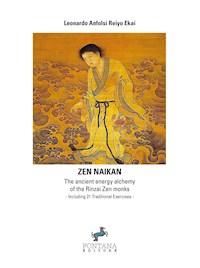
While we have invented technological prostheses external ourselves, thanks to the current materialist mentality, Zen Naikan encourages us to become our own internal source of passion, strength, awareness and freedom. The word naikan was used by Master Hakuin Ekaku only three centuries ago to define expressly a method of cultivating energy associated with a new concept of dynamic meditation practice, suited both to laymen leading a life active in society as well as to practicing monks. Zen Naikan brings to those who practice it harmonious well-being, continuous joy, and the most solid aid to healing, encouraging the highest form of spiritual realization. Zen Naikan is a gift of the Rinzai school of Zen Buddhism, from the monks and laymen dedicated to developing spiritual, mental, and physical strength.
Das E-Book können Sie in Legimi-Apps oder einer beliebigen App lesen, die das folgende Format unterstützen:
Veröffentlichungsjahr: 2018
Ähnliche














Maestro zen Leonardo Anfolsi Reiyo Ekai
ZEN NAIKANThe ancient energy alchemyof the Rinzai Zen monks
Including 21 Traditional Exercises
Translation by Gay Hsiao-Lin Bardin
Editor’s Preface
While preparing this text, uniquely precise and clear among its kind, I spoke at length with the Author. It is distinguished by being the only book revealing and explaining the use of the techniques taught by Master Hakuin Ekaku.
Master Leonardo Anfolsi Reiyo Ekai possesses an encyclopedic knowledge of the field, as well as extensive personal experience, having long practiced these techniques with - as he stressed to me - a precise and definite aim: for a Zen Master, satori is the ultimate goal.
Within the initiatic context of Rinzai Zen Buddhism, such an endeavor is unique. The books describes a dynamic zen practice - which in truth has its thousand-year-old history and tradition of transmission - but for the modern practitioner. For today’s practitioner, for whom understanding Master Hakuin’s work, and figuring out its possible applications to today’s context may be difficult, this book is a precious resource.
Some of the techniques are clearly interlaced with known Tantra yoga techniques. For this reason, the reader could easily misunderstand their use within the Zen context, and how Zen provides a different approach to what would seem to be familiar material.
An impassioned practitioner myself, I have had the precious opportunity to ask Master Leonardo Anfolsi Reiyo Ekai some essential details concerning the techniques directly. This has reiterated for me how personal the practitioner’s relationship with his practice must be, and how important it is to have direct oral transmission from Master to Disciple.
Nevertheless this book is an incomparable resource for anyone practicing alone, even though - personally - I strongly suggest participating in one of the Master’s workshops. The very act of putting oneself in relation with the Master is per se already a koan, essential for anyone who wishes to know zen, or oneself, at the most fundamental level. It is a very simple relationship, direct yet personal, in which the shared interaction is live and unmediated. Much of the initiatic knowledge related to these techniques may be transmitted solely through direct personal teaching, and cannot be recorded or published.
Rocco Fontana
About the Author
Leonardo Anfolsi received his training from Master Engaku Taino, under the aegis of Master Taishitsu Yamada Mumon. The most beloved Buddhist Master of contemporary Japan and President of the Imperial University of Hanazono, Mumon ritually welcomed Anfolsi as a young monk.
Anfolsi obtained recognition as Master from the Tibetan Lama Gomo Tulku Sonam Rinchen XXII, and in fact received the secret teachings of Tibetan Buddhist Masters Kalu Rimpoche (1905-1989), Chőgyal Namkhai Norbu R., Nyoshul Kenpo R. (1932–1999), and the Böm Master Tenzin Namdak R.. In 1990, in Dharmasala, he received the complete teachings, or the the six Yogas of Naropa - which he practices assiduously - from His Holiness the Dalai Lama.
Master Anfolsi teaches Buddhism and meditation in the American and Italian school systems, and lectures and gives workshops on the Zen Naikan technique he has imported from his own zen lineage. He has carried out institutional activities on behalf of the UBI, the Buddhist Union of Italy, under the protection of whom he is organizing the Mumonji Project.
Anfolsi made his debut as a writer with an ironic spiritual autobiography (Banananda, 1989), an immediate bestseller edited and published by Franco Battiato in his L’Ottava Edizioni (reprinted by Fontana Editore); he shares his position in the series with the Nobel Prizewinner Natsume Soseki’s texts from the Sufi scriptural tradition, as well as Gurdjieff’s classic texts. Anfolsi continues his writings on Buddhism and zen; his lectures are appreciated internationally for their humor and erudition. He directs Nitrogeno, the international review of operative alchemy and the project relative to it in collaboration with Fontana Editore.
Leonardo Anfolsi also collaborates with artists and entrepreneurs, guiding them and having served in that same environment as publicist, as for example in Opera Unica, co-authored with Marco Bagnoli, Alessandro Magini, and the editor Sergio Risaliti (Mondadori Arte Electa 2016). In 2007 Anfolsi participated as a multimedial artist in the space at the 52nd Biennale of Venice dedicated to the celebration of Joseph Beuys.
Since the 1980’s Anfolsi has studied and practiced naturopathy, a discipline he combines with his role as minister of the faith. In the 1990’s he was called to direct the therapeutic division of the Bologna Naturist Association, at the time the most respected, well-articulated and advanced organization of its kind in Europe. The organization has produced several leaders in the world of physical education and physiatry, yoga, and contemporary medical philosophy.
To contact the Master directly: [email protected]
Introduction
“When one learns to be calm and tranquil, without turbulence, the ancestral energy adapts itself spontaneously, producing an all-pervasive and unbroken qi energy. If I hold this energy within me, how can I possibly fall ill? The point is to keep this energy-qi inside us, pervading and providing support to the whole body so that between the 360 points and the 84,000 pores, not even a hairsbreadth lacks it. Know that this is the secret to preserving life.” - Hakuin zenji[1][2]
Zen Naikan brings to those who practice it harmonious well-being, continuous joy, and the most solid aid to healing, encouraging the highest form of spiritual realization.
Zen Naikan is a gift of the Rinzai school of Zen Buddhism, from the monks and laymen dedicated to developing spiritual, mental, and physical strength.
While we have invented technological prostheses external ourselves, thanks to the current materialist mentality, Zen Naikan encourages us to become our own internal source of passion, strength, awareness and freedom.
Historically, Zen Naikan had various sources within the Rinzai school, and even today in China we have examples of this dynamic Zen teaching. The word naikan was used by Master Hakuin Ekaku only three centuries ago to define expressly a method of cultivating energy associated with a new concept of dynamic meditation practice, suited both to laymen leading a life active in society as well as to practicing monks.
In 1977, at the age of 18, I had the honor of being received at sanzen - debate of Zen koan with the Master in the secret room - by Master Luigi Mario Engaku Taino at the Zenshinji temple. Two years later I was welcomed in sanzen also by Master Yamada Mumon. That was when I gained a clear understanding of what the power of the dantien can be in an eighty-year-old man, even one who had been ill since his youth. Everyone remembers Master Mumon for his inexhaustible energy, in spite of possessing only one functioning lung, and the stunning power he commanded with his ki-tentai, externalizing his qi.[3]
It is certainly thanks to the strength that Master Mumon manifested, as well as his humanity and open-mindedness, that he became not only head of the Rinzai school in Japan (Rinzai shu), but also president of the Imperial University of Hanazon. Even more importantly, it seems to me, he was also the first Zen Master to open the dialog with the West and the Christian world, capable of receiving the first Westerners seeking monastic training. All of this Mumon accomplished earning fame as a calligrapher alongside all the other activities that caused him to become a landmark for contemporary Japanese lay society.[4]
I came to appreciate Hakuin’s genius through my practice and study of zen methods both of the Rinzai (línjì) and Sōtō (caodong) schools, as well as of vajrayana and dzogchen. Hakuin was able to read the traditional Mahayana sūtras and decipher their densely codified, highly symbolic subliminal teachings. The reader may, if desired, consult the third part of the Orategama, where Hakuin hints at a deeper meaning of the Lotus Sūtra, and communicates this reading in a letter to a Nichiren nun. It is certain that Hakuin practiced meditations specifically meant as strong stimulation for not only his vitality but also his intelligence.
This is the purpose of this book: to make those methods available to today’s practitioner, and to explain and comment on their application so as to present an operative introduction with useful techniques derived from both Chinese and Japanese Zen traditions, in preparation for further possible developments in respect of Hakuin’s desires. In certain instances, the Master’s explanations of how to execute the techniques are complete, but often they seem bare sketches, as if he were relying on the monks’ intuition - sharpened by the intense ascetic vows typical of the Rinzai - to bring them speedily to complete comprehension.
Historically, Naikan has demonstrated three salient properties. It is able:
to facilitate the understanding of zen practice by both monks and laypeople,to heal monks of the zen sickness - zenbyo - that causes the heat to rise and the water element to sink,to stretch the muscles, to heal, and facilitate life in general.Note that from what Hakuin says, naikan was taught also to laymen. This encourages us not to be tempted to keep this information secret, as Hakuin himself had no desire to hide it, but as the Dalai Lama advises, to offer the opportunity for self-development to those who are ready.[5]
The better WE are, the better a world we create.
The contents of this book, over the course of two years, ended up inspiring and astonishing me. The most important thing is to continue reading, always, even if you don’t understand. Better to be patient and practice the exercises until you gradually penetrate the secret hidden within the teaching. It is well worth your trouble. I promise that, with the help of my most advanced students, I will answer all your questions on line.
Zen Naikan, practiced by Chinese and Japanese zen monks, is a form of yogic ascesis:
Mental, given that it operates through visualizations and the breath.Energetic, encouraging the flow of emotional/nervous/pranic energy and the bioelectric/respiratory power of the qi, andPhysical, using particular movements and breathing techniques to develop the bioelectric and staminal forces. To use the current terminology, Zen Naikan integrates the principle of yoga, which works with the five prāṇas, with the essence of qigong, which works with the jing and the qi to realize the shen.[6]By ‘staminal’ we mean the germinative, constitutional principle of living organisms of all kingdoms, from the vegetable to the animal all the way up to human beings. The word’s Greek and Latin roots evoke the concept of something ancestral, structural, tied to the idea of “to stand”, “supporting structure”, “fulcrum”, “thread”. Stem cells may truly be considered a primordial fulcrum, a structure or basic fiber of life. Just as the bioelectrical voltage differential acts as a fulcrum, the flow of electrical current lies at the base of life and our wellbeing as it moves every function at the cell, tissue, and organ levels.
Let us add that the latest scientific discoveries pertaining to the extrapyramidal nervous system and the enteric nervous system, or epigenetics and the development of the concept of resilience only provide contemporary scientific confirmation of the principles guiding the ancient methods of Naikan.
We may certainly state that the practice of Naikan strengthens our immune or adaptive capacity. It is a rapidly-applied technique allowing one to realize those tangible effects commonly termed miracles that I witness every day of my life. These experiences are certainly encouraging, but should not so much distract us from our inner seeking as nourish it, opening us to a sense of wonder at once innocent and responsible. We must think about this, consider where we are, what times these are, and how we must all - sooner or later - confront the mystery and how it constitutes the very breath of our daily life. In other times, neither better nor worse than today, this perception was an inborn part of humanity, although the human race was more ingenuous and instinctual.
The zen monks of the past were taught - as standard practice - that ecstatic states, the manifestation of powers or even having thoughts was makyo, or demonic. In this way they prevented the most serious and dangerous errors. Today however similar affirmations would be considered undue, exaggerated and even condemnable - today, when our inability to generate ecstasy, or psychic and magnetic energy places us at risk of developing all those maladies provoked by an over-crowded, extremely complicated existence and where, in contrast with the past, everything is monitored, rushed and held maniacally under control.
This mistake is not yet understood by those who still possess the instinctual force of our ancestors but have been captured by the new religion of Science, which allows them to identify themselves in a freer, more literate and cultured world, or so it appears to the senses, free of the fideistic obscurantism of the past. And yet since Science, like religion, is a mass phenomenon, for most it becomes an experience of standardized identity, bearing nothing in common with the lofty ideals of those minds which truly are more open and more accepting of possibility. In this way we subscribe en masse to that need to identify ourselves in something, forcing us to apply our faith to discoveries, assumptions, and theories, the same that tomorrow will be rejected as unfounded, if not foolish or even criminal.
This is how the mandate of the seekers of so-called Truth, whether religious or scientific, betrays itself. From the Zen point of view, in contrast, the disinterest in truth is definitive. Buddhism deals with reality, and what is real must simply be recognized, adhering to what is for what it is, and thus on a level that is at once pre-verbal and usable. This occurs in silence, listening and returning to that place from where all knowledge stems, that moment of glorious enlightenment rarely attained by either religious or scientific genius, and rarely recognized when it occurs, as its brilliance surpasses the possibilities of its historical time. In general, Buddhism has this unique capability: it does not permit anyone to own the truth, or even to nurture the vaguest idea of a similar hypothesis. This principle remains constant, even though someone has tried to contest its parameters every century. Even Pure Land Buddhism, which sustains the possibility of salvation, is only a method and is expressed as such to its followers, who thus share the responsibility of salvation through a method, a concept totally alien to the monotheistic religions. For Zen in particular, the methods, well-applied, force us to accept that even though the execution may be perfect, it comes into being only in the moment in which we abandon ourselves to the evidence of reality.
And the evidence, which Buddhism considers innate, precedes all concepts: the very silence of meditation itself. Thanks to this, Buddhism teaches us to see everything and understand it for what it truly is, silent, nude, with no intromission of ideation-idealism-ideology. Buddhism as it is practiced is an innate religion that does not require the revelation of some absolute truth by some invested person. It is a religion from which background one can understand quantum physics, or other religions, or certainly admire them, without being understood by anyone who has not trained himself in that extreme, unexpected and sustained form of liberty called meditation, or encountered those undefinable, unfathomable individuals called Masters.
The Naikan we present in this introductory document is not the Naikan of Yoshimoto Ishin - who has all our respect - but the alchemical training taught for thousands of years in the Rinzai School of Zen. The tradition is clearly traceable back to the teachings of Hóngrěn, the fifth Chinese patriarch, continued in Rinzai’s day and - either in accordance with his desire or that of his descendants - represented in the figure of Master Puhuà. We may recognize this continuum through two historical moments in which the Rinzai school gained eminence, first through its influence on the samurai class and finally with Hakuin Ekaku. Maestro Hakuin, true cornerstone of the Rinzai tradition in Japan, authored the two fundamental texts on Naikan that we include at the end of this volume. More recently, we rediscover Naikan in Kōno Dakei and Kawaguchi Ekai. Kawaguchi Ekai was the master of Yamada Mumon Roshi, who in turn taught Engaku Taino, who is my direct Master. This teaching thus arrives to us through an unbroken line of transmission from Hakuin Ekaku, who rediscovered it thanks to his boundless scholarly zeal.
Among the principle studies on the material mentioned above relative to the Rinzai school, we find the research realized in part by the prestigious scholars of the University of Hanazono - for many years directed by Mumon Roshi himself - and a few studies and translations of texts into Western languages. A note on the transliteration of names in Chinese and Japanese. We have chosen:[7]
to use the pinyin transliteration for names of people or places, and also dharma names, in accordance with typical academic usage today.to leave the transliteration from the Chinese used in our translations of the Yasenkanna and the Itsumadegusa as they are translated respectively by Waddel, Legget, and Yampolsky, who write the more commonly-known names without accents, and the lesser-known ones following the Wade-Giles system (i.e. Chuang Tzu, Chih-i).to prefer the term zen often over Chán for simplicity’s sake, as is common usage in academic studies on the subject.Note:
The energy held in every point and pore of the body is not simply a saying, but the substance of exercise 19.[2]
The bio-electric energy is called “qi” in Chinese, while the same ideogram is pronounced “ki” in Japanese.[3]
Yamada Mumon dissociated himself completely from the hyper-nationalistic ideology of one of his Masters, Seise’tsu Genshō, before such matters reached the extremes they later would; but this was insufficient to inhibit the zeal of the school’s habitual antagonist, who launched headlong into his criticisms in complete disregard of the reserved manner that the Japanese express their disagreement, and without even bothering to inform himself as to the Master’s point of view, so in complete ignorance that Mumon was considered by many in Japan as a pacifist, opposed to war.[4]
See the chapter on the Eighth Source.[5]
Akizuki Ryūmin, Yanagida Seizan, Iriya Yoshitaka, Daisetz Teitaro Suzuki. Paul Demiéville, Gregory and Daniel Getz, T. Griffith Foulk, Peter Gregory, Chi-chiang Huang e Ding-hwa Hsieh, Whalen Lai, Lewis Lancaster, Trevor Legget, Miriam Levering, Ruth Fuller Sasaki, Morten Schlütter, Philip Boas Yampolsky, Burton Watson.[7]
The Eight Sources. The Presence of Taoist Alchemy within Zen
For Eighteenth-century practitioners, Hakuin’s naikan was useful for healing energetic ailments of the qi caused by the obsessive asceticism and extreme trials that the monks inflicted on themselves, the long hours of meditation withstanding with unbowed heads the scoldings of their relentless masters, but with no comprehension of their own emotional and energetic impulses. Hakuin invented naikan as a form of energetic gnosis designed to correct the Japanese Zen practice, which had by then become obtuse and unnecessarily exhausting.
Master Hakuin Ekaku imagined a practical Zen training; thanks to his meticulous historical studies, he was able to trace it back to Master Da Hui’s teachings - that same Master who had so irritated Dogen because of his obsessive use of the koans.
For today’s students of zen, the Naikan techniques are useful as a way to approach the practice of zazen and the koans without misunderstandings. For non-practitioners they constitute an excellent approach to meditation, whether seated or active as conceived by Hakuin. Naikan remains universally the best practice to maintain one’s health in this difficult historical moment, especially since the message broadcasted by the medical profession and some multinational pharmaceutical companies tends to erode our faith in the natural human capacities for immunity, resilience, and recovery.
The origin and tantric/magical inspiration of the dharani recited during the okyo ritual practiced daily by zen monks - the intoning of the Sūtras - speaks clearly: for example, if we read Daihishu’s translation, the Se Son Myo So Gu - in Sanskrit Samanamukha Parivarta - or the translation of the Prayer for the Offering of Food to the Hungry Spirits, the textual content is clearly Tantric, aimed at the evocation of archetypes. Thanks to the translations of the Gobi desert scrolls found the near the the oasis of Dunhuang by A. Stein et al., we have become aware of the deep connections between Chinese Zen, Tantra, and Tibetan Dzogchen, where Chán came to be defined as Heshang Moheyan, or the Mahayana elders.[1][2]
It is a well-known fact that some Tibetan dzogchen lineages incorporate Chán teachings; probably the semdé approach to dzogchen derives from them, just as some Tibetan methods have assuredly conditioned the Chán practice. So, as noted above, the visionary penetration of the substance of reality so typical of dzogchen, is evidently part of Hóngrěn, the fifth Chán patriarch’s teaching. I discussed this with Prof. Paul Harrison at Stanford, who also found it peculiar that Hóngrěn would cite the sūtra of Amitayus as a fundamental text for the practice of Chán in China. More about this soon.[3][4]
To conclude, we must add that the Chán teaching, like almost all branches of Chinese Mahayana Buddhism, was absorbed and then apparently re-proposed several times by the Tientai school. The Tientai school constituted the ideal heir to the Indian monastic universities in which each Buddhist school, with its relative methods, commentaries and sūtras of reference had space and expression. The same thing happened in Japan, given that the Tientai, or Tendai in Japanese, trained all of the founders of the different Buddhist schools, the Zen, Shingon, Nichiren and Jodo, so that initially they were all Tendai monks. Among these we have Eisai, Dogen, Kobo Daishi, Nichiren and Honen, to name only a few of the best-known.
Let me emphasize again that all of these initially started out as Tendai monks, and developed only later as Zen, Nichiren, Jodo, etc. This undeniable fact allows us to recognize the effective historical connection of Zen with the practice of ritualistic, yogic, and esoteric techniques, even if practiced with an essential, self-significant hermetism - always characteristic of Zen - with that inspiration that caused exceptional individuals like Esai and Dogen to become enamored of it. Soon we will see how Japanese Zen, ever since its origins in the Kamakura period, was direct, incisive and unavoidably magical. I understand that this may be difficult to digest for those raised in contemporary Japan, without a complete historical background, and even more so for those formed under the guidance of a Zen master coming from the positivist-reductionist mentality that has conquered so many in modern hyper-technological Japan.
Students of the history of Buddhism and the history of ideas well know that the reductionist-materialist mentality is only a fatal reaction to the degeneration of unquestioning monotheistic belief; at the same time, magical idealism is the involution and/or synthesis of thought capable of gnosis, or the highest psychic capacity man can attain, able to deconstruct and reconstruct knowledge by means of archetypes, thus giving shape to methods.
The next step is complete the penetration of the fabric of reality, something that a very few gifted individuals are able to do, and which, again, is an innate ability, neither learned nor cultivated but a legacy inherent in the hidden eternal nature of the human race.
What I have just explained, in addition to the vicissitudes and the techniques I will treat further on, will help you understand why at the end of the XIX century an intelligent, cultured man such as abbot Kawaguchi Ekai, with a future of certain success, decided, instead of going on a pilgrimage to India, Tibet and Nepal, to go in search of the earliest roots of Zen outside China. He was to return to Japan and with Kōno Daikei helped heal Mumon Yamada, a young monk then suffering from tuberculosis, but destined to become the very incarnation of XX century Zen Rinzai in Japan.
As mentioned, I had the honor of being ritually received at sanzen by Master Mumon Yamada, who filled me with the strength of a world that no longer existed, and encouraged me in my work with the series of koans, in which I was taught in every particular along with other courageous companions by Engaku Taino, Luigi Mario, formed under Mumon himself.
Engaku Taino encouraged me to study the history and methods of the Zen tradition, and the enigmas - koan - left by the old Masters, and so all of us who followed his teaching, monks, nuns and laymen sought to do.
I pause here and invite the reader to follow the history of Naikan in the next chapter, in which I relate how there is documented historical evidence of the practice of this internal alchemy since the days of Bodhidharma, how it arrived to the Fifth Patriarch Hóngrěn and was passed on all the way to Rinzai. Thanks to the energy teaching given the samurai and practiced by the Tendai and Yamabushi hermits, we may assert that Hakuin simply rediscovered it, transmitting it with knowledge, experience, and great wisdom.
For his part, very sensibly by my view, Master Engaku Taino added some physical exercises such as yoga and t’aiqi to the practice of zen. He encouraged those who meditate to practice sports, in particular extreme rock-climbing. Besides this, he taught a self-healing practice using the breath that he learned from the Zen monk Inoue Muhen. All told, we could say that he was encouraging the practice of something similar to naikan.
This demonstrates how, inevitably, we find what we need to teach our Students best, as long as we remember how the teaching may become degraded, just as the energy of the practitioner may become degraded.
Let me tell you something I heard from Imei Emmyo Miyamoto, the current abbot of Shoinji, the Temple of the Shade of the Pine-tree, the seaside temple personally founded by Hakuin Ekaku at Hara, not far from Mount Fujiyama.
Abbot Emmyo insisted with great fervor on what Hakuin says in the Yasenkanna, the same passage cited at the beginning of this book. The abbot, who like Master Engaku Taino looks at least fifteen years younger than his age, wanted to specify that the entire body system is strengthened only when the circulation in the dantien is accelerated, and as it were dynamically compacted.
The dantien becomes elastic, and as the kikai dantien is activated, particularly the larger receptive kikai that spans the area from groin to chest, the flow of exchange between the surrounding energy and the human dantien is intensified. This activation becomes increasingly perceptible over time as a pulsing in the whole system. At this point, as Hakuin says, every cell of the body is filled with energy-qi. This experience is certainly strengthened by the practice of the Mu koan; we will treat the practice of the Mu koan in conjunction with naikan in greater depth in the chapter discussing the techniques taught by Hakuin.
It is fundamental toextract and develop a protocol for the current day from the documents and information arriving through oral transmission from zen lineages, so that these naikan techniques besides giving health and satisfaction, may serve as a shortcut for Westerners in their practice of Zen, so that they may realize the absorption in samadhi/zanmai even while fully immersed in life, navigating its unpredictable challenges, playing it by ear.
Note:
Daistez Teitaro Suzuki attempted to translate some phrases of the text back into Sanskrit from the Chinese, in which the evocative sense comes through clearly [Respect to all of the Benandanti-Who-Keep-Watch-Down-Here! Om!] which in fact uses terms typical of mantras: “Namah sarva-tathagatavalokite! Om!Sambala, sambala! Hum!Namah surupaya tathagataya! Tadyatha,Om, suru[paya], surupaya, surupaya, suru[paya], svaha!Namah samantabuddhanam, vam!”[1]
This ritual is identical to the ritual offering of the relative body contained within the chöd-pa (tib. gcod) rite celebrated (often during long isolated retreats) by the Tibetan exorcist-yoghins.[2]
Paul Harrison is Professor of Religious Studies at Stanford University. Having completed his studies in his native land New Zealand and Australia, he specialized in Buddhist Literature and History, particularly Mahāyāna, and study of Buddhist manuscripts in Sanskrit, Chinese, and Tibetan.[3]
The XLIX Volume of The Sacred Books of the East series, Oxford, 1894. See note 3, p. 29.[4]
The First Source: The mysterious hermit Bodhidharma
Bodhidharma, the first patriarch of the chán/zen school, taught a few yoga and physical exercise techniques to the monks at the old Shaolin temple. At that time the temple was in a marshy area, and it seems that these exercises were meant simply to help the monks keep their strength up, the way Tibetan monks practice Lujong. Only centuries later Bodhidharma’s exercises evolved into wing chung, the discipline invented by the nun Wu Mei as a martial exercise to increase vitality. “Wing Chung” in fact means “eternal spring”. This technique, becoming ever more a martial art, in time evolving into xingyiquan, taijiquan or baguazhang, or generically, wu shu. Still later the Shaolin style would be invented, at the temple which then took the name of Bodhidharma’s old monastery. These gave rise to the disciplines which later became famous as kung fu and qigong.
For reasons of space, here we will talk about Bodhidharma only regarding the subject at hand, naikan.
Bodhidharma was said to have written a text, the Yi Gin Ching or Book on Muscular Development, and for centuries the techniques taught therein were called called wai dan or weitan, that is ‘external alchemy’ (or ‘cinnabar’ [can you explain why ‘cinnabar’?]), which usually would indicate laboratory alchemy, but in this case refers to the physical alchemy of muscles and tendons.
Twelve centuries later Hakuin would call his method on the contrary naikan; pronounced Neidan in Chinese, or ‘inner alchemy’ because of its yogic-psycho-energetic nature.
The story of this discussion between Bodhidharma and the Emperor Wu of Liang is quite well-known: a white-haired mandarin, to befriend the emperor who fancied acting as if he were a monk on a retreat, thought it would be nice to present him with a real hermit fresh from his cave. Unfortunately, it went badly. When the emperor began to describe all the good deeds that he had done, ordaining monks and founding monasteries, Bodhidharma scowled ferociously: “Monasteries? Monks?” he thundered, “What use are they for eternity - satori? Do they have any absolute, or dharmic value? No.”
Obviously.
The emperor took offense and Bodhidharma was allowed to return to his favorite activity, staring at the wall of his dark cave.
We have documentation that in China, a couple of centuries before Bodhidharma, there lived another traveling hermit called Gunabhadra, who like Bodhidharma spoke in paradoxes. Truth be told, the Dunhuang scrolls and other documents and epigraphs give us contradictory information on Gunabhadra. Even so, and even if Gunabhadra was a fictional figure, just as (much less probably) Bodhidharma himself might be, we must understand that such apparently mad behavior is the natural consequence of the prolonged isolation of a hermit. The Zen idea of using cumulative shock to bring a Student to enlightenment is a teaching method that may be produced only by a mind that has lived long in solitude, in the fullness of contemplation, watching the days, the butterflies, the river, the clouds, everything from within the deepest cave of interior absorption.[1]
It seems that the Indian monk Gunabhadra focused his teaching on meditation, basing himself on the written authority of the Lankavatara Sūtra, which he had translated into Chinese. From his work sprang the Lankavatara School, leng kia tsung, in some ways the remote ancestor of Chán. To boot, the Lankavatara was one of the favorite sūtras of the Chán Masters, and Hui Ke, the second Chán Patriarch, came from the Leng Kia Tsung School.
Let us cite Gunabhadra again, from a text found at Dunhuang: “Buddha is not Buddha, nor does he save the beings. Sentient beings impose distinctions, and thus they think that Buddha saves the beings. But this way they cannot realize this mind; and they have no stability.”[2]
And also:
“Can you penetrate a jar? Can you enter a pillar? Can you enter into fire? Can you penetrate a mountain? And, tell me, would you do it physically or mentally? The leaves of a tree can preach the Dharma, a jar can preach the Dharma. This staff can teach the Dharma, a room can teach the Dharma, just as earth, water, fire, and air can. This heap of dirt, this firewood, this roofing tile or this rock can all teach the Dharma. What is this?”
These ancestral lines of proto-Zen, shouted, almost screamed, are extremely important for understanding both Zen metaphysics and the energy concepts o [...]




