


Erhalten Sie Zugang zu diesem und mehr als 300000 Büchern ab EUR 5,99 monatlich.
- Herausgeber: Nick Hern Books
- Kategorie: Poesie und Drama
- Serie: NHB Modern Plays
- Sprache: Englisch
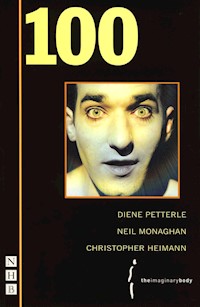
A strikingly original play combining traditional storytelling with physical theatre, created by The Imaginary Body. Imagine that you must choose one single memory from your life. Imagine that choosing this memory is your only way of passing through to eternity. Imagine that you have just one hour to choose... 100 was first performed at the 2002 Edinburgh Festival Fringe, where it won a Fringe First Award. It subsequently went on an extensive international tour, including a sell-out run at the Soho Theatre, London. 'Armed with only five bamboo sticks, the actors created a visual piece of theatre that captured the imagination of every spectator... They all left the theatre thinking about what their 'one memory' would be' Joyce McMillan
Sie lesen das E-Book in den Legimi-Apps auf:
Seitenzahl: 59
Veröffentlichungsjahr: 2015
Das E-Book (TTS) können Sie hören im Abo „Legimi Premium” in Legimi-Apps auf:
Ähnliche









Christopher Heimann, Neil Monaghanand Diene Petterle
100
NICK HERN BOOKS
London
www.nickhernbooks.co.uk
Contents
Title Page
Original Production
Thanks
Introduction
Characters
100
About the Authors
Copyright and Performing Rights Information
100 was originally produced by theimaginarybody and received its world premiere at the Smirnoff Underbelly on 1 August 2002 during the Edinburgh Festival Fringe. The cast was as follows:
ALEX
Matt Boatright-Simon
KETU
Matthieu Leloup
SOPHIE
Tanya Munday
NIA
Claire Porter
GUIDE
Claire Porter
Devised by
The Company
Director and co-writer
Christopher Heimann
Producer and co-writer
Diene Petterle
Co-writer
Neil Monaghan
Set Designer
Soutra Gilmour
Lighting Designer
Adam Crosthwaite
Costume Designer
Annemarie Woods
Movement Work
Matthieu Leloup
Associate Producer
Steve King
Associate Producer
Hannele Brown
Our collaborators along the way
Ruth Baldwin, Anil Desai, Alma Fridell, Maggie O’Brien,William Rowsey, Gal Sapir, Christina Thanasoula
Thanks to
Sue Emmas and everyone at the Young Vic TheatreMehmet Ergen and everyone at the Arcola TheatreRichard Lee and everyone at the Jerwood SpaceRebecca Salt at Colman Getty PR
Special thanks to
Markolf Heimann, Christine Heimann-Bossert,Diethard Heimann, Hedwig Bossert, Reinhard Bestgen,Ruy Petterle, Hans and Carolyn Kohl, Manuela Maiguashca,Zoe Hassid, Susanna Bauer and Zia Trench
Introduction
Our journey – an unusual process
The work on 100 started with an email from the Arcola theatre in London, in July 2001. It offered Diene and me the opportunity to put on a play as part of the theatre’s Short Cuts season of short plays – the only condition was that the piece had to be ready exactly one month later.
Instead of looking for a play, we felt we were more interested in creating a play based on certain themes we felt strongly about. As we sat down and brainstormed, a number of starting points appeared:
One was the question of what may be essential in life. We wondered what it would be like to stop, step out, look at our lives and reconsider our choices. We had often felt that we, as most Londoners, were running around and missing some kind of balance in our everyday lives. How would we be living our lives if we had a clear sense of what was essential, what was really important to us?
The theme of death and dying had been of interest to both of us, for different reasons. And it also seemed to follow on naturally from the previous point: isn’t death the ultimate ‘stop’? One often hears stories of how ‘near-death experiences’ make people completely re-evaluate their lives and often make changes for the better. Why do we need to almost die to ask ourselves these questions? And can’t the idea of Judgment Day or Purgatory be understood in a similar way, as an instance that poses the very same questions?
Another starting point was our shared love for the literary style of Magical Realism and the work of Gabriel Garcia Marquez in particular. We were inspired by the way in which reality and fantasy blend seamlessly in his novels. We also knew that while dealing with serious issues, we really wanted to bring a magical sense of wonder, lightness and fun into our piece. In fact, some of the memories in the play have been inspired by Marquez’ novel One Hundred Years Of Solitude.
Out of these starting points we created the premise and narrative structure for 100, and outlines of characters and character journeys.
What followed was a period of ten intense days in a rehearsal room, improvising with a group of actors. All the collaborators contributed immensely.
At the end of these ten days, and exactly one month after the initial email, we presented 100 at the Arcola theatre as a work-in-progress piece on three evenings. We felt we had found the core of something that was very special and dear to us. The audience response was very strong and positive, too. We decided to develop 100 and take it to the Edinburgh Festival.
While the heart of the piece was already well developed at this infancy stage, we were very much aware that we needed to fundamentally rework the piece. We felt that while the devising process was very creative, we weren’t sure it would lead us to the quality of dialogue and clarity of shape we were looking for, especially given the limited amount of time we were able to have with actors in the rehearsal room.
Diene and I were also aware that we were not the right people to do this work alone, as we are both not native English speakers. So we began to look for a scriptwriter to collaborate with. This turned out to be a lot more difficult than expected. Over the following months we searched, while we also went through another period of script development and improvisations with a group of actors at the Young Vic theatre in London.
Finally – and with the help of the internet – our path and Neil’s met. Together, we tried to go back to the essence of the piece. Over the following months in the run up to the Edinburgh Festival, Neil wrote several drafts from scratch. These drafts went back and forth between him, Diene and myself, being constantly reworked and developed. Our collaboration was getting more and more fruitful and it soon became clear that we had become a new creative team, a team of three. We were complete.
On the first day of rehearsal, four weeks before the Edinburgh Festival, it became apparent that our script wasn’t ready enough to be the basis of the rehearsal process. The script at this point reflected a very fertile ground with intriguing possibilities but it was far from a finished product. We decided to go back to creating a very detailed precise narrative outline of the play. Based on this outline we started a parallel process of improvising in the rehearsal room while writing the play simultaneously, with both processes feeding off and into each other. Our new company of actors were seasoned improvisers and their creative juices were just what 100 needed to fulfil its potential. Their flexibility, generosity and calm support kept the boat afloat. Matthieu Leloup ran daily sessions of movement work, creating a great sense of ensemble and alertness in the company, which informed the improvisation process. Having been involved with 100 since the very beginning, his contribution inside and outside the rehearsal room was a defining influence to the piece.
It was in this period that our unusual writers’ collaboration became most intense and probably most creative. It felt like all three of us were constantly pushing each other further and surprising each other. At some point we even had the ocean as an obstacle, as Neil went on a holiday he’d planned long before 100




