


4,49 €
Mehr erfahren.
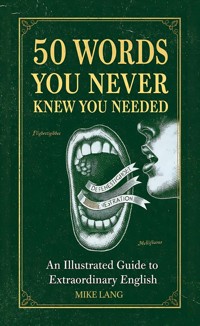
Do you know the word for the sound your stomach makes in a silent room?
The word for throwing someone out of a window?
The word for a voice that flows like honey?
You're about to.
English hides extraordinary words in plain sight — words precise enough to name what you thought was nameless, sharp enough to win any argument in a single syllable, and delightful enough to make you wonder how you ever managed without them.
50 Words You Never Knew You Needed gives you fifty of the rarest, most remarkable words in the English language — each one fully illustrated and explained so you can understand it, remember it, and actually use it.
Each word comes complete with:
- A clear, concise definition with an immediate example
- A simple phonetic pronunciation — say it right from day one
- Varied example sentences showing the - word in real context
- Synonyms and antonyms to anchor it in your existing vocabulary
- A full illustration that makes the meaning immediately unforgettable
- A fascinating etymology — know where the word
came from and you'll never forget it.
Inside, you'll discover words like:
- DEFENESTRATION — the act of throwing someone out of a window (yes, this needed its own word)
- MELLIFLUOUS — a voice so smooth it flows like honey
- BORBORYGMUS — that embarrassing stomach rumble in a silent room
- HIRAETH — the aching longing for a home you can never return to
- TERGIVERSATE — to change sides so often no one knows where you stand
- SLUBBERDEGULLION — a slovenly, worthless wretch (the most satisfying insult in English)
This book is for you if:
- You love language and want to go deeper than everyday vocabulary
- You're a writer searching for the exact word, not the approximate one
- You're a student building an advanced, impressive English vocabulary
- You want the perfect gift for a word lover, book lover, or language nerd
- You're simply curious about the hidden richness of the English language
From ABSQUATULATE to ZEUGMA — fifty words that will sharpen your thinking, elevate your writing, and permanently expand the way you see the world.
"The limits of my language mean the limits of my world." — Ludwig Wittgenstein
Your world is about to get considerably larger.
Das E-Book können Sie in Legimi-Apps oder einer beliebigen App lesen, die das folgende Format unterstützen:
Veröffentlichungsjahr: 2026
Ähnliche














50 Words You Never Knew You Needed
An Illustrated Guide to Extraordinary English
Table of contents
INTRODUCTION
1 – AUGEND
2 – Buphagus
3 - CATAPLEXY
4 - DEFENESTRATION
5 - EGREGIOUS
6 – FLIBBERTIGIBBET
7 - GOBBLEDYGOOK
8 - HULLABALOO
9 - INEFFABLE
10 - JETTISON
11 - KERFUFFLE
12 - LOLLYGAG
13 - MELLIFLUOUS
14 – NINCOMPOOP
15 - OBSTREPEROUS
16 – PERSIFLAGE
17 – QUIXOTIC
18 – RAPACIOUS
19 – SESQUIPEDALIAN
20 – TATTERDEMALION
21 – ULULATION
22 – VELLICHOR
23 - WIDDERSHINS
24 – XENIAL
25 – YOBBERY
26 – ZEUGMA
27 – ABSQUATULATE
28 – BORBORYGMUS
29 – CALLIPYGIAN
30 – DISCOMBOBULATE
31 – ANFRACTUOUS
32 – BLATHERSKITE
33 – CACHINNATE
34 – DEASIL
35 – EPOPEE
36 – FROWSTY
37 – GRIFFONAGE
38 – HIRAETH
39 – INANILOQUENT
40 – JUGULATE
41 – KENSPECKLE
42 – LIMINAL
43 – MUMPSIMUS
44 – NOCTIVAGANT
45 – OXTER
46 – PAUCILOQUENT
47 – QUERIMONIOUS
48 – RECUMBENTIBUS
49 – SLUBBERDEGULLION
50 – TERGIVERSATE
landmarks
Title page
Cover
Table of contents
Book start
INTRODUCTION
Why These Words?
Every language hides treasures that everyday conversation never reaches.
English is no exception. Beneath the surface of the words we use daily lies an extraordinary vocabulary — words precise enough to name feelings we thought were nameless, words sharp enough to skewer a fool in a single syllable, words so perfectly constructed that knowing them feels like gaining a new sense entirely.
This book is your guided expedition into that territory.
What You Will Find Here
Fifty special words explained and illustrated. Not the fifty most useful, nor the fifty most impressive — but fifty of the most remarkable: words that reward curiosity, that carry history in their syllables, and that, once learned, will change the way you see the world around you.
You will find words that describe the inexpressible — ineffable, hiraeth — feelings that existed long before you had a name for them. You will find words that arm you with precision - tergiversate, recumbentibus — the vocabulary of someone who thinks sharply and speaks deliberately. And you will find words that are simply, gloriously, unapologetically delightful to say aloud like these ones: flibbertigibbet, slubberdegullion,.
Each entry gives you everything you need:
A clear definition with an immediate example
A simple phonetic pronunciation so you can say it with confidence
Three varied example sentences so you understand it in context
Synonyms and antonyms to anchor the word in your existing vocabulary
A visual illustration to make the meaning immediate and unforgettable
The word's etymology — because knowing where a word came from is the surest way to never forget what it means
Who This Book Is For
This book is for the curious. For the reader who pauses at an unfamiliar word not with frustration, but with excitement. For the writer who knows that the right word — the precise word — is always better than three approximate ones. For the student who wants to move beyond the ordinary. For anyone who has ever felt that English, used well, is one of the most expressive instruments in the world.
It is equally a book for those who simply enjoy language for its own sake — who find pleasure in the fact that there is a word (borborygmus) for the sound a stomach makes, a word (deasil) for walking clockwise, and a word (kenspeckle) for the person at a party you cannot possibly miss.
How to Use This Book
There is no correct way to read these pages. Some readers will move through the words sequentially, building a mental library entry by entry. Others will open to a random page when they need a moment of linguistic discovery. Still others will use this book as a reference — returning to a specific word when the right moment to use it finally arrives.
A Final Thought
The English writer Anatole France once observed: "Do not try to satisfy your vanity by teaching a great many things. Awaken people's curiosity. It is enough to open minds; do not overload them."
This book does not seek to overload. It seeks to open — fifty small doors into a language far larger and stranger and more wonderful than most of its daily users ever suspect.
Turn the page. Choose a word. Say it aloud.
The rest will follow.
— Mike Lang
2 – Buphagus
BUPHAGUS
Definition: A genus of African birds, commonly known as oxpeckers, that feed on ticks and parasites found on large mammals. For example, "A buphagus perched on the buffalo's back, picking at insects."
Pronunciation: [byoo-FAY-gus]
Examples: The buphagus provides a valuable pest-control service to rhinos and zebras. Researchers study the buphagus to understand symbiotic relationships in African ecosystems. Spotting a buphagus on a giraffe's neck is a common sight on the savanna.
Synonyms and Antonyms: Synonyms: oxpecker, tickbird, symbiont, parasite-picker, avian cleaner Antonyms: parasite, pest, predator, harmful organism
Etymology: BUPHAGUS comes from the Greek bous (ox) and phagein (to eat), meaning "ox-eater."




