


91,99 €
Mehr erfahren.
- Herausgeber: John Wiley & Sons
- Kategorie: Wissenschaft und neue Technologien
- Sprache: Englisch
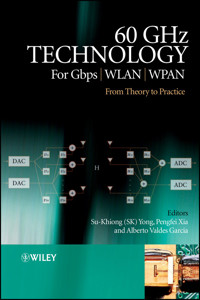
This book addresses 60 GHz technology for Gbps WLAN and WPAN from theory to practice, covering key aspects for successful deployment. In this book, the authors focus specifically on 60 GHz wireless technology which has emerged as the most promising candidate for multi-gigabit wireless indoor communication systems. 60 GHz technology offers various advantages over current or existing communications systems (e.g. huge unlicensed bandwidth worldwide, high transmit power, high frequency reuse and small form factor), which enables many disruptive applications that are otherwise difficult if not impossible to be realized at lower frequencies. The book addresses all aspects of the state-of-the-art in 60 GHz technology for high data rate wireless applications. Key Features: * Comprehensive coverage from theory to practice: provides readers with a thorough technical guide of 60 GHz technology development * Brings together the entire area of 60GHz technology for Gigabits per second (Gbps) WLAN and WPAN applications. * Discusses practical system designs covering wide aspects such as antenna propagation, beamforming, circuit design, digital communication, signal processing, system architectures, etc. * Provides up-to-date standardization activities, regulatory issues, technology development as well as future trends * Includes examples and case studies for practical scenarios * Contains theoretical, simulation and experimental results to demonstrate and compare the performance of various schemes (or systems) This book serves as an excellent reference for system engineers, system architects, IC designers, standard engineers, researchers, and vendor and manufacturer consumers. Technical consultants, software and application developers will also find this book of interest.
Sie lesen das E-Book in den Legimi-Apps auf:
Seitenzahl: 383
Veröffentlichungsjahr: 2011
Ähnliche


















Content
Preface
List of Contributors
1 Introduction to 60 GHz1
1.1 What is 60 GHz?
1.2 Comparison with other Unlicensed Systems
1.3 Potential Applications
1.4 Worldwide Regulation and Frequency Allocation
1.5 Industry Standardization Effort
1.6 Summary
2 60 GHz Channel Characterizations and Modeling1,2
2.1 Introduction to Wireless Channel Modeling
2.2 Modeling Approach and Classification of Channel Model
2.3 Channel Characterization
2.4 Industry Standard Channel Models
2.5 Summary
3 Non-Ideal Radio Frequency Front-End Models in 60 GHz Systems
3.1 RF Front-End Architecture
3.2 Nonlinear Power Amplifier
3.3 Phase Noise from Oscillators
3.4 Other RF Non-Idealities
4 Antenna Array Beamforming in 60 GHz
4.1 Introduction
4.2 60 GHz Channel Characteristics
4.3 Antenna Array Beamforming
4.4 Summary
5 Baseband Modulation
5.1 Introduction
5.2 OFDM Baseband Modulation
5.3 Case Study: IEEE 802.15.3c Audio Video OFDM
5.4 SC with Frequency-Domain Equalization
5.5 SC Transceiver Design and System Aspects
5.6 Digital Baseband Processing
6 60 GHz Radio Implementation in Silicon
6.1 Introduction
6.2 Overview of Semiconductor Technologies for 60 GHz Radios
6.3 60 GHz Front-End Components
6.4 Frequency Synthesis and Radio Architectures
6.5 Radio–Baseband Interface
7 Hardware Implementation for Single Carrier Systems
7.1 Introduction
7.2 Advantages and Challenges of SC Systems
7.3 System Design with Non-Coherent Detection2
7.4 System Design with Differentially Coherent Detection3
7.5 Test and Evaluation4
7.6 Advanced SC System with Per-Packet Coherent Detection
7.7 Conclusion
8 Gbps OFDM Baseband Design and Implementation for 60 GHz Wireless LAN Applications
8.1 OFDM Physical Layer Implemented on FPGA
8.2 OFDM Baseband Receiver Architecture
8.3 OFDM Baseband Transmitter Architecture
8.4 60 GHz Link Demonstration
8.5 Next-Generation OFDM Demonstrators for 60 GHz Wireless LAN Applications
9 Medium Access Control Design
9.1 Design Issues in the Use of Directional Antennas
9.2 IEEE 802.15.3c MAC for 60 GHz
9.3 Design Considerations for Supporting Uncompressed Video
9.4 Performance Study
9.5 Conclusions and Future Directions
10 Remaining Challenges and Future Directions
Index
This edition first published 2011
© 2011 John Wiley & Sons Ltd.
Registered office
John Wiley & Sons Ltd, The Atrium, Southern Gate, Chichester, West Sussex, PO19 8SQ, United Kingdom
For details of our global editorial offices, for customer services and for information about how to apply for permission to reuse the copyright material in this book please see our website at www.wiley.com.
The right of the author to be identified as the author of this work has been asserted in accordance with the Copyright, Designs and Patents Act 1988.
All rights reserved. No part of this publication may be reproduced, stored in a retrieval system, or transmitted, in any form or by any means, electronic, mechanical, photocopying, recording or otherwise, except as permitted by the UK Copyright, Designs and Patents Act 1988, without the prior permission of the publisher.
Wiley also publishes its books in a variety of electronic formats. Some content that appears in print may not be available in electronic books.
Designations used by companies to distinguish their products are often claimed as trademarks. All brand names and product names used in this book are trade names, service marks, trademarks or registered trademarks of their respective owners. The publisher is not associated with any product or vendor mentioned in this book. This publication is designed to provide accurate and authoritative information in regard to the subject matter covered. It is sold on the understanding that the publisher is not engaged in rendering professional services. If professional advice or other expert assistance is required, the services of a competent professional should be sought.
Library of Congress Cataloging-in-Publication Data
Yong, Su-Khiong.
60 GHz technology for Gbps WLAN and WPAN : from theory to practice / Su-Khiong Yong, Pengfei Xia, Alberto Valdes Garcia.
p. cm.
Includes bibliography and index.
ISBN 978-0-470-74770-4 (cloth)
1. Millimeter wave communication systems. 2. Wireless LANs. 3. Gigabit communications. 4. Wireless communication systems. I. Xia, Pengfei. II. Garcia, Alberto Valdes. III. Title.
TK5103.4835.Y66 2011
621.384–dc22
2010022098
To my wonderful family Chia-Chin, Jerrick and my parents
– Su-Khiong (SK) Yong
To Dad, Mom, Wenjun and Niuniu
– Pengfei Xia
To my daughter Cecilia who came into existence along with this book
– Alberto Valdes-Garcia
Preface
Since the first wireless transatlantic radio wave transmission (based on long wave) by Marconi from Cornwall, England, to Newfoundland, Canada, in 1901, wireless communications have undergone tremendous growth. Today, wireless communications systems have become an integral part of our daily life and continue to evolve in providing better quality and user experience.
One of the most important emerging wireless technologies in recent years is millimeter-wave (mm-wave) technology. Although it has been known for many decades, it is only over the past five or six years that advances in silicon process technologies and low-cost integration solutions have made mm-wave a relevant technology from a commercial perspective. As a result, this technology has attracted significant interest from academia, industry and standardization bodies. In this book, we specifically focus on 60 GHz wireless systems that enable several new applications that are not feasible at lower carrier frequencies.
60 GHz technology offers various advantages over current or existing communications systems. One of the most important is the availability of at least 5 GHz of continuous bandwidth worldwide. While this is comparable to the unlicensed bandwidth allocated for ultra-wideband (UWB) purposes, the 60 GHz bandwidth is continuous and less restricted in terms of power limits. In fact, the large bandwidth at 60 GHz band is one of the largest unlicensed bandwidths being allocated in history. This huge bandwidth represents great potential in terms of capacity and flexibility, making 60 GHz technology particularly attractive for gigabit wireless applications. The compact size of the 60 GHz radio also permits multiple-antenna solutions at the user terminal that are otherwise difficult if not impossible at lower frequencies. Compared to 5 GHz system, the form factor of mm-wave systems is approximately 140 times smaller and thus can be conveniently integrated into consumer electronic products.
Despite the various advantages offered, mm-wave based communications face a number of important challenges that must be solved. This book outlines the challenges, opportunities and current solutions at every layer of a 60 GHz system implementation. The outline of the book is as follows.
Chapter 1 presents an introduction to 60 GHz technology. It starts with direct comparisons between 60 GHz technology and other high data rate counterparts such as UWB and IEEE 802.1 1n technologies in terms of their transmit power, bandwidth and spectrum efficiency in delivering high data rate solutions. Several key applications that have proved challenging in the past become feasible with the Gbps data rate of 60 GHz. The worldwide regulatory and frequency allocation of the 60 GHz band is then introduced. Finally, intensive standardization efforts are discussed and a comparison of their physical layer features is provided.
Chapter 2 presents an overview of 60 GHz channel modeling, which forms the basis for reliable 60 GHz wireless communications system design. This chapter begins by highlighting the different modeling approaches available and setting out their advantages and disadvantages in generating a realistic 60 GHz channel model. Next, generic modeling frameworks for both large- and small-scale channel characterizations are thoroughly discussed. An extensive list of references with summary and comprehensive discussions on the reported results is provided. This chapter also discusses 60 GHz polarization modeling methodology for multi-polarized multiple-antenna systems. Finally, channel parameterizations for the proposed generic channel models are provided. In particular, the channel models used in IEEE 802.15.3c and IEEE 802.11.ad are discussed and their limitations also highlighted.
Chapter 3 describes radio frequency (RF) nonlinearities and their behavioral models which should be considered in the design of 60 GHz wireless communication systems. It starts with an overview of conventional RF analog front-end architectures and their applicability to 60 GHz systems. RF nonlinearities possibly given by these architectures are also presented, with emphasis on power amplifier nonlinearities. A brief review of power amplifier models is given, and their effect on system performance presented. Then, phase noises arising from a local oscillator are investigated, with primary emphasis on their modeling procedures. This chapter ends with a brief introduction to other RF nonlinearities that may also affect system performance.
Chapter 4 discusses antenna array beamforming as a technology enabling Gbps throughput over general 60 GHz non-line-of-sight (NLOS) channels. The 60 GHz channel is briefly analyzed, and transmit/receive beamforming is shown to be a necessary technique for the 60 GHz channel. For transmit/receive beamforming, an antenna training/tracking algorithm is crucial such that the NLOS blocking issue can be solved. Two different antenna training/tracking methods are presented. One is the iterative antenna training and tracking method for adaptive antenna arrays, and the other is the divide-and-conquer training and tracking method for switched antenna arrays.
Chapter 5 discusses baseband modulation in achieving Gbps throughput at 60 GHz. We focus particularly on orthogonal frequency division multiplexing (OFDM) and single carrier (SC) block transmission (SCBT) as two major candidates in enabling high spectral efficiency transmissions. In the first part, a brief introduction to OFDM communications is given, followed by general OFDM design considerations. The challenges of designing OFDM systems for 60 GHz systems are also emphasized. The first part then uses IEEE 802.15.3c audio video (AV) OFDM as a case study and discusses various issues in baseband designs, including uncompressed video communications, physical layer equal and unequal error protection schemes, bit interleaving and multiplexing schemes, and AV OFDM modulation. The second part is devoted to SCBT with frequency-domain equalization (SC-FDE), which provides very low to very high bit rates with excellent robustness. The second part starts with a rationale for using a SC at 60 GHz and then describes how this is specified in the IEEE802.15.3c standard. The chapter continues with system aspects such as transceiver design, effect of non-idealities and equalizer design. Then, a large section is devoted to describe the signal processing functions of the SC receiver, covering acquisition, joint estimation of channel, fine carrier frequency offset and I/Q imbalance parameters, equalization, tracking and decoding.
Chapter 6 presents the current solutions, techniques and tradeoffs involved in the implementation of a high data rate 60 GHz radio in silicon from the RF front-end to the mixed-signal (analog–digital) interface with a digital baseband integrated circuit. The discussion starts with an overview of the different silicon technologies available for the implementation of 60 GHz systems, analyzing their limitations and capabilities. Given that the link margin of a wireless system is strongly dependent on the receiver’s noise figure and the transmitter’s P1dB, the performance of currently existing 60 GHz low-noise amplifier and power amplifier solutions is reviewed in detail. Radio architectures for single- and multiple-antenna (phased array) systems are presented. Radio architectures are reviewed with emphasis on their feasibility and limitations for an integrated implementation. The current state of the art in high-speed digital-to-analog and analog-to-digital converters and modulators as important system components is analyzed in the context of their application to Gbps systems. The tradeoffs involved in a radio design for SC and OFDM modulations are discussed and implementation guidelines are provided. Finally, an outlook of the remaining challenges for the implementation of commercial 60 GHz radios is presented.
Chapter 7 covers SC hardware implementation. It starts with early-phase SC implementation examples with digital baseband, one with non-coherent detection and the other with differentially coherent detection. Then, we discuss how to implement more advanced SC systems that can comply with a certain standard, such as IEEE 802.15.3c. Readers will quickly realize that an appropriate 60GHz system demonstration requires more than just implementation work for a given standard, and algorithm-level research, in particular the receiver side, is playing a critical role in achieving robust end-to-end 60 GHz systems.
Chapter 8 presents design consideration and implementation issues for 60 GHz OFDM hardware demonstrators. After introducing the designed OFDM physical layer and frame architecture, we present baseband processor architectures and their implementation details for both OFDM transmitters and receivers. 60 GHz wireless link demonstrations with the developed OFDM demonstrator are also highlighted. Finally, the next-generation OFDM demonstrator we have designed for wireless LAN applications and its performance evaluation are briefly introduced.
Chapter 9 discusses MAC layer design for 60 GHz communications systems. The MAC layer plays a critical role in moderating access right to the shared wireless channel. In 60 GHz wireless networks, issues related to carrier sensing, deafness and device discovery which form the major medium access control challenges in the presence of directional transmission are first discussed. Then a number of techniques to improve the MAC layer performance such as a large packet size of the order of hundreds of kilobytes, data aggregation, block-ACK and automatic repeat request (ARQ), are presented. Then the chapter delves into 60 GHz MAC design considerations to support short-range uncompressed video streaming. Finally, a performance study is presented.
Chapter 10 presents further challenges and future direction for 60 GHz communication systems.
List of Contributors
André Bourdoux
Principal Scientist Wireless Research, SSET, IMEC Belgium
Chang-Soon Choi
Ph.D., IEEE Member, NTT DoCoMo communications Laboratories Europe GmbH Munich, Germany
Marcus Ehrig
Dipl.-Ing. IHP microelectronics GmbH, Frankfurt (oder), Germany
Eckhard Grass
Dr.-Ing. IHP Microelectronics GmbH Frankfurt (oder), Germany
Yasunao Katayama
Ph.D., Senior Technical Staff Member IBM Research – Tokyo Yamato Kanagawa, Japan
Maxim Piz
Dr.-Ing. IHP microelectronics GmbH Frankfurt (oder), Germany
Harkirat Singh
Ph.D., IEEE Member Staff Engineer Wireless Connectivity, Samsung Electronics San Jose, CA, USA
Alberto Valdes-Garcia
Ph.D., Communication and Computation Subsystems, IBM Research Yorktown Heights, NY, United States
Pengfei Xia
Ph.D., IEEE Senior Member Broadcom Corp. San Diego, CA, USA
Su-Khiong (SK) Yong
Ph.D., Marvell Semiconductor Inc. Santa Clara, CA, USA
1
Introduction to 60 GHz1
Su-Khiong (SK) Yong
1.1 What is 60 GHz?
Since the first wireless transatlantic radio wave transmission demonstration by Marconi from Cornwall, England, to Newfoundland, Canada, in 1901 (based on long wave), wireless communications have undergone tremendous growth. They were first used mainly by military and shipping companies and later quickly expanded into commercial use such as commercial broadcasting services (such as shortwave, AM and FM radio, terrestrial TV), cellular telephony, and global positioning service (GPS), wireless local area network (WLAN), and wireless personal area network (WPAN) technologies. Today, these wireless communications systems have become an integral part of daily life and continue to evolve in providing better quality and user experience. One of the recent emerging wireless technologies is millimeter-wave (mm-wave) technology. It is important to note that mm-wave technology has been known for many decades, but has mainly been deployed for military applications. Over the past 5–6 years, advances in process technologies and low cost integration solutions have made mm-wave a technology to watch and begun to attract a great deal of interest from academia, industry and standardization bodies. In very broad terms, mm-wave technology is concerned with that part of the electromagnetic spectrum between 30 and 300 GHz, corresponding to wavelengths from 10 mm to 1 mm [1], as shown in Figure 1.1. In this book, however, we will focus specifically on 60 GHz radio2 which enables many new applications that are difficult if not impossible to offer by wireless systems at lower frequencies, as discussed in Section 1.3.
Figure 1.1 Electromagnetic spectrum allocation.
1.2 Comparison with other Unlicensed Systems
60 GHz technology offers various advantages over current or existing communications systems [2]. One major reason for the recent interest in 60 GHz technology is the huge unlicensed bandwidth. As shown in , at least 5 GHz of continuous bandwidth is available in many countries worldwide. While this is comparable to the unlicensed bandwidth allocated for ultra-wideband (UWB) purposes [3], the 60 GHz bandwidth is continuous and less restricted in terms of power limits. This is due to the fact that UWB system is an overlay system and thus subject to very strict and different regulations [4]. The large bandwidth at 60 GHz is one of the largest unlicensed bandwidths ever to be allocated. This huge bandwidth represents great potential in terms of capacity and flexibility, making 60 GHz technology particularly attractive for gigabit wireless applications (see Section 1.3).
Lesen Sie weiter in der vollständigen Ausgabe!
Lesen Sie weiter in der vollständigen Ausgabe!
Lesen Sie weiter in der vollständigen Ausgabe!
Lesen Sie weiter in der vollständigen Ausgabe!
Lesen Sie weiter in der vollständigen Ausgabe!
Lesen Sie weiter in der vollständigen Ausgabe!
Lesen Sie weiter in der vollständigen Ausgabe!
Lesen Sie weiter in der vollständigen Ausgabe!
Lesen Sie weiter in der vollständigen Ausgabe!
Lesen Sie weiter in der vollständigen Ausgabe!




