


3,69 €
Mehr erfahren.
- Herausgeber: Thunderchild Publishing
- Kategorie: Gesellschafts- und Liebesromane
- Serie: 633 Squadron
- Sprache: Englisch
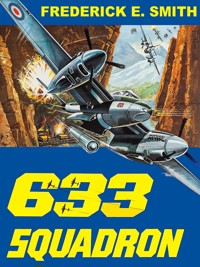
They called it Vesuvius
It was the mission on which D-day depended and it was given to 633 Squadron, the R.A.F.’s crack squadron at a time when every ounce of skill counted. They were top pilots who flew with the recklessness of a passionate hatred for the enemy.
But although they were fighting machines, they were also men. There was the Wing Commander, tough, cynical, careless of his life but not of his crews; Gillibrand, the big, brash flier who never knew when to stop; Bergman, the Norwegian resistance fighter whose bravery was remarkable even when acts of courage were an everyday event.
The planes roared down the runway on that cold spring morning. And the men who had lived together, trained together, played together, were off on a mission that could change the course of the war.
"YOU HAVE PERMISSION TO ABORT MISSION" The desperate message crackled over the R/T. A dangerous mission had become suicidal. But as their planes screamed over the black fjords of Norway, the men of 633 Squadron refused to turn back. Caught between attacking German aircraft and the grim mountain walls, they plunged straight on into a howling valley of death.
Adapted as a 1964 movie starring Cliff Robertson and George Chakiris, directed by Walter E. Grauman.
Das E-Book können Sie in Legimi-Apps oder einer beliebigen App lesen, die das folgende Format unterstützen:
Seitenzahl: 396
Veröffentlichungsjahr: 2024
Ähnliche















Table of Contents
633 SQUADRON
Copyright Information
Dedication & Acknowledgment
Chapter 1
Chapter 2
Chapter 3
Chapter 4
Chapter 5
Chapter 6
Chapter 7
Chapter 8
Chapter 9
Chapter 10
Chapter 11
Chapter 12
Chapter 13
Chapter 14
Chapter 15
Chapter 16
Chapter 17
Chapter 18
Chapter 19
Chapter 20
Chapter 21
Chapter 22
Chapter 23
Chapter 24
Chapter 25
Chapter 26
Chapter 27
Chapter 28
Chapter 29
Chapter 30
Chapter 31
633 SQUADRON
Copyright © 1956 by Frederick E. Smith.
Copyright Information
This is a work of fiction. All of the characters, organizations,and events portrayed in this novel are either products o the author’s imagination or are used fictitiously.
633 SQUADRON
Copyright © 1956 by Frederick E. Smith.
Published by arrangement with the Frederick E. Smith literary estate.
All rights reserved.
Edited by Dan Thompson
A Thunderchild eBook
Published by Thunderchild Publishing.
First American Edition: 1964
First Thunderchild eBook Edition: September 2017
Dedication & Acknowledgment
To DES and BOB
The other two “musketeers” of A Flight
With thanks to my good friends
in Norway for their assistance
Chapter 1
“I’ve always thought it one of the greatest stories of the war,” the young American said, his eyes shining. “The way those boys went in, knowing what was coming to them…. Gee, what great guys they must have been!”
The innkeeper’s eyes were growing reminiscent. “They were,” he said. “Great guys.”
“And every operation connected with the Black Fjord was carried out from here?”
“Yes; Sutton Craddock was made their base. They arrived in January ’43, and began training for the job shortly afterwards.”
“So you’d meet the rest of the squadron—Gillibrand, Barrett, Bergman…all of them as well as Grenville himself?”
“Yes. I knew them all.”
The American shook his head in envy. “Grenville has been my hero since I was a kid at school. I never thought that one day I’d be standing in the pub where he and his boys used to drink their beer.”
His eyes wandered round the lounge. Like the rest of the Black Swan it was of great age, with panelled walls and a timbered ceiling blackened by the smoke of centuries. Polished brass ornaments were everywhere, some shining golden in the soft tights from the shaded lamps, others winking back the firelight from the stone hearth. The counter against which the American and his friend were leaning was a massive structure, scarred and weathered, and at one end of it a large bowl of daffodils glowed with startling brightness against the pitch-black wood. Behind it a huge stand of oak shelves obstructed the view into the bar which lay beyond.
But the outstanding feature of the room was its photographs. These were hanging in double tiers round its panelled walls. There were pictures of aircraft: of a Boston, of a crashed Messerschmitt 110, of a graceful twin-engined plane with R.A.F. markings and cannon protruding from its sleek nose: there were photographs of airmen, some in flying-kit, others in uniform, nearly all young and nearly all smiling. Among them, seeming incongruous in their company, was the portrait of a tall, fair-headed naval lieutenant. In its way the room was a hall of fame: the innkeeper’s tribute to courage, to the men he had known and loved.
The American drew in a deep breath and turned back eagerly. “Tell us something about ’em, Pop. Tell us all you know about the Black Fjord job.”
“Haven’t you read the war histories?” the innkeeper asked.
The American’s voice was contemptuous. “Of course, but you know what they are. They’re so cold-blooded they give you the creeps. Folks want to hear the real stuff—how those boys felt during their training, the girls they had, what they let out when they were drunk, how they felt on the last day…. The human stuff! One day some guy’s going to put it all down, and what a story it’s going to be.”
There was an odd light in the innkeeper’s eyes now. “You mean a biography that tells the stories behind the story.”
“That’s just what I mean, Pop. And you must know a few of ’em yourself—a pub’s a great place for hearing things. How about telling them to us?” The American motioned towards his companion, a young English pilot officer alongside him. “Me and Danny here are pretty soft on 633 Squadron. We heard about your place a few weeks back and made up our minds to do a trip up here the first chance we got. We thought if we came across soon after opening time you might be able to spare us a few minutes. We’re due back tomorrow, so don’t let us down.”
The innkeeper, heavy of build and short-sighted, looked at each eager face in turn. Both men were young, no more than twenty-two or three. The American, who had introduced himself as Malcolm Daly, was slimly built with dark hair and humorous yet thoughtful eyes. He was wearing the uniform of the U.S.A.A.F. His friend in the R.A.F., Danny Johnson, was more stocky of build with sandy hair and a square, pleasant face. Both were still young enough to feel hero-worship, and the atmosphere of the room had brought its glow into their eyes. The innkeeper glanced at the clock, then nodded.
“All right,” he said. “I was going to look after the bar until eight, when a friend who’s staying with me is due back from Highgate. But I’ll ask my girl to take over. She won’t mind—we never do much business on a Monday, particularly in the lounge. Take your beers over to a table while I go and ask her.”
The two pilots went over to a table by the fire. Two minutes later the innkeeper returned. He had a thick folder and a photograph album under his arm. He put them down on the table in front of the two men.
“There you are,” he said to Daly. “There’s your biography. And here are some more photographs.”
Daly stared at him. “Biography!”
The innkeeper smiled. “Yes. I’ve already done what you said—written a biography of 633 Squadron’s operation in the Black Fjord, or the Svartfjord as it’s called in Norway.”
The American was dumbfounded for a moment. He picked up the folder and stared at it. The English boy was the first to speak.
“Are you going to go through it with us?” he asked eagerly.
The innkeeper settled his heavy body into a chair beside them. “Yes; I’ve arranged it with Ivy. She’s going to finish her tea in the bar and take care of both rooms. She’ll manage all right—as I said, we get very few in on Monday night.”
The eager mood of the two airmen had infected the innkeeper, and he was now as keen to talk as they were to listen. He opened the album and pointed to a photograph of two shell-torn aircraft. “That’s how two of the planes looked after getting back from Bergen. They flew four hundred miles like that….”
At that moment a car engine sounded on the drive outside. It revved up once as if in protest, then died sullenly away. After an appreciable pause a man entered the lounge. The innkeeper half-turned, saw Ivy bustling through from the bar, and turned his attention back to the airmen.
The newcomer, wearing a trilby hat and an old, belted mackintosh, hesitated in the doorway. The atmosphere of the room seemed to daze him with its impact, and the sight of the three men at the table to add further irresolution to his movements. He was turning back to the door when he shook his head almost angrily and approached Ivy at the counter. After a further glance at the engrossed innkeeper, he ordered a beer in a low, unfriendly voice.
Ivy, blonde, over-ripe, inquisitive in a good-natured way, eyed him with interest. In his middle thirties, she’d say, and not at all bad-lookin’…. A commercial traveller was her guess, having drink to help him forget how badly things were going.… She watched him take his glass into the corner by the door, then shrugged and returned to the bar. The newcomer sat among the shadows, his head lowered, his eyes alternating between the photographs and the bespectacled innkeeper at the table.
The innkeeper closed the album and pushed it aside. The young American grinned. “That was just to whet our appetites, Pop, huh? Now for the story. I can’t wait—this place has got me….”
The innkeeper was suddenly aware himself how the atmosphere had grown. The past was very much alive tonight—an invisible force, tugging at the sutured veins of his memory and starting the living blood flowing again.
As he drew the folder towards him, he suddenly thought of the newcomer and peered back across the room. His short-sighted eyes detected the blurred, shadowy figure in the corner, and he wondered if he should invite him over. He finally decided against it: the war had not hit everyone alike. If he were interested he would surely come across without being asked. He would be able to hear what they were talking about clearly enough in the quiet room….
As he turned back to the airmen, the light reflections from the framed photographs, distorted through the lenses of his spectacles, surrounded the room with dozens of luminous shapes. His mind, conditioned by the atmosphere of the room, gave him an instant simile. Like ghosts, he thought—their ghosts, gathering in silent company around them. But why had they come tonight, and what was the strange eagerness among them…?
Both amused and irritated by his imagination, the innkeeper turned to the American. “You’re quite right about there being a great deal missed out of the war histories,” he said. “Much of the truth could not be told at the time. In fact, it has taken me all these years to get permission to write this biography. Apart from the intelligence work and the organization behind the raid, it also tells the inside story of 633 Squadron—why they were nearly wiped out over Bergen, and the real reason for Grenville’s attack on the building there. It might even explain why Gillibrand won himself a V.C.… Of course, no one can ever know the full workings of a man’s mind in a battle crisis, but at least the facts help one to make some shrewd guesses. I think you’ll find all those facts in here.”
There was respect as well as eagerness on the faces of his listeners now. “You’ve got all that in?” Daly muttered.
“Yes; this is the complete story of the operation. It starts with 633 taking up their new base on the airfield opposite, and ends among the Focke-Wulfs and flak in the Black Fjord.”
There was a hush in the room as the innkeeper opened the folder. The ghosts nudged one another and drew nearer….
And this, in somewhat greater detail, is the story they heard.
Chapter 2
633 Squadron took over its new airfield at Sutton Craddock on the 8th January, 1943. It was a bleak day with a spot of drizzle and a raw wind from the east. The deep, low humming of the aircraft grew louder until the windows of the Black Swan were rattling with the noise. A crow, perched high on the crab-apple tree in the front garden, took fright and fled down the road like a startled enemy bandit.
The first Boston appeared out of the cloud. It was piloted by Grenville, and he brought it low, studying the layout of the airfield. He caught sight of the lone inn on the road alongside the field and wondered what it was. A Cockney voice suddenly came over the intercom.
“Looks as if the natives are friendly, skipper. See that girl down there, waving to us? Now ain’t that nice…?”
That was Hopkinson, his observer. Hoppy had the eyesight of a sparrow-hawk. Grenville’s eyes, the only part of his face visible above his mask, crinkled in a brief smile as he wagged his wings in reply. Then Control came through again and once more his gaze became intent on the airfield. He completed a circuit, then came down to land. With flaps down and engines throttled back, the Boston swooped over the field and landed as gracefully as a ballerina. The rest of the squadron followed her down, scattering groups of sparrows like dry leaves in a wind.
The Black Swan across the way was an old country inn with thick, whitewashed walls and a grey slate roof. Behind its front garden was the private porch that gave access to the living quarters. Alongside it a gravel drive led to its two public rooms, the bar and the lounge, both of which were at the side of the inn.
On hearing the approaching engines, Maisie, the barmaid, had run to the door of the bar. She was a big, handsome girl with black hair, dark eyes, and bold features. She stood on the steps, waving a duster at each plane as it roared by. She was joined a few seconds later by the innkeeper, Joe Kearns. Kearns was a man in his middle fifties, bespectacled, stout of build, with thinning white hair and a pleasant, ruddy face. He stood peering up into the drizzle until the last plane had gone by.
It was a Bombay, full of administration and other ground-staff officers. Its black hulk passed right over them, the air whining through its struts and over its airfoils. Then it had landed, and the sky resolved itself into a formless ceiling again, devoid of shape or colour or noise.
Maisie’s eyes were still sparkling with excitement as she drew reluctantly back into the bar.
“They looked fine, didn’t they, coming in low like that? Did you see ’em waggling their wings—they saw me wavin’ to them.” There was satisfaction in her strong, throaty voice.
A smile pulled at the corner of Joe Kearns’ mouth. “Yes; they saw you all right.”
There was an archness in Maisie’s walk now as she stepped back to the bar. She flicked her duster reflectively over it.
“I wonder who they are. One of the guards we had last week said they were a crack squadron comin’ here for special duties. The corporal with him gave him a nasty look, so there might be somethin’ in it.”
“We’ll probably get to know soon enough,” Kearns said, closing the door to keep out the drizzle.
Maisie’s eyes turned dreamy. “Gee; just suppose they’ve got some of those aces among them, like those you read about in the papers! Wouldn’t that be wonderful?” She looked eagerly at Kearns. “D’you think any of ’em will come over tonight?”
Kearns shook his head. “I don’t know, lass. They’ll have their own messes, don’t forget. But we’re bound to get some over eventually.”
One of them, although not one of Maisie’s aces, decided to go over that evening before dinner. He was Adams, the Station Intelligence Officer. Before leaving his billet he hastily checked his appearance in a mirror. The S.W.O. was a terror for smartness—there had been more than one case of senior officers being reported to the adjutant for untidy dress….
The mirror showed a man in his middle forties with short legs, a plump, round face, and spectacles. His service greatcoat added to his stoutness and the peaked cap made his face look owlish. Nothing could look less military and Adams turned away from the vision in distaste.
There had been no need to worry about his appearance, he thought, as he groped his way up to the camp entrance. The black-out was complete, he could have gone out in his shirt tails and no one would have known. Twice he wandered off the path into sticky mud, and once he stumbled heavily against a pile of stacked bricks. Nothing is more bleak or inhospitable than a newly laid airfield, and he breathed a sigh of relief when he passed by the sentry at the entrance and started down the road.
Adams was something of a complex character. He hated war, yet would have given his right arm or a leg to have been young and fit enough for flying duties. Temperamentally he was unsuited for Intelligence work because of the romantic streak in his nature which constantly rebelled at having to keep silent over the deeds of courage he heard almost daily. He was a keen observer, highly imaginative, self-critical to a fault, and utterly contemptuous of his role in the war, being quite certain that the crews he interrogated shared his contempt. His wife was a woman fifteen years younger than himself—another indication of his inherent romanticism—and it was because of her he was making his present call at the Black Swan.
He stood now in front of the black-out curtain of the lounge, staring round at the panelled walls with their glinting brass ornaments. Maisie, reading a thriller behind the counter, looked up and quickly preened herself. He wasn’t exactly the film-star type, but still he was a squadron-leader and Maisie decided he deserved one of her Sunday-afternoon smiles.
“Good evenin’, sir. What can I get you?”
Adams approached the counter. “Good evening. Is the landlord about? I’d like a word with him, please.”
“The landlord, sir! That’s Mr. Kearns. Half a mo’. I’ll give him a shout for you.”
With another bright smile, Maisie swung off to the side door, her skirt swirling invitingly about her legs.
“Joe,” she shouted. “There’s a gentleman from the aerodrome to see you. A squadron-leader.”
Kearns entered the bar, eyeing Adams curiously. “Good evening, sir. What can I do for you?”
“I’m looking for a place for my wife,” Adams told him. “I’ve just arrived today and one of the workmen said you had rooms here. What’s the position?”
Kearns shook his white head regretfully. “Sorry, sir; but I don’t let rooms any more. I’m a widower and can’t get the help to do the cookin’ and that sort of thing. Help’s hard to come by these days, you know.”
Adams looked disappointed. “If it’s only the cooking, I don’t think my wife would mind doing her own.”
“It isn’t only that, sir. There’s the washing and the cleaning-up….”
“Mrs. Billan would help you out there,” Maisie interrupted. “She said she’d give a hand if ever you were stuck.” The grateful look on Adams’ face encouraged Maisie to continue. “He’ll never get a room in Highgate—it’s full of evacuees. Go on—let him have one here. We’ll manage.”
Kearns shifted uncomfortably. He was a kind-hearted man who always found difficulty in refusing a request. Maisie, exploiting his weakness ruthlessly, went on: “It ain’t right to keep a Service man away from his wife, not when you’ve got empty rooms. It ain’t patriotic.”
She winked at Adams who felt his face redden. Kearns scratched his head. “You think your wife wouldn’t mind doing her own cooking, sir?”
“I’m sure she wouldn’t,” Adams said, who was not sure at all. Kearns was still undecided. “I hadn’t intended to let them,” he muttered.
“Go on—let him look at them,” Maisie said. “It’s the least you can do for someone who’s fightin’ for us.”
Adams felt himself flush again. Kearns gave way. “All right, sir. Seeing how things are, I’ll do it. You’d better come through and see what I’ve got.”
“That’s better,” Maisie said cheerfully, opening the flap of the counter to let Adams through. “It’s up to us all to do what we can for the Services.”
Somewhat hastily Adams followed the landlord. He came back ten minutes later, looking pleased. He went round the counter, then approached Maisie, who leaned forward.
“Well; are you all fixed up?” she asked.
“Thanks to you, yes. What will you have to drink?”
“You don’t have to buy me a drink for that.”
“I want to buy you a drink,” Adams said awkwardly. “What will you have?”
Maisie surrendered gracefully. “All right; if it’ll make you feel better. I’ll have a drop of gin—we managed to get a few bottles last week. Like a tot?”
“No; I’ll have a pint of bitter, please.”
Maisie poured the drinks, then leaned voluptuously against the counter. “Were you in one of the planes that passed over here this afternoon?”
Adams nodded. “Yes. I was in the Bombay, the big one that came in last.”
“Did you see me wavin’?”
“Yes. We all saw you. I waved back, as a matter of fact.”
Maisie was pleased and was going to say so when the blackout curtain parted and two airmen appeared. One was a thinly built L.A.C., an old sweat with a long, dismal face and a pointed nose. He was wearing a crumpled rag of a field service cap and a camouflaged ground-sheet as protection against the drizzle. His companion was a young A.C.2, very new-looking in his high-buttoned greatcoat. The strap of his gas-mask running down from somewhere alongside his neck, appeared to be half strangling him.
The A.C.2 was the first to notice the squadron-leader. He halted dead in his tracks like a rabbit seeing a stoat. The old sweat gave him a push.
“G’wan,” he hissed. “This isn’t Padgate. And it ain’t out of bounds to airmen. Watcha afraid of…?”
Then he saw Adams was looking at him and he made a vague up-and-down motion of his right hand. An enemy, wishing to discredit him, might have said it was a compromise salute.
“Evening, sir. Grim night, sir.”
“Good evening, McTyre,” Adams said, his blue eyes twinkling behind his spectacles.
With another surreptitious push McTyre sent the A.C.2 stumbling across the room to a table in the far corner. Muttering his contempt of fireballers who toady to authority, he pulled off his wet ground-sheet, revealing a uniform almost as greasy as his cap. His gas-mask, black with oil, was slung over his left shoulder in officer fashion, and the top button of his tunic was open, revealing a black shoe-lace of tie struggling to hold together the frayed remains of a service shirt. Adams eyed him in fascination, thinking what unholy joy his appearance would bring to the S.W.O.
Still muttering, the old sweat dropped into a chair. Beside him the erk sat stiffly upright, his young, round face emerging hot and flushed from his buttoned-up collar. His eyes were glued on Adams.
Maisie had all the snobbishness of her kind for other ranks. “Did they all come in today as well?”
“Some of them,” Adams said noncommittally. Seeing she was making no move to serve them, he threw a half-crown on the counter.
“Take them a couple of beers, will you?” he said casually. Maisie’s eyes opened wide. “My, is that the way you treat your blokes? Do you tuck ’em in bed as well?”
She filled two glasses and went over to the airmen. Adams drained his glass and picked up his gloves from the counter. “See you later,” he said as she came back. “And thank you again for your help.”
Maisie showed her disappointment. “Are you goin’ already? When’s your wife coming?”
“Monday, I hope. I’m phoning her tonight and will drop in tomorrow to let you know.”
Seeing the young A.C.2 was rising, obviously trying to pluck up the courage to thank him, Adams moved hastily to the blackout curtain. “Cheerio, and thank you again.”
“Cheerio,” Maisie sighed. She watched him go out, then turned to the two airmen. She gave a sarcastic laugh.
“No wonder you join the Air Force!”
McTyre scowled, picked up his beer, and slouched forward. “Don’t get any wrong ideas about us, kid. You know who we are?”
Maisie eyed him with both scorn and curiosity. “Haven’t a clue.”
“We’re 633 Squadron. That’s who we are.”
“Names and numbers mean nothing to me,” Maisie sniffed, inwardly impressed.
McTyre’s face assumed the expression old sweats always assume before erks and civilians: a mixture of cynicism, bitterness and contempt.
“You ain’t heard of 633? What’s the matter with you? Ain’t you English?”
“Don’t get fresh with me,” Maisie snapped.
The young A.C.2 wandered to the bar. His eyes had not yet recovered from his being treated to a beer by a squadron-leader. McTyre jerked a grimy thumb at him.
“Just posted to us. Don’t know the time yet.”
“I ain’t surprised, with that clock of yours floating around in front of him,” Maisie threw back. “What’ve you come to Sutton Craddock for, anyway?”
McTyre’s face took on a secretive expression. He leaned forward. “Special job, kid. Big stuff. Must be, or they wouldn’t have sent us.”
“You ain’t half got an opinion of yourself, haven’t you? What’s so wonderful about your squadron?”
McTyre’s voice held all the bitterness of the unsung hero. “If you read th’ papers, you’d know. I keep telling you—there ain’t a squadron in Blighty like ours.” He screwed up his long face for inspiration. It came—brilliantly. “We’re like…we’re like the Guards in the Army, kid. The best! Ain’t you heard of Grenville’s raids on Rotterdam? Or on Emden and Brest? What’s the matter with you…?”
Maisie’s eyes had suddenly rounded. “Did you say Grenville? Roy Grenville?”
“That’s right,” McTyre said, his expression triumphant now. “Roy Grenville. He’s our Squadron Commander. See what I mean now, kid?”
Chapter 3
Twelve hours later a small Norwegian fishing-boat drew alongside a jetty in a northern Scottish port. Except for a car, standing with dimmed lights, and two waiting men, the jetty was deserted. The boat’s diesel engine went silent as she drifted slowly in, the wind soughing through her riggings. The two waiting men seized her mooring ropes, and a few seconds later the boat was firmly anchored to the quayside.
The two men on the jetty hurried back to their car, one settling behind the wheel, the other taking his seat in the back. The engine started up impatiently. A few seconds passed, then a man wearing a dark-blue fisherman’s jersey leapt up from the boat and ran towards them. He was no sooner in the car than it pulled away, throwing him back into his seat. He felt his hand gripped tightly.
“Hello, my boy. How did it go this time?”
“Very well, sir.” The newcomer had a faint Norwegian accent.
“No trouble?”
“No, sir. Nothing.”
The darkness was giving way to the grey of the dawn, and both men could see the other’s features. The Norwegian was a man in his late twenties, tall and broad, with an open, pleasant face and a shock of yellow hair. His questioner was an elderly man of soldierly appearance with iron-grey hair and a trim moustache. The epaulettes on his khaki greatcoat showed him to be a Brigadier.
He had a clipped, controlled voice. “Any more luck?” he asked quietly.
“Yes. A little more, anyway.”
The Brigadier’s hand gripped the younger man’s arm. “Well done. We’ve had a bad week, wondering how things were going.” He paused, then went on: “How are you feeling after the trip? Would you like a rest before the interrogation? We’re all pretty keen to get started, of course, but I can arrange a rest if you need one.”
“No; I’m all right, sir. Where are we going now?”
“We’ve got a place in the country—it’s only fifteen minutes from here. Anyway, you can have a long rest tomorrow. In fact, you should have a fairly easy time for the next two or three weeks. This is what we have laid on for you….”
The Brigadier spoke for over ten minutes. “You’ll leave by train in two days’ time,” he finished. “When you get to Highgate, the Air Force will take you over. We’ve put an Air Commodore in the know, a chap called Davies, and he’ll take you to the squadron’s new base at Sutton Craddock. Once there, your job is to prevent curiosity. That could be a nuisance, so we’ve arranged for you to go as a naval lieutenant. The story will be circulated that you’ve been sent by the Admiralty as a liaison officer—to study Air Force procedure, and also to tip off the squadron about enemy naval movements and so on. Most bomber squadrons get one sooner or later, and we think it will cover you up nicely. Of course, you’ll get more detailed instructions before you go, but is everything clear so far?”
“Quite clear. What squadron is it, sir?”
The Brigadier’s voice expressed his satisfaction. “We’ve done well for you there, although Bomber Command didn’t let them go without a fight. We’ve got 633 Squadron—Roy Grenville’s boys. As you probably know they are one of Bomber Command’s crack squadrons.” His tone grew serious again. “They need to be, from what we hear.”
The Norwegian was looking puzzled. “But Grenville’s squadron uses Bostons, doesn’t it? Surely they cannot carry heavy enough bombs for this job? And you say Sutton Craddock is down in North Yorkshire. Shouldn’t they use a base in Scotland to cut down the range?”
Again the Brigadier lowered his voice. “Jerry might start getting suspicious if a new light bomber squadron moved up into Scotland. He’ll be wondering about 633, of course, but for the very reason you mention he won’t guess its purpose.”
The doubt was still in the Norwegian’s eyes. “But I still do not understand, sir. How can they do this job in Bostons?”
“They won’t have to,” the Brigadier told him. “There’s something very special coming along. Don’t worry—they’ll have the planes to get there.”
Back at Sutton Craddock that morning all the orderly disorder of a squadron on the move was at its height. An endless convoy of lorries was bringing in the stores. Thousands of gallons of high-octane fuel were being poured into the petrol dump; hundreds of tons of equipment was being stacked into the workshops, the hangars, and the Nissen huts. The bomb-store at the far end of the airfield was being filled with 2,000-lb A.P.’s, 1,000-lb and 500-lb M.G.’s, 250-lb incendiaries, fragmentation bombs, S.C.I.’s, 4-lb incendiaries, and dozens of different types of fuses and detonators. In the station armoury were being stored the spare Browning guns, the gun-sights, the belt-filling machines, the Mk. IX bomb-sights, the spare bomb-carriers, the bomb-pistols: all the hundred and one ancillaries that go with the weapons of a modern squadron.
In the workshops men toiled, heaved and swore. Mechanics complained about their tool kits, lost in transit. Sweating N.C.O.s dashed from officers to men and from men back to officers again. As fast as stores were removed, fresh piles took their places as the lorries rolled in. New postings from training units wandered rain-soaked and glassy-eyed through the chaos, too dazed to palpitate at the yells and curses from red-faced N.C.O.s.
Everywhere it was the same. The Orderly Room looked as if a bomb had burst slap in the middle of the floor. Requisition forms, leave passes, ration slips: all the bumph so dear to Sergeant Whitton’s heart was strewn in unbalanced heaps on desks, chairs and cupboards, and littered over the floor. Typewriters lay at odd, dejected angles, clearly without hope of being used again. Men moved like nightmare figures, moving paper from A to B, wincing as another pile thudded on A again.
Panics came thick and fast. The Station Equipment Officer found a packing-case of men’s underpants was incredibly filled with Bloomers Blue, Style 7, a grave mutation indeed. The Armament Officer found his harmonizing gear a shattered mess of twisted tubes and pulverized glass. The Maintenance Officer found that one of his bowsers had been routed to Scotland; and the Signals Officer found his dachshund pup, Hans, was missing. For safety Hans had been put in the care of three wireless mechanics who were bringing the Signals Van to the airfield. A pub had proved his downfall. While the three airmen were inside, having a hasty pint, Hans had spied a comely bitch pattering prettily down the pavement outside. With a yelp and a howl Hans had gone out of the window and hotfoot down the street after her. Result—Hans A.W.O.L., and sparks twittering round the Signal Officer’s lips.
But at last order began to emerge. The example was set by the Station Disciplinary Officer, W/O Bertram (known from the C.O. down to the lowest erk as Bert the Bastard). After allotting his hundreds of airmen their billets, he set about putting an end to this nonsense. Superbly indifferent to the chaos raging around him he lowered his massive frame down on a packing-case and made out his first duty roster. The sight of those D.R.O.s was salutary. The guard-room rallied and made its first kill—an A.C.1 wearing a pair of civilian shoes. The Maintenance Officer contacted his bowser heading for the Western Isles, and said a few succinct words to its driver. Hans was discovered by an M.P. howling outside a house of low repute and brought back a sadder and wiser pup. The Intelligence and Navigation Officers found their charts and maps and began getting their offices in order. The Squadron Office, the Flight Offices, the Messes, the Cook House, the Crew Rooms: all started receiving their equipment at last. The familiar yellow gas detectors began appearing in their usual places, at the entrance to the E.T. rooms and the latrines….
In short, 633 Squadron was rapidly becoming itself again.
Chapter 4
The station wagon drove into the gates of Sutton Craddock and halted. The M.P. on duty peered in, then stiffened to attention. A sergeant, already alerted, came out of the guard-house at the double, his boots clattering on the tarmac road. He skidded to a halt and saluted.
The driver, a pretty W.A.A.F. with a supercilious nose, leaned her forage cap and curls from the side window. “Station Headquarters—the C.O.’s office, please.”
The sergeant pointed along the road to a long, low brick building on the left. “Second door, Miss, and take the first corridor to the right….” Before he could finish the car shot away from him. He thought ponderously, then threw a discreet salute after it.
The Station Commander’s office that morning was not its usual self. The rooms on either side of it had been emptied for the occasion and a security guard posted in the corridor and on the road outside the window, both men with instructions to look as inconspicuous as possible.
Barrett, the Station C.O., was standing restlessly at the window. Barrett was a heavily built man of forty-two, with thinning hair, rather melancholy brown eyes, and a moustache large enough to earn him the nickname of Wally from his men. He was a South African by birth, his parents having settled in England during his early teens. He had joined the R.A.F. as a regular, and an apprenticeship at Halton had been followed by a pre-war tour in both India and the Middle East. Although not imaginative, he was efficient, conscientious, and popular with his men. His ribbons included the A.F.C., and the D.F.C., the latter medal having been won over Kiel in the early days of the war when he had collected a chest wound that had grounded him for a long time. Because of it he was still under orders to fly as little as possible—an order that irked him, for he was a very keen pilot.
As he stood at the window the distant roar of engines as a Boston was run up for testing came to him. Queer business, this posting, he reflected. Too much secrecy for his liking. Anyway, maybe something would come out of the bag today. He certainly hoped so.
The station wagon pulled up outside with a squeal of brakes. Barrett gave it one look, then strode quickly to the door, motioning the sentry towards him.
“They’re coming now,” he said gruffly. “Don’t let ’em see you’re on guard. But keep a close watch once they’re inside.”
He returned into his office and waited. A few seconds later he heard footsteps in the corridor, then a tap on the door.
Barrett knew the first of the two men who entered. It was Air Commodore Davies, an alert little man with a sharp, intelligent face and quick darting eyes. In certain moods he resembled a truculent cockerel. Temper or not, he was a man Barrett held in high esteem. He came forward now with characteristic quick strides, his hand outstretched. He had a sharp, somewhat high-pitched voice.
“Hello, Barrett. How’s everything going? Seeing daylight yet?”
“We’re nearly out of the wood, sir. We’re getting the kites air-tested today.”
“Good man. That’s fine. Now I want you to meet Lieutenant Bergman. Lieutenant Bergman: this is Wing Commander Barrett, 633 Squadron’s C.O.”
The Norwegian, tall and broad-shouldered in his naval uniform, stepped forward. Barrett took a look at his firm mouth and steady blue-grey eyes and decided he looked a good type. He held out his hand.
“Glad to meet you, Lieutenant.”
“I am very pleased to meet you, sir.”
Barrett noticed the foreign accent and wondered whether it had any connection with the conference to follow. He saw Davies looking at him.
“Where’s Grenville and your Intelligence Officer?”
“They’re both in the S.I.O.’s room, sir. I thought there might be something you wanted to tell me before they came in. I can get ’em here in half a minute.”
Davies shook his head. “No; I don’t think there’s anything. Give them a call, will you?”
As Barrett spoke into his desk telephone, Bergman moved to the window, watching the airman who was sauntering up and down with the utmost unconcern before it. He caught Barrett’s eye as the C.O. put the receiver down.
“One of your security men, sir?”
Barrett looked disappointed. “Why, yes, he is, as a matter of fact.” He went resentfully to the window. “I told the damn fool to look as inconspicuous as possible.”
Davies’s bright eyes twinkled. “I shouldn’t worry too much, Barrett. Lieutenant Bergman has a nose for them. He needs to have, in his job.”
There was a tap on the door. “Come in,” Barrett shouted. Bergman turned with him, watching with interest.
One of the men who entered was Adams, his eyes curious behind his spectacles at the sight of the naval officer. Bergman examined him, then turned his gaze on his companion. This one, he knew, would be Grenville.
Roy Grenville was twenty-six, slightly over medium height and compact of build. The force of his personality struck Bergman at once, that indefinable magnetism that makes a man a natural leader. Yet there was nothing about his appearance to conform with the popular conception of the ace pilot: he wore his uniform correctly and well. The same self-discipline showed in his expression and movements, indicating that here was a man who, after subjecting his mind and body to a hundred perils, had learned all their tricks, and now had both under rigid control. He looked an intelligent man who was applying all the power of his mind to the business of war with a ruthless disregard to its effects on himself. Below his pilot’s brevet was an impressive row of ribbons, including the D.S.O. and D.F.C.
Introductions were made and Bergman found himself shaking hands with Grenville. The pilot’s eyes stared into his own, assessing him, coldly speculative on his role in the conference.
Davies, who knew Grenville, exchanged a few warm words with him, then took his place behind Barrett’s desk. His quick, keen eyes flickered on each man in turn.
“The first thing I’m going to impress on you,” he began, “is the need for absolute secrecy in everything you’re going to hear. Not only Lieutenant Bergman’s life, but the lives of hundreds of others could be lost by careless talk. In fact,” and his voice was grim, “God knows just what isn’t at stake in this show, so keep your mouths buttoned right up.”
He threw a glance at Bergman, smiling now. “As you’re going to find out in a moment, the Lieutenant here isn’t quite all he seems. But as far as the rest of this squadron goes, he is a Norwegian Naval Officer who has come here to find out what makes the R.A.F. tick, and also to act as a liaison officer between you and naval affairs in northern waters. Most bomber squadrons get a naval officer sooner or later, and this is yours. Look after him and play up to him. That’s something you can let out of the bag.”
He stared briefly out of the window, then turned to them again, his voice lower now. “In actual fact Lieutenant Bergman is a liaison officer acting between the Norwegian Linge—that’s their resistance movement—and our own Special Services. He used to spend most of his time over in Norway, tipping us off by wireless about shipping movements and that sort of thing. Now, however, he has handed those duties over to one of his assistants because he has made a discovery too important to be mentioned over the radio, even in code. During the last few months he has been nipping backwards and forwards, sometimes by sea, sometimes by air, to find out what more he can do about it and also, of course, to keep his resistance men organized. Now it seems things have gone far enough for us to be called in to help.
“Now I can’t tell you what the job is going to be, because I don’t know myself yet. Frankly, I was only told this little bit three days ago and then, I suspect”—and he threw a wry smile at Bergman—“only because the powers-that-be decided it would look less suspicious if your squadron orders came through Group in the ordinary way instead of direct from Special Services. But this much I can tell you…
“You’re going to operate with these Norwegian patriots. You’re going to drop supplies to them when they need them, and you’re going to make any attacks Lieutenant Bergman thinks necessary. I hope he finds plenty necessary because then it’ll help to justify your existence to Bomber Command, who loaned you to Special Services with the greatest reluctance. They don’t know what is behind all this, either. But, according to Lieutenant Bergman and a certain gentleman I cannot name, you’re going to be given the biggest job you’ve ever tackled within the next few months, and you have to start training for it shortly. No, don’t ask me what it is—I haven’t a clue. All I’m told is that it’s immensely important and that you’ll need to be trained to perfection to carry it out. Now I’m going to let Lieutenant Bergman take over for a minute or two. He might enlighten you a little more—we’ll see. Lieutenant Bergman….”
All three men watched the fair-headed Norwegian intently as he rose to address them, and all felt disappointment when he gave a rueful shake of his head.
“I am very sorry, gentlemen, but the Air Commodore has covered everything that I am allowed to tell you at the moment. Of course, when training starts, you will have to be told more, but until then I have the strictest instructions to say nothing about this discovery. I can only assure you that its importance cannot be exaggerated.”
He sat down apologetically. Davies shrugged his shoulders. “Well; there it is—very hush-hush indeed. Your guesses are as good as mine.” He turned to Bergman. “All right, you can’t talk about the big job. But what about the preliminary stuff leading up to it? What about that convoy you were talking about that has a bearing on it?”
“I’m waiting for news of it now. It should come through in the next day or two.”
Davies gave his attention now to Barrett and Grenville. “From his contacts the Lieutenant has been tipped off that a fair-sized enemy convoy, anchored in a fjord to the north of Bergen, might be making a dash southwards in the next few days.
“There’s no hope of getting it at anchor, but it’ll be a different matter when it sails. It’s obviously a job for us because, apart from the time factor, it will be at the wrong side of the minefields for the Navy. That’s why I want you operational at the earliest opportunity; we must play safe…. Get your kites air-tested today and don’t let your men wander far away. Lieutenant Bergman will give you all the details once I’ve gone so you’ll be ready when the green light comes through. All right; any questions before I go?”
Grenville’s face was expressionless, but Barrett was shuffling restlessly in his chair. Davies’s keen eyes fixed on him.
“Any questions, Wing Commander?”
Barrett looked slightly uncomfortable. “I don’t quite follow how the machinery of this is going to work,” he said gruffly. “I don’t mean regarding the big job—we’ll hear about that later—I mean on the preliminary stuff—such as the dropping of supplies or this shipping strike. Does the Lieutenant give his orders to me, or do they come through from Group?”
A delicate diplomatic point. Bergman, in appearance at least, was of junior rank to Barrett. Davies made it clear the point had not been overlooked.
“Orders will come through from Group, from me,” he said without undue emphasis. “After I have given them, you can then approach the Lieutenant for the finer details. Sometimes—as in the case of this shipping strike—it may be necessary for him to attend the briefings. If so, I’ll tell you. When that happens the crews must think he is there on Admiralty orders. Quite clear?”
Apparently it was. Barrett’s moustache lost its temporary agitation as he sank back into his seat.
Adams spoke for the first time. “I take it arrangements will be made for a full range of photographs and maps to be sent me, sir?”
“You’ll be getting a cartload,” Davies told him. “They should be on their way now. Anything else?”
His eyes moved on to Grenville, but the Squadron Commander’s expression did not change. There was silence in the room, every man knowing the futility of asking the questions he had in mind. Davies nodded and picked up his gloves.
“Right; then I’m off. They haven’t finished with me back there—God knows what else they have brewing for us. Keep on your toes in the meantime; the green light for this shipping strike might come on at any time.”
He paused at the door, his quick, bright eyes flickering from man to man. “And mind you look after your new naval officer! From what I can gather he’s worth more than a division of men just now.”
Barrett saw him out to his station wagon. As it pulled away down the tarmac road, an airman, coming out of the nearby Orderly Room, let out a wolf cry on seeing the pretty W.A.A.F. driver, only to freeze into horrified silence as Davies glanced out of the window. His consternation increased when he noticed Barrett not twenty yards away.
Barrett scowled and returned to his office. He put a call through to his Maintenance Officer, then turned to Grenville. “Townsend says all the kites will be ready for air-testing by 15.00 except for M Mary. Some are ready now. You’d better go round and tip off your crews. No, wait…. Maybe we’d better first have a chat with Lieutenant Bergman about this strike, so we know what we’re in for. Then you can take him round with you and introduce him to the boys. Adams, I’ll want to see you again this afternoon. Say at 15.00 hours….”
Half an hour later Bergman accompanied Grenville to the Flight Offices. He felt a certain diffidence while walking along the tarmac with him: Grenville was taciturn and the Norwegian’s own training had done nothing to make idle talk come easily. As a result they walked most of the way in silence.




