


3,69 €
Mehr erfahren.
- Herausgeber: Thunderchild Publishing
- Kategorie: Gesellschafts- und Liebesromane
- Serie: 633 Squadron
- Sprache: Englisch
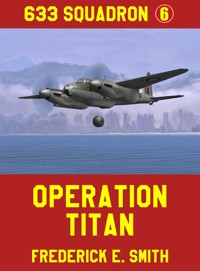
The immense Allied landing on the coast of France signals invasion to the enemy, and the mighty German panzer divisions begin a furious race northward to the beaches of Normandy. With the outcome of the war at stake, the daredevil pilots of Squadron 633 take on their most harrowing mission ever: Operation Titan. A 100-mile flight through occupied territory to destroy the crucial and massively guarded bridge across the Loire River.
Frederick E. Smith (1919-2012) joined the R.A.F. in 1939 as a wireless operator/air gunner and commenced service in early 1940, serving in Britain, Africa, and finally the Far East. At the end of the war, he married and worked for several years in South Africa before returning to England to fulfill his lifelong ambition to write. Two years later, his first play was produced and his first novel published. Since then, he wrote over forty novels, about eighty short stories, and two plays. Two novels, 633 Squadron and The Devil Doll, were made into films, and one, A Killing for the Hawks, won the Mark Twain Literary Award.
Das E-Book können Sie in Legimi-Apps oder einer beliebigen App lesen, die das folgende Format unterstützen:
Seitenzahl: 349
Veröffentlichungsjahr: 2024
Ähnliche















Table of Contents
OPERATION TITAN
Copyright Information
Dedication
Acknowledgments
Chapter 1
Chapter 2
Chapter 3
Chapter 4
Chapter 5
Chapter 6
Chapter 7
Chapter 8
Chapter 9
Chapter 10
Chapter 11
Chapter 12
Chapter 13
Chapter 14
Chapter 15
Chapter 16
Chapter 17
Chapter 18
Chapter 19
Chapter 20
Chapter 21
Chapter 22
Chapter 23
Chapter 24
Chapter 25
Chapter 26
Chapter 27
Chapter 28
Chapter 29
Chapter 30
Chapter 31
Chapter 32
Chapter 33
OPERATION TITAN
Frederick E. Smith
Copyright Information
This book is a work of fiction. Any references to historical events, real people, or real places are used fictitiously. Other names, characters, places, and events are products of the author’s imagination, and any resemblance to actual events or places or persons, living or dead, is entirely coincidental.
Copyright © 1982 by Frederick E. Smith.
Published by arrangement with the Frederick E. Smith literary estate.
All rights reserved.
Edited by Dan Thompson
A Thunderchild eBook
Published by Thunderchild Publishing.
First American Edition: 1982
First Thunderchild eBook Edition: February 2018
Dedication
To
John and Kay
Acknowledgments
The author wishes to give credit to the following sources:
Bekker, The Luftwaffe War Diaries (Macdonald);
Constable and Tolivier, Horrido! (MacMillan);
Adolf Galland, The First and the Last (Methuen and Co.);
Richards and Saunders, Royal Air Force 1939-1945 (H.M.S.O.);
Sir C. Webster and N. Frankland, The Strategic Air Offensive Against Germany 1939-1945 (H.M.S.O.).
Chapter 1
The Mosquitoes were peeling away and swooping down like kites in a high wind. Their target was a train of war supplies threading its way through a terrain of wooded hills. As the leading aircraft flattened out, two rockets speared from its wings and exploded in bright flashes alongside the track.
On the footplate of the train the fireman was urging on his driver. “Faster, man! Faster!” The driver, his unshaven face drenched in sweat, pushed his regulator to the limit of its quadrant. The locomotive’s great pistons pounded faster and its iron lungs gasped out steam like a living creature fighting for survival.
A flak wagon at the rear of the train was already in action. Two LMGs were firing at the second Mosquito which was flattening from its dive and a 37 mm pom-pom put its first burst of shells dead ahead of it. Startling its pilot at the very moment he released his two rockets, the missiles swerved off course and burst harmlessly among a clump of trees. As the cursing pilot swung away, the LMG gunners followed him and drilled a neat row of holes in the root of his starboard wing.
A second flak wagon, positioned in the middle of the train, began firing at the rest of the Mosquitoes circling above. As black puffs burst among them, an American voice let out a startled yell. “Goddam it, they’ve nearly shot my tail off.”
An English voice, laconic and relaxed, answered the pilot. “Have you still got control, Millburn?”
There was humour in the reply. “I’ll let you know before I crash, skipper. Yeah, I’m O.K.”
“Stay out of range until we’ve finished. Number 3, down you go.”
A third Mosquito peeled off and dived on the speeding train. All the gunners in the two flak wagons concentrated on it and a barrage of shells appeared in its path.
Recognizing the problem, the Squadron Commander changed his tactics. “Numbers 4 and 5 attack from opposite sides. Down you go!”
Obeying instantly, two Mosquitoes dived obliquely on both sides of the train, Number 5 slightly ahead to avoid collision. With the flak gunners forced to divide their firepower, the crews were less harassed and were able to take more careful aim. But with steep hills protecting its flanks, the target was not easy and only one wagon was hit. The second pilot’s yell of triumph turned into alarm as a shell struck his fuselage. Pulling out of his dive he tried to make height but a fuel tank suddenly exploded and the Mosquito cartwheeled into the hillside and burst into a hundred blazing fragments.
Someone muttered ‘poor old Vic’ over the R/T. That was all and yet the mood of 633 Squadron had perceptibly changed. Used to missions of high importance and high risk, they had tended to look upon trains as soft targets, particularly these days since the Luftwaffe appeared in strength only when a vital installation was threatened.
But it was never the German way to provide soft targets for anybody and the recent inclusion of flak wagons among their freight cars was a move to hit back. The pathetic pieces of burning wreckage below gave evidence it was an effective one.
Its very effectiveness, however, gave a sense of purpose to the Mosquito crews that had perhaps been lacking before. Vic Andrews and his navigator Charlie Warren had been popular colleagues, and in the illogical way men react when those they are attacking fight back, crews were now determined to avenge them. Ignoring the intimidating flak, Numbers 6 and 7 went after the speeding train like bull terriers after a felon.
They were just levelling out when the train crew, rounding a bend in the track, caught sight of the refuge for which they had been bursting the locomotive boilers. As the stoker yelled and pointed ahead, the driver slammed on his air brakes. With massive wheels screeching along the track and hurling out huge sparks, the entire assembly went sliding into a tunnel beneath a long hill ridge.
With their eyes fixed on the train, the Mosquito crews needed an urgent order from their Commander to alert them to their danger. Hauling back on their control columns, pilots saw the hills sweeping less than two hundred feet below them.
Inside the tunnel all was grinding metal and the thunder of steam as the train fought to stop before it broke out into the open again. Brilliant sparks lit up the black and grimy sides and the stench of steam and oil almost choked the occupants. Peering through the smoke, they saw the circle of light growing larger. Every man aboard let his breath out in relief as the locomotive halted less than twenty yards from the exit.
In the sky above there was less relief than frustration as the circling Mosquitoes waited in vain for the train to emerge. After a minute the Squadron Commander’s calm voice broke the silence. “That’s one that got away. Break it off and let’s go home.”
Reluctantly, and not a little vengefully, crews glanced back at the dark tunnel as they banked from their orbit and followed their leader northward.
The British crews were not returning to the island they had once known on that late April day in 1944. In many ways Britain now resembled a medieval walled city under siege. For over four years, protected only by its Royal Navy, its Air Force, and the strip of English Channel, the island had held out against the greatest army the world had ever seen while it had frantically mobilized its population and trained them in arms. Now its soldiers were waiting to sally forth in an attempt to break the enemy’s stranglehold. Success would mean the liberation of Europe and a new dawn for mankind. Failure would mean the return of the Dark Ages.
By this time, however, Britain was not alone. In company with men from Europe who had escaped the yoke of Nazism and had trained to become soldiers of liberation, American soldiers were now pouring into Britain in ever greater numbers. In January 1944 their number had been 750,000. By late April that number had swollen to 1,500,000 men. Side by side with the British and Canadians, the GIs were to storm the western wall of Hitler’s European fortress.
On a relatively small island, the problems of accommodating such vast armies were enormous. Areas the size of cities were needed for their billets, their training grounds, and for the staggering amount of equipment that came with them. A partial answer had been to allow the Americans to ‘occupy’ the counties of Cornwall, Devon, and parts of Dorset. The British and Canadian armies were based further along the south coast in the counties of Hampshire and Sussex.
But the problem of space was only the tip of the iceberg. To equip such great armies meant an even greater army of workmen. All over Britain foundries blazed and poured out rivers of steel. Aircraft came off production lines like automobiles. Ships of all shapes and sizes were made in shipyards, along roads, and even prefabricated outside tiny workshops. Thousands of factories and millions of workers produced everything from Bren gun carriers to bootlaces to make certain the armies lacked nothing when the Day of Destiny arrived.
In addition ports worked day and night to unload the queues of ships bringing in supplies for the American armies. Roads became choked with military traffic, making civilian movement almost impossible. Prohibited areas appeared everywhere, in forests, parks, farms, even in cities, as the enormous stockpile grew. The entire British populace was mobilized and at times the very island itself seemed to be groaning under the weight of its burden. There were men who feared the country might never be the same again after such a gigantic effort.
Yet all this sweat and sacrifice might be in vain if the enemy were to discover which part of the French coast would receive the Allied onslaught. To confuse him, the Allies had begun launching heavy ‘interdiction’ air raids in early 1944 on his transport and communication systems all over France and Belgium. The purpose was twofold: to leave the enemy uncertain where the invasion would take place and to hamper his response when he was no longer in doubt. Even though thousands of Allied fighters and ships patrolled the sky and sea lanes to drive off his probing aircraft and U-boats, it was manifestly impossible to conceal from him the massive build up of ships and troops on the centre and southwestern coast of Britain. So, highly subtle plans were already in motion to make him believe the concentration was a giant bluff and the real attack would come in the Pas de Calais area.
The invasion had originally been planned for May 1944 but a shortage of landing craft caused by the Italian campaign had compelled a month’s delay. It was a delay that caused some consternation among the planners because the seventh of June was the absolute deadline. With a maximum of five weeks to go and acutely aware of the consequences of a wrong decision, men were still arguing about moon tables, tides, and whether a daylight or a night assault was preferable. An unpredictable factor was the weather, for all knew it could be decisive on the day.
But men could only plan against factors remotely under their control and the one that was giving Eisenhower and his staff the greatest concern was the problem of German reserves. Until the artificial harbours the Allies were to drag across the Channel were secured in position, the only armour they would be able to land on the beaches would be amphibious and thin-skinned. Would the Germans succeed in rushing up their heavy panzer divisions before the beachheads were widened and the Allies were able to match force with force? If they did, D-Day might turn into a disaster of unparalleled magnitude.
Chapter 2
Adams made a note on the form, then glanced up. “Where was this, Ian?”
“About twenty miles from Saumur.” The young Wing Commander held out his hand. “These are the coordinates.”
Adams took the piece of paper. “And you think the train was carrying field artillery?”
“It looked that way. Everything was covered by tarpaulin, of course, but a couple of guns were blown off the wagon Machin hit. They ought to show on his cinéfilm.”
The bespectacled Intelligence Officer nodded. He was seated at a large desk at the far end of a Nissen hut that was full of maps, posters, filing cabinets and scale models of German aircraft. Nicknamed ‘The Confessional’ by the aircrews, it served both as Adams’ office and his debriefing centre. At the moment it was filled with young men in uniform sipping tea. Most were still wearing flying boots and a few were carrying their helmets and face masks. Like all intelligence officers, Frank Adams liked to catch the crews straight from a mission when their memories were still fresh.
Adams was in his mid-forties, a highly sensitive man who had never come to terms with his age or with the poor eyesight that had kept him out of aircrew. Blessed or cursed with a complex nature, he found war a monstrous obscenity while at the same time he envied these young fliers who brought hope to the enslaved people in Occupied Europe. Like a doctor too involved with his patients, Adams shared their joys and sorrows with an intensity that was physically ageing him. His shame at his safe job was never as acute as when he was discussing the death of young colleagues. His eyes were lowered as he asked the question that was almost routine at debriefings.
“Did you see Andrews hit, Ian?”
The Wing Commander nodded. “I think it was a 37 mm shell in a fuel tank. He hit the hillside and blew up. There weren’t any survivors.”
Adams winced. “And you say the train stayed in the tunnel?”
“It did until we left. I was surprised we caught it in the open at all. That’s why I think it must have been carrying an important consignment.”
In full agreement with the young officer’s reasoning, Adams nodded. “I think we can safely assume a field regiment is moving north. But I’d like to see your ciné and still films before I put in my report.”
The officer he was interrogating was Ian Moore, the Squadron Commander. Medium in height and build, Moore was a fresh-complexioned man with wavy, fair hair. Like the rest of his crews, he was not wearing flying clothes. The April evening was mild and the Mosquito was a warm aircraft. Unlike his men, however, who mainly used their oldest uniforms for operations, Moore’s uniform was beautifully tailored and pressed. His enemies—and they were few—would mutter that anyone with his wealthy background could afford the luxury, but they missed the point. Moore’s uniform was an expression of his personality, the signature of a man who believed in keeping the wrappings of a package securely tied so that the contents did not spill out and disintegrate.
In many ways Ian Moore was a rarity among fighting men. Gifted with both intelligence and imagination, he was also aware of the positive handicaps both attributes could be in the mad butchery of war. Accordingly both were treated with caution and kept under tight rein. No one would blame himself more than Moore if any of his men lost their lives through a failure of detail on his part. But if that loss, however painful, was caused by circumstances outside his control, something that had happened often during his time of command, the iron control Moore kept over his emotions enabled him to withstand the blows better than most.
At the same time, no man is indestructible. Ever since Teddy Young’s death a month ago for which, against all informed opinion, Moore blamed himself, there were some who believed they saw signs of strain in the young Squadron Commander.
The row of ribbons he wore beneath his RAF Wings included the DSO and Bar, the DFC and Bar, and the American Legion of Merit medal. In inclement weather he sometimes walked with a slight limp, the result of a serious leg wound received when giving cover to American troops during Operation Crucible the previous autumn. A puckered scar on his right cheek came from a flak shell that would have blown his face away had it burst a few inches closer.
The Squadron’s two Flight Commanders were standing immediately behind Moore. One of them, Frank Harvey, was showing impatience at Adams’ questions. Scowling, unable to contain himself any longer, he leaned forward. “If I were you, Ian, I’d give Greenwood a bollicking. If he’d let us carry a few 250-pounders we might have kicked that train up the arse even after it got into the tunnel.”
Greenwood was the station’s new armament officer, posted there after Lindsay’s death in the German air attack on Sutton Craddock during Operation Cobra. A somewhat officious little man, he had dismissed with some impatience Harvey’s pre-operational suggestion that light bombs should be carried.
The second Flight Commander, Tommy Millburn, gave a laugh of derision. “You kidding? You can’t slide bombs along railroad tracks. Where’ve you been all these years?”
Harvey turned. He was a tall, raw-boned officer whose faded tunic was frayed at the cuffs and shiny from hundreds of hours in the air. A product of the depressed northern towns, with a face as craggy as his native Yorkshire fells, his scowl was said to give shingles to young recruits. It was in evidence now as he stared at Millburn.
“You ever heard of skip bombing, Millburn? Or were you still at school in those days?”
Millburn’s eyes twinkled. At heart no one on the station had more respect for his fellow Flight Commander. Yet a puckish sense of humour would never let him miss an opportunity to provoke the prickly Yorkshireman.
An American, Millburn had been promoted to Flight Commander after the death of Teddy Young. To the station WAAFs he was God’s gift to women with his good looks, unruly dark hair, and his readiness to play the field. To his fellow fliers, all veterans of many missions, he was a highly skilful and reliable colleague, and if in the past he had suffered from an excess of daring, this imbalance was now being rectified by his new responsibilities.
“Skip bombing against ships, maybe. But you can’t skip ’em into railroad tunnels. They’d either bounce off the track or stick into the sleepers.”
The knowledge he was right did nothing to improve Harvey’s feelings over the loss of Andrews and Warren. “We still could have tried. Anything’s better than letting the bastards make fools of us.”
“What about that hill ridge over the tunnel?” Millburn asked. “If we’d gone arsing in any lower, we’d have pranged it for sure.”
Conscious that the crews at the far end of the hut were now listening, Harvey lowered his voice. “Speak for your own lot, Millburn. I’ll lay a quid or two my lads would have managed it.” He turned back to Moore. “We ought to try something new, Ian, particularly as Jerry’s now arming his trains. It’s bloody frustrating to let him play hide and seek with us like this.”
Adams’ eyes were on the young Squadron Commander’s face. Until only recently Moore’s patience and tact were a byword on the station and knowing it took crews time to unwind after a mission, he would have treated the arguments between the Flight Commanders with patience and humour. Now, detecting irritation in his expression, Adams intervened hastily.
“It’s true Jerry’s using the tunnels very cleverly these days. But without dropping these new ten-ton bombs on them, it’s difficult to see what else we can do.”
Moore, facing the scowling Harvey and the grinning Millburn, clearly had no intention of joining the argument.
“As we can’t carry ten-tonners, there’s not much point in you two niggling at one another, is there? Get your debriefing over and then make way for the men. If they’re anything like me, they’re ready for their dinner.”
Chapter 3
The small navigator with the Welsh accent pushed open the door of the billet and flung his helmet and face mask on his bed. “What the hell were you and Harvey arguing about in there? You forgotten the rest of us like to eat too?”
Millburn, newly changed into a fresh uniform, was checking his appearance in a cracked mirror that rested on the window ledge. He gave his disgruntled navigator a grin. “He thinks we ought to have flown right in after that train and stuck a bomb up its arse. I had to remind him it’s kinda hairy inside tunnels.”
The Welshman eyed him in disgust. “Is that what you were arguing about? Clobbering a train inside a hill?”
“That’s right. Harvey thinks we ought to try skip bombing.” For a moment Millburn’s grin faded. “Mind you, seeing Andrews and Warren were in his flight, I guess he’s got some cause to feel peeved.”
The navigator was in no mood to show sympathy. “I’ll bet the eggs’ll be like doughnuts when they serve ’em. If you two want to talk crap to one another, why don’t you do it in your own time?”
Millburn’s grin returned. “You’re in a hell of a mood for a guy who’s soon going on a fortnight’s leave, aren’t you? Has Gwen called it off?”
He received a glare. “No, she hasn’t. She’s as keen as ever.”
Millburn shook his head in wonder. “Two weeks with a little binder like you! Boyo, that dame’s either a masochist or a heroine. Maybe that’s what she is, a heroine. She’s doing it for the war effort.”
The reminder he was going on leave after one more operation restored Gabby’s temper. He gave the American a malicious grin. “Fourteen days, mush. A little cottage, a big bed, and no bloody orders from anybody. Isn’t that something?”
“You want to watch that bed, buster. With your appetite you’re likely to be going up with the window blinds before you get back.”
The Welshman smirked lecherously. “Some men have what it takes, Millburn. Don’t forget that.”
“You think that’s why they call you the Swansea Stallion? Kid, you’ve got it all wrong. They call you that because you’re the easiest guy in the world to take for a ride. Any WAAF on the station knows that.”
The navigator grinned and blew a raspberry. He was Johnnie Gabriel, known to all as Gabby or The Gremlin because of his small wiry frame and sharp features. He had been Millburn’s navigator since the days the American had first flown with a Mitchell squadron. Although the two men could hardly have been more different in looks and in temperament, they were inseparable friends and notorious for their madcap pranks and tireless pursuit of women. In the past they had gone on leave together but this time it had not proved possible because of Millburn’s recent promotion. Although either man would have died rather than admit it, both were feeling regret and, in the way of servicemen, were hiding their disappointment with banter and mockery.
Grinning, Millburn was checking his appearance in the mirror. Gabby, who was on duty that night, eyed him curiously. “What’s all the shine for?”
Millburn made a final adjustment to his tie, then straightened. “I’ve got a date with that dame we met in Scarborough last week. The one who passed you over. I’m taking her out to dinner. Didn’t I tell you?”
It was news that brought back all the Welshman’s indignation. “So that’s why you weren’t in a hurry to eat. That’s typical, Millburn. Bloody typical.”
The grinning American slapped the navigator across the back with his cap as he walked past. “You want my advice, kiddo? Get all the sleep you can this week. Otherwise that wild Welsh woman’s going to eat you up and spit out the Pips.”
A dog began barking excitedly as Harvey approached his billet. As he opened the door a large black mongrel leapt up at him and tried to lick his face. For a moment he responded, cuffing its head. Then he pushed it impatiently aside. “Cut it out, you silly old bugger.”
The dog immediately ceased its gyrations. Sam, a one-man dog if ever there was one, knew his master’s moods better than anyone on the station. Reducing his joy at his master’s return to a throaty whinny, he followed Harvey to his bed on which the big Yorkshireman sank with a grunt.
Lighting a cigarette, Harvey stared at the floor. Casualties in his flight always upset him and he exhaled smoke as he thought about the two letters he would have to write. The Yorkshireman never left the harrowing task to the adjutant or Moore, even though he had been known to spend an entire evening on one letter. Words did not come easily to Harvey, nor did the display of emotion, and yet his closest friends would have been astonished had they known how many replies he had received from bereaved parents and wives thanking him for the warmth of his sympathy. Afraid these replies might fall into the hands of his colleagues, Harvey always made a point of burning them.
To the ground staff and the men in his flight, he was a hard man. A mechanic had only to risk aircraft with shoddy maintenance or a flier had only to disobey orders, and the Yorkshireman was down on him like a ton of bricks. One-hundred-percent thorough himself, Harvey did not reward efficiency in others, he expected it. The cause reached back to his childhood and his father, Arthur Harvey, a small grey man partially crippled from World War I. Almost the first words the infant Harvey had heard his father speak were: “Never take on a job, lad, unless you do it properly.”
For Harvey and millions like him it had been advice as basic as the need to read and write. At that time in the north of England, with queues of men waiting outside every factory door, thoroughness was the only key to survival. But in truth there was more to it than that. A man’s work expressed his character and there was shame in shoddy workmanship. The pre-war Northcountryman was poor in pocket but rich in pride.
His background explained Harvey’s attitude to the war. During the struggle that had finally broken and killed his mother, Harvey had found all the war he needed in helping his family to survive, and if one could have drilled through his hard shell one would have found a deep and abiding hatred for those who added war to the list of life’s miseries. Before that depth was reached, however, the drill would have uncovered Harvey’s aversion to a society that had drained away the spirit and lifeblood of his parents. Today Arthur Harvey, now fifty-five, was working as a vanman for two pounds ten shillings a week. Harvey’s mother had lain in an unmarked grave until Harvey had saved enough out of his service pay to buy her a headstone.
As always when thinking about his mother, Harvey found the memories too painful and forced his mind back to the present. Uncomplicated in his feelings for the enemy, Harvey always tried to avoid leading his men into tit for tat situations, believing that not even three enemy dead were worth one of his own. To lose a crew as he had that morning, without any real damage to the enemy, went against all his instincts and explained his present mood.
To make matters worse he had known young Andrews’ wife. The couple had been married in Highgate only six weeks ago and Harvey had attended the wedding. Their obvious happiness had moved the Yorkshireman and he thanked God the girl was now back with her parents in Leicester. Had she remained in Highgate he would have felt obliged to break the news to her personally.
Inevitably his thoughts moved to Anna Reinhardt, the courageous German girl he had fallen in love with the previous year. Ten months had now passed since the SUE had sent her back into Occupied Europe: ten months that at times had seemed like ten years to Harvey. He wondered when the invasion of Europe would begin. Until a few months ago, when the first invasion rumours had started to circulate, it had seemed the war would go on forever. Now, if the invasion were a success, and that was by no means certain, the end would surely be in sight.
Yet everyone knew the enemy would fight even more fiercely the closer the Allies came to his Fatherland. And as the perimeters shrank, the density of the German armies and aircraft would increase. The last months of the war could well be more savage than any that had gone before.
Like many veterans, Harvey found that thought depressing. In the early days of the war, when the RAF had been outnumbered on every front, he had decided he would not live to see its end. It had not been a morbid decision. Along with many realists, he had felt it wiser to accept the inevitable and then put it out of his mind. That way a man could accept each new day as a gift and not as a threat.
But since he had met Anna Reinhardt, Harvey had felt a change in him. He had fought against it, because in Harvey’s world a man seldom got what he desired and to hope was to invite disaster. To some extent he had succeeded. With Anna facing the monstrous Gestapo threat every day and with himself a member of a squadron specializing in hazardous missions, the scales were heavily loaded against their future together.
Recently, however, a vision had been returning to Harvey: a photograph in Picture Post a few months before the outbreak of war, two small crosses intertwined in a First World War cemetery, isolated from the great sea of graves that seemed to stretch to the horizon, the graves of a British and a German airman. Their date of death—eleven minutes after eleven A.M. on November 11, 1918. Without the benefit of radio, the two men had fought to the death and crashed together, unaware that on the shell-torn battlefield which swallowed their young bodies, enemies had risen from their trenches eleven minutes earlier to shake hands and hug one another.
At the time Harvey had found it moving. Today the picture was beginning to haunt him. And he knew it would grow worse when the invasion came. Every passing day would bring hope that he and Anna might survive and so every day would bring its quota of fear.
Not that he would be alone. Millions of men on both sides, numbed by the giant cataclysm around them, would begin to reassess their chances of a future with their loved ones. Brave men would begin to flinch at the mere scream of a shell; volunteers would dry up.
Harvey was afraid it would happen to him. Recently he had found himself hesitating before making an attack. Only momentarily and certainly not long enough for his navigator to notice, but Harvey had noticed it and wondered.
As always when the Yorkshireman turned introspective, his dislike of excuses took over. Like most of the original squadron, he had flown nearly three times as many operations as regulations demanded. Statistically he should have been killed three times already. So what the hell was he doing blaming Anna? His bloody nerves were starting to crack, it was as simple as that.
If only he could see her again. He had no photographs of her, and although sometimes her image was lifelike in his mind, at other times he was unable to recall her face and then he would feel a kind of panic.
At his feet Sam gave a solicitous whinny and laid a paw on his foot. Staring down, Harvey cursed. If the lads had the same insight as the dog, there’d be some ribald comments. Cursing again, Harvey leaned across to his bedside cabinet and drew out a bottle of whisky.
Chapter 4
The evening wind, moaning over the pantiled roof of the farmhouse, sounded subdued and apprehensive. Occasionally it sent a warning draught into the attic below where three men and a girl were waiting beside a portable radio. The girl, dark-haired and attractive, was wearing a shapeless blouse and a black skirt. The men wore French peasant dress of blue serge and heavy boots.
The radio operator, weather-beaten, wiry, and middle-aged, had a cigarette dangling from his mouth and the phones pressed to his ears. The other two men and the girl were squatting on piles of straw behind him. One man was in his late fifties, skinny, balding, and wearing a pair of rimless spectacles. In spite of his peasant dress, his physical appearance and nervousness betrayed him as a man unaccustomed to hardship and danger.
The same could not be said for his three colleagues who worked for Allied Intelligence and Special Operations Executive. Jean Poix’s task was to monitor radio messages from London and to see they reached their destinations. His comrade, Henri Bonel, a dark nuggety man, had the task of selecting suitable landing fields for clandestine night missions and to send their descriptions and coordinates back to SOE. The girl, Anna Reinhardt, being German, had a wider role and it was her resourcefulness that had made possible both the Rhine Maiden and Cobra missions.
Each time the moaning wind dropped, the BBC announcer’s voice could be heard through the static. As the news bulletin ended, the listeners drew closer to the radio operator. Lifting one earphone, he glanced at the girl. “The messages are beginning now, Lorenz.”
She crouched at his elbow. The seemingly meaningless French phrases that came every night could now be heard. “The horse has six heads.” “The car does not fit the garage.” “The river flows uphill to the chateau.” Two more messages came and went and then Poix stiffened. Ten seconds later he turned towards the girl excitedly. “It’s on, Lorenz. Tonight.” The girl jumped to her feet and turned to the civilian. “Did you hear that, Monsieur Boniface? They’re fetching you out tonight.”
Before the nervous man could answer, Bonel gave a grunt of protest. “They’ve picked a bad night, Lorenz. There’ve been patrols in the area since the weekend. A wounded English flier was found in a farmhouse. So they’re combing the district in case there are any more.”
The girl frowned. “But I thought you said the area around the field was clear.”
“It is. But they still might be close enough to hear the aircraft fly in.”
“That’s a chance we have to take. If the weather changes we could lose the moon and our orders are to get Monsieur Boniface to London as quickly as possible.”
Although the girl’s determination and courage were a byword among his colleagues, Bonel felt he must put up a fight. He cast a meaningful glance at the frightened Boniface. “Are you sure it’s worth taking the risk?”
“Which is the bigger risk?” the girl demanded. “You know how important this is. So stop arguing and let’s get started. You said it’ll take us at least an hour to get to the field.”
With a resigned grin at Poix, Bonel rose and doused his cigarette. Forty minutes later he was leading the girl, Boniface, and two newcomers down a country lane. All five were riding bicycles. Bonel’s two extra men, a grocer and a butcher’s assistant, were drawn from a local village. Riding alongside the French agent, the girl motioned back at them. “Where is the equipment they’re going to need?”
“Everything’s hidden near the field,” Bonel told her. “It’ll only take us a few minutes to be ready.”
The moon was three-quarters full and the shadows of the trees that lined the lane looked impenetrable. As the cyclists approached a bend they heard the hum of an engine. Bonel shook his head at Boniface’s nervous question. “No, monsieur. The Lysander isn’t due until one o’clock.” Turning, he ordered his party to dismount.
A few seconds later they saw a light flashing in the distance. Bonel gave a curse. “It’s a German patrol. Get the bicycles off the road.”
A stone hedge ran behind the trees. Heaving Boniface’s bicycle unceremoniously over it, Bonel turned to help Anna but the lithe girl was having no difficulty with the climb. Further down the hedge, stones rattled as Bonel’s two assistants also took cover.
The hum of the engine was louder now and a searchlight appeared, combing trees and sweeping across mist-covered fields. Bonel leaned towards Anna. “You should have done as I said. It’s too dangerous tonight.”
She shook her dark head. “No, we can’t risk waiting. Too much is at stake.”
The chilly night air rustled the leaves of a poplar. The vehicle was close now and German voices could be heard. Alongside the girl, Boniface was trembling with fright and she pressed his arm reassuringly.
Moss felt cold against her face as she peered through a crack in the stones. The vehicle was a flat-topped truck with a searchlight and a machine gun mounted behind the cab. Two soldiers were operating the searchlight and she could see the silhouettes of two more standing beside the machine gun as the beam traversed the field opposite. As it swung back, its brilliant light slitted through the gaps in the stone hedge and made her shrink back. Then the truck had passed and the hum of its engine began to fade, although its searchlight could still be seen playing on trees and hedges.
The small party reached the landing field ten minutes later. Flooded in moonlight, it was about 700 metres long and 200 metres wide with the grass close-cropped by cattle. Although it had a slight hollow filled with mist towards its eastern boundary, Bonel had judged it safe for an aircraft of a Lysander’s capabilities.
The stone hedge ran along its southern boundary and Bonel fumbled beneath a pile of stones that cattle had pushed over. A moment later he drew out a large waterproof bag which contained three torches mounted on sharp sticks. Giving one to each of his assistants, he estimated the direction of the wind, then pointed towards the slight hollow. “Set your torches just beyond it, fifty metres apart. Don’t switch them on until I give you the signal. If you catch sight of any Germans, get the hell out of it and we’ll try again tomorrow night.”
Hiding their bicycles in a thicket of brambles, the two men hurried off under cover of the stone hedge. Taking Anna’s arm, Bonel led her and Boniface in the opposite direction until they reached the western end of the landing strip. A hawthorn hedge ran along this boundary and the trio kept in its shadow until they were halfway across the field. Here Bonel halted. “I’ll wait here until they arrive. You two get to the far corner of the field and stay there until I call you.”
The girl’s protest was instinctive. “Why should we do that? We’ll wait here with you.”
Bonel shook his head. “No. I don’t like the feel of it tonight. Over there you’ve a chance if anything goes wrong.” Seeing she was about to protest again, Bonel silenced her with a warning glance at the frightened civilian. “Have you got your pistol with you?”
“Yes, of course I have.”
“Then off you go. Wait until the aircraft has turned around for takeoff before you run out.”
She had to pause twice to allow Boniface to regain his breath before they reached the far corner of the field where they settled down behind a bush. In the distance she heard the call of a fox. She wished the moonlight were less bright. Standing in it a man could be seen half a mile away and the shadows it was throwing were a perfect cover for enemy soldiers.
Six long minutes passed before she heard the distant drone of an engine. Rising from the bush she glanced around but could see no telltale searchlight and decided the Lysander was approaching. As the droning grew louder two faint lights down the field began to flicker. Bonel’s two assistants had received their signal and were setting up their hooded torches.
She could see the Lysander now, a gull-like silhouette against the moon-washed sky. A hundred metres from her, Bonel had stepped from the cover of the hedge and was flashing his identification signal.
Above, the Lysander pilot could see the field clearly with its three landing lights. Along the route he had kept passing over large patches of fog, particularly along the Loire and the Saône, but to his relief the fog had cleared as he reached the higher ground. He was a young Australian who had been posted to Tempsford only four months ago and this was his deepest mission into France.
He banked the Lysander gently around the field until the three landing lights formed a giant inverted L. Below Bonel was still giving his identification signal. Replying with his own signal light, the Australian reduced his speed to 100 mph and wound back the tail trim. He then checked that his mixture control was normal and that his propeller was in fine pitch. Finding all in order, he throttled back and headed for the field.
With its high-wing configuration the Lysander looked like a giant night bird coming in to roost. Settling down on its immensely strong undercarriage it ran towards the second light and began braking. There it turned 90 degrees towards the third light, turned again, and began taxiing back towards Bonel.
The girl waited until the Lysander had made its last 180 degree turn in preparation for a fast takeoff before pushing Boniface from the bushes and urging him towards it. In the aircraft the young Australian was busy carrying out his cockpit drill. Drawing his pistol, his other hand on the throttle, he waited for his reception committee to appear. When Bonel ran beneath his starboard wingtip the Australian yelled ‘good luck’ to the agent in the plane and slid his cabin roof back. The agent, another Frenchman, threw his baggage to Bonel and climbed down after it.




