



0,49 €
Niedrigster Preis in 30 Tagen: 2,49 €
Niedrigster Preis in 30 Tagen: 2,49 €
Mehr erfahren.
- Herausgeber: Booksell-Verlag
- Kategorie: Geisteswissenschaft
- Sprache: Englisch
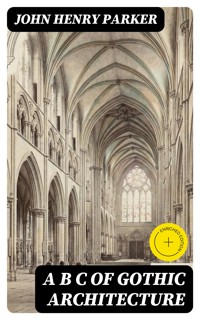
In 'A B C of Gothic Architecture,' John Henry Parker meticulously explores the intricate elements that define Gothic architecture, presenting a structured analysis that demystifies this architectural style for both scholars and lay readers. The text employs a didactic approach, combining vivid illustrations and concise commentary to elucidate the various components of Gothic cathedrals'—from soaring spires to intricate stained glass windows. Positioned within the 19th-century Victorian context, Parker's work reflects a burgeoning fascination with medieval heritage and the revival of Gothic styles during his era, showcasing a harmonious blend of artistic appreciation and architectural precision. John Henry Parker, an eminent antiquary and architect, was deeply influenced by the Romantic movement's reverence for the past and its architectural wonders. His extensive studies, particularly in the realms of medieval architecture and art, laid the groundwork for 'A B C of Gothic Architecture.' Parker's dedication to preserving and understanding the nuances of Gothic design not only informed his scholarly pursuits but also expressed his passionate commitment to cultural heritage. This book is a must-read for anyone with a keen interest in architecture, art history, or the cultural implications of Gothic design. Parker's insightful commentary and comprehensive illustrations serve as an invaluable resource, offering both aesthetic appreciation and scholarly rigor that will enrich your understanding of this magnificent architectural style. In this enriched edition, we have carefully created added value for your reading experience: - A succinct Introduction situates the work's timeless appeal and themes. - The Synopsis outlines the central plot, highlighting key developments without spoiling critical twists. - A detailed Historical Context immerses you in the era's events and influences that shaped the writing. - A thorough Analysis dissects symbols, motifs, and character arcs to unearth underlying meanings. - Reflection questions prompt you to engage personally with the work's messages, connecting them to modern life. - Hand‐picked Memorable Quotes shine a spotlight on moments of literary brilliance. - Interactive footnotes clarify unusual references, historical allusions, and archaic phrases for an effortless, more informed read.
Das E-Book können Sie in Legimi-Apps oder einer beliebigen App lesen, die das folgende Format unterstützen:
Veröffentlichungsjahr: 2019
Ähnliche













A B C of Gothic Architecture
Table of Contents
Introduction
At its heart, A B C of Gothic Architecture argues that medieval buildings can be read like a language, and that learning the fundamental forms, patterns, and construction principles equips any attentive observer to recognize how faith, function, and craftsmanship shaped the distinctive character of Gothic design across time and place.
This work is a concise architectural primer by John Henry Parker, a nineteenth-century English writer on architecture and antiquities, composed within the Victorian era’s vigorous interest in medieval art and building. It introduces readers to the study of Gothic architecture, a style that flourished in medieval Europe and left an especially rich legacy in Britain. As a guidebook to form and understanding rather than a travelogue, it belongs to the tradition of practical handbooks that emerged alongside preservation movements and scholarly classification during the nineteenth century.
Readers encounter a straightforward, didactic approach that privileges clarity over ornament, emphasizing careful looking and steady accumulation of terms and concepts. The book establishes a shared vocabulary for arches, mouldings, tracery, vaults, and other characteristic features, while encouraging comparison across examples to train judgment. Its voice is patient and explanatory, designed to make complex buildings approachable without diluting their intricacy. The experience is less about exhaustive history than about method: how to observe, distinguish, and name what one sees, so that cathedrals and parish churches alike become intelligible rather than merely impressive.
The themes that run through the book remain timely: that architecture is a record of ideas in material form; that structure and ornament are interdependent; and that stylistic change is both intelligible and rooted in practical needs. Parker’s emphasis on classification invites readers to notice continuity as well as variation, avoiding both romantic vagueness and rigid dogma. By cultivating visual literacy, the book models an approach to cultural heritage that balances respect for tradition with analytical curiosity, offering tools that help today’s readers navigate debates about conservation, restoration, and the value of historical authenticity.
A central appeal of this primer is its insistence that aesthetic appreciation grows from understanding how things are made. The text treats Gothic not as an abstraction but as a system of solutions to structural challenges, in which ribs, buttresses, windows, and profiles work together to admit light, carry loads, and articulate space. This perspective reframes ornament as meaningful, showing how repeated motifs clarify construction and guide the eye. By doing so, it steers readers away from mere surface effects and toward the underlying grammar of the style, encouraging a measured, evidence-based admiration.
For students, travelers, and general readers, the book serves as a pocket method for looking—one that is portable across towns, regions, and centuries. Its guidance supports productive visits to historic buildings, helping readers to situate what they see within broader patterns without demanding specialist training. Teachers and enthusiasts will find a foundation sturdy enough to build upon, while those involved in heritage work can appreciate its careful distinctions. Above all, it fosters confidence: the sense that with a reliable set of terms and comparisons, even very intricate medieval structures become conversational partners rather than puzzles.
In an age of rapid change, this nineteenth-century guide remains relevant because it elevates attention as a civic and intellectual virtue. By slowing down the act of looking and supplying a disciplined method for naming and comparing, it enables readers to engage with the past in a spirit of humility and precision. The result is not nostalgia, but an informed appreciation that recognizes both the ingenuity of Gothic builders and the responsibilities of modern observers. A B C of Gothic Architecture thus offers a durable starting point for anyone seeking to understand, preserve, or simply take delight in medieval architecture.
Synopsis
John Henry Parker’s A B C of Gothic Architecture is a concise primer designed to introduce readers to the identification and understanding of medieval Gothic architecture in England. It presents the subject as a sequence of styles, moving chronologically and explaining how to recognize each period by its characteristic forms. The book focuses on ecclesiastical buildings, using clear descriptions, measured dating ranges, and illustrative examples to build a practical method of observation. Parker organizes material to progress from broad definitions to specific features, emphasizing windows, arches, and moldings as diagnostic elements. The overall aim is a practical, accessible handbook that teaches readers to date and classify Gothic work with confidence.
The opening sections define the scope of Gothic architecture and distinguish it from earlier and later phases. Parker outlines the basic plan of a medieval church—nave, chancel, transepts, aisles, and chapels—and explains how successive building campaigns often layered styles. He introduces key terminology and the principle that structural needs and stylistic preference together shape details. Readers are guided to look for consistent markers across a building: the form of arches, the profile of moldings, the pattern of tracery, and the character of capitals. These foundations prepare the way for the chronological survey that follows, which anchors stylistic labels to observable features and approximate dates.
Parker begins the historical sequence with the Norman, or Romanesque, period, noting its massive walls, round arches, and sturdy piers. He describes characteristic details such as small, deeply splayed windows, cushion capitals, and carved ornaments like chevron and billet. Doorways with multiple orders and recessed arches are emphasized as reliable indicators. Transitional work, where the pointed arch first appears with Romanesque proportions, is identified and dated by moldings and section profiles. Examples from cathedrals and parish churches demonstrate regional variety within a coherent style. The discussion sets a baseline of form and construction against which the later Gothic developments are measured.
The Early English style is presented next, marked by the full adoption of the pointed arch, tall proportions, and lancet windows often grouped in pairs or triplets. Parker highlights the use of clustered shafts, frequently of polished stone, and the prevalence of dog-tooth ornament. He notes the move from plate tracery toward the earliest bar tracery and the refinement of ribbed vaulting. Buttresses become more prominent and slender, spires and broach spires appear, and moldings are sharper and more deeply cut. The text dates these features within clear ranges, illustrating how their combination aids identification and distinguishes early Gothic from both Norman and later work.
Moving to the Decorated period, Parker identifies a shift toward richer surface pattern and more complex window tracery. He separates earlier geometric patterns from later flowing forms, illustrating reticulated, intersecting, and curvilinear designs. Ball-flower ornament and naturalistic foliage carving are cited as common motifs, alongside ogee curves in canopies and arches. Vaulting patterns grow more elaborate, and doorways and sedilia gain greater profusion of detail. The discussion ties tracery types and decorative habits closely to dating, while recognizing local variation. Through comparative examples, the text shows how Decorated work balances structural clarity with increasing ornamental sophistication, preparing the way for the next stylistic phase.
The Perpendicular style is characterized by emphatic vertical lines, large windows with panel tracery, and the distinctive four-centred, or Tudor, arch. Parker describes the extensive use of battlemented parapets, strong transoms, and straight mullions that continue through the heads of windows. Interior treatment includes elaborate timber roofs such as hammerbeam constructions and, in major works, fan vaulting. Doorways, screens, and porches display rectilinear paneling and standardized moldings. Towers and clerestories broaden and brighten interiors. The book provides chronological markers for the emergence and maturation of these features and notes how Perpendicular design rationalizes and systematizes earlier Gothic tendencies into a cohesive, highly legible style.
Beyond the stylistic survey, Parker devotes chapters to constructional elements used as dating tools. He analyzes arch profiles, pier sections, capitals, bases, and the evolution of moldings, explaining how subtle profile changes indicate period. The treatment of buttresses, including the introduction and refinement of flying buttresses, is linked to vaulting developments that enabled larger windows. Roof structures, from stone vaults to timber solutions, are related to structural demands and regional practice. Tracery is examined methodically, with diagrams clarifying the shift from plate to bar and from geometric to panel forms. These technical chapters support the reader in applying the chronological framework with greater precision.
The book also surveys church fittings and ornaments that complement architectural evidence. Fonts, piscinas, sedilia, screens, stalls, pulpits, porches, and door ironwork are cataloged with notes on their typical forms in each period. Parker discusses monuments, effigies, brasses, stained glass patterns, and tile pavements, treating them as secondary indicators that often survive when structural evidence is altered. Plan elements associated with monastic buildings—cloisters, chapter houses, and refectories—are briefly outlined. Throughout, the emphasis is on careful observation of detail, comparison with known examples, and correlation between ornament and structure to strengthen dating and attribution.
In concluding sections, Parker consolidates the method into practical guidance for travelers and students. He presents checklists of features to examine, encourages noting inconsistencies that reveal alterations, and points to well-dated examples for comparison. A glossary and references to illustrative examples support independent study. The book’s central message is that Gothic architecture in England developed through identifiable stages, each leaving clear structural and decorative signatures. By learning these signatures, readers can recognize, date, and understand medieval buildings with greater accuracy. The work thus serves as a compact, instructive companion to the observation and study of English Gothic architecture.
Historical Context
A B C of Gothic Architecture first appeared in 1851 in Oxford, during the reign of Queen Victoria (1837–1901). John Henry Parker, an Oxford bookseller, publisher, and archaeologist (1806–1884), wrote for a public newly alert to the value of medieval buildings. The immediate setting was a university city where antiquarian societies flourished and where debates about church design were unusually intense. The same year, London hosted the Great Exhibition, a showcase of industry and design, while railways bound provincial towns to the capital. In this climate of reform and expansion, Parker sought to codify England’s medieval church fabric into clear chronological types that clergy, architects, and educated travelers could recognize and protect.
Between roughly 1800 and 1870, the Gothic Revival transformed Britain’s built environment into a stage for national and religious identity. A catalytic event was the fire of 16 October 1834 that destroyed the old Palace of Westminster; in 1840 Charles Barry, aided by Augustus Welby Northmore Pugin, began the new Houses of Parliament in a revived Perpendicular style, a project continuing into the 1860s. County churches, collegiate quadrangles, and law courts followed suit, adopting pointed arches, tracery, and vaults as emblems of continuity with the medieval kingdom. Parker’s manual is inseparable from this revival: it supplies the vocabulary and dating system—Early English, Decorated, Perpendicular—that allowed patrons and builders to emulate medieval precedents with historical precision rather than eclectic display.
In 1833 John Keble’s Assize Sermon at St Mary’s, Oxford, initiated the Oxford Movement, in which figures like John Henry Newman and Edward Bouverie Pusey urged a recovery of pre-Reformation theology and worship. Its social program extended to church architecture: chancels, altars, and ritual seating were to be restored to medieval norms. The Cambridge Camden Society (founded 1839; later the Ecclesiological Society) published the Ecclesiologist from 1841, prescribing "Middle Pointed" (c. 1280–1340) as best suited to Anglican liturgy. Parker, active in the Oxford Architectural Society from 1839, positioned his book as a neutral, factual aid to this reform climate. By classifying moldings, window forms, and plans by date and region, he provided clergy and diocesan architects with evidence to design or restore in conformity with revived practice.
Industrialization and population growth after 1800 created an unprecedented demand for places of worship in new towns and factory districts. The Church Building Act of 1818 (the "Million Act") and later grants funded more than 600 Commissioners’ Churches through the 1850s, many criticized for thin construction and historical inaccuracy. Cheap printing, expanding literacy, and railways enabled handbooks to circulate widely among parish committees and builders. In 1851 the Great Exhibition displayed medievalizing ironwork and stained glass, with Pugin’s Medieval Court popularizing Gothic taste. Parker’s book, inexpensive and portable, responds to these conditions: it teaches lay patrons how to distinguish a 13th‑century lancet from a 15th‑century panel traceried window, discouraging ill‑judged economies and guiding better‑informed new construction.
The book’s historical framework rests on England’s medieval building chronology. Early English (c. 1180–1250) followed the 1174 fire at Canterbury, yielding pointed arches and lancet windows; Salisbury Cathedral rose 1220–1258 as a model. The Decorated phase (c. 1250–1350) refined tracery, as at the Angel Choir of Lincoln (1256–1280) and Exeter Cathedral’s nave (1270–1350). The Perpendicular (c. 1350–1550) emphasized vertical panels and fan vaults, exemplified by Gloucester choir (remodeled 1337–1357) and King’s College Chapel, Cambridge (1446–1515). National shocks—especially the Black Death of 1348–1350 and the Hundred Years’ War (1337–1453)—reshaped labor and patronage. Parker anchors his categories in such dated monuments, enabling readers to link stylistic change to broader historical pressures.
Another context is the Anglo-Norman rebuilding campaign after 1066. William I and his barons introduced massive Romanesque forms—thick walls, round arches, chevron ornament—visible in the White Tower (c. 1078–1100) and Durham Cathedral (begun 1093). After the 1174 fire, Canterbury Cathedral’s choir, rebuilt under William of Sens and William the Englishman, helped usher in structural pointedness. Parker treats Norman and Transitional features as the alphabet’s opening letters: capitals, bases, and arch profiles are read as chronological clues. By rooting stylistic shifts in events—conquest, fire, monastic patronage—his manual turns archaeology into a practical interpretive tool for Victorian observers.
Destruction and alteration after the 16th century also shaped the book’s urgency. The Dissolution of the Monasteries (1536–1541) dispersed shrines and cloisters; Edwardian injunctions (1547–1553) intensified iconoclasm; the Civil Wars and Interregnum (1642–1660) brought further damage to glass, imagery, and fittings. Victorian "restoration"—led by architects such as George Gilbert Scott, William Butterfield, and G. E. Street in the 1840s–1860s—often rebuilt medieval fabric to idealized patterns, prompting controversy that culminated in the Society for the Protection of Ancient Buildings (1877). Parker, advocating careful observation, made accurate identification of phases a prerequisite for responsible repair. A B C of Gothic Architecture equips committees and architects with dated examples to distinguish original work from later accretions before intervening.
As a taxonomic guide, the book functions as cultural criticism of mid‑Victorian Britain. It challenges utilitarian expediency in church building and the class‑driven tendency to commission showy yet historically incoherent designs, urging instead a disciplined respect for parish heritage. By explicating chancels, screens, and ritual space, it critiques post‑Reformation neglect and the social atomization of industrial towns, proposing the medieval parish church as a model of communal order. It indirectly interrogates state patronage after 1818 by making lay patrons responsible for informed choices. The work thus exposes the era’s tensions between speed and stewardship, economy and authenticity, national modernity and historical memory.




