


0,49 €
Niedrigster Preis in 30 Tagen: 1,99 €
Niedrigster Preis in 30 Tagen: 1,99 €
Mehr erfahren.
- Herausgeber: DigiCat
- Kategorie: Geisteswissenschaft
- Sprache: Englisch
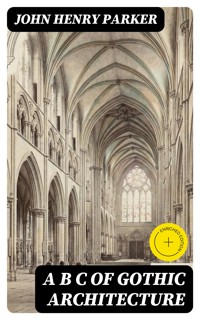
In "A B C of Gothic Architecture," John Henry Parker meticulously demystifies the complexities of Gothic architecture, weaving together historical insights with practical illustrations and detailed descriptions. The book serves as both a guide and a compendium, featuring clear explanations of architectural elements such as arches, cathedrals, and the intricacies of medieval design. Parker's literary style is marked by clarity and precision, making the text accessible to both enthusiasts and scholars, while its scholarly context situates it within the Victorian era's burgeoning interest in heritage conservation and architectural study. John Henry Parker (1806-1884) was a prominent architectural historian and a key figure in the revival of Gothic architecture during the 19th century. His background in architecture and archaeology, combined with a deep appreciation for medieval craftsmanship, propelled him to pen this influential work. Parker's passion for preserving historical edifices informed his writing, as he sought to articulate the significance and beauty of Gothic structures, particularly amid the rampant industrialization of his time. For readers fascinated by architectural history or those simply looking to deepen their appreciation of Gothic structures, Parker's "A B C of Gothic Architecture" is an indispensable resource. Its engaging prose and rich visual content make it an enlightening read, inviting both novices and experts to explore the grandeur of this iconic style. In this enriched edition, we have carefully created added value for your reading experience: - A succinct Introduction situates the work's timeless appeal and themes. - The Synopsis outlines the central plot, highlighting key developments without spoiling critical twists. - A detailed Historical Context immerses you in the era's events and influences that shaped the writing. - A thorough Analysis dissects symbols, motifs, and character arcs to unearth underlying meanings. - Reflection questions prompt you to engage personally with the work's messages, connecting them to modern life. - Hand‐picked Memorable Quotes shine a spotlight on moments of literary brilliance. - Interactive footnotes clarify unusual references, historical allusions, and archaic phrases for an effortless, more informed read.
Das E-Book können Sie in Legimi-Apps oder einer beliebigen App lesen, die das folgende Format unterstützen:
Veröffentlichungsjahr: 2022
Ähnliche














A B C of Gothic Architecture
Table of Contents
Introduction
Between the living stones of medieval churches and the questioning gaze of a modern reader, A B C of Gothic Architecture builds a patient bridge of understanding. John Henry Parker’s guide introduces the fundamental language of Gothic building so that anyone can recognize patterns of structure, ornament, and proportion. Instead of assuming specialist knowledge, it respects the reader’s curiosity and provides orientation through clear explanations and concrete examples. The book’s promise is not to overwhelm with theory, but to teach what to look for and why it matters. It offers a disciplined way of seeing that turns scattered impressions into informed recognition.
Composed as a concise handbook of architectural history and appreciation, this work belongs to the nineteenth-century revival of interest in medieval building. Its author, John Henry Parker, was an English writer on architecture who devoted much of his career to documenting historic fabric and clarifying technical terms. The book addresses readers in Britain and beyond who encounter Gothic churches, civic spaces, and collegiate buildings, and want a trustworthy compass for understanding them. Within that context, the volume functions as a guide to observation rather than a manifesto, aligning practical description with a broader culture of study and restoration that marked the period.
At its core, the premise is straightforward: by learning essential parts, forms, and cues, the reader can identify how Gothic architecture works and how its variations evolved. Parker’s voice is measured and instructive, favoring careful definition and step-by-step explanation over flourish. The style is compact, oriented to tangible details a visitor can verify on a wall, window, arch, or pier. The tone is encouraging but exacting, building confidence while insisting on accuracy. Rather than forcing conclusions, the book offers methods, so that recognition becomes a personal accomplishment grounded in patient looking and a shared vocabulary.
Several themes give the book enduring coherence. It treats terminology not as jargon but as a tool that opens doors to history, allowing features to be named, compared, and dated with humility. It emphasizes the interplay of structure and ornament, showing how beauty arises from constructive logic rather than from surface display alone. It acknowledges variety within a common system, guiding readers to notice regional habits and workshop preferences without losing sight of broader principles. Above all, it invites close reading of buildings as documents, where stones preserve decisions made by craft, culture, and use across centuries.
For contemporary readers, the book matters because it cultivates architectural literacy at a humane scale. In an age of rapid images and generalized labels, it trains attention on evidence: profiles, joints, tracery, and the practical questions those details answer. Such habits of inquiry support thoughtful travel, community stewardship, and responsible conservation, whether one is visiting a parish church or considering interventions in a historic district. Its method also equips designers and students to learn from precedent without imitation, to study how solutions emerged from materials and need, and to translate lessons about light, span, and rhythm into today’s concerns.
Readers will find that Parker builds understanding cumulatively, moving from simple recognitions to subtler distinctions, and reinforcing ideas through well-chosen examples from accessible buildings. The prose remains focused on what can be seen and measured, encouraging readers to verify claims by looking again and comparing like with like. This approach respects the intelligence of non-specialists while remaining useful to students seeking clarity amid competing terminologies. The result is an atmosphere of calm instruction: precise without pedantry, practical without narrowness. By the end, one possesses not merely facts, but habits of looking that continue to repay attention in new places.
A B C of Gothic Architecture stands, therefore, as both primer and companion—a portable discipline that helps transform curiosity into knowledge and admiration into care. Without demanding prior expertise, it honors the complexity of medieval craft and the dignity of patient study. Its legacy lies in how it reshapes everyday encounters with the built environment, giving readers a way to read stones as evidence rather than as scenery. Entering its pages is to accept an invitation to see more clearly, to name what we see, and to connect that clarity with the ethical work of preserving what endures.
Synopsis
A B C of Gothic Architecture is presented as an elementary handbook by John Henry Parker, a nineteenth-century English architectural historian. It introduces readers to the essential features, terminology, and historical scope of Gothic building in Britain, aiming to make the subject intelligible to students and travelers. Parker’s approach is practical and descriptive: he defines key parts of a church, groups recurring forms, and supplies criteria for recognizing periods. Rather than advancing speculative theories, he concentrates on what can be seen and compared in surviving fabric. The book sets out a concise framework that readers can carry into the field to identify style and date.
Parker opens by sketching the passage from earlier medieval construction to the fully developed Gothic manner. He emphasizes how structural innovations—especially the pointed arch and ribbed vaulting—enabled greater height and complexity, and how these capabilities gradually reshaped plans and elevations. To orient beginners, he adopts the mainstream English division of Gothic into successive phases commonly termed Early English, Decorated, and Perpendicular, with transitional overlaps. Each phase is introduced through its characteristic profiles, proportions, and surface treatment. The narrative underscores continuity: new forms arise from adjustments to existing practice, and changes in taste register first in detail before transforming an entire composition.
A central section treats structure as the key to reading style. Arches are sorted by form and section; piers and bases are analyzed by their clustered or monolithic build; and vaults are described through their ribs and cells. Buttresses are explained not only as supports but as visible records of engineering intent, their stages and offsets serving as chronological markers. Parker links these components to construction logic, arguing that apparent decoration often clarifies load paths and junctions. By training attention on profiles and joints rather than isolated motifs, he supplies a method for dating work that avoids relying on a single conspicuous feature.
Openings provide another diagnostic field, and Parker follows their development with care. He begins with narrow lancets and simple hood-moulds, then traces the rise of multi-light windows and complex tracery. Geometric patterns lead to more flowing lines, before a later preference for panelized verticality asserts itself. Doorways are treated in parallel: orders, jamb shafts, and labels are observed for how they announce period and craft. Mouldings receive special emphasis because their sections change in telling ways across time. The account shows how windows, doors, and their moulded frames form a coordinated system that reveals both the date and the design priorities of a building.
The book then considers plan and elevation in relation to use. Parker differentiates the needs of cathedrals, monastic churches, and parish buildings, noting how liturgical and communal functions influence aisle arrangements, transepts, and chapels. He draws attention to towers, spires, and roofs as expressions of both structure and regional habit. While avoiding exhaustive catalogues, he points to recurring solutions—such as nave arcades paired with clerestories or the treatment of porches—that help readers compare sites. The account ties space, light, and circulation to structural means, showing how Gothic form arises from practical requirements refined through successive generations of workmanship.
Ornament is addressed as disciplined enrichment rather than arbitrary display. Parker surveys carving programmes, from stylized foliage to more naturalistic leaves, and notes how capitals, corbels, and bosses register shifts in taste. He records features commonly associated with particular phases, such as the ballflower in middle-period work and the culmination of vault design in elaborate late examples. Yet he cautions that no single motif can date a building in isolation; context and construction must be read together. Materials and workmanship are considered, with attention to how stone choice, tooling, and jointing affect the sharpness of mouldings and the endurance of carved detail.
The final sections return to method, encouraging systematic observation, comparison across parts of the same building, and caution in assigning dates. Parker’s concise typology, consistent vocabulary, and attention to measurable profiles offer a portable toolkit for study. By organizing English Gothic into intelligible phases anchored in structure and detail, the book helps non-specialists engage critically with medieval architecture and provides a baseline for more advanced research. Its enduring significance lies in standardizing terms and criteria that influenced later surveys, while inviting readers to test classifications against the evidence of the stones, preserving curiosity without foreclosing further interpretation.
Historical Context
In early nineteenth-century Britain, interest in medieval buildings shifted from antiquarian curiosity to systematic study. Thomas Rickman’s 1817 "Attempt to Discriminate the Styles of English Architecture" supplied durable labels—Norman, Early English, Decorated, and Perpendicular—that framed subsequent scholarship. Post-Napoleonic stability and the 1818 Church Building Act stimulated thousands of new churches, intensifying attention to historical models. County histories, parish surveys, and architectural handbooks multiplied, encouraging field observation and measured drawings. This environment made concise, reliable guides valuable, especially for clergy, builders, and travelers who needed clear terminology to describe features like arches, tracery, and vaulting without advanced academic training.
The Gothic Revival moved from taste to policy after the 1834 fire destroyed the Palace of Westminster. The parliamentary competition of 1835 required a Gothic or Elizabethan design, resulting in Charles Barry’s scheme enriched by A. W. N. Pugin’s Gothic detailing. Pugin’s writings—"Contrasts" (1836) and "The True Principles of Pointed or Christian Architecture" (1841)—asserted Gothic’s moral and functional superiority for Christian worship. As the new Houses of Parliament rose from the 1840s, Gothic became a national idiom, shaping commissions, pattern books, and public expectations. Manuals explaining stylistic periods and constructional elements found a receptive, widening readership.
Religious reform sharpened architectural awareness. The Oxford Movement, begun in 1833, promoted renewed sacramental emphasis in Anglicanism, encouraging churches planned for processions, chancels, and altars consistent with medieval precedent. The Cambridge Camden Society (founded 1839; from 1845 the Ecclesiological Society) advocated "Middle Pointed" design and published The Ecclesiologist, critiquing buildings and restorations to enforce liturgical and stylistic standards. Diocesan architectural societies spread similar agendas. Their campaigns led parish committees to examine historic fabric closely and to consult reference works for dating windows, arcades, and roofs. A precise, shared vocabulary became essential for communication among clergy, architects, and parishioners.
By mid-century, restoration dominated practice. Architects such as George Gilbert Scott, George Edmund Street, and William Butterfield led extensive medieval church repairs and rebuildings, often removing later accretions. Debate over method became acute. John Ruskin’s "The Seven Lamps of Architecture" (1849) and "The Stones of Venice" (1851–53) denounced conjectural restoration, urging conservation of age and fabric. On the Continent, Eugène Viollet-le-Duc argued for stylistic completion, further energizing British disputes. William Morris founded the Society for the Protection of Ancient Buildings in 1877 to resist destructive “scrape.” Accurate identification of periods and details thus gained practical stakes in parish decisions.
John Henry Parker (1806–1884) worked at the center of this discussion as an Oxford bookseller, publisher, and architectural writer. From his Broad Street firm he issued affordable, illustrated works that standardized terms and encouraged field study. His "A Glossary of Terms Used in Grecian, Roman, Italian, and Gothic Architecture" first appeared in 1836 and went through enlarged editions, becoming a standard reference. Active in the Oxford Architectural Society (founded 1839; later the Oxford Architectural and Historical Society), he supported lectures and excursions that joined scholars, clergy, and architects. Parker’s publishing program linked university culture with practical antiquarian investigation.
Parker extended his educational aims through narrative surveys and primers. "An Introduction to the Study of Gothic Architecture" synthesized English medieval building chronologies for general readers. Later, he issued A B C of Gothic Architecture as a concise primer, distilling periodization and feature recognition into an accessible format. Its clear descriptions and plentiful illustrations guided beginners to read mouldings, tracery, piers, and vaults, and to assign them to accepted chronological phases. The book’s utility lay in translating specialist classification—rooted in Rickman’s schema—into portable instruction suitable for parish visits, society excursions, and the needs of working practitioners.
Victorian institutions reinforced this didactic mission. The Institute of British Architects, founded in 1834 and chartered in 1837, professionalized discourse about design and history. Railway expansion opened remote parish churches to day-trippers and surveyors, creating demand for compact handbooks. Museums advanced public scholarship; Parker became Keeper of the Ashmolean Museum in 1870, promoting classification and display. He also sponsored photographic documentation and published The Archaeology of Rome in the 1870s–1880s, exemplifying evidence-based method. In Britain, the same empirical habit underpinned his Gothic guides, which organized observation and provided consistent labels for features encountered in the field.
A B C of Gothic Architecture reflects a mature Victorian synthesis: moral and liturgical claims had made Gothic central, yet conservation anxieties demanded accuracy rather than conjecture. Parker’s primer avoids polemic, equipping readers to identify dates and constructional logic, thereby participating in wider efforts to record, restore, or protect churches responsibly. It assumes the Rickman-derived periods and trains attention on verifiable features, aligning with rising preservation sentiment visible in measures such as the Ancient Monuments Protection Act of 1882. Through clarity and portability, the work embodies its era’s belief that shared, standardized knowledge could guide public taste and policy.




