


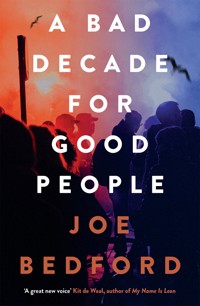
7,19 €
Mehr erfahren.
- Herausgeber: Parthian Books
- Kategorie: Gesellschafts- und Liebesromane
- Sprache: Englisch
'An ode to grief and sibling love from a great new voice' Kit de Waal, author of My Name Is Leon 'A beautifully layered story… Poignant, astute and hopeful' Sharon Duggal, author of Should We Fall Behind 'Highly compelling… a fascinating exploration of political hope, friendship, difficulty, infatuation, and unrequited desire' Naomi Booth, author of Exit Management 'This captivating novel is a reminder that love, coupled with courage, just might conquer all.' Heidi James, author of The Sound Mirror 'Deeply, profoundly human… leaves the reader heartsore in exactly the right ways' Will Burns, author of The Paper Lantern 'An ambitious state-of-the-nation debut' Helen Cullen, author of The Truth Must Dazzle Gradually 'A beautifully observed portrayal of the spirit of Brighton' Allie Rogers, author of Little Gold 'Unforgettable and stirring… An important debut' Alice Ash, author of Paradise Block 'Really compelling... It's at once psychologically thrilling and fast-paced with a meditative heart' Anna Vaught, author of Saving Lucia 'It will resonate with a large, bruised section of the population still fighting for a better future' Glen James Brown, author of Ironopolis A fiercely hopeful novel about family, sexuality, grief and how we as individuals can rediscover our political agency in the face of continued uncertainty. Brighton, 2016. Laurie wears the scar given to her by a policeman's baton as a mark of pride among her circle of bright young activists. Her conscionable but sensitive brother George should be a part of that circle, until the appearance of enigmatic Spanish migrant Antonio threatens to divert him from his sister's world of marches and moral accountability. As the clouds gather over Brighton and the EU referendum accelerates both Laurie's political zeal and Antonio's ambiguous desires, George is faced with the fact that their city of parties and protests is suddenly a place where the possibility of saving the world – as well as the people around him – is in jeopardy of being lost forever. At once a letter of support to everyone disillusioned by British politics, and a deeply perceptive snapshot of modern relationships, A Bad Decade for Good People is a captivating state-of-the-nation tale that begs the question: when it feels like the world is falling apart, how do you keep those you love from doing the same?
Das E-Book können Sie in Legimi-Apps oder einer beliebigen App lesen, die das folgende Format unterstützen:
Veröffentlichungsjahr: 2023
Ähnliche




















Contents
Advance Praise
Title Page
Dedication
Epigraph
Introduction
1. SOMEONE ELSE
2. THE MAN WITHOUT A COSTUME
3. HOW THE WORLD WORKS
4. THAT KIND OF PRIDE
5. THE BISABUELO
6. A BAD DECADE FOR GOOD PEOPLE
Epilogue
ACKNOWLEDGEMENTS
Copyright
Advance Praise For A Bad Decade For Good People
‘An ode to grief and sibling love from a great new voice writing about our messy and uncertain times.’ Kit de Waal, author of My Name Is Leon and Without Warning & Only Sometimes
‘A beautifully layered story about the complexity of relationships, political and sexual identity, loss, activism, familial love, being European, Brexit chaos and living in Brighton. Poignant, astute and hopeful.’ Sharon Duggal, author of Should We Fall Behind (a BBC Two Between the Covers Book Club Choice)
‘Bedford achieves a rare feat with this novel: he writes about disappointment in a way that is highly compelling. A Bad Decade for Good People is a fascinating exploration of political hope, friendship, difficulty, infatuation, and unrequited desire.’ Naomi Booth, author of Exit Management and Sealed
‘This captivating novel is a reminder that love, coupled with courage, just might conquer all.’ Heidi James, author of The Sound Mirror
‘Deeply, profoundly human, while at the same time precisely capturing the essence of a time and a place, A Bad Decade for Good People is one of those books which genuinely seems to fabricate a whole world. In prose that is subtle, deft and unobtrusive Joe Bedford’s debut leaves the reader heartsore in exactly the right ways.’ Will Burns, author of The Paper Lantern and Country Music
‘An ambitious state-of-the-nation debut that meaningfully fuses the personal and the political to great effect’ Helen Cullen, author of The Truth Must Dazzle Gradually and The Lost Letters of William Woolf
‘A beautifully observed portrayal of the spirit of Brighton in the second decade of the 21st century, capturing the light and the darkness of this city by the sea’ Allie Rogers, author of Little Gold
‘Bursting with the life and colour of Brighton and tenanted with its vivid eccentrics and revolutionaries, this deeply empathetic study of the strengths (and weaknesses) of humanity is an unforgettable and stirring experience. An important debut.’ Alice Ash, author of Paradise Block
‘It’s really compelling. 2016 – clouds gather; we’re in Brighton. It’s at once psychologically thrilling and fast-paced with a meditative heart: what can we tolerate, how can we love?’ Anna Vaught, author of Saving Lucia and These Envoys of Beauty
‘A serious take on youthful idealism crashing into the hard reality of a world repeating past mistakes, A Bad Decade for Good People explores what happens to the collective when its individuals begin to flounder. It will resonate with a large, bruised section of the population still fighting for a better future.’ Glen James Brown, Portico Prize- and Orwell Prize-shortlisted author of Ironopolis
A Bad
Decade
for
Good
People
Joe
Bedford
For Anna
A man that is born falls into a dream like a man who falls into the sea. If he tries to climb out into the air as inexperienced people endeavour to do, he drowns…
Joseph Conrad, Lord Jim
If the policeman’s baton had found Laurie half an inch lower she would be blind in one eye. Instead it left her with a long, crescent-shaped scar, which she wore like a medal, never hiding it and never knowing how it made my stomach flip. Every time I saw it I had to shake off the memory of her blood running down over her eyelids and onto her jacket, and afterwards the stitching and the gooey rivets it left behind and the halo of yellow bruising that hung around the socket for weeks.
Her scar was all I could see while she pleaded with me by the side of the road, until we were lit in the headlights of Dad’s car and then running, slipping, gripping each other’s clothes in the ditch. I remember the sound of Dad’s voice carrying over the hum of the engine, the faint warmth coming through Laurie’s jacket as she held me, the smell of mud and silage. The hills opposite looked like the silhouette of a man sleeping on his side, cut against the stars – the kind of thing you notice at midnight in the countryside, with someone who makes you feel as though things could be better. That and the raw feeling that your failure isn’t yet total but just another blip in time, waiting to pass.
We tried not to laugh aloud as Dad stumbled back into his car, slammed the door and sped away. After that Laurie was earnest again and pleading for me to pack it in at the pub and come away with her to Brighton, where she’d found the perfect place for us to carve something out, her words. Where Helena was waiting, whose name she couldn’t mention without smiling.
‘I just want to make it right,’ I said, but she didn’t recognise my guilt, never could.
She just pointed the torch up to her chin and pulled a face, which forced me to laugh. The stars above her head disappeared and I saw the long, moon-shaped line of damage illuminated above her eye. Half an inch lower, that eye would be blind, I thought. Then she’d be someone else and I’d be someone else. Though she’d always be my sister.
1
SOMEONE ELSE
2016
When summer arrives in Brighton, it bursts all over the city like a paint bomb. That year, summer came early and when it did the city seemed to breathe a deep collective sigh of relief. The pavements filled out with people blinking in the sunlight. I watched them on the promenade, stopping to take pictures of the white light skimming across the sea – the same people who’d bustled about under brollies all spring, now dry and warm, walking with free and easy steps. All different now the weather had changed, just as Helena had promised.
I watched them idly while the sun went down over the Lanes, shuffling along the queue for a cab on East Street. You could call it bacchanalia – the life of the place as its doors and windows begin to open. It’s the feeling that this is how the city should be at all times, the city at its most natural, when the dusk no longer drives people indoors but draws them out.
Certainty, liveliness and comfort. And underneath, just the ghost of a feeling that at any minute one mighty gust of wind might blow all the colour from the streets.
Though not tonight.
The party was at Duncan’s – a friend of Helena’s who lived with a few others in a disused school building on the edge of town. The corridor looked almost identical to the one Laurie and I had marched down as teenagers – mottled carpet, scuffed blue walls skirted with white. A sign on the wall reminded guests THIS IS NOT A SQUAT, though that’s what Laurie had led me to believe. There was a message about their landlords – a property company that rented out empty buildings to vetted tenants. Something I’d never heard of. EU flags led down to the assembly hall, along with calls to VOTE and DONATE.
It was Helena who invited me. The invitations normally came from her and then Laurie would follow up to insist. For two months Laurie had tried to sell me house parties as underground get-togethers and pub drinks as action meetings, and assured me that the marches and demos would pick up once the weather improved. She said our night at the school would be a chance to make plans for the referendum campaign. Though even as I followed the dizzy calypso music down the corridor I was relieved to see I was walking into just another party.
There were no crisps or balloons in the assembly hall but neither was there any daggering or smack. Just forty-odd people standing around drinking Jamaican lager under Remain campaign banners and Laurie, a head taller than most of them, polemicising under the climbing ropes. She stood with the same old over-wide posture, legs apart, elbows too far out, a slight stoop at the shoulders. Identical to the day she stood up to a PE teacher who was telling me off, physically stood up to him, eye to eye. Big-sister stuff. I tapped her on the shoulder and she turned and grabbed me so that the bottles in my carrier bag crashed together. She wore her jacket that night – one of a pair, hers and mine. I should have expected that.
‘George, George, George, George.’
She gave my smile a gentle slap and waved Helena over. Helena had a semicircle of boys around her cawing with laughter, but when she saw me she bowed out quickly and skipped across. She gripped me harder than my sister had done, even ran her fingernails up the hair on the back of my neck. She told me while still holding me how nice it was to see me, and how she was so glad I could make it, as if there was any danger of me rejecting one of her invitations.
Laurie was excited to tell me she had a canvassing thing lined up for us the following week. She blabbered the whole thing but I got the gist.
Helena interrupted her with a kiss. ‘Sorry, George. She’s always on politics, whenever we come here. Help me out, won’t you.’
I laughed. ‘What can I do?’ I’d hoped we could keep her off the referendum, at least to begin with. Slim chance.
‘George understands,’ said Laurie. ‘And don’t forget,’ scrunching her face, scary monster, ‘he’s my little brother.’ She squeezed my neck into a headlock, really squeezed. I wrestled free.
‘So aggressive,’ muttered Helena, and then hooked us by the elbows. ‘Let’s find Duncan.’
People parted for us as we walked – it made me feel like someone who was meant to be there. That feeling came from Helena, I knew that. She gave it to everyone.
A slate on the door of Duncan’s room read HEADMASTER. Two plastic seats were bolted to the floor beside it, just like the ones Laurie and I had occupied so many times while waiting for a bollocking. I remember how she’d taken a hardback from the school library and ripped it in half, vertically down the spine, with one strained motion, and how the librarian had burst into tears. No one but me understood why she’d taken that particular book, with Tony Blair’s face on the cover, after I’d made a short, impassioned speech on Iraq that she translated into instant physical violence. The spine tore in her hands like cotton.
Her voice was hot in my ear. ‘We’ll chat later,’ though really I’d be happy if we could get through the night without talk of demos, protests, riots. Still, I nodded firmly – oh, hrmph, yes, of course – and Helena pushed open the door. The first time I ever entered a headmaster’s office of my own accord.
Laurie had let me kip on her floor when I first moved down, and only after several weeks of double shifts at the bar did I manage to move into a bedsit of my own. I was happy to hold my own set of keys – the first set of keys I called mine since university, with no debts to anyone, even if the place was poky and overpriced and faintly damp. Lower ground floor, meaning below the ground. ‘That’s Brighton,’ so I was told. I slept in a sleeping bag at first, then on a single mattress from the BHF on London Road. If I’d taken the job at LSE I might have had a studio in South London by now, but I tried not to think about that. Actually it was only when I walked into Duncan’s bedroom that I realised just how frugally I’d been living for so many years.
His bookshelves overflowed with records and tatty orange paperbacks. Framed posters and postcards covered the walls – Votes for Women, Rock Against Racism ’78, Coal Not Dole. I was immediately jealous of the desk at the far end of the room, a huge thing with decanters, papers and a green blotter. That was about the only thing that looked like it belonged in a headmaster’s office, and even that had a kind of Tony Benn feel to it. I didn’t see Duncan until he was already marching towards us from the record player.
‘Here he comes,’ I said.
Duncan was an eyeful of a man at all times, a living billboard for that kind of lifestyle. He really did march across the carpet like a comrade-in-arms. He performed continental air kisses for Helena – mwah, mwah, mwah in the Russian style – and I thought for a second he was going to do the same with Laurie but they settled for a hug. Firm grips, white knuckles.
‘Ah, George.’ He saluted. ‘Welcome to headquarters.’
‘Thanks for having me.’
‘Fair few reds floating around tonight,’ winking, ‘keep your wits about you.’ He always underplayed the London N1 in his accent, but it was still there. Laurie didn’t seem to mind and neither did I. He was charming and I liked it. ‘What’s in the tote?’ he said.
‘One red, one white.’
‘Grand. Cava first though – we’re keeping Lidl in business this year. Champagne socialists, aren’t we just?’
He drank from an old-fashioned champagne coupe cupped in the palm of his hand. Behind him I recognised Marta at the desk, his new fellow traveller as he put it. She wore dungarees and a headscarf in Catalonian yellow and red. I didn’t know the guys she was with.
She spotted us, scooped up three fresh glasses.
‘Marta, estimada meva,’ Duncan said, though by her sympathetic smile I guessed this was the only Catalan he knew and possibly incorrect.
She kissed him, then me, then turned to watch her friends stumble off towards the main room. One of them – a little guy in a leather jacket – held on to the other so tightly I thought they must be an item. Good-looking couple. Marta reassured us: ‘He’s fine. Antonio’s getting him some water.’
And then it was the five of us, the core of the group, so it felt like, the ones who were always there – Laurie and Helena, Duncan and his latest fellow traveller, and me. Marta had a gentle way about her that I took for deep, instinctive kindness. She handed me a glass.
‘Thank you,’ I said. ‘So decadent.’
When Helena took hers she eyed me and said Designed after Marie Antoinette and pushed it to her tit so that the skin around her cleavage was sucked into the glass. There was a brief moment of electricity, which I tried to dampen with laughter, but already Duncan was tugging his collar and shaking his head like There goes the neighbourhood. After he poured out the last dribble of cava for us he lifted his coupe for a toast and I met eyes with Laurie across the circle. The look on her face then, in the headmaster’s office with her new friends who I think by then had already accepted me, was the same look of gratefulness she’d looked up at me with from her hospital bed at Whitechapel. Six years ago now. She looked at me like something had been achieved, like she was fulfilling a promise to me. Though up until I arrived in Brighton I had wanted it to be the other way around.
Duncan was following the referendum closely for his blog – Left Nut, silly title – and was always fired up enough about it to set my sister off. After that it was Helena’s turn to step forward and keep everything together. She had a gift for that. I would watch her friendly, easy disposition get even friendlier and even easier, and notice how good she made people feel about themselves. She knew about socialism and Scottish independence and the names and voting records of all our shitty MPs. Laurie listened to her with such silent respect it was like watching her in front of Chomsky or Žižek, though without the spittle. Seeing her there, so unusually placid while Helena spoke, made it feel like the versions of ourselves we had left behind in the village were a million miles away. Until Duncan set her off again with his little rousing indictments.
‘…a way for Tory backbenchers to manoeuvre themselves into power…’
And that kind of talk.
This party was no different – we rallied around the referendum for several hours while people came and went and the party slowly filled out, until around midnight when I found myself on the bed between Laurie and Helena. Laurie was reiterating the mantra she’d developed at school and never abandoned – I want change, I want a revolution – and Helena listened patiently.
‘There’s just so much stuff to organise. I know everybody is trying to play down the danger here, and yes, I’m sure everything is going to be fine, but…’
I had half an eye on Duncan who was spilling white powder onto his blotter. That was his scene as well, along with the politics. Marta sat on his lap, stroking his ear.
‘…and honestly, now George is here we’ll be able to do so much more. George has a real head for these things, don’t you George? You should have seen us at school…’
As the powder disappeared up Duncan’s nose, his face rose and his eyes locked on mine. Then he was coming over.
Laurie sat up straight and shuffled to the edge of the bed for him to sit. Duncan fell onto the mattress with a thump that jogged half the drink out of my glass. He lay there quiet and grinning, a loved-up moon face, and asked what we were talking about.
‘London,’ said Helena.
Duncan swooned. ‘Old London town. Viva la revolution.’
‘Oh, yes,’ I said. ‘I forgot you two lived together. Where was that?’
‘Islington,’ said Duncan. Which was, I thought, where his dad worked as a councillor for the Greens. ‘This wench made it half bearable.’
‘Forget about London.’ Laurie gripped my arm. ‘It’s grim. Brighton is much more committed, I think. Much less cynicism.’
Duncan laughed. ‘Well, you’re bound to dislike London if you only ever go up when they’re rioting.’
Laurie had told Helena the story of her scar more than once when I was there and probably again when I wasn’t. She’d told others as well – Helena’s friends, friends of friends, strangers at parties. I wanted to escape but I was squished between them on the bed and I could feel the booze flushing in my face.
‘That was in 2010,’ she said. ‘I’ve been a few times since then.’
‘George was there too, weren’t you, darling?’ Helena stared at Laurie’s scar, and then her eyes fell on Marta, the new girl. I knew I’d have to take my punishment.
‘I didn’t know that was your cup of tea,’ said Marta.
‘Well, actually,’ said Laurie, ‘it was George who saved me from getting more fucked up than I did.’
I squirmed to show I wanted to leave. Nobody moved.
‘Come on.’ Duncan seemed happy to listen too, though he’d already heard it. ‘Tell all.’
‘Never mind that,’ I said. ‘Marta, I want to meet your—’
But Laurie was ready to spill. ‘That was my first time in London – I think it was probably the first big protest we ever went to together, wasn’t it?’
And so I was picturing it too, whether I wanted to or not.
I had run for the train that morning, even though it was me who suggested we join the march, and sat wheezing on the floor of the carriage while Laurie bought my ticket. I was supposed to be at sixth form – seventeen years old – and she was ecstatic that I’d suggested I bunk off so we could go together. We wore our denim jackets that day, the matching ones.
The crowd felt like a mosh pit, with all the middle fingers and the shoving. It was me who was curious to get to the front, Laurie who pushed us through to where the crowd was thickest. There were placards about tuition fees and austerity, and the red smoke of a flare blew over the heads of the students and anarchists and all the normal people who felt betrayed by the Lib Dems jumping into bed with the Tories. Same way Laurie felt. Behind the demonstrators I could see the riot police in their shields and helmets, and behind them the horses and vans and more journalists. The cameras made the whole thing feel like a film set.
We’d been side by side, Laurie and I, until the first baton cracked against the skull of the boy beside us in a clear, lone sound that never left me. The boy fell back against me – I let him fall – and the crowd tried to scatter. I felt the panic of being pushed towards the police, with their stern eyes behind the glass, like being herded off a cliff. Screams, blood and my hands raising above my head. And then my sister was lost.
‘Anyway…’ Laurie spun the yarn for the group on the bed. By now Marta was all ears and I was wriggling, writhing, praying for an excuse to leave. ‘I don’t remember much after that. Whitechapel Hospital was where I woke up. I woke up and this lovely bastard was already there. Watching over me.’
‘Well, I—’ But the shame of it caught in my throat.
‘That’s so inspiring,’ said Duncan. ‘Ken Loach could have written that.’
I stuttered. ‘She’s making it sound more dramatic than it really was.’
‘I am not.’ Laurie gripped her jacket. ‘George dragged me right through the line after I got my head bashed in, right through to where the paramedics were.’
‘Laurie, please.’ I tried to sound light. ‘You’re embarrassing me.’
‘What? No! You’re a bloody hero.’
‘A bloody hero,’ Helena smiled.
What Laurie didn’t know was that I’d thrown my jacket into the conifers at the end of our driveway after finding a spot of her blood on it. I pictured the mulch of it decaying into the clayey West Sussex soil, its denim threads passing slowly through the earthworms, beetles, bacteria. It made me want to throw up. Duncan squinted as though he’d finally picked up on the ill look on my face, just as a blonde girl in a beret fell onto the bed, hissing something very urgent and garbled. The rest of us clambered up awkwardly, tipping each other off balance with the movement of the mattress. The blood rushed to my head.
Duncan turned to Laurie directly and gestured towards the door. He said discreetly: ‘I think something’s going down in the main room.’
Laurie took me by the elbow and pulled me with her. The exodus from the headmaster’s office was total.
‘Thriller’ played in the assembly hall, months off-season, and as the music cut out we pushed through the crowd under the sound of Vincent Price’s laughter and nothing else. Everyone was staring at something going on by the opposite entrance. An opening formed in front of us, with Laurie physically moving people aside. Duncan held Marta’s hand. I followed behind. In the silence the disco lights blinked epileptically.
A semicircle had formed under the climbing ropes. Clinging on about ten feet up was Marta’s friend, the boy in the leather jacket. He was shouting in a language I couldn’t understand, and laughing and hiccupping. I looked around for his friend, the one Marta had called Antonio, but he’d disappeared.
The boy slipped, people gasped, my nerves leapt. He didn’t fall. That sobered him up, I think, because then he came down slowly, hand over hand. When he reached the ground, he picked out Duncan and stepped right up into his face. The force of it knocked Marta back – she fell into Laurie’s arms. Marta wriggled free, wouldn’t let Laurie hold her. Something must have caught her septum piercing because blood splashed down over her lip. It compounded the spin in my stomach. I noticed the pins and badges on the front of the boy’s jacket – CND, PLO, ANL. He looked Duncan in the eye and said Fucking fakes in a deep, wet slur. Duncan faltered, Helena pulled him back. And then the circle was empty, except for me, at the front, and the boy in the leather jacket. He looked me in the eye. I looked for somewhere to vomit.
I heard my sister’s voice behind me. ‘Don’t worry, George.’ I glanced back and she looked like she was itching to get involved but Helena was holding her hand now. Beside them, Marta wept in Duncan’s arms. The boy took no interest in them, only in me. I was tipsy, more than tipsy. My brain tried to focus on the chipped paint on the wall of the assembly hall but my body remained in the moment. People were shouting Just leave! but the boy wasn’t listening. No one was touching me now; I was in limbo. The centre of the circle. The boy with the badges walked forwards and the nerves ran through my mind like Christ what’s happening I thought Brighton was supposed to be a lovely place and then we were touching nose to nose.
I just stood there, head spinning, waiting for the violence. I felt like I’d already been punched in the stomach. The only inclination I had – the only thing my body was telling me to do – made no sense at all, but it was rising in me and it was strong and loud and I could feel it taking over. Where it came from, I had no idea – maybe from the booze or my panic or wherever – but I rose onto my tiptoes, just for a second, and kissed him gently, mindlessly, quite sweetly, on the nose. After that the silence was very real, except for his little flurry of fingers, rubbing his face like he’d been stung by a bee. I jerked back, slipped and fell. Then there was a hand reaching down to me, its palm hot and wet, dragging me up. I blinked the blotches from my eyes.
The man named Antonio stood in front of me in a heavy cloud of aftershave, so strong it crinkled my nose. His eyes found mine and held me there – steady and open and his face still and purposeful. He looked at me so intently it was as if everyone else around us were actors rehearsing an awkward drama and a firm, competent director had appeared to readjust the scene. Like the only one of us without a costume.
He put a firm hand on his friend’s shoulder. ‘Amigo, puedo ver que eres una buena persona, pero incluso debes…’ He spoke directly to him, extraordinarily fast, punctuating his words with his free hand while he gripped the boy’s sleeve. He whispered and jabbered and sighed. The boy looked confused but Antonio kept talking, faster even, laughing at points. We all just watched.
The boy turned as red and shiny as a strawberry. He tried to turn away but Antonio lightly twisted his leather lapel so that a badge tinkled to the floor. ‘Nunca, nunca, nunca debes tratar a las mujeres de esta manera.’
Then he clicked his fingers and the boy lowered his head and walked away towards the corridor. We stood waiting and everything was quiet except for the sound of Marta heaving in Duncan’s arms.
Before anyone moved, the man named Antonio turned towards us and said in firm but broken English: ‘I am a-sorry.’ He was quietly proud and I hoped and expected he might say something more, but he didn’t. He simply bowed, turned and followed his friend towards the exit, stage left.
Duncan was the first to move, shouting something like Good riddance, and then Marta, who hugged him even tighter, and then Helena, who threw her arms around Laurie and kissed her fiercely – something so passionate I thought I shouldn’t have seen it. I could see then what Laurie meant to her, how they kept each other safe. And then Helena was off again and laughing and making things well. We looked together then, the group, with everyone huddling around me and congratulating me for my kiss as if after some kind of victory. My heart rushed a little, being in the centre of the circle, just by being surrounded by my sister and these people who I liked and who knew how to be exciting. It felt like the way things were supposed to be.
At the back of them Laurie simply stood there, her eyes moving between me and the gently swaying ropes, holding my eye for just a moment.
‘I was there, okay? I would have sorted him.’
The adrenaline ran through to my fingers. ‘I know.’
‘No, I mean it. I’m always here for you, George.’ She grabbed my head. ‘I love you. I’m so happy you’re here.’
I nodded and wondered, only briefly while fingers ruffled my hair and the rest of the assembly hall erupted into joyful gossip, whether this was all part and parcel of the bacchanalia, the life of the place and the bubble of its politics. A continuation of the party.
I kissed my sister on the cheek. ‘I love you too.’
Laurie was always protective of me, and it made no difference to her that she was a girl and I was a boy. If any of the kids at school brought that up, it got even worse for them, and she knew how to dish it out. She didn’t let Dad get away with that either, even though since Mum left she had been the only girl in the house. The only woman, I mean, after she turned about eleven.
Dad never laid a finger on either of us, never even raged at his most sloppy drunk. I don’t believe he had it in him. And for all his grunting skinhead manliness he wasn’t angry when Laurie came out to him, same evening I told him I wanted to study in Wales. He only laughed and said he was glad one of us is getting some pussy, and Laurie took me by the hand and we stormed out to the conifers at the end of our cul-de-sac – the place we always talked things over. She was sorry she hadn’t told me first, though I knew. The boys at school had already started teasing me over it – crude words that struck hairy images in my mind. I knew Laurie had slept with a couple of girls already, and she knew I’d never got more than a snog off one. Later at Bangor I only lost my virginity because I knew how late I was losing it, and after that I felt relieved and a little sick. I rang Laurie about it and she congratulated me, though she also told me she hadn’t slept with anyone since school. Not until Helena. They met at a human rights thing in London and after that they’d stayed in touch and Helena had moved down to Brighton and Laurie had decided to follow her.
It was Laurie who walked in on Mum that time, with someone other than Dad, just a few weeks before she flew off to the South of France. I was too young to remember.
Summer in Brighton, a few weeks since Duncan’s party. I still had the image of that guy, Antonio – his calm face, which had floated between me and the violence – sitting at the back of my mind. Under one of the Dutch elms that line the Level park, I opened a can of posh lemonade, Laurie opened an energy drink, and we looked out over the naked bodies in the sunlight.
There were two hundred of them at least, mounted on bicycles or standing casually beside them, chatting away like it was any other day. It was a sea of body paint and banners, flab and saddles, spokes and ribs. Everywhere I saw penises of all sizes and shapes, and breasts and vaginas and pubes. There were young people who might never have been naked in public before, and old hippies with bags of skin. Over them hung dozens of flags, all limp in the still air, and banners with the words VOTE REMAIN. They weren’t linked, the Naked Bike Ride and the campaign, but something about them seemed to intersect, at least in Brighton, where spirits were high. Eleven days until the vote, and still it was only Laurie who seemed worried about it.
She stood with her hands on her hips, clothed – Thank God – taking it all in. Inside me, the novelty of the day and the nerves of being in a crowd fought for control. I looked over the bodies for anyone we recognised, though I didn’t want to catch anybody’s eye directly. More cyclists edged towards the start line, due to set off shortly.
‘Over there.’
Laurie barged through the crowds – not maliciously, just carelessly. The same way she’d charged through the playground at lunchtime with me in her wake. I could see it bothering people, their eyes turning on us. I manoeuvred carefully through the bodies but contact was inevitable. I felt a patch of someone else’s sweat wet my T-shirt.
‘There they are.’
We found our friends at the opposite edge of the park, close to the start line. Helena wore a sports bra, Marta a white T-shirt that made her summer melanin pop. She’d finally got a flat, just that week, and already she looked more well rested. After however many weeks living sixteen to a room in a backpacker’s hostel, I was unsurprised she didn’t want to get naked in public.
Helena kissed Laurie on the neck. She must have tried to convince her to join – she’d certainly tried to convince me – and now Laurie was saying how happy everyone looked and maybe she should have gone for it after all. Which was bullshit. The crowds surrounded us on all sides, swelling slightly as they had at the riot in London, at the beginning.
Marta asked if I was alright.
‘Me? I’m fine. Where does the bike ride go, exactly?’
‘All through town. Then we join the beach at Black Rock and have a dip in the sea.’
Helena added: ‘There’s a club night afterwards.’
‘Sounds squishy,’ I said.
As my eyes wandered over the cyclists preparing to set off, I did a double take and froze in place. Laurie was already staring.
Emerging from a lull in the procession, Duncan strode across the grass pushing his bike by the seat, lifting his free hand to tweak his workman’s cap at somebody in the crowd. His body was pale and patchy with dark hair. The line of a long tattoo snaked out from one of his wellies. He walked proudly, defiantly, as if knowing that everybody would notice the length and heft of his penis. I stepped back with my tepid lemonade in my hand and he passed to give Helena a hug, her bike in between them. From the way she looked at him I guessed that she’d already seen him naked, that they’d already got past any of that in those London years when she slept with men. She was always open about that, though she’d never mentioned Duncan specifically. At least not to me – it was none of my business. Laurie put her energy drink on the grass to applaud.
I joined her. ‘Duncan. Good to see you. Well, all of you, apparently. Bravo.’
He offered me his hand and as our palms squelched together I thought God what else has this hand touched? I made a conscious effort – desperately conscious – to maintain eye contact throughout and then, when he wasn’t looking, wiped my hand on my shorts.
He breathed the sweaty air. ‘Lovely day for it. Shame I’m the only one who’s gone full Godiva.’ He whispered something in Marta’s ear and she nodded and smiled. By then everyone was saying how he was serious about this one, though I didn’t know him well enough to tell. He looked disparagingly at mine and Laurie’s clothes. ‘When will you two get your kit off?’
I swallowed a big gulp of lemonade a little too vigorously, felt the cold of it sitting in my stomach.
‘Sorry,’ I said. ‘Other plans.’
Laurie had arranged for us to post Remain leaflets through the letterboxes in Whitehawk. I think she was put out that no one else offered to help – if anyone had I might have been able to skip it myself. Even Helena said she needed the day off. So it was just me and Laurie, and the others apologised and made plans that in eleven days’ time we’d all get up early and go down to the polling station together, draped in blue flags, to cast our votes. The next day, after the results were in, we would celebrate.
Helena pouted. ‘So serious.’
‘Shame,’ said Duncan as he straddled his seat with a lunge.
But it really wasn’t.
Helena had told me she’d be going nude for the bike ride but I guess she’d changed her mind. Which was fine by me. Being naked in public – sober and during the daytime – is beyond me, and I was relieved when an air horn sounded and the riders at the front edged away.
We applauded the elderly especially and I was embarrassed to catch eyes with an old man in a military beret. A gap appeared behind a happy family all cycling together. Across the line I had a clear view of the spectators opposite, also clapping and cheering. Among them, standing at the front in reflective sunglasses, I saw someone I recognised – a tall dark man with a smile on his face.
If I’d come across him somewhere else he might have been lost forever. In fact, if the city had remained as it is in winter, with the whole population hiding indoors, that might have been the case. But in Brighton, in summer, it’s impossible to walk around for long before bumping into someone whether you’re trying to or not. I knew already by then that Brighton is in so many ways just another village, where the same people make the same circles, revolving around each other like horses on a carousel.
Antonio was fully clothed, drinking cider, apparently by himself. His black hair looked sleek in the sunlight. I waved at him but I couldn’t see where he was looking through his sunglasses. No one had seen him since the party in May – he and the drunk guy had checked out of Marta’s hostel the day after.
I nudged Laurie. ‘Look, it’s him.’
‘Who?’
‘Him. The guy from the party.’
Laurie didn’t understand. I watched Antonio applauding with his can under his arm.
‘Wait here,’ I said, and then slipped in between the moving bicycles.
He stood still as I approached. I saw myself reflected in his sunglasses, peering at his face. I felt the nerves of the day melt into a little flush of curiosity. ‘Remember me?’ I said.
He pulled off his glasses and narrowed his eyes. Dark and direct, severe even. The man without a costume. His aftershave stung my nostrils as it had before. The smell of it seemed to fit with his crow’s feet, the grey in his hair. Older than I’d noticed in the dim light of the assembly hall. For a moment I thought he was going to turn me away. Then he pointed his finger in my face.
‘Yes.’ He pronounced it Jess with an absurdly hard J. ‘To the party. You was on the floor!’
I laughed. ‘I was at the school when your friend – well, when your friend had one too many. You were there with Marta and Duncan, I think.’
He smiled but evidently he had no idea what I was saying. I’d forgotten completely that he’d broken up the fight without a word of English. I glanced back at Laurie but she and Helena were falling over each other at some private joke.
‘Sorry, I didn’t give my name. I’m George.’
‘Antonio.’ His hand was rough and firm.
‘Antonio, nice to meet you. Where are you staying now?’ I wasn’t sure whether he was still at the hostel, or had left because of the fight or for some other reason. But he didn’t understand my question.
I asked again: ‘Do you have a flat now?’
Still blank.
‘Apartment?’ I tried.
‘Ah, no. One other hostel. Hostelpoint.’
Which meant he must have been living in hostels for several weeks at least. Duncan had done a Left Nut piece on long-time hostel guests, migrants looking for jobs, saving money, living day to day. I’d been in any number of hostels and guesthouses for the six months I’d been abroad after university, moving from place to place, and had found it hard enough. I couldn’t imagine living indefinitely in a hostel, trying to eke out a normal life as Marta had done in Brighton. It would suffocate you.
‘Are you here alone?’
He didn’t answer.
‘¿Solo?’ I tried.
‘Ah si, estoy solo. ¿Hablas español? Todos mis amigos están en el trabajo pero yo aún no tengo trabajo. En realidad, he estado buscando algo…’
‘Come,’ I said. ‘Come with me. Marta and Duncan are here, and the rest of our friends. Amigos.’
He thanked me and then walked directly out in front of the naked cyclists, stopping them with a wave of his hand. They skidded and wobbled and struggled to avoid him. I followed behind him laughing and apologising and tripping up.
The sun was still rising and the morning was getting hotter. I found Marta dabbing a spot of chain oil onto Duncan’s nose while he laughed, sent off a tweet, slipped his phone into his wellie. He had ten thousand Twitter followers apparently, not that I spent much time on there.
‘Do you remember this guy?’ I said.
He bowed to Marta and greeted her in Spanish – she was genuinely pleased to see him. When Duncan spoke his friendly patter came out with forced charm. I’d seen this happen before, when he wanted to impress people. I wondered if he felt any self-consciousness about his exposed penis now. If he did he showed no signs of it.
‘Pleasure to see you again, brother.’ He doffed his cap. ‘Forgive the formal attire, won’t you?’
I wanted to introduce Antonio to Laurie but she and Helena were still laughing together and staring into each other’s eyes. When they finally turned, they looked at him just as Duncan had done – like his presence required a quick gathering of thoughts. Maybe because he was good-looking, maybe because he was older.
‘This is my sister Laurie and her girlfriend Helena,’ I said.
He shook their hands, looked Helena and her bicycle up and down.
‘You…’ Again the hard J as in Jew. ‘…cycle… in the race…’
She laughed. ‘Yes.’
‘¡Pero!’ His arms flailed in mock indignation. ‘Why so much clothe?’
‘Yes, Helena,’ Duncan chided. ‘Why so many rags?’
Laurie tensed up beside me but even she must have been able to tell by Antonio’s tone that he was only joking.
Helena laughed. ‘And why yourself?’
‘¿Yo?’ Antonio presented himself with a bow. ‘No tengo bicicleta. Pero, pero, pero…’ He wedged his cider between his knees, crossed his arms to the hem of his shirt and pulled it with one deft stroke over his head. ‘This is Brighton?’
The girls applauded and Duncan hollered Respect. Antonio’s skin was rich and rough with several wide scars across his chest. He stood proudly with his hands on his hips, chin pointed in profile. He glanced at me like I might follow, and then Laurie, but neither of us moved. That was when I regretted we had things to do.
Helena toyed with the lip of her bra.
‘This is Brighton,’ I suggested.
With the same fluid movement she pulled off her sports bra and swung it above her head. Duncan made a deep bow of worship. Antonio and Marta cheered and I did too, seeing how happy and comfortable she was, until I noticed that Laurie wasn’t making any sound at all. Helena came up to her, pecked her on the cheek and offered her her bra without a word. Laurie placed it in her bag with the leaflets and turned away to check her phone – or pretend to.
Helena winked at me before turning back to ding-ding the bell on her bike.
*
We waited while more of the riders set off. Flab, saddles, hair, paint. An old man in budgie smugglers passed close to us, dragging a trailer with heavy speakers behind his back wheel. Hard techno music came between us briefly – one solid clattering rhythm like someone banging on sheet metal – and then receded into the parade.
Helena asked Antonio where he was from.
‘¿Yo? Soy español, yes.’
‘Whereabouts in Spain?’
‘¿Dónde?’ Antonio clutched his heart. ‘Guadalupe, en Extremadura.’




