


Erhalten Sie Zugang zu diesem und mehr als 300000 Büchern ab EUR 5,99 monatlich.
- Herausgeber: Tilted Axis Press
- Kategorie: Gesellschafts- und Liebesromane
- Sprache: Englisch
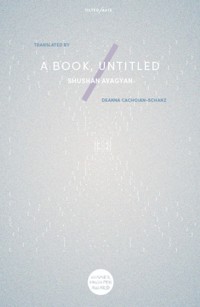
What is history, undocumented? How do we archive censored lives? A poetic reflection on authorship and erasure, A Book, Untitled is an intimate and innovative approach to autofiction and the act of remembering. In her first novel, Armenian writer Shushan Avagyan tells the story of a fictional encounter between Shushanik Kurghinian and Zabel Yesayan, two early twentieth-century pioneers of feminist literature, whose legacies have been obscured in Armenian history. Their fictive meeting is interspersed with conversations between the author and her friend Lara, who are researching the work of Kurghinian and Yesayan. While sifting through censored documents, unpublished works, and unfinished drafts, they linger in speculation and piece together lives that have been overshadowed by the Tsarist and Stalinist regimes. At once electric and ephemeral, A Book, Untitled is a story of re-cognition otherwise—posthumous, imagined, and intricately powerful.
Sie lesen das E-Book in den Legimi-Apps auf:
Seitenzahl: 190
Veröffentlichungsjahr: 2023
Das E-Book (TTS) können Sie hören im Abo „Legimi Premium” in Legimi-Apps auf:
Ähnliche




















A Book, Untitled
Praise for A Book, Untitled
A Book, Untitled
Title Page
A Note on BOOK
Dedication
1. Preface, or We as
1.5. Letter to Violet
2. Coming from Our Native Land . . .
3. A Distant Sorrow in the Flower-Garden of My Soul
4. How I Write and How I Would Like to Write
5. She’s My Laurel and the Mighty Marble Statue of My Glory
6. The Inevitable Will Crown Us with an Inseparable Connection
7. My Dear Sister, on the Occasion of Your Return
8. But Only One Bright Ray? . . . Oh, That’s Not Enough, Dear Gentlemen
9. There Are Unknown Songs . . . Silent and Voiceless
10. Reversal, or Peripety
11. That’s Her, They Say, the Poet
12. A Short Chapter
13. They Told Me
14. We Happened Upon Each Other Again in a Room, Me
15. To the Square!
16. An Unbearable Chapter
17. No New Armenian
18. There Was No Water
19. At Dawn
20. Raquellessness, or
21. Take Away My Longing
22. On Black Nights When There Are No Stars
23. I’ll Wander and Endure . . .
24. And They Swung from
25. Some Blackguards . . .
26. Conclusion, Or
Translator’s Afterword
Chapter Guides*
Copyright
About Tilted Axis Press
1
2
3
5
9
10
11
12
13
15
17
18
19
20
21
22
23
25
26
27
28
29
30
31
32
33
35
36
37
38
39
41
42
43
44
45
46
47
48
49
50
51
52
53
55
56
57
58
59
60
61
62
63
64
65
66
67
68
69
70
71
72
73
74
75
77
78
79
80
81
83
84
85
87
88
89
90
91
92
93
94
95
96
97
98
99
101
102
103
104
105
107
108
109
110
111
113
114
115
116
117
118
119
121
122
123
124
125
126
127
128
129
130
131
132
133
135
136
137
138
139
140
141
142
143
144
145
146
147
148
149
150
151
152
153
154
155
156
157
158
159
160
161
162
163
164
165
166
167
168
169
170
171
172
173
174
175
176
177
179
180
181
182
183
184
185
186
187
188
189
191
Landmarks
Cover
Table of Contents
Start of Content
Praise for A Book, Untitled
“The English-speaking world already owes Shushan Avagyan a tremendous debt for her essential translations of the Russian formalist Viktor Shklovsky. Now she has composed a brilliant novel of her own. A Book, Untitled is a powerful pastiche of voices and eras, as well as a feminist reclamation of Armenian women writers lost to time. For all its shifting, its purposeful resistance, its sharpness and darkness, I found this book simply delightful.”
—Martin Riker, author of The Guest Lecture
“At once lyrical and theoretical, personal and protest, Avagyan’s singular approach fabricates a polyvocal palimpsest tinged with exile and opacity, distortion and estrangement. Authorship, and the hegemony from which it hails, will never be the same.”
—Alex Brostoff, co-translator of
Ailton Krenak's Life Is Not Useful
“Written in fragments, excerpts of dialogue, quotations, parts of poems, and imagined postcards, Shushan Avagyan’s A Book,Untitled poses the question: How does writing create under- standing? In commendation of two largely ignored Armenian women writers—Shushanik Kurghinian and Zabel Yesayan— this book is a kind of answer.”
—Micheline Aharonian Marcom,
author of A Brief History of Yes
“A Book, Untitled is an absorbing, moving literary experiment.”
—Alistair Ian Blyth, translator of Varujan
Vosganian’s The Book of Whispers
“Shushan Avagyan’s Girq-anvernagir is among the most interesting phenomena of the post-Soviet era.”
—Taguhi Ghazaryan, literary critic
“Avagyan’s book is completely new writing within the Armenian world, as much in its form and mode as in its content.”
—Marc Nichanian, author of Writers of Disaster:
Armenian Literature in the Twentieth Century
A Book, Untitled
A Note on BOOK and Its
Historical Protagonists
from the Translator
Girq-anvernagir was published as samizdat in Yerevan in 2006. The book’s cover image—two black, empty cast iron chairs seated on opposite sides of a matching black table, set slightly to the left—meets the eye against a minimalist red and white backdrop, setting the stage for an unassuming 128 pages divided into 26.5 chapters composed in Eastern Armenian.
Written as a literary experiment while its author was simultaneously translating the poems of Armenian writer Shushanik Kurghinian into English, Girq-anvernagir reads on its surface as a translator’s diary. However, through seemingly unrelated and fragmented vignettes in disparate and unidentified voices, the reader discovers that Avagyan is actually mapping out a larger archival or archeological site. The book’s first chapter, “Preface, or We as Two Separate Planets,” draws our map: an imagined encounter between two early twentieth-century writers, Shushanik Kurghinian and Zabel Yesayan, whose legacies have largely been obscured and forgotten. Juxtaposed with this fictive meeting is a conversation between two characters—“the typist/writer” (ostensibly Avagyan, the author) and her friend Lara—who share with each other what they’ve uncovered while sifting through the archives of various state institutions in Yerevan in their effort to piece together the forgotten stories of Kurghinian and Yesayan. The novel opens with “the typist/writer” and Lara sitting in a café in Yerevan, just as their predecessors might have done. Discussing the fragments they have found in the archive, including letters that were written to the forgotten authors, the friends are burdened with questions of loss. Lara suggests to write a book about it. Avagyan answers her call.
In the chapters that unfold, Girq-anvernagir not only tells the story of the author and her friend’s search for Kurghinian and Yesayan, but through that story, the novel is also a poetic reflection on authorship and the fashioning of the self. The novel, then, might best be described as a work of metafiction or autotheory—a genre of literature in which the text theorizes itself. As such, A Book, Untitled tells a story about, in, and through archival gaps: an approach through which Avagyan as author and literary critic offers her own commentary on censorship, editorship, translation, and the lost legacies of these (women) authors in the Armenian literary and historical canons.
The main historical protagonists of A Book, Untitled are the authors Shushanik Kurghinian and Zabel Yesayan. Shushanik Kurghinian (1876–1927) was a poetry and prose writer from Alexandrapol (present-day Gyumri, Armenia) who wrote highly revolutionary poetry, women’s rights central to her voice. Kurghinian (née Popoljian) attended primary school at a local monastery, then the Alexandrapol Arghutian Girls’ School, and later a Russian gymnasium. Kurghinian was the founder of the first women’s branch of the Social Democrat Hunchakian Party in her hometown. In 1897, she married Arshak Kurghinian, who was a member of the socialist underground in the Caucasus. In 1903, under the threat of ending up in the Tsar’s Siberia after being blacklisted and set to be arrested for her socialist activism in Alexandrapol, she escaped with her two children, Arshakanoush and Shavarsh, to Rostov-on-Don. Her third child, Arsham, was born in 1910. Kurghinan remained in Rostov with the children while Arshak returned to Alexandrapol to tend to the family business. Kurghinian returned to Armenia in 1921, when the country became a socialist republic, at the invitation of Alexander Miasnikian, the Chairman of the Council of People’s Commissars of Armenia (1921–1922). As a poet, Kurghinian was criticized both by the tsarist regime and Armenian writers and nationalist members of the Armenian Revolutionary Federation (or Dashnaktsutyun Party) for her socialist and revolutionary ideas. Despising her socialist themes and unable or unwilling to acknowledge the strength of her writing, they criticized Kurghinian for her lack of “artistry.” Later, in the Soviet era, her overtly feminist poems were ignored, while her poems devoted to the working class were used to serve the ruling political opportunisms of the Soviet party and its ideology. After the collapse of the Soviet Union, even as a proletarian poet, Kurghinian was simply forgotten. Her name remained only in the memories of the older generation—a trace of Soviet propaganda.
Zabel Yesayan (1878–1943?) was a prose writer, translator, and literature professor from Constantinople (present-day Istanbul, Turkey). She was a prolific writer, whose early works depicted a multiculturalist Ottoman society, giving voice to characters across ethnoreligious divides as well as denouncing social conservatism. At a young age, Yesayan (née Hovhannesian) was sent to study at a neighborhood school in her native city, and later, attended classes in Paris, including at the Sorbonne. She married the painter Dikran Yesayan in 1900 while in Paris, and in 1901, their daughter Sophie was born. For extended periods following, their family both migrated together and was separated: Yesayan moved back and forth from Paris to Constantinople between 1902 and 1908, finally resettling in Constantinople following the Young Turk Revolution. Her son Hrant was born in 1910, in Paris, during yet another sojourn. After continued back and forth between the two cities, Dikran took Sophie and moved definitively to Paris. Yesayan and Hrant remained in Constantinople. Yesayan fled Constantinople to Bulgaria in the fall of 1915 to escape persecution: she was one of those listed on the April 24 Blacklist of 1915, which condemned most of her male intellectual peers to death at the onset of the Armenian Genocide. From Bulgaria she fled to the Caucasus, where she worked with Armenian refugees, documenting their eyewitness accounts of atrocities, and from where she led relief efforts for Armenian orphans. The family was eventually reunited in France after the war in 1919. Dikran died there two years later. Yesayan made her first visit to Soviet Armenia in 1926, settling there with her two children in 1933. Four years later, she was accused of Armenian nationalism during the Great Purge in 1937. She was first imprisoned and then physically disposed of by the Stalin regime sometime around 1943. The details and location of her disappearance have been censored. Later, the majority of her seminal literary works were hardly popular. Yesayan is the author of sixteen works, including novels and essays written in Armenian, French, and Turkish. Kurghinian is derided and forgotten; Yesayan is killed. Yet, in 1926, the year in which Avagyan sets their meeting, the lives of both women overlap in Yerevan: Yesayan has just arrived in the Soviet Armenian capital, and Kurghinian dies there one year later, in 1927.
“Literature is a weapon to struggle against injustice,” wrote Zabel Yesayan. In Avagyan’s contemporary response to the literary canon’s erasure of Kurghinian and Yesayan, Girq takes Yesayan’s task to arms by formally mimicking the very erasure and distortion of the canon that it criticizes. Girq autocensors through the use of ****, plagiarizes poetry and prose (from Kurghinian, Yesayan, and elsewhere), and uncovers lost h(er)stories. In so doing, Girq performs various forms of censorship and provokes the question of “who can author?”
As the novel progresses, it becomes apparent that the “typist/writer” is also writing love postcards, the lines of which pepper the novel in italics. Who is the recipient of these unaddressed postcards? A lover, the writers, the reader, a homeland? Who is the speaker? What is historical, what is imagined? Is there a difference? What has been, and what is still being censored?
Thus, through a series of meta critiques, a stream of (fictional?) memories, and this collection of unsent or unarrived love postcards (not unlike the postcards written to and by Yesayan while she was in jail), the novel, between theory and practice, recounts the story of a constant becoming. In turn, Avagyan beseeches her readers to sit in the uncomfortable knowing that neither history, nor memory, nor ourselves, are ever fully recoverable. Instead, as the novel suggests, it is our duty to re-make them, each time re-remembered, and again anew.
—D. Cachoian-Schanz
For Varanda
1. Preface, or We as
Two Separate Planets
Dear Marina Tsvetaeva, I wish you hadn’t hurried. I’m standing below your window now repeating your words: When you love, you live without Hope.
In spring.
The next time we met, she told me not to write her anymore.
Starting today, she said.
One day in spring.
On March 22 of 1960, Sophie Yesayan writes, “My mother was in the city jail; I needed to see her. She caressed my two-year-old child and said to her, ‘You’ll be a pioneer, and you’ll say: My grandmother was a counter-revolutionary.’ She asked for embroidery thread.”
I am not to write to you.
Lara and I are sitting at the café on Abovyan Street, across from the museum.
Perhaps write a book (and start from the end)?
.Kurghinian’s to close very philosophically were ideas her, revolutionary-counter a Though
I promise not to wait for your call, my dear.
Just imagine if they’d met each other, says Lara.
Like You and Me.
“In the Waiting Room.”
Someone will remember the disappeared, and while remembering, write verses dedicated to them, and while reading those verses, yet another will re-remember them.
The loss of one thing will help re-find another.
In his letter Arshak writes, “You’re torturing me. If you doubt it then take a good hard look at me.” It was May 24, 1895, when the cherry blossoms had already fallen from the trees.
I’m going to write to you in an Other language so that you won’t understand the underflowing current of my feelings.
In early spring, when the snow melts . . .
Some of the final pages of Barpa Khachik are missing.
Or more precisely, the book wasn’t finished.
“Spouses are actors who simultaneously play different roles upon the same stage.”
We’ll reflect upon this theme in the coming chapters.
Perhaps they would have sat just like us, in a café, people-watching. One would have recounted her exiled life in Paris, and the other her life in Rostov-on-Don.
I’m dedicating this book to you.
My dear, it’s been a whole week since we’ve seen each other. Last Sunday when you came to visit me . . .
You’re the city in which I’m exiled.
Not all postcards bear such pleasant news.
Sophie writes, “I saw her twice in the summer of 1940. She said that she appealed to Beria, and now she’s waiting . . . hoping for the best.”
Tell me about your cocooned life, about how you were covered in silken threads, about how you fell asleep. Tell me about how your body changed colors, about how you didn’t recognize yourself when you awoke, and about how the rays of the sun newly welcomed your waking eyes.
Unpublished note: “Easily possessed desire has no charm.”
All the promises, all the now-and-forever-and-evers, all of them are irrevocable.
On one of your sidewalks, my dear, I hid a sickly seed, a tiny black-eyed seedling. Let me water it so it doesn’t die.
She was writing by candlelight . . . erasing and writing: “And so, departing from your side, oh so suddenly, I will fly like lightning, and then fall back to the black earth’s frigid arms, crushed by your unknowing heart.”
Her first poem poured out from her with ease (like the salty waters of the Black Sea), (with the righteousness of a martyr) swooping down unashamed, unexpected, and drunken like the seagulls.
I’ll enter my office, lock my doors,
and turn on (Tamar’s) lamp,
My hands will take this very same pen and I’ll write . . .
Two days is an eternity
On the frozen petals of the iris
And I’ll write: two years is old age, resting on my shoulders
like a wedding veil;
And I’ll write: two centuries is an ephemeral second, quivering
on my lips from your kiss;
And when finally the ink of my pen dries,
I will open my doors to the Ringing of the Dawn;
I’ll step outside,
Holding the pages of your life to my chest.
If we could have recovered all of the pages that had been torn out, burned, and destroyed by the critics, the libraries would simply overflow.
(let me lick all your wounds);
I descend from the tribe of the Arlez, Semiramis’s immortal
dogs,
A servant of the altar, daughter of insolence; I came
to give you new breath, your veins new blood;
You’ve become lifeless, bloodless, without shelter, abandoned
and hardened after the battle, your pride wounded . . .
Let me plant my roots in you, my city. I’ll sprout and grow with new branches, and spread my roots deeper inside you.
“The warden turned down the third meeting.”
One day you’ll write, Lara. Just don’t put it off.
The most important part of a book is its footnotes, but many people ignore them. We’ve got to come up with a different method.
Fifty-nine handwritten notebooks.
All the poems included in these pages (with the exception of those highlighted in the footnotes) are being published for the first time.
Sophie writes, “And just like that, I never saw my mother again.”
You probably don’t remember me. I always sat in the very back of the classroom, usually silent.
What should I write about? How should the book attract you, seduce you so that you don’t put it down, so you can feel the hopelessness of my sleepless nights?
Only on two conditions, you said: not to write you and not to look for you.
Imagine that you’re reading four books in four different languages, simultaneously.
Your hands, your strong arms, your slender, delicate fingers.
“Sometime between 1940–41 they transferred my mother from Yerevan to Leninakan,” Sophie writes. “My brother saw her in prison.”
Together, Lara and I went to the museum to see the manuscripts.
Sophie writes, “That was my brother’s last meeting with her.”
How can I trust you? How can I know? Perhaps this is also our last meeting.
Don’t assume, don’t wait, don’t
Marina’s light has faded. She’s standing in the dark by the window, smoking her Gitanes cigarettes. The rings of smoke are black and envelop her body.
. . . they are collected in one generic notebook that contains about one hundred and twenty poems, both published and unpublished.
The notebook is dated: 1894–1908.
One day it’ll happen: with the clarity of a lake, my mind afresh and my fingers nimble, in my own words, one day I’ll write.
But now I can’t—you forbid it.
These words grew on your streets, numb from your frigidity and veiled in the shadows, hidden in the cracks of the asphalt warped from the cold.
Sophie writes, “In 1939 she’d often send us postcards,” embroidered with red thread.
One is preserved in the museum.
Condemned postcards.
“From 1940–41, the postcards became fewer and farther between.”
A meeting that never took place.
Maybe she’d have talked about her childhood and how her father had decided to send her off to a convent, and how one day they’d locked her up in the “rodent pit” because she’d misbehaved.
It’s already late, but wait just a little bit longer.
Sophie writes, “Between 1941–42, the postcards stopped.” Then she adds, “I imagine she died sometime in those years.”
A book composed of postcards from death row.
Sitting together in the café, they’ve completely forgotten that it’s getting cold and that their glasses have long been empty.
“According to the official data, my mother has been sent from Yerevan to Baku,” writes Sophie.
“And then from Baku to Karaganda, but she hasn’t arrived. She’s been placed in the unknown category.”
Busts of all the beloved figures are arranged in the lobby of the state university. “But where is she?” asks Lara. “Why isn’t her bust there?”
I answer.
Fifty-nine pages are missing from the book and while reading you come across asterisks denoting that some things from that section have been erased.
Sophie writes, “The Public Court withdrew her official date of death. The Registry Office dated it 1937.”
It’s today: men and women have gathered at the sacrificial altar.
I surrender my possessions to you all—all of me—
my only dowry and riddle;
take out my eyes, take them out with the branches of an apple
tree,
place them on your silver sacrificial tray, let them dry;
henna-painted, break my fingers one-by-one
so that I won’t write anymore, won’t bleed from the wounds
of a needle;
they weren’t created for embroidering;
cut off my breasts, that hang like two lovesick earrings,
they’re not giving milk, worthless! worthless!
full of lies and maggots,
villainous! oh! villainous!
remove my tongue so I won’t pray,
so that I won’t sing for you in the foreign words of the
mythical Arlez;
this tongue, that for many lives, has been imprisoned between
my teeth—
silenced from fear, silenced! silenced!
Sophie writes, “I would have wanted the ashes to have been brought to our pantheon; she loved her fatherland, her compatriots; that would have been her final resting place, ‘At the foot of Ararat,’ as she’d liked to say.”
Cause of death: unknown.
Place of death: unknown.
1.5. Letter to Violet
Brave people have formed a line all the way up to the front of the coffee shop at Logan Airport.
They make everyone remove their belts.
Her last name in Turkish means garden.
We still have two hours before the flight.
I read couplet by couplet while they compared the translation to the original.
When the three of us arrived and knocked on the door, she met us barefoot and we stood on the porch for half an hour.
It turns out the neighbors had the keys.
In his preface, Boccaccio writes on behalf of women: “Remember, we are all women and no one among us so young that she doesn’t know what follies we’d make without the help of some man.”
That evening we decided to go to a tearoom to get to know each other, and then begin our work the next day.




