


Erhalten Sie Zugang zu diesem und mehr als 300000 Büchern ab EUR 5,99 monatlich.
- Herausgeber: Pushkin Press
- Kategorie: Gesellschafts- und Liebesromane
- Sprache: Englisch
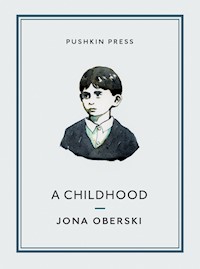
A small boy grows up in Amsterdam, making sand pies, playing with his favourite jumping jack toy, visiting his father's office as a treat. He is loved. Then men with guns come in the night to take them away, and the familiar world of his childhood is destroyed. In this searing, spare novel Jona Oberski, who was transported to Bergen-Belsen as a young boy, recreates the state of childhood with unblinking, almost unbearable clarity. Conveying the joy of family life and the terror of separation, these vivid, haunting snapshots of memory have the darkness and strangeness of the most terrible fairy tale, as a child tries to understand the horror unfolding around him.
Sie lesen das E-Book in den Legimi-Apps auf:
Seitenzahl: 127
Veröffentlichungsjahr: 2014
Das E-Book (TTS) können Sie hören im Abo „Legimi Premium” in Legimi-Apps auf:
Ähnliche



















JONA OBERSKI
A CHILDHOOD
Translated by Ralph Manheim
PUSHKIN PRESS LONDON
grass in a blue teapot set apart, amongst the growing, fading, still living grass
JUDITH HERZBERG
From Beemdgras en zachte dravik
(Meadow grass and soft brome)
CONTENTS
I
MISTAKE
“DON’T BE AFRAID. Everything’s all right. I’m right here.”
The hand on my cheek was my mother’s; her face was close to mine. I could hardly see her. She whispered and stroked my hair. It was dark. The walls were wood. There was a funny smell. It sounded like there were other people there. My mother lifted my head up and pushed her arm under it. She hugged me and kissed me on the cheek.
I asked her where my father was.
“There’s been a mistake, but everything will be all right. We’ve gone away for a few days with a lot of other people, but we’ll be going home soon and daddy will be there too. They’ve made a mistake, so we’ll have to stay here for a few days, visiting the way we visited with Trude a while ago. Remember? Trude made cauliflower. But when it was on your plate you wouldn’t eat it, because you weren’t used to cauliflower. She tried to make you believe that babies come out of cauliflowers. But you know they come out of their mother’s tummies. You came out of mine. Remember those pictures at home that show you coming out of my tummy and drinking milk from my breast, and having a bath. Remember?
“Daddy had to go to the office yesterday morning. Then they came to get us, but you were very sleepy. Remember? We walked a long way. I left a note for daddy, because they made a mistake, we really didn’t have to go. They’ll give daddy the note and in a few days we’ll be going home again. There are lots of people here with children, so you won’t be bored. We haven’t got many toys, because we had to leave in a hurry. I couldn’t even tell the woman next door. Later on, we were lucky enough to meet some people we knew. Remember? That nice Mr. L. joked with you. He promised to let daddy know. He must have told him long ago. Maybe when it gets light tomorrow there’ll be a letter from daddy.
“There are other people here, that’s why we have to whisper. Otherwise, we’d wake them up, and all the people here are tired. You’re tired too. You slept the whole time in the train. Remember the train? No, angel, maybe not. You were too sleepy.
“It’s too bad they made this mistake. But we’ll be home again in a few days.”
Somebody shouted Shhh. My mother whispered so close to my ear that it tickled. “Go to sleep now. I’m right here, I won’t go away. Tomorrow we’ll take a look at our camp, and in a few days we’ll go home to daddy.”
She gave me a kiss. The air in my nose was cold. It was cold under the blankets too. I cuddled up to my mother and her warm breath blew into my nose.
On the second day a letter came from my father, and on the fourth day there was a package. Every day I asked if we could go home. But she said no, it would be a few days.
A week later we went home. A few other people went, but most stayed.
My father was waiting for us.
He kissed my mother and me and they cried.
JUMPING JACK
“YOU’RE GOOD AT KEEPING your eyes shut,” my mother said. “Shut them good and tight. I’m going to carry you inside, and you can open them when I tell you. All right?”
I shut my eyes. Through my closed eyelids I could see the light in my room. I heard my father. “Can we come in?” my mother called. She picked me up in her arms. I looked to see what was happening. “No, angel,” she said. “Shut them tight. You promised.” She carried me through the house. My eyes kept wanting to open, so I put my hand over them. I noticed we’d come to where my father was. “You can open them now.” In that same moment my father and mother began to sing “Happy Birthday to You.” My father and mother kissed me on the cheeks and I kissed them back. My father took me from my mother’s arms. My mother looked at me. I saw the lamp reflected in her dark eyes. I felt my father’s rough cheek and tickly hair on my cheek. His hair was black. My mother’s hair was red. We were wearing our dressing gowns. My father’s was light-brown. My mother’s was light-blue. There were all sorts of different coloured things on the table.
“Aren’t you going to unwrap your presents?”
I looked at my father. The colours of the things on the table were reflected in his eyes. I gave him a kiss on the nose. That made him laugh.
“Don’t you want to see your presents?” He wanted to put me on the floor, but I was so comfortable just as I was. I had one arm round his neck and I held him tight.
“All this is for you.” My mother smiled at me and pointed at the table and kissed me. She picked up a red package, began to open it, and asked me to help her. While she held the package, I tried to get the paper off with one hand. It tore.
“It doesn’t matter, it’s only the paper.” My father put me down on the floor and I pulled the paper off with both hands. Out came a flat wooden doll with strings. He was brown and red and yellow with a laughing face. My mother took hold of a string and held it up. “Here, pull this.” I held on to my father’s dressing gown with one hand and pulled the string with the other. My mother helped me. The jumping jack spread his arms and legs when I pulled and dropped them when I let go.
“We’ll hang him up over your bed. Here, angel, hold him in both hands.” I took him, I had fun with my toy. My father had his arm around my mother’s shoulder and all together we watched the jumping jack. I had to laugh every time he spread his legs. They laughed too.
“There are lots of other presents. Look.”
I looked at the jumping jack in my hand.
“It’s too much at once,” my father said. “Let’s give him the rest later.” He grabbed me around the waist with his two big hands. He lifted me up and I flew through the air. He set me down on his shoulders, bent low to get through the doors, and plopped me down on my parents’ big bed. I crawled under the light-blue blankets. My father and mother drank tea in bed. We laughed at my jumping jack.
They gave me the rest of the presents later.
SHOPKEEPER
THE DOOR OF THE SHOP was behind my back. It was open and my mother was inside. I could hear her talking with the shopkeeper. The rain was coming down on my hood. My hands under my cape kept dry. I put one hand through the slit. I saw the raindrops coming down on my hand. The drops kept giving me little cold taps, each time in a different place.
There was sand all around me. I took a light-yellow brick and put it down on end in the dark-yellow sand. I let go. It fell over. I smoothed the sand a little with the brick. Then it stayed up.
My mother came and stood near me. “Isn’t it nice in the rain? Do you want your bucket and spade? I’ll get them for you.” I looked round. There was no one in sight. All I could see was the shop: a wet window and a dark hole. My mother called out to the shopkeeper. She said I was playing outside the door. The shopkeeper called back: “All right.” I looked after her. The shopkeeper came and stood in the doorway. “Nice rain, eh?” I pointed at my mother. “She’ll be back straight away,” he said. My mother tapped hard on the windowpane and waved to me. I laughed and waved back. I took another brick and stood it on end. It fell over every time I let go. Suddenly my mother was standing beside me. She shovelled sand into the bucket. “You see?” she said. “This is how it’s done.” I knew that already. I started shovelling. “I’m going back up again,” she said, and kissed me on my wet forehead. I gave her a kiss on her wet chin.
With my spade I beat the sand flat. The bricks stayed up. My mother had brought a mould too. I put sand in the mould and made a row of sand pies.
The bricks fell over. I saw two feet. I stood up. A boy was looking at me. He lifted one foot and brought it down on a sand pie. I looked at the sand pies. Bam. The biggest one was squashed. He stamped on every one of them. The mould disappeared in the sand. “Ha ha ha,” he said and ran away. I had to laugh too. I took my shovel and dug the mould out of the sand. I made new pies on a flat stretch of sand. I filled the pail; I thought I’d make a big sand pie. I smoothed out a place with my hand. The feet almost stepped on my hands. I moved them away quick and looked up at the boy. He stamped on all my pies. He shouted “ha ha” and “lovely” and “this is fun.” I looked at our window. My mother wasn’t there. The shop door was closed. My hood got pulled off my head. “Ha ha, what a crazy Jewish coat.” A lot of sand came down on my head. I began to cry. The bucket fell on the ground beside me. I stood up. I ran to our house. I ran up the stairs. I banged on the door. My mother opened it. She picked me up. “Angel,” she said. “What is it?” She hugged me tight. She wiped the sand off my face with a flannel. She kissed me and brushed the sand out of my hair. I stopped crying. “Oh, what a deep sigh,” she said. She took me over to the window. “Haven’t you brought your bucket and spade back?”
She went and got them. I didn’t want to go with her. I looked out of the window. She came back. I ran to the door to meet her and asked if she had the mould too. She went back, but she couldn’t find the mould.
Later my father came home. We told him what had happened. My father asked if it was the grocer’s son. I nodded. My father went out. I looked out of the window and saw him going into the shop. After a while he came back. He took me on his lap and kissed me. The grocer said it couldn’t have been his son; he said he’d always sold us everything we wanted, which had got him into plenty of trouble, and my mother shouldn’t have left me outside the shop all by myself. My father told my mother never to do it again.
My mother was crying when she came home next day. My father comforted her. She said: “He wouldn’t sell me anything. I asked him why, seeing we’ve always paid promptly. He said it was forbidden.” My father said my mother could go to a shop that belonged to someone we knew, who’d be glad to help us. My mother said it was a long way to go, but all right.
I climbed up on my mother’s lap. I put my arm round her neck. She hugged me tight. My father came over to us.
“We’ll make a circle of heads,” he said. “Then we can give each other a kiss all at once.”
That’s just what we did.
WINDOW CLEANER
“THE WINDOW CLEANER IS HERE.” My mother woke me gently from my afternoon nap. “Would you like to watch him?”
I stood up and threw my arms round her neck. She carried me into the parlour. The tile stove was burning and the lamp was lit. I heard music.
I climbed up on the bench across from the bookcase. The window cleaner waved at me through the window. I waved back. My mother brought me a cup of hot milk. It was dark outside. The window cleaner was dressed in white. He wet the windows with a sponge and rubbed from top to bottom and from left to right to left. Now and then he’d scratch the pane with his finger-nail. Then he did the same thing with another sponge that he dipped in a different bucket. He pressed the wet sponge flat against the glass. Streams of water zigzagged down the pane. He wiped away most of the water with his black wiper, right, left, right, in big circles. He took a chamois out of his white bucket, squeezed it out and folded it. Left, right, left, same as with the wiper, but this time it was harder. I heard it squeaking on the glass. My mother looked up from her ironing board. She turned up the music. “Do you like this music?” I nodded. She began to sing. “It’s Mozart. That’s the name of the composer. Remember that name, Mozart.”
She put the iron down on its end and took something from the pile of clothes. “Would you dampen it for me?” she asked. I took another swallow of hot milk. Then I went over to her. She dipped my hand in the lukewarm water and sprinkled the dress she was going to iron. The window cleaner pursed his lips and nodded. He stood on the edge of the window frame, moved the ladder and wet the other window. My mother rolled up the dress. I dipped my hand in the water again, sprinkled some other things and rolled them up. Then I sprinkled my hair.
I went to my room, climbed up on my bed, and took my jumping jack. I made it dance for the window cleaner. He clapped his hands. Then he climbed down the ladder.
*




