


75,99 €
Mehr erfahren.
- Herausgeber: John Wiley & Sons
- Kategorie: Wissenschaft und neue Technologien
- Sprache: Englisch
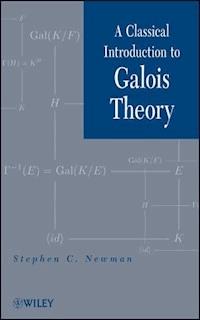
Explore the foundations and modern applications of Galois theory Galois theory is widely regarded as one of the most elegant areas of mathematics. A Classical Introduction to Galois Theory develops the topic from a historical perspective, with an emphasis on the solvability of polynomials by radicals. The book provides a gradual transition from the computational methods typical of early literature on the subject to the more abstract approach that characterizes most contemporary expositions. The author provides an easily-accessible presentation of fundamental notions such as roots of unity, minimal polynomials, primitive elements, radical extensions, fixed fields, groups of automorphisms, and solvable series. As a result, their role in modern treatments of Galois theory is clearly illuminated for readers. Classical theorems by Abel, Galois, Gauss, Kronecker, Lagrange, and Ruffini are presented, and the power of Galois theory as both a theoretical and computational tool is illustrated through: * A study of the solvability of polynomials of prime degree * Development of the theory of periods of roots of unity * Derivation of the classical formulas for solving general quadratic, cubic, and quartic polynomials by radicals Throughout the book, key theorems are proved in two ways, once using a classical approach and then again utilizing modern methods. Numerous worked examples showcase the discussed techniques, and background material on groups and fields is provided, supplying readers with a self-contained discussion of the topic. A Classical Introduction to Galois Theory is an excellent resource for courses on abstract algebra at the upper-undergraduate level. The book is also appealing to anyone interested in understanding the origins of Galois theory, why it was created, and how it has evolved into the discipline it is today.
Sie lesen das E-Book in den Legimi-Apps auf:
Seitenzahl: 458
Veröffentlichungsjahr: 2012
Ähnliche


















Table of Contents
Title Page
Copyright
Preface
Chapter 1: Classical Formulas
1.1 Quadratic Polynomials
1.2 Cubic Polynomials
1.3 Quartic Polynomials
References
Chapter 2: Polynomials and Field Theory
2.1 Divisibility
2.2 Algebraic Extensions
2.3 Degree of Extensions
2.4 Derivatives
2.5 Primitive Element Theorem
2.6 Isomorphism Extension Theorem and Splitting Fields
References
Chapter 3: Fundamental Theorem on Symmetric Polynomials and Discriminants
3.1 Fundamental Theorem on Symmetric Polynomials
3.2 Fundamental Theorem on Symmetric Rational Functions
3.3 Some Identities Based on Elementary Symmetric Polynomials
3.4 Discriminants
3.5 Discriminants and Subfields of the Real Numbers
Chapter 4: Irreducibility and Factorization
4.1 Irreducibility Over the Rational Numbers
4.2 Irreducibility and Splitting Fields
4.3 Factorization and Adjunction
Chapter 5: Roots of Unity and Cyclotomic Polynomials
5.1 Roots of Unity
5.2 Cyclotomic Polynomials
Chapter 6: Radical Extensions and Solvability by Radicals
6.1 Basic Results on Radical Extensions
6.2 Gauss'S Theorem on Cyclotomic Polynomials
6.3 Abel'S Theorem on Radical Extensions
6.4 Polynomials of Prime Degree
Chapter 7: General Polynomials and the Beginnings of Galois Theory
7.1 General Polynomials
7.2 The Beginnings of Galois Theory
Chapter 8: Classical Galois Theory According to Galois
Chapter 9: Modern Galois Theory
9.1 Galois Theory and Finite Extensions
9.2 Galois Theory and Splitting Fields
Chapter 10: Cyclic Extensions and Cyclotomic Fields
10.1 Cyclic Extensions
10.2 Cyclotomic Fields
Chapter 11: Galois's Criterion for Solvability of Polynomials by Radicals
Chapter 12: Polynomials of Prime Degree
Chapter 13: Periods of Roots of Unity
Chapter 14: Denesting Radicals
Chapter 15: Classical Formulas Revisited
15.1 General Quadratic Polynomial
15.2 General Cubic Polynomial
15.3 General Quartic Polynomial
Appendix A: Cosets and Group Actions
Appendix B: Cyclic Groups
Appendix C: Solvable Groups
Appendix D: Permutation Groups
Appendix E: Finite Fields and Number Theory
Appendix F: Further Reading
References
Index
Copyright © 2012 by John Wiley & Sons, Inc. All rights reserved
Published by John Wiley & Sons, Inc., Hoboken, New Jersey
Published simultaneously in Canada
No part of this publication may be reproduced, stored in a retrieval system, or transmitted in any form or by any means, electronic, mechanical, photocopying, recording, scanning, or otherwise, except as permitted under Section 107 or 108 of the 1976 United States Copyright Act, without either the prior written permission of the Publisher, or authorization through payment of the appropriate per-copy fee to the Copyright Clearance Center, Inc., 222 Rosewood Drive, Danvers, MA 01923, (978) 750-8400, fax (978) 750-4470, or on the web at www.copyright.com. Requests to the Publisher for permission should be addressed to the Permissions Department, John Wiley & Sons, Inc., 111 River Street, Hoboken, NJ 07030, (201) 748-6011, fax (201) 748-6008, or online at http://www.wiley.com/go/permission.
Limit of Liability/Disclaimer of Warranty: While the publisher and author have used their best efforts in preparing this book, they make no representations or warranties with respect to the accuracy or completeness of the contents of this book and specifically disclaim any implied warranties of merchantability or fitness for a particular purpose. No warranty may be created or extended by sales representatives or written sales materials. The advice and strategies contained herein may not be suitable for your situation. You should consult with a professional where appropriate. Neither the publisher nor author shall be liable for any loss of profit or any other commercial damages, including but not limited to special, incidental, consequential, or other damages.
For general information on our other products and services or for technical support, please contact our Customer Care Department within the United States at (800) 762-2974, outside the United States at (317) 572-3993 or fax (317) 572-4002.
Wiley also publishes its books in a variety of electronic formats. Some content that appears in print may not be available in electronic formats. For more information about Wiley products, visit our web site at www.wiley.com.
Library of Congress Cataloging-in-Publication Data:
Newman, Stephen C., 1952–
A classical introduction to Galois theory / Stephen C. Newman.
p. cm.
Includes index.
ISBN 978-1-118-09139-5 (hardback)
1. Galois theory. I. Title.
QA214.N49 2012
512′.32–dc23
2011053469
Preface
The quadratic formula for solving polynomials of degree 2 has been known for centuries, and it is still an important part of mathematics education. Less familiar are the corresponding formulas for solving polynomials of degrees 3 and 4. These expressions are more complicated than their quadratic counterpart, but the fact that they exist comes as no surprise. It is therefore altogether unexpected that no such formulas are available for solving polynomials of degrees 5 and higher. Why should this be so? A complete answer to this intriguing problem is provided by Galois theory. In fact, Galois theory was created precisely to address this and related questions about polynomials, a feature that might not be apparent from a survey of current textbooks on university level algebra. The reason for this change in focus is that Galois theory long ago outgrew its origin as a method of studying the algebraic properties of polynomials. The elegance of the modern approach to Galois theory is undeniable, but the attendant abstraction tends to obscure the satisfying concreteness of the ideas that underlie and motivate this profoundly beautiful area of mathematics.
This book develops Galois theory from a historical perspective. Throughout, the emphasis is on issues related to the solvability of polynomials by radicals. This gives the book a sense of purpose, and far from narrowing the scope, it provides a platform on which to develop much of the core curriculum of Galois theory. Classical results by Abel, Gauss, Kronecker, Lagrange, Ruffini, and, of course, Galois are presented as background and motivation leading up to a modern treatment of Galois theory. The celebrated criterion due to Galois for the solvability of polynomials by radicals is presented in detail. The power of Galois theory as both a theoretical and computational tool is illustrated by a study of the solvability of polynomials of prime degree, by developing the theory of periods of roots of unity (due to Gauss), by determining conditions for a type of denesting of radicals, and by deriving the classical formulas for solving general quadratic, cubic, and quartic polynomials by radicals.
The reader is expected to have a basic knowledge of linear algebra, but other than that the book is largely self-contained. In particular, most of what is needed from the elementary theory of polynomials and fields is presented in the early chapters of the book, and much of the necessary group theory is provided in a series of appendices. When planning and writing this book, I had in mind that it might be used as a resource by mathematics students interested in understanding the origins of Galois theory and the reason it was created in the first place. To this end, proofs are quite detailed and there are numerous worked examples, while on the other hand, exercises have not been included.
Several acknowledgements are in order. It is my pleasure to thank Professor David Cox of Amherst College, Professor Jean-Pierre Tignol of the Université catholique de Louvain, and Professor Al Weiss of the University of Alberta for their valuable comments on drafts of the manuscript. I am further indebted to Professors Cox and Tignol for their exceptional books on Galois theory from which I benefitted greatly (see the References section). The commutative diagrams were prepared using the program diagrams.sty developed by Paul Taylor, who kindly answered technical questions on its use.
Needless to say, any errors or other shortcomings in the book are solely the responsibility of the author. I am most interested in receiving your comments, which can be e-mailed to me at [email protected]. The inevitable corrections to follow will be posted and periodically updated on the websites http://www.stephennewman.net and ftp://ftp.wiley.com/public/sci_tech_med/galois_theory.
Finally, and most importantly, I want to thank my wife, Sandra, for her steadfast support and encouragement throughout the writing of the manuscript. It is to her, with love, that this book is dedicated.
Chapter 1 Classical Formulas
where the coefficients a0, a1, … , an are indeterminates. When a solution exists, it provides a “formula” into which numeric coefficients can be substituted for specific cases. The quadratic formula for second degree equations is no doubt familiar to the reader (see the following discussion).
In fact, methods of solving quadratic equations were known to the Babylonians as long ago as 2000 B.C. The book Al Kitab Al Jabr Wa'al Muqabelah by the Persian mathematician Mohammad ibn Musa al-Khwarizmi appeared around 830 A.D. In this work, the title of which gives us the word “algebra,” techniques available at that time for solving quadratic equations were systematized. Around 1079, the Persian mathematician and poet Omar Khayyam (of Rubaiyat fame) presented a geometric method for solving certain cubic (third degree) equations.
An algebraic solution of a particular type of cubic equation was discovered by the Italian mathematician Scipione del Ferro (1465–1526) around 1515, but this accomplishment was not published in his lifetime. About 1535, a more complete set of solutions was developed by the Italian mathematician Niccolo Fontana (ca 1500–1557), nicknamed “Tartaglia” (the “Stammerer”). These results were further developed by another Italian mathematician, Girolamo Cardano (1501–1576), who published them in his book Artis Magnae, Sive de Regulis Algebraicis (The Great Art, or the Rules of Algebra), which appeared in 1545. The solution of the quartic (fourth degree) equation was discovered by yet another Italian mathematician, Ludovico Ferrari (1522–1565), a pupil of Cardano.
The next challenge faced by the mathematical scholars of the Renaissance was to find the solution of the quintic (fifth degree) equation. Since the quadratic, cubic, and quartic equations had given up their secrets, there was every reason to believe that with sufficient effort and ingenuity the same would be true of the quintic. Yet, despite the efforts of some of the greatest mathematicians of Europe over the ensuing two centuries, the quintic equation remained stubbornly resistant. In 1770, the Italian mathematician Joseph-Louis Lagrange (1736–1813, born Giussepe Lodovico Lagrangia) published his influential Réflexions sur la résolution algébrique des équations. In this journal article of over 200 pages, Lagrange methodically analyzed the known techniques of solving polynomial equations. The principles uncovered by Lagrange, along with his introduction of what would ultimately become group theory, opened up an entirely new approach to the problem of solving polynomial equations by radicals.
This was certainly the view held by the Italian mathematician and physician Paolo Ruffini (1765–1822), who published a treatise of over 500 pages on the topic in 1799. An important feature of his work was the extensive use of group theory, albeit in what would now be considered rudimentary form. Although specific objections to the proofs Ruffini presented were not forthcoming, there seems to have been a reluctance on the part of the mathematical community to accept his claims. Perhaps this was related to the novelty of his approach, or maybe it was simply because his proofs were excessively complex, and therefore suspect. Over the years, Ruffini greatly simplified his methods, but his arguments never seemed to achieve widespread approval, at least not during his lifetime. A notable exception was the French mathematician Augustin-Louis Cauchy (1789–1857), who was supportive of Ruffini and an early contributor to the development of group theory.
In any event, the matter was definitively settled by the Norwegian mathematician Niels Henrik Abel (1802–1829) with the publication in 1824 of a succinct and accessible proof showing that it is impossible to solve the general quintic equation by radicals. This result, along with its various generalizations, will be referred to here as the Impossibility Theorem. As remarkable as this achievement was, the methods used by Abel shed relatively little light on why the quintic equation is insolvable.
This question was answered in a spectacular manner by the French mathematician Évariste Galois (1811–1832). In fact, his approach encompasses not only general polynomial equations but also the more complicated case where the coefficients of the polynomial are numeric. In the manuscript Mémoire sur les conditions de résolubilité des équations par radicaux, submitted to the Paris Academy of Sciences when he was just 18 years of age, and published posthumously 14 years after his tragic death, Galois provides the foundations for what would become the mathematical discipline with which his name has become synonymous.
This book presents an introduction to Galois theory along both classical and modern lines, with a focus on questions related to the solvability of polynomial equations by radicals. The classical content includes theorems on polynomials, fields, and groups due to such luminaries as Gauss, Kronecker, Lagrange, Ruffini, and, of course, Galois. These results figured prominently in earlier expositions of Galois theory but seem to have gone out of fashion. This is unfortunate because, aside from being of intrinsic mathematical interest, such material provides powerful motivation for the more modern treatment of Galois theory presented later in this book.
Over the course of the book, three versions of the Impossibility Theorem are presented. The first relies entirely on polynomials and fields, the second incorporates a limited amount of group theory, and the third takes full advantage of modern Galois theory. This progression through methods that involve more and more group theory characterizes the first part of the book. The latter part of the book is devoted to topics that illustrate the power of Galois theory as a theoretical and computational tool, but again in the context of solvability of polynomial equations by radicals.
In this chapter, we derive the classical formulas for solving quadratic, cubic, and quartic polynomial equations by radicals. It is assumed that the polynomials have coefficients in , the field of rational numbers. This choice of underlying field is made for the sake of concreteness, but the arguments to follow apply equally to “general” polynomials as defined in Chapter 7. The discussion presented here is somewhat informal. In Chapter 2 and later in the book, we introduce concepts that allow the material given below to be made more rigorous. Suggestions for further reading on the material in this chapter, and other portions of the book devoted to classical topics, can be found in Appendix F.
1.1 Quadratic Polynomials
Let
1.1
1.2
The roots of f(x) are given by the quadratic formula:
1.3
Here and throughout, the notation ± is to be interpreted as follows: α1 corresponds to the + sign and α2 to the − sign. Accordingly, (1.3) is equivalent to
A corresponding interpretation is given to the notation ∓.
where
The roots of g(y) are
1.4
The quantity a2 − 4b is referred to as the discriminant of f(x) and is denoted by disc(f). We have from (1.3) that
1.5
1.6
This gives us a way of deciding whether a quadratic polynomial has a repeated root based solely on its coefficients. We will see a significant generalization of this finding in Chapter 3.
The symbol deserves a comment. In the absence of further conditions, represents either of the two roots of x2 − (a2 − 4b). When a2 − 4b > 0, is a real number, and it is common practice to take to be the positive square root of a2 − 4b. To take a simpler example, is typically regarded as the positive square root of 2, that is, The negative square root of 2 is then The distinction between the positive and negative square roots of 2 rests on metric properties of real numbers. In this book, we are focused almost exclusively on algebraic matters. Accordingly, unless otherwise indicated, stands for either the positive or negative square root of 2. Expressed differently but more algebraically, represents either of the roots of x2 − 2. As such, we are not obligated to specify whether equals 1.414 … or − 1.414 … , only that it is one of these two quantities; by default, is the other. Returning to , we observe that switching from one root of x2 − (a2 − 4b) to the other merely interchanges the values of α1 and α2, leaving us with the same two roots of f(x).
1.2 Cubic Polynomials
Let
1.7
1.8
where
1.9
into (1.8) and obtain
where z is assumed to be nonzero. The roots of g(y) can be determined by first finding the roots of
1.10
and then reversing the substitution (1.9). Observing that r(z) is a quadratic polynomial in z3, it follows that the roots of r(z) are the same as the roots of
Let
1.11
where, in keeping with (1.9), λ1 and λ2 are chosen so that
1.12
By definition, the cube roots of unity are the roots of the polynomial
In particular, the roots of x2 + x + 1 are
1.13
where, as usual, . In (1.13), we take to be the positive square root of 3. The notation ω will be reserved for for the rest of the book. We note in passing that
1.14
It follows that the roots of r(z) are
At first glance, it appears that the cubic polynomial g(y) also has six roots, which is impossible. However, because of (1.12), the following identities hold:
The three roots of g(x) are therefore
1.15
Substituting from (1.11), we obtain
1.16
which are known as Cardan's formulas.
1.3 Quartic Polynomials
Let
1.21
where
and
1.22
Let θ1 be a “quantity,” as yet unspecified, and add to both sides of (1.22) to obtain
1.23
We assume for the moment that θ1 ≠ p and view the expression in square brackets in (1.23) as a polynomial in y. As remarked in Section 1.1, this polynomial will be a square if its discriminant
equals 0. Accordingly, we now require θ1 to be an arbitrary but fixed root of
1.24
Cardan's formulas can be used to find an explicit expression for θ1. In view of (1.6), we can now rewrite (1.23) as
1.25
Define ϕ1 by setting
1.26
Then (1.25) becomes
This is equivalent to the pair of quadratic equations
which we rewrite as
1.27
respectively.
Denote the roots of the first equation in (1.27) by β1 and β2, and those of the second by β3 and β4. We then have
1.28
which will be referred to as Ferrari's formulas. Note that if we replace ϕ1 with − ϕ1 in (1.28), we obtain the same roots for g(y) but with the rows of (1.28) reversed.
The reason for the choice of notation will be made clear in Chapter 5. We return to Φ5(x) several times later in the book. To give Φ5(x) a more familiar interpretation, observe that
In the terminology of Chapter 5, the roots of x5 − 1 are the 5th roots of unity. More specifically, the roots of Φ5(x) are ζ5, , , and , where
The reduced polynomial corresponding to Φ5(x) is
In the above notation,
The reduced polynomial corresponding to s(z) is
Using Cardan's formulas, we find that h(y) has the roots
It follows that the roots of s(z) are
The respective values of ϕ1 are
Choosing and taking all square roots to be positive, we find from Ferrari's formulas that the roots of Φ5(x) are
1.29
In (1.29), the assignment of the powers of ζ5 to their expressions in terms of radicals was made on the basis of their respective numerical values.
References
Books and Monographs on Galois Theory and Related Topics
1944. E. Artin, Galois Theory, 2nd ed. (University of Notre Dame Press, Notre Dame, 1944).
1984. J. R. Bastida, Field Extensions and Galois Theory. (Addison-Wesley, Menlo Park, CA, 1984).
2006. J. Bewersdorff, Galois Theory for Beginners: A Historical Perspective. (American Mathematical Society, Providence, RI, 2006).
1960. W. S. Burnside and A. W. Panton, The Theory of Equations: With an Introduction to the Theory of Binary Quadratic Forms, Volume II. (Dover, New York, 1960), (Unabridged and unaltered republication of seventh edition published by Longmans, Green and Company in 1928.).
2005. A. Chambert-Loir, A Field Guide to Algebra. (Springer, New York, 2005).
1971. A. Clark, Elements of Abstract Algebra. (Wadsworth, Belmont, CA, 1971).
2008. R. Cooke, Classical Algebra: Its Nature, Origins, and Uses. (John Wiley & Sons, Inc., Hoboken, NJ, 2008).
2004. D. A. Cox, Galois Theory. (John Wiley & Sons, Inc., Hoboken, NJ, 2004).
1960. E. Dehn, Algebraic Equations: An Introduction to the Theories of Lagrange and Galois. (Dover, Mineola, NY, 1960), (Unabridged and corrected republication of book originally published by Columbia University Press in 1930.).
1902. L. E. Dickson, Introduction to the Theory of Algebraic Equations. Congruence of Sets and Other Monographs. (Chelsea, New York, 1902, 1967).
1965. H. Dörrie, Section 25: Abel's Impossibility Theorem In: 100 Great Problems of Elementary Mathematics: Their History and Solution. (Dover, New York, 1965).
2004. D. S. Dummit, and R. M. Foote, Abstract Algebra, 3rd ed. (John Wiley & Sons, Inc., Hoboken, NJ, 2004).
1984. H. M. Edwards, Galois Theory. (Springer-Verlag, New York, 1984).
2001. J.-P. Escofier, Galois Theory. (Springer, New York, 2001).
1992. M. H. Fenrick, Introduction to the Galois Correspondence. (Birkhäuser, Boston, MA, 1992).
1988. L. Gaal, Classical Galois Theory with Examples, 4th ed. (Chelsea, New York, 1988).
1986. D. J. H. Garling, A Course in Galois Theory. (Cambridge University Press, Cambridge, 1986).
1966. C. F. Gauss, Disquisitiones Arithmeticae: English Edition. (Springer-Verlag, New York, 1966).
1978. C. R. Hadlock, Field Theory and Its Classical Problems. (Mathematical Association of America, Washington, DC, 1978).
2006. J. M. Howie, Fields and Galois Theory. (Springer, London, 2006).
1985. N. Jacobson, Basic Algebra 1, 2nd ed. (W. H. Freeman & Company, New York, 1985).
1996. R. B. King, Beyond the Quartic Equation. (Birkhäuser, Boston, MA, 1996).
1993. S. Lang, Algebra, 3rd ed. (Addison-Wesley, Reading, MA, 1993).
2006. F. Lorenz, Algebra: Fields and Galois Theory, Volume I. (Springer, New York, 2006).
2011. Maplesoft, Maple User Manual. (Waterloo Maple Inc., Toronto, 2011).
1929. G. B. Mathews and W. E. H. Berwick, Algebraic Equations. (Hafner, New York, 1929).
1996. P. Morandi, Field Theory and Galois Theory. (Springer, New York, 1996).
2003. P. Pesic, Abel's Proof: An Essay on the Sources of Meaning of Mathematical Unsolvability. (MIT Press, Cambridge, 2003).
2004. M. M. Postnikov, Foundations of Galois Theory. (Dover, Mineola, 2004), (Unabridged and unaltered republication of the first English edition originally published by The MacMillan Company in 1962.).
1964. H. Rademacher, Lectures on Elementary Number Theory. (Robert E. Kreiger, Malabar, 1964).
1996. L. T. Rigatelli, Evariste Galois, 1811–1832. (Birkhäuser Verlag, Basel, 1996).
1995. S. Roman, Field Theory. (Springer-Verlag, New York, 1995).
1990. J. Rotman, Galois Theory, 2nd ed. (Springer, New York, 1990).
2004. I. Stewart, Galois Theory, 3rd ed. (Chapman & Hall/CRC, Boca Raton, FL, 2004).
2004. J. Swallow, Exploratory Galois Theory. (Cambridge University Press, Cambridge, 2004).
2001. J.-P. Tignol, Galois' Theory of Algebraic Equations. (World Scientific, Singapore, 2001).
1991. B. L. van der Waerden, Algebra, 7th ed., Volume I. (Springer-Verlag, New York, 1991).
2006. S. H. Weintraub, Galois Theory. (Springer, New York, 2006).
1938. L. Weisner, Introduction to the Theory of Equations. (Macmillan, New York, 1938).
Papers on Galois Theory and Related Topics
1980. R. G. Ayoub, Paolo Ruffini's contributions to the quintic. Archive for History of Exact Sciences 23, 253– 277 (1980).
1982. R. G. Ayoub, On the nonsolvability of the general polynomial. American Mathematical Monthly 89, 397– 401 (1982).
1890–91 O. Bolza, On the theory of substitution groups and its applications to algebraic equations. American Journal of Mathematics 13, 59– 144 (1890–91).
1985. A. Borodin, R. Fagin, J. E. Hopcroft, and M. Tompa, Decreasing the nesting depth of expressions involving square roots. Journal of Symbolic Computation 1, 169– 188 (1985).
1994. L. Gårding and C. Skau, Niels Henrik Abel and solvable equations. Archive for History of Exact Sciences 48, 81– 103 (1994).
1969. R. L. Goodstein, The discriminant of a certain polynomial. The Mathematical Gazette 53, 60– 61 (1969).
1967. J. Heading, The discriminant of an equation of th degree. The Mathematical Gazette 51, 324– 326 (1967).
1971–72 B. M. Kiernan, The development of Galois theory from Lagrange to Artin. Archive for History of Exact Sciences 8, 40– 154 (1971–72).
1992. S. Landau, A note on “Zippel denesting”. Journal of Symbolic Computation 13, 41– 45 (1992).
1994. S. Landau, How to tangle with a nested radical. The Mathematical Intelligencer 16, 49– 55 (1994).
1959. J. H. McKay, Another proof of Cauchy's group theorem. American Mathematical Monthly 66, 119 (1959).
2003. J. Minác, Newton's identities once again! American Mathematical Monthly 110, 232– 234 (2003).
1899–1900 J. Pierpont, Galois' theory of algebraic equations. Part I. Rational resolvents. Annals of Mathematics, 2nd series 1, 113– 143 (1899–1900).
1900–1901 J. Pierpont, Galois' theory of algebraic equations. Part II. Irrational resolvents. Annals of Mathematics, 2nd series 2, 22– 56 (1900–1901).
2002. I. Radloff, Évariste Galois: principles and applications. Historia Mathematica 29, 114– 137 (2002).
1995. M. I. Rosen, Niels Hendrik Abel and equations of the fifth degree. American Mathematical Monthly 102, 495– 505 (1995).
1982. T. Rothman, Genius and biographers: the fictionalization of Evariste Galois. American Mathematical Monthly 89, 84– 106 (1982).
1985. R. Zippel, Simplification of expressions involving radicals. Journal of Symbolic Computation 1, 189– 210 (1985).
Chapter 2 Polynomials and Field Theory
This chapter provides the background material on polynomials and fields needed as a foundation for the remainder of the book. We begin with a few remarks on notation. The ring of integers will be denoted by , and the fields of rational, real, and complex numbers by , , and , respectively. The letters E, F, K, and L will always denote fields; x, y, and z will always denote indeterminates; and m and n will always denote integers, usually natural numbers.
Recall that a field F has characteristic 0 if for all natural numbers n,
Otherwise F is said to have nonzero characteristic. Any field of characteristic 0 contains an isomorphic copy of . If F has nonzero characteristic, then the smallest natural number n violating the characteristic 0 property is a prime, say p. In this case, F is said to have characteristic . Up to isomorphism, there is a unique field of elements, and it has characteristic . We adopt the following convention:
Lesen Sie weiter in der vollständigen Ausgabe!
Lesen Sie weiter in der vollständigen Ausgabe!
Lesen Sie weiter in der vollständigen Ausgabe!
Lesen Sie weiter in der vollständigen Ausgabe!
Lesen Sie weiter in der vollständigen Ausgabe!
Lesen Sie weiter in der vollständigen Ausgabe!
Lesen Sie weiter in der vollständigen Ausgabe!
Lesen Sie weiter in der vollständigen Ausgabe!
Lesen Sie weiter in der vollständigen Ausgabe!
Lesen Sie weiter in der vollständigen Ausgabe!
Lesen Sie weiter in der vollständigen Ausgabe!
Lesen Sie weiter in der vollständigen Ausgabe!
Lesen Sie weiter in der vollständigen Ausgabe!
Lesen Sie weiter in der vollständigen Ausgabe!
Lesen Sie weiter in der vollständigen Ausgabe!
Lesen Sie weiter in der vollständigen Ausgabe!
Lesen Sie weiter in der vollständigen Ausgabe!
Lesen Sie weiter in der vollständigen Ausgabe!
Lesen Sie weiter in der vollständigen Ausgabe!
Lesen Sie weiter in der vollständigen Ausgabe!
Lesen Sie weiter in der vollständigen Ausgabe!




