


Erhalten Sie Zugang zu diesem und mehr als 300000 Büchern ab EUR 5,99 monatlich.
- Herausgeber: The Poetry Business
- Kategorie: Poesie und Drama
- Sprache: Englisch
A Commonplace is a dialogue about how poetry is made and how it makes a difference to our lives. Jonathan Davidson's quiet but distinctive poems – including pieces from the 17th Century, from Kyiv and Lisbon, and from Finland and Nicaragua – are complemented by outstanding work by sixteen other poets and translators. Littered with unruly footnotes and featuring a gazetteer and bibliography, A Commonplace invites the reader to experience poetry as a lived art form.
Sie lesen das E-Book in den Legimi-Apps auf:
Seitenzahl: 81
Veröffentlichungsjahr: 2020
Das E-Book (TTS) können Sie hören im Abo „Legimi Premium” in Legimi-Apps auf:
Ähnliche











Published 2020 by
Smith|Doorstop Books
The Poetry Business
Campo House
54 Campo Lane
Sheffield S1 2EG
www.poetrybusiness.co.uk
Copyright © Jonathan Davidson 2020
All Rights Reserved
ISBN 978-1-912196-33-3
ePub ISBN: 978-1-912196-46-3
Jonathan Davidson hereby asserts his moral right to be identified as the author of this book.
British Library Cataloguing-in-Publication Data.
A catalogue record for this book is available from the
British Library.
Design & typeset by Tim Morris
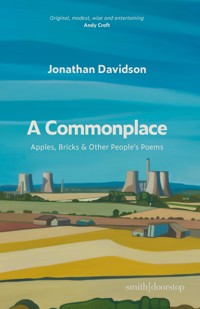
Cover image: ‘The Industrial Henge’
by Anna Dillon (www.annadillon.com).
Author photo by Lee Allen
Printed by T J International
Smith|Doorstop Books is a member of Inpress:
www.inpressbooks.co.uk. Distributed by
NBN International, 1 Deltic Avenue,
Rooksley, Milton Keynes MK13 8LD.
The Poetry Business gratefully acknowledges the support of Arts Council England.
Contents
7 A Note on A Commonplace
11 Introduction
Poems
15 Brick by Richie McCaffery
17 Won’t
18 Clouding Over
19 Nineteen Fifty-Six
21 A Breakfast
22 The Back Roads
23 Father
26 Winter, Lye Waste by Roz Goddard
27 A Quadratic Equation
29 A Letter to Johann Joachim Quantz
30 William Smith’s Poem
31 Collage, 1941
32 A Last Letter to Ophelia Queiroz
33 The Lyric Eye by Zaffar Kunial
36 Sonnet for Dick by Kit Wright
37 Tony
38 Darling by Jackie Kay
41 Frederick Arthur Davidson
42 Utopia
43 Borders
44 Brick-Life
45 Brickwork
47 Land by Mick North
49 Cycling
52 A Music Box
54 The Silence
55 Live Broadcast
56 Printing
57 The Honeycomb by Pauline Stainer
59 Apple Picking
61 Wild Strawberries by Helen Dunmore
63 Brecht, B. v Steffin, M., Marlebäck, 1940
65 Miss Balcombe’s Orchard
66 Claud, 1982
67 Zero Hour by Ernesto Cardenal, tr. by Robert Pring-Mill
68 On ‘Why Brownlee Left’
70 Night Flight to Belfast by Catherine Byron
71 Striletska Street 15
72 Kyiv Writers
73 Metro
75 We Set Our Guns
76 The Lack of a Dandy Tyrant
77 On the Arrest of Thomas Prince, 1649
78 Without Venice
80 Six Filled the Woodshed with Soft Cries by Maura Dooley
81 Leaving
82 The Ridgeway, 2117
83 Like Lichen
84 The Greenwood
85 Padley Woods: June 2007 by Ann Atkinson
88 Just off the A5, West of Llangollen
89 Didcot Parkway
90 Long Hot Summer
91 The Grass Rash
93 Quiet the afternoon after rain
94 After The Birthday by Sylvia Kantaris
95 Listen by Gottfried Benn, tr. by Michael Hofmann
97 Gazetteer
101 Bibliography
105 Acknowledgements
A Note on A Commonplace
The poems by Jonathan Davidson that feature in this collection were written between 1981 and 2019 in Didcot, Leicester, Ilkley, Skipton, Coventry, Denbighshire, Birmingham and Sheffield, and in Ventspils (Latvia) and Kyiv (Ukraine). The commentary was written in Birmingham between Summer 2018 and Summer 2019. The final edits took place during July 2019 in Haapsalu (Estonia) and from October to December 2019 in Birmingham.
For Mollie & Frederick and my Mother and late Father
Introduction
Poems – my own and other people’s – are scattered across my life. They are in books and notebooks, folded in wallets and hidden in desk drawers; a few are memorised. They are as commonplace as food and drink. I wouldn’t want to live without them, although I dare say I could. They will be the last things I forget when everything else is gone. Some of these poems are gathered together in this book, A Commonplace.
A Commonplace is a collection of my own poems interleaved with other people’s poems, poems I admire and that give solace or inspiration. As there are things I want to say about my own poems, and about those by other poets, I have included an ongoing commentary. This isn’t something I’ve done before, but it has made me think about how poetry is released into the world. By strange chance I learned, half-way through writing the commentary, that Ted Hughes had almost gone down the same path. Here’s what he said in 1989:1
‘I’ve been thinking of making a selection of my verses and setting them in a commentary – like the Vita Nuova. The pieces I mostly read. // This is heresy. But there seems to me a possibility that many poems simply slip from the great memory because they lack context.’2
I’m not afraid of heresy: heresy is my middle name.3 The commentary is the context.
Footnotes are given to some of the poems and to the commentary. They add afterthoughts and additional information. A bibliography is no bad thing for the curious reader, and so one is included.
There is also a gazetteer, with grid-references where locations are difficult to identify by name only. Readers can set off to visit them all and be home by Christmas.4
Gathered together – the poems, the commentary, the footnotes, the bibliography and the gazetteer – the whole forms a kind of commonplace book.5 So, having now introduced A Commonplace: Apples, Bricks & Other People’s Poems, we can begin. Here follows, overleaf, a poem I like very much by Richie McCaffery.
1 From a letter to Keith Sagar, 5 August 1989, p. 174, Poet and Critic: The Letters of Ted Hughes and Keith Sagar.
2 I am indebted to my friend Greg Leadbetter for bringing this letter to my attention.
3 It’s not. My middle name is Frederick.
4 Which Christmas I wisely do not say. It makes quite a journey: you’ll need a flask and some sandwiches.
5 Commonplace books were common from the Renaissance onwards. They were a place to gather all sorts of ideas, quotes and memories.
Brick
By Richie McCaffery
They say Belgians are born with a brick
in their stomachs, such is their love
of property. It’s taken us until now
to have a few thousand of our own.
I’ve brought little to the buying
of this place, but I do have a brick.
It’s deeply stamped Radcliffe –
the brickworks (that no longer exist)
that made the red blocks
of the 1930s semi I called home.
My rough brick won’t sit flush
in these fine walls. Still, I lay it down.
This poem is from Richie McCaffery’s book Passport. I like the seeming simplicity of it, how unostentatiously it builds1 and how powerful is its understatement. And it has that truth about it that cannot be denied, about the Belgians and the Radcliffe brickworks:2 all necessary for the poem to work.
The house Richie3 grew up in was probably not dissimilar to my own semi-detached ancestral home,4 although a few decades older. And the good bricks too, how they nurtured so many of us: cold, hard, regular, permanent and in their lifelessness life-sustaining. I’m with the people of Belgium when it comes to bricks.
Of course, I am projecting my own interests onto Richie’s poem. It is, I suspect, far more about the relationship being cemented5 by joint ownership than the nature of bricks as things. Perhaps. But I want poetry to say one thing and also mean another, and this poem does that. And it is a fine thing.
The poems that follow are not about bricks – my brick poems will come later – but about my mum, mostly after my dad died.6 The first is a poem about the poem ‘Won’t’, written by Walter de la Mare.7 I’ve two poems in this book about other people’s poems, as well as many poems by other people. It is confusing, I know.
My sister, Sylvia, is referenced in the second poem. Throughout her life my mum called us all by the name of whatever cat was in the house at the time. My mum grew up near Liverpool,8 a city that at times was divided by religion. The instance described in the final poem made me laugh when it happened, and it still does.
1 Pun intended.
2 Although, frustratingly, it is not listed in my copy of British Bricks by David Kitching. It transpires it was actually one of many ‘brands’ produced by the Amble Brickworks in Northumberland.
3 We are acquainted so I think I can be so familiar.
4 The bottom end of Icknield Close, Didcot, Oxfordshire.
5 These puns won’t stop just because you want them to.
6 August 2017.
7 I included this de la Mare poem in my book On Poetry and the cost of the permission to do so sadly forbids me doing so again. It can be found, of course, in de la Mare’s own collections.
8 Formby, then Crosby.
Won’t
Mum reads me ‘Won’t’ by Walter de la Mare,
as she used to when we were first mother
and son. It’s the same house, the same air,
the same words, but in her head another
woman holds her little boy. She tells me:
I read this to you when I was your mother.
Her voice distorts. She doesn’t cry. A bee
taps at the window, twice, then drifts away.
But you’re still reading it, I say, and we
are still mother and son.
Oh. Will you stay
for your tea? she asks, as she always does.
I won’t, no; sorry. I have to get away.
Clouding Over
Clouding over, she forgets a face,
then a date, then the day of the week.
She calls her daughter the name of a cat
she had as a girl. The lightning striking
momentarily illuminates her life:
the night she woke to see the city burn;
that time they told her she was adopted.
The thunder reminds her of the bakery
she worked in. She remembers the Falls
at Llangollen, the river in full spate:
The rowing boat capsized, we all got wet.




