


60,99 €
Mehr erfahren.
- Herausgeber: John Wiley & Sons
- Kategorie: Wissenschaft und neue Technologien
- Sprache: Englisch
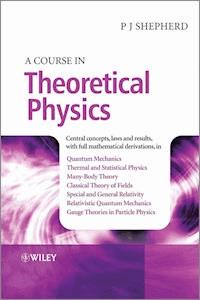
This book is a comprehensive account of five extended modules covering the key branches of twentieth-century theoretical physics, taught by the author over a period of three decades to students on bachelor and master university degree courses in both physics and theoretical physics.
The modules cover nonrelativistic quantum mechanics, thermal and statistical physics, many-body theory, classical field theory (including special relativity and electromagnetism), and, finally, relativistic quantum mechanics and gauge theories of quark and lepton interactions, all presented in a single, self-contained volume.
In a number of universities, much of the material covered (for example, on Einstein’s general theory of relativity, on the BCS theory of superconductivity, and on the Standard Model, including the theory underlying the prediction of the Higgs boson) is taught in postgraduate courses to beginning PhD students.
A distinctive feature of the book is that full, step-by-step mathematical proofs of all essential results are given, enabling a student who has completed a high-school mathematics course and the first year of a university physics degree course to understand and appreciate the derivations of very many of the most important results of twentieth-century theoretical physics.
Sie lesen das E-Book in den Legimi-Apps auf:
Seitenzahl: 599
Veröffentlichungsjahr: 2013
Ähnliche



















Contents
Cover
Title Page
Copyright
Dedication
Notation
Preface
Module I: Nonrelativistic Quantum Mechanics
Chapter 1: Basic Concepts of Quantum Mechanics
1.1 Probability interpretation of the wave function
1.2 States of definite energy and states of definite momentum
1.3 Observables and operators
1.4 Examples of operators
1.5 The time–dependent Schrödinger equation
1.6 Stationary states and the time–independent Schrödinger equation
1.7 Eigenvalue spectra and the results of measurements
1.8 Hermitian operators
1.9 Expectation values of observables
1.10 Commuting observables and simultaneous observability
1.11 Noncommuting observables and the uncertainty principle
1.12 Time dependence of expectation values
1.13 The probability–current density
1.14 The general form of wave functions
1.15 Angular momentum
1.16 Particle in a three–dimensional spherically symmetric potential
1.17 The hydrogen–like atom
Chapter 2: Representation Theory
2.1 Dirac representation of quantum mechanical states
2.2 Completeness and closure
2.3 Changes of representation
2.4 Representation of operators
2.5 Hermitian operators
2.6 Products of operators
2.7 Formal theory of angular momentum
Chapter 3: Approximation Methods
3.1 Time–independent perturbation theory for nondegenerate states
3.2 Time–independent perturbation theory for degenerate states
3.3 The variational method
3.4 Time–dependent perturbation theory
Chapter 4: Scattering Theory
4.1 Evolution operators and Møller operators
4.2 The scattering operator and scattering matrix
4.3 The Green operator and T operator
4.4 The stationary scattering states
4.5 The optical theorem
4.6 The Born series and Born approximation
4.7 Spherically symmetric potentials and the method of partial waves
4.8 The partial–wave scattering states
Module II: Thermal and Statistical Physics
Chapter 5: Fundamentals of Thermodynamics
5.1 The nature of thermodynamics
5.2 Walls and constraints
5.3 Energy
5.4 Microstates
5.5 Thermodynamic observables and thermal fluctuations
5.6 Thermodynamic degrees of freedom
5.7 Thermal contact and thermal equilibrium
5.8 The zeroth law of thermodynamics
5.9 Temperature
5.10 The International Practical Temperature Scale
5.11 Equations of state
5.12 Isotherms
5.13 Processes
5.14 Internal energy and heat
5.15 Partial derivatives
5.16 Heat capacity and specific heat
5.17 Applications of the first law to ideal gases
5.18 Difference of constant–pressure and constant–volume heat capacities
5.19 Nondissipative–compression/expansion adiabat of an ideal gas
Chapter 6: Quantum States and Temperature
6.1 Quantum states
6.2 Effects of interactions
6.3 Statistical meaning of temperature
6.4 The Boltzmann distribution
Chapter 7: Microstate Probabilities and Entropy
7.1 Definition of general entropy
7.2 Law of increase of entropy
7.3 Equilibrium entropy S
7.4 Additivity of the entropy
7.5 Statistical–mechanical description of the three types of energy transfer
Chapter 8: The Ideal Monatomic Gas
8.1 Quantum states of a particle in a three–dimensional box
8.2 The velocity-component distribution and internal energy
8.3 The speed distribution
8.4 The equation of state
8.5 Mean free path and thermal conductivity
Chapter 9: Applications of Classical Thermodynamics
9.1 Entropy statement of the second law of thermodynamics
9.2 Temperature statement of the second law of thermodynamics
9.3 Summary of the basic relations
9.4 Heat engines and the heat–engine statement of the second law of thermodynamics
9.5 Refrigerators and heat pumps
9.6 Example of a Carnot cycle
9.7 The third law of thermodynamics
9.8 Entropy-change calculations
Chapter 10: Thermodynamic Potentials and Derivatives
10.1 Thermodynamic potentials
10.2 The Maxwell relations
10.3 Calculation of thermodynamic derivatives
Chapter 11: Matter Transfer and Phase Diagrams
11.1 The chemical potential
11.2 Direction of matter flow
11.3 Isotherms and phase diagrams
11.4 The Euler relation
11.5 The Gibbs–Duhem relation
11.6 Slopes of coexistence lines in phase diagrams
Chapter 12: Fermi–Dirac and Bose–Einstein Statistics
12.1 The Gibbs grand canonical probability distribution
12.2 Systems of noninteracting particles
12.3 Indistinguishability of identical particles
12.4 The Fermi–Dirac and Bose–Einstein distributions
12.5 The entropies of noninteracting fermions and bosons
Module III: Many-Body Theory
Chapter 13: Quantum Mechanics and Low–Temperature Thermodynamics of Many–Particle Systems
13.1 Introduction
13.2 Systems of noninteracting particles
13.3 Systems of interacting particles
13.4 Systems of interacting fermions (the Fermi liquid)
13.5 The Landau theory of the normal Fermi liquid
13.6 Collective excitations of a Fermi liquid
13.7 Phonons and other excitations
Chapter 14: Second Quantization
14.1 The occupation–number representation
14.2 Particle–field operators
Chapter 15: Gas of Interacting Electrons
15.1 Hamiltonian of an electron gas
Chapter 16: Superconductivity
16.1 Superconductors
16.2 The theory of Bardeen, Cooper and Schrieffer
Module IV: Classical Field Theory and Relativity
Chapter 17: The Classical Theory of Fields
17.1 Mathematical preliminaries
17.2 Introduction to Einsteinian relativity
17.3 Principle of least action
17.4 Motion of a particle in a given electromagnetic field
17.5 Dynamics of the electromagnetic field
17.6 The energy–momentum tensor
Chapter 18: General Relativity
18.1 Introduction
18.2 Space–time metrics
18.3 Curvilinear coordinates
18.4 Products of tensors
18.5 Contraction of tensors
18.6 The unit tensor
18.7 Line element
18.8 Tensor inverses
18.9 Raising and lowering of indices
18.10 Integration in curved space–time
18.11 Covariant differentiation
18.12 Parallel transport of vectors
18.13 Curvature
18.14 The Einstein field equations
18.15 Equation of motion of a particle in a gravitational field
18.16 Newton’s law of gravity
Module V: Relativistic Quantum Mechanics and Gauge Theories
Chapter 19: Relativistic Quantum Mechanics
19.1 The Dirac equation
19.2 Lorentz and rotational covariance of the Dirac equation
19.3 The current four–vector
19.4 Compact form of the Dirac equation
19.5 Dirac wave function of a free particle
19.6 Motion of an electron in an electromagnetic field
19.7 Behavior of spinors under spatial inversion
19.8 Unitarity properties of the spinor–transformation matrices
19.9 Proof that the four–current is a four–vector
19.10 Interpretation of the negative–energy states
19.11 Charge conjugation
19.12 Time reversal
19.13 PCT symmetry
19.14 Models of the weak interaction
Chapter 20: Gauge Theories of Quark and Lepton Interactions
20.1 Global phase invariance
20.2 Local phase invariance?
20.3 Other global phase invariances
20.4 SU(2) local phase invariance (a non–abelian gauge theory)
20.5 The “gauging” of color SU(3) (quantum chromodynamics)
20.6 The weak interaction
20.7 The Higgs mechanism
20.8 The fermion masses
Appendices
A.1 Proof that the scattering states | ϕ + 〉 ≡ Ω + | ϕ 〉 exist for all states | ϕ 〉 in the Hilbert space H
A.2 The scattering matrix in momentum space
A.3 Calculation of the free Green function 〈 r |G0 (z)|r′〉
Supplementary Reading
For Module I: Nonrelativistic Quantum Mechanics
For Module II: Thermal and Statistical Physics
For Module III: Many–Body Theory
For Module IV: Classical Field Theory and Relativity
For Module V: Relativistic Quantum Mechanics and Gauge Theories
Index
This edition first published 2013 © 2013 John Wiley 8 Sons, Ltd.
Registered office John Wiley 8 Sons Ltd, The Atrium, Southern Gate, Chichester, West Sussex, PO19 8SQ, United Kingdom
For details of our global editorial offices, for customer services and for information about how to apply for permission to reuse the copyright material in this book please see our website at www.wiley.com
The right of the author to be identified as the author of this work has been asserted in accordance with the Copyright, Designs and Patents Act 1988.
All rights reserved. No part of this publication may be reproduced, stored in a retrieval system, or transmitted, in any form or by any means, electronic, mechanical, photocopying, recording or otherwise, except as permitted by the UK Copyright, Designs and Patents Act 1988, without the prior permission of the publisher.
Wiley also publishes its books in a variety of electronic formats. Some content that appears in print may not be available in electronic books.
Designations used by companies to distinguish their products are often claimed as trademarks. All brand names and product names used in this book are trade names, service marks, trademarks or registered trademarks of their respective owners. The publisher is not associated with any product or vendor mentioned in this book. This publication is designed to provide accurate and authoritative information in regard to the subject matter covered. It is sold on the understanding that the publisher is not engaged in rendering professional services. If professional advice or other expert assistance is required, the services of a competent professional should be sought.
The publisher and the author make no representations or warranties with respect to the accuracy or completeness of the contents of this work and specifically disclaim all warranties, including without limitation any implied warranties of fitness for a particular purpose. This work is sold with the understanding that the publisher is not engaged in rendering professional services. The advice and strategies contained herein may not be suitable for every situation. In view of ongoing research, equipment modifications, changes in governmental regulations, and the constant flow of information relating to the use of experimental reagents, equipment, and devices, the reader is urged to review and evaluate the information provided in the package insert or instructions for each chemical, piece of equipment, reagent, or device for, among other things, any changes in the instructions or indication of usage and for added warnings and precautions. The fact that an organization or Website is referred to in this work as a citation and/or a potential source of further information does not mean that the author or the publisher endorses the information the organization or Website may provide or recommendations it may make. Further, readers should be aware that Internet Websites listed in this work may have changed or disappeared between when this work was written and when it is read. No warranty may be created or extended by any promotional statements for this work. Neither the publisher nor the author shall be liable for any damages arising herefrom.
Library of Congress Cataloging-in-Publication Data applied for.
A catalogue record for this book is available from the British Library.
HB ISBN: 9781118481349
PB ISBN: 9781118481424
To N.
Notation
The following types of alphabetic symbol are used in the mathematical expressions in this book:
Preface
The twentieth century saw the birth and development of two great theories of physics – quantum mechanics and relativity, leading to an extraordinarily accurate description of the world, on all scales from subatomic to cosmological.
Indeed, the transformation of our understanding of the physical world during the past century has been so profound and so wide in its scope that future histories of science will surely acknowledge that the twentieth century was the century of physics.
Should not the great intellectual achievements of twentieth–century physics by now be part of our culture and of our way of viewing the world? Perhaps they should, but this is still very far from being the case. To take an example, Einstein’s general theory of relativity is one of the most beautiful products of the human mind, in any field of endeavor, providing us with a tool to understand our universe and its evolution. Yet, far from having become part of our culture, general relativity is barely studied, even in university physics degree courses, and the majority of graduate physicists cannot even write down Einstein’s field equations, let alone understand them.
The reason for this is clear. There is a consensus amongst university physics professors (reinforced by the fact that as students they were mostly victims of the same consensus) that the mathematics of general relativity is “too difficult”. The result is that the general theory of relativity rarely finds its way into the undergraduate physics syllabus.
Of course, any mathematical methods that have not been carefully explained first will always be “too difficult”. This applies in all fields of physics – not just in general relativity. Careful, and appropriately placed, explanations of mathematical concepts are essential. Serious students are unwilling to take results on trust, but at the same time may not wish to spend valuable time on detailed and often routine mathematical derivations. It is better that the latter be provided, so that a student has at least the choice as to whether to read them or omit them. Claims that “it can be shown that… ” can lead to relatively unproductive expenditure of time on the filling of gaps – time that students could better spend on gaining a deeper understanding of physics, or on improving their social life.
Several excellent first–year physics degree texts have recognized the likely mathematical limitations of their readers, and, while covering essentially the entire first–year syllabus, ensure that their readers are not left struggling to fill in the gaps in the derivations.
This book is the result of extending this approach to an account of theoretical topics covered in the second, third and fourth years of a degree course in physics in most universities. These include quantum mechanics, thermal and statistical physics, special relativity, and the classical theory of fields, including electromagnetism. Other topics covered here, such as general relativity, many–body theory, relativistic quantum mechanics and gauge theories, are not always all covered in such courses, even though they are amongst the central achievements of twentieth–century theoretical physics.
The book covers all these topics in a single volume. It is self–contained in the sense that a reader who has completed a higher–school mathematics course (for example, A–level mathematics in the United Kingdom) should find within the book everything he or she might need in order to understand every part of it. Details of all derivations are supplied.
The theoretical concepts and methods described in this book provide the basis for commencing doctoral research in a number of areas of theoretical physics, and indeed some are often covered only in first–year postgraduate modules designed for induction into particular research areas. To illustrate their power, the book also includes, with full derivations of all expressions, accounts of Nobel–prize–winning work such as the Bardeen–Cooper–Schrieffer theory of superconductivity and the Weinberg–Salam theory of the electroweak interaction.
The book is divided into five parts, each of which provides a mathematically detailed account of the material typically covered in a forty–lecture module in the corresponding subject area.
Each of the modules is, necessarily, shorter than a typical textbook specializing in the subject of that module. This is not only because many detailed applications of the theory are not included here (nor would they be included in most university lecture modules), but also because, in each of the modules beyond the first, the necessary background can all be found in preceding modules of the book.
The book is the product of over thirty years of discussing topics in theoretical physics with students on degree courses at Exeter University, and of identifying and overcoming the (often subtle) false preconceptions that can impede our understanding of even basic concepts. My deepest thanks go to these students.
Like most course textbooks in such a highly developed (some would say, almost completed) subject area as theoretical physics, this book lays no claim to originality of the basic ideas expounded. Its distinctness lies more in its scope and in the detail of its exposition. The ideas themselves have been described in very many more–specialized textbooks, and my inclusion of some of these books in the lists of recommended supplementary reading is also to be regarded as my grateful acknowledgment of their authors’ influence on my chosen approaches to the relevant subject matter.
John Shepherd Exeter, July 2012
Module I
Nonrelativistic Quantum Mechanics




