


0,49 €
Mehr erfahren.
- Herausgeber: Quickie Classics
- Kategorie: Geisteswissenschaft
- Sprache: Englisch
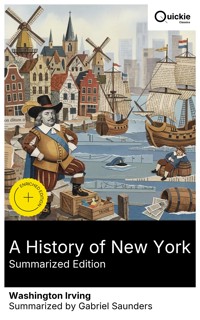
A History of New York, narrated by the fictive antiquary Diedrich Knickerbocker, is at once a mock-chronicle and an urban origin myth. Beginning with cosmogony and proceeding through the Dutch settlement to the fall of New Netherland, Irving parodies the pomp of classical historians with bogus citations, pedantic footnotes, comic etymologies, and mock-epic set pieces featuring governors like Wouter Van Twiller and Peter Stuyvesant. Published in 1809, the book situates itself within early American efforts to forge a national literature even as it lampoons historical pretension, drawing on Swift and Sterne to invent New York's enduring comic self-image. Irving, a native New Yorker (1783-1859), had apprenticed himself to satire in the periodical Salmagundi and honed a taste for playful hoaxes; the Knickerbocker persona was launched through missing-person notices that primed the city for his 'discovered' manuscript. Trained in law and steeped in local folklore and Dutch remnants, he understood both the authority and the absurdity of archival rhetoric. The city's partisan ferment in the Jeffersonian era gave him targets and urgency, while his family's mercantile ties supplied the intimate topography he turns to burlesque. Scholars and curious readers will relish this classic; choose an annotated edition for fullest enjoyment. Quickie Classics summarizes timeless works with precision, preserving the author's voice and keeping the prose clear, fast, and readable—distilled, never diluted. Enriched Edition extras: Introduction · Synopsis · Historical Context · Author Biography · Brief Analysis · 4 Reflection Q&As · Editorial Footnotes.
Das E-Book können Sie in Legimi-Apps oder einer beliebigen App lesen, die das folgende Format unterstützen:
Veröffentlichungsjahr: 2026
Ähnliche












A History of New York (Summarized Edition)
Table of Contents
Introduction
Between the earnest urge to record a city’s past and the irresistible impulse to dress it in flamboyant legend, A History of New York: From the Beginning of the World to the End of the Dutch Dynasty establishes a comic proving ground where national memory, urban pride, scholarly pose, and marketplace bravado contend, revealing how authoritative tones, extravagant digressions, and mock-epic flourishes can enchant while distorting, how invented authorities masquerade as evidence, and how the bustling myth of New Amsterdam becomes a looking glass for the self-invention of a young nation, as exuberant in its storytelling as it is susceptible to its own theatrical confidence.
Washington Irving’s book is a satirical mock history set chiefly in the Dutch colonial era of New Amsterdam and the early English transition, published in 1809 under the persona of the antiquarian Diedrich Knickerbocker. Blending parody with antiquarian detail, it draws on the conventions of learned chronicles while targeting the credulities they can invite. Its New York is both a real place and a comic stage, and its genre—part burlesque, part civic mythography—places it at the beginnings of American literary humor. The two-volume design underscores a sweeping ambition even as it winks at the grandiosity of historical epics.
The premise is disarmingly simple: a self-important narrator undertakes to recount the origins of New York, marshaling a thicket of authorities, manuscripts, and anecdotes that range from cosmic beginnings to the waning of Dutch rule. The reading experience is one of exuberant digression and mock-scholarly apparatus, with playful notes and learned asides used as instruments of comedy. Irving’s voice, filtered through Knickerbocker, is ceremonious and mischievous at once, alternating stately cadences with sly undercutting. The tone is affectionate yet irreverent, allowing readers to savor tall tales while noticing how rhetoric shapes what passes as historical truth.
At the heart of the satire lies an inquiry into how communities manufacture tradition, how power seeks legitimacy through narrative, and how the posture of objectivity can conceal bias. Irving toys with the historian’s toolkit—citation, chronology, and origin stories—to expose the vanity of authority and the slipperiness of evidence. The city becomes a character whose identity is negotiated through competing anecdotes, patriotic boasts, and cultural rivalries. Alongside the laughter runs a persistent question: when myths organize the memory of a place, what happens to the unruly facts that resist a tidy, heroic arc?
For contemporary readers, the book matters as a primer in critical reading and as a lively reminder that information gains force through presentation. In an age of confident assertions, curated archives, and public relations, Irving’s burlesque highlights the mechanics of persuasion, the seductions of certainty, and the civic stakes of storytelling. Its comedy is not merely decorative; it is diagnostic, helping us notice tone, framing, and performance. Some caricatures reflect the assumptions of the author’s era and warrant a critical eye today, which further sharpens the book’s utility as a lens on the conditions of its own making.
Irving also offers a portrait of New York as an organism in motion—mercantile, fractious, and exuberantly self-inventing—long before it becomes the metropolis we recognize. The streets, customs, and public rituals appear in heightened relief, producing a map that is both imaginative and historically anchored. The two volumes move from cosmogony and settlement toward colonial governance and civic life, using mock-heroic set pieces to trace how local habits harden into lore. The city’s growth is simultaneously celebrated and sent up, suggesting that civic greatness often arrives wearing the motley of comedy.
Approaching this complete edition, readers are well served by patient attention to the sentences, which coil and sparkle with layered irony, and by an ear for the narrator’s performance as he courts authority and punctures it. Read as satire, as early American urban mythology, or as an experiment in narrative voice, the work rewards each angle. It helped popularize the “Knickerbocker” emblem that long hovered over New York’s identity, and it remains a touchstone for American humor. Taken together, the two volumes deliver a full arc from cosmic prelude to the close of Dutch rule, without exhausting their playful skepticism.
Synopsis
Washington Irving’s A History of New York: From the Beginning of the World to the End of the Dutch Dynasty presents a mock-heroic chronicle of New Amsterdam and its people, first published in 1809 under the persona of Diedrich Knickerbocker. The book adopts the framing device of a discovered manuscript and an eccentric antiquarian narrator who promises exhaustive accuracy while indulging in extravagant digressions. With elaborate notes and a parodic scholarly apparatus, Irving burlesques learned history even as he assembles a vivid, sequential account. The complete edition in two volumes gathers this satire into a unified narrative that spans mythic origins to the close of Dutch colonial rule.
The opening movement expands the timeline to cosmic dimensions, tracing the world’s formation and the continent’s fanciful emergence with a tone of playful pedantry. Irving transforms geographical features and early migrations into comic episodes, setting the stage for a city whose destiny seems both elevated and absurd. He sketches the natural advantages of the region and the character of its earliest European traders, inventing prefaces and precedents that lampoon historical causation. A portrait of nascent New Amsterdam coalesces: a riverside settlement guided by commercial logic and homely comforts, already producing local legends and a vocabulary that pretends to explain everything while proving almost nothing.
From these beginnings the narrative narrows to the colony’s first period of governance, where Irving treats municipal routines as epic rites. Under the figure of Wouter Van Twiller, portrayed as placid and deliberative to a fault, the settlement acquires habits that define its civic personality: smoking, council meetings, Sunday observances, and a dogged affection for old-world customs. Irving’s satire lingers on how institutions grow from small conveniences into solemn traditions. The texture of daily life—market bargaining, waterfront bustle, and household economies—builds a social backdrop against which public decisions unfold. In this phase, the colony’s contented inertia serves as both strength and comic vulnerability.
Tension intrudes as the narrative proceeds to a more contentious governorship, caricatured under the sobriquet William the Testy. Here Irving dramatizes the hazards of impulsive policy and rhetorical bravado, especially in dealings with neighboring peoples and the management of trade. Decrees multiply, councils fracture, and the narrator’s mock citations swell as if greater documentation could stabilize shaky authority. Conflicts sharpen the book’s central questions about prudence, legitimacy, and the uses of power in a small, exposed community. The atmosphere of satire never obscures the stakes: survival, prosperity, and the fragile cohesion of a town balancing mercantile opportunity with civic order.
Irving widens the lens to survey regional rivalries, notably the colony’s uneasy relations with Scandinavian settlers to the south and with New England communities to the east. Skirmishes over trade routes, river forts, and ambiguous boundaries receive grandiloquent treatment, inflating minor disputes into world-historical struggles. Charters, commissions, and envoys parade through the pages, their ceremonious language contrasted with the stubborn facts of terrain and supply. In these episodes, the book becomes a study in colonial diplomacy: the careful weighing of paper claims against practical power. The satire underscores how institutional pride can mask insecurity when outposts compete on a shifting frontier.
Between diplomatic crises, the narrative returns to the city’s interior life, building a cultural panorama of Dutch New Amsterdam. Irving inventories feasts, fashions, guild practices, and household customs with a loving exactitude that is both affectionate and sly. He catalogs family names and anecdotes, turning genealogies into episodes of civic legend-making. The topography of streets and wharves is sketched as a record of habits as much as of place. This ethnographic vein, equal parts homage and parody, suggests how collective identity forms from routine pleasures and shared superstitions, leaving a storehouse of lore that later generations mistake for authoritative history.
A new phase commences with the arrival of a more forceful administrator, rendered as Peter the Headstrong. Irving depicts assertive leadership that prizes order, fortification, and unequivocal rules, recasting the colony’s mood from drowsy self-satisfaction to purposeful discipline. Campaigns to regularize trade and defend borders proceed alongside efforts to curb municipal bickering. The narrator’s tone shifts toward mock-epic, staging councils and marches with theatrical grandeur. Yet the book continues to pose its central question of balance: how a small, plural community negotiates authority and freedom, tradition and change, without losing the genial spirit that first sustained it.
As pressures mount, the city’s internal factions and external adversaries converge into a period of strain. Irving orchestrates proclamations, pamphlets, and assemblies whose ceremonies cannot fully conceal uncertainty. The colony’s commercial lifelines feel precarious, while neighboring powers test its resolve. Scenes of negotiation and confrontation accumulate, each narrated with heightened irony to expose the distance between official rhetoric and material circumstance. Without itemizing final outcomes, the story points to the limits of insularity and the inevitability of transition when competing empires reconfigure the region. The tone remains steadfastly comic, but the stakes for civic continuity are palpable.
Irving closes by reaffirming the narrator’s antiquarian mission even as he reveals its artifice, leaving a composite portrait of New Amsterdam that is at once invented and enduring. The book’s broader significance lies in how it shapes American humor and New York’s civic mythology, modeling a way to read the past with skeptical delight. It satirizes pedantic certainty, partisan puffery, and the vanity of official chronicles, yet it preserves a warm vision of community built from customs and stories. The result is a work that questions how histories are made while giving a formative city an unforgettable, if mischievous, origin tale.
Historical Context
Washington Irving’s A History of New York appeared in New York City in 1809, when the post‑Revolutionary port was expanding into the nation’s commercial capital. A lively print culture fueled magazines, pamphlets, and newspapers read by a politically engaged public. Institutions such as the New-York Historical Society, founded in 1804, began collecting colonial records and encouraging regional history. American writers sought a distinct national voice while borrowing British forms of satire and history. In this setting, Irving adopted a mock‑scholarly persona to retell the city’s colonial past, using New Amsterdam’s remembered Dutch era to comment on contemporary manners, civic pride, and the uses of history.
New York’s colonial origins lay in the Dutch enterprise of New Netherland. In 1609 Henry Hudson, sailing for the Dutch East India Company, explored the river that bears his name. The Dutch West India Company, chartered in 1621, organized settlement and trade. New Amsterdam grew around Fort Amsterdam on Manhattan, while patroonships granted to wealthy investors encouraged agricultural estates upriver. Peter Minuit’s 1626 purchase of Manhattan from local Indigenous people entered civic lore, and Director-General Peter Stuyvesant’s long tenure shaped governance and the Reformed Church’s influence. This plural, mercantile society—Dutch, Walloon, African, and others—supplied Irving with institutions and characters to caricature.
Anglo-Dutch rivalry transformed the colony in the seventeenth century. In 1664 an English fleet compelled New Amsterdam’s surrender; the city was renamed New York for the Duke of York. Dutch rule briefly returned in 1673–1674 as New Orange during the Third Anglo-Dutch War, but the Treaty of Westminster confirmed permanent English control. The transition blended legal customs, languages, and landholding patterns, preserving some Dutch practices under English governors. This well-documented shift—between pragmatic commerce, contested sovereignty, and community continuity—provides the chronological frame for Irving’s “end of the Dutch dynasty,” letting him lampoon both colonial administrators and later patriotic mythmaking.
Early American historiography mixed Enlightenment narrative with antiquarian zeal. Works by William Smith Jr. on New York (1757) and Samuel Smith on New Jersey (1765), along with David Ramsay’s national histories, modeled sober, documentary prose. Historical societies in Boston (1791) and New York (1804) promoted collecting manuscripts and debating precedence. Irving burlesqued these practices through an avalanche of footnotes, mock citations, and invented authorities under the persona “Diedrich Knickerbocker.” His parody presumes readers familiar with solemn colonial chronicles, travelogues, and disputes over origins, borders, and charters, making the apparatus itself a target as he questions how authority in history is constructed.
The book emerged amid economic strain and partisan maneuvering. The Embargo Act of 1807 disrupted Atlantic trade, hurting New York’s merchants and stoking newspaper wars between Federalists and Democratic‑Republicans. Civic societies, notably Tammany, mobilized voters and fostered a boisterous political culture. With Anglo‑American tensions mounting toward the War of 1812, debates over neutrality, militia readiness, and commercial rights saturated urban conversation. Irving, steeped in period journalism and theatricals, channels that environment’s bombast into his colonial burlesque. By couching topical anxieties in seventeenth‑century scenes, he could lampoon official pomposity, factional rhetoric, and municipal foibles without directly naming contemporary leaders or controversies.
Irving’s technique aligns with transatlantic satiric models. He borrows the mock‑epic pace, catalogues, and digressions of Rabelais and Swift, and the playful narrator and typographical comedy associated with Laurence Sterne’s Tristram Shandy. English antiquarian burlesque and traveler’s tales supply additional cues. American readers recognized these forms from imported editions and magazines, yet Irving anchors them in local topography—Manhattan streets, the Hudson River, Dutch family names—so the comedy rests on tangible places. This hybrid method advanced a distinctly New York literature, demonstrating how European genres could be adapted to American subjects while lampooning the self‑importance of both chroniclers and city fathers.
Irving launched the book with a playful publicity hoax, placing newspaper notices about the disappearance of “Diedrich Knickerbocker” and a manuscript left at a hotel, which the proprietor threatened to publish to settle a bill. The ruse created curiosity when the volume appeared in December 1809. Some descendants of old Dutch families bristled at its caricatures, prompting revisions in later editions, including 1812. The name “Knickerbocker” soon became shorthand for New Yorkers of Dutch heritage and, later, city identity. Irving also popularized St. Nicholas as New Amsterdam’s patron, a motif that fed nineteenth‑century holiday culture while rooting it in local tradition.
Thus the work belongs to an early republic moment when Americans mined colonial archives to shape civic memory and national character. By staging Dutch New Netherland as both quaint and consequential, Irving mocks antiquarian pedantry, punctures heroic origin stories, and exposes the provincial ambitions of a modern port city. His burlesque of governors, councils, and municipal quarrels doubles as commentary on contemporary politics and boosterism. Without demanding prior knowledge, the narrative invites readers to scrutinize how histories are written and why communities cherish certain myths, making A History of New York a foundational satire of American memory and identity.
Author Biography
Washington Irving (1783–1859) was an American author, essayist, and diplomat whose career bridged the early republic and the rise of Romanticism. Best known for the enduring tales Rip Van Winkle and The Legend of Sleepy Hollow, he helped establish the short story in the United States and gave American settings a refined, transatlantic literary voice. Writing with a cultivated wit and an eye for folklore, he drew readers on both sides of the Atlantic and became, for many contemporaries, the first widely recognized man of letters from the new nation. His work shaped perceptions of New York, the Hudson Valley, and the American past.
Raised in New York City, Irving received a practical education and read law, gaining admission to the bar in 1806, though literature soon eclipsed legal practice. Early essays under the pseudonym Jonathan Oldstyle revealed his debt to British periodical writers such as Addison and Steele, whose urbane tone and observational humor he adapted to local scenes. Travels in Europe beginning in the first decade of the nineteenth century broadened his literary horizons and introduced him to Romantic currents and continental folklore. Encounters with British and Scottish literary circles, notably his acquaintance with Sir Walter Scott, reinforced his interest in blending history, legend, and polished prose.
Irving's first notable successes were satirical. With collaborators he issued the comic periodical Salmagundi (1807–1808), lampooning cultural fashions and helping to popularize Gotham as a nickname for New York. He then published A History of New York (1809) under the persona Diedrich Knickerbocker, a mock-scholarly chronicle that mingled whimsical erudition with playful mythmaking about the city's Dutch past. The book's inventive voice and framing devices introduced signatures he would revisit: the use of narrating masks, the mingling of documentary tones with fancy, and the affectionate caricature of local types. The Knickerbocker name also seeded a lasting identity for New York's literary and civic heritage.




