


15,49 €
Mehr erfahren.
- Herausgeber: Nick Hern Books
- Kategorie: Poesie und Drama
- Sprache: Englisch
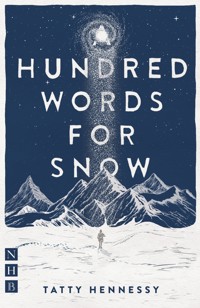
'It's a bit weird to be sitting at the Arctic Circle chatting to a fit boy with your dad's ashes in your backpack.' Rory's dad was an explorer. Well, not literally. Literally, he was a geography teacher. But inside, she knows, he was Bear Grylls. And when he dies suddenly in an accident, Rory knows she needs to make one last expedition. With a plastic compass and Dad's ashes at her side, Rory sets off in the footsteps of all the dead beardy explorers before her, to get Dad to the North Pole. Before Mum finds out they've gone. Tatty Hennessy's play A Hundred Words for Snow is about being an explorer in a melting world. It's a coming-of-age story. With polar bears. The play won the Heretic Voices Monologue Competition and was first produced at the Arcola Theatre, London, in 2018. A new production was performed at the 2018 VAULT Festival, where it was the winner of a VAULT Origins Award for outstanding new work from the VAULT Festival. It then toured the UK, with a run at the Trafalgar Studios in London's West End in 2019. This edition also includes the diary of her research trip to the Arctic Circle, and the short play Distant Early Warning, set in 2053 in what was once Greenland.
Das E-Book können Sie in Legimi-Apps oder einer beliebigen App lesen, die das folgende Format unterstützen:
Veröffentlichungsjahr: 2019
Ähnliche












Tatty Hennessy
A HUNDRED WORDS FOR SNOW
NICK HERN BOOKS
London
www.nickhernbooks.co.uk
Contents
Original Production
Farthest North
Note on Text
A Hundred Words for Snow
Distant Early Warning
About the Author
Copyright and Performing Rights Information
A Hundred Words for Snow was produced by RJG Productions and first performed at the Arcola Theatre, London, on 9 January 2018, as part of Heretic Voices. A new production was performed at VAULT Festival 2018, before touring to Warwick Arts Centre, The Mill Studio at Guildford’s Yvonne Arnaud, Aldeburgh Jubilee Hall, The Spring Havant, The Garage Norwich and Riverfront Newport, ending in a full run at Trafalgar Studios 2 in London’s West End.. The cast was as follows:
RORY
Gemma Barnett
Director
Lucy Jane Atkinson
Designer
Christianna Mason
Lighting Designer
Lucy Adams
Sound Designer
Mark Sutcliffe
Associate Sound Designer
Annie May Fletcher
Producer (RJG Productions)
Rebecca Gwyther
Stage Manager
Bryony Byrne
Farthest North
I’ve always been a bit obsessed with Polar Exploration, people pushing themselves to extremes, risking and often losing their lives in the pursuit of knowledge. It seems all the more poignant now, as we continue to come to terms with our hand in climate change and disaster – this landscape used to lay waste to us, and now we destroy it. Which may, in turn, destroy us. I wanted to write a story that probed at this. What does it mean to be an explorer of the world? How do we relate to the planet and each other? What world will we leave for the generations after us? How do we come to terms with what we’ve already lost? And I knew I wanted a hero at the centre of that story who wasn’t like the explorers we’re used to seeing in the history books. The wild, baffling, lonely, improbable landscape of the Arctic felt like quite a natural place to explore the similar landscape of girlhood and adolescence, and of grief. Rory was born.
While writing A Hundred Words for Snow I was lucky enough to receive a grant from the Peggy Ramsay Foundation to travel to Tromsø and Svalbard to follow in Rory’s footsteps. It was a strange and exhilarating trip. By way of an introduction to these two pieces, which I think represent two extremes of despair and ultimately hope on the subject of the Arctic, Nick Hern Books have kindly allowed me to print some extracts from the diary I kept of the trip, and how the north itself shaped these plays.
Tatty Hennessy
January 2019
10 August 2017
I am currently eating a sandwich in a little park in the centre of Tromsø, in Norway, beneath a seagull be-shitten statue of polar explorer Roald Amundsen. It’s hard to describe how it feels to follow the path of a character I invented. Like I imagined my way here. Stopped for a coffee earlier and saw a woman who looks exactly like Frida. Or rather Frida will now look exactly like her.
Yesterday I took myself to the Tromsø Polar Museum (like Rory!). Lots of mannequins of seal-trappers swinging axes at stuffed baby seals. Black-and-white photos of a fox being peeled. A vacant-looking mannequin woman in a fur stole just captioned ‘The consumer’. A polar-bear heart in a jar.
There’s a grave. A replica of a grave site of a British or Dutch whaler, discovered on Svalbard and preserved by the ice. His mouth is wide open and his teeth are all intact but there’s just a bundle of bones where his feet used to be. Behind him is a corny painted pantomime backdrop of mountains and midnight-sun sky. Next to him is a pile of whale bones. His prey. I tried to imagine the moment whoever buried him had to turn around and go.
There’s a whole room on Nansen, and lots of photographs of Wanny Woldstad (mounted on a pink wall…) and inspirational lines like ‘She made the trappers’ homes nicer by bringing tablecloths and cooking for them’, proving that the unequal division of emotional labour is rife in all climates, and even being able to kill and skin a polar bear single-handed is no defence. There’s also a model of a ship called the MS Polarfart which is funny whoever you are. Took a trip to Polaria; a tired aquarium whose star attraction is some rather sad-looking seals torpedoing apathetically over a green-grimed underwater walkway. The MS Polstjerna is more interesting; a perfectly preserved 1940s seal-hunting ship in a fake-ice landscape. Amazing how the history of white people in the Arctic is so inextricably bound in violence against it. There’s an accompanying exhibition about the techniques Nansen and Amundsen learned from the Inuit, how to adapt their sledges, to hunt, what clothes to wear. Apparently ‘anorak’ comes from the Inuit word ‘anore’ (wind) and ‘anguloq’ (birdskin), and ‘kayak’ comes from the Inuit word ‘qajaq’ which means ‘man’s boat’, even though they were usually made by women.
At night (such as night is, more of an unending sunset) I went up Fløya, the mountain across the river. Every step further up the beauty doubles. The clouds looked so much like snow it felt like if I lay on my back I could walk on them.
I’m understanding Rory more.
13 August
Just landed in Svalbard. I haven’t stopped shaking since we landed. It is terrifying here. Like the mountains are just waiting to fall on us. This is the end of the human world. What can a human life mean here?
It seems utterly meaningless here that we can take any power from the things we leave behind, from what lasts. The only power we have is in what passes.
It’s illegal to die in Svalbard because you can’t be buried – bodies don’t rot in the permafrost. The ground doesn’t even want our corpses.
Polar bears still attack people here. It’s illegal to kill them and illegal to die so I imagine as well as being fucking terrifying being attacked by a polar bear would also present a bewildering legal dilemma.
I could never have imagined it would feel like this. What am I doing.
15 August
Yesterday I walked on Foxfonna glacier with a guide (Hilde) and an out-of-season sled dog (Bomsa). Bomsa means teddy bear. I feel like bears are everywhere.
We hiked up the mountain over rocks like the surface of Mars, like walking on a scaly alien’s back, covered in orange-black-green lichen and white crumbly reindeer moss. Even here, things grow. We passed a big observation station with impossible-looking vast satellite dishes. The mouth of the fjord below and the mountains were the only thing in all directions. None of this feels people-sized. Then we saw the glacier itself loom ahead, a threshold. We stepped over the line onto the ice like through a portal to another world, just empty white. Stopping for the strangest lunch of my life, hunkered down with packets of pasta and hot Ribena, washing our spoons by dipping them into the ice, looking out at nothing but white in all directions. My boots are not as waterproof as I might have hoped. I would have been a shit explorer.
17 August
The sun hasn’t set at all while I’ve been here. Last night I went to a bar in town and drank a cognac (they sell a Nansen cognac, I’m only human) with two engineers, on their way out to Ny-Ålesund, the northernmost permanently inhabited point in the world. Even the name seems desolate to me. Leaving in the middle of the night to bright sun is wonderfully baffling. It’s like the slate never gets cleaned, never reset, everything is always as it is with no concern at all for our little rhythms.
Even Longyearbyen itself feels temporary, like a goldrush town which I suppose it is but with coal in place of gold. Set into a valley beneath spidery old mining stations jutting out of the mountains. There’s a little graveyard on the edge of town. Neat rows of little white crosses, from before the law was passed. Miners, probably. Bleak place to be left.
18 August
Took a trip to Pyramiden, an abandoned Russian mining town, on the brilliantly named MS Polargirl. Three hours there, up on deck, cold cold cold. I mean obviously it’s cold, but it is cold. Got talking to another man travelling alone and turns out he’s a geography teacher. Although he wasn’t all that enthused when I exclaimed: ‘That’s amazing! The dead dad in my play is a geography teacher!’ You live and learn. He’s taking a course at the university in Longyearbyen on climate change. He talked to me about albedo, glaciation and tectonic drift, how this is the best place in the world to do field work. I like to think that in the future Rory is like this.




