


1,99 €
Mehr erfahren.
- Herausgeber: Quickie Classics
- Kategorie: Fantasy und Science-Fiction
- Sprache: Englisch
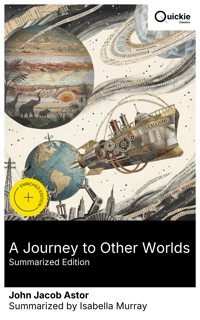
A Journey to Other Worlds, a late–nineteenth-century scientific romance set in the year 2000, imagines a United States governed by technocrats who straighten Earth's axis and harvest boundless energy before launching an apergy-propelled craft, the Callisto, to Jupiter and Saturn. Astor alternates engineering exposition with travelogue: prehistoric megafauna and steamy swamps on Jupiter, crystalline landscapes and disembodied intelligences on Saturn, and meditations on immortality. His ornate, reportorial prose, indebted to Verne and contemporaneous utopian fiction, funnels Gilded Age confidence into a panorama of invention, expansion, and spiritual inquiry. John Jacob Astor IV—Gilded Age magnate, hotel builder, and amateur inventor with several patents—writes from the vantage of capital, infrastructure, and restless ingenuity. His experience organizing vast projects and his fascination with electricity, transportation, and celestial science shape the novel's faith in large-scale engineering and corporate rationality. Equally timely is his engagement with spiritualism and psychical speculation, popular among elites of the 1890s, which inflects the Saturn episodes with metaphysical ambition. Recommended to readers of Verne, Bellamy, and early Wells, this novel rewards anyone interested in the prehistory of spaceflight, techno-utopianism, and American imperial imagination. Approach it both as prophecy and artifact, and you will find its boldness illuminating. Quickie Classics summarizes timeless works with precision, preserving the author's voice and keeping the prose clear, fast, and readable—distilled, never diluted. Enriched Edition extras: Introduction · Synopsis · Historical Context · Author Biography · Brief Analysis · 4 Reflection Q&As · Editorial Footnotes.
Das E-Book können Sie in Legimi-Apps oder einer beliebigen App lesen, die das folgende Format unterstützen:
Veröffentlichungsjahr: 2026
Ähnliche

















A Journey to Other Worlds (Summarized Edition)
Table of Contents
Introduction
Between boundless faith in progress and the uncharted vastness of the cosmos, this novel asks how ambition reshapes human destiny. First published in 1894, John Jacob Astor’s work is an early American scientific romance set in a technologically remade near future around the year 2000. Blending speculative engineering with planetary travel, it situates readers at the threshold of interplanetary exploration while retaining the manners and certainties of its time. The result is a forward-gazing adventure that balances instruction with wonder, inviting us to imagine how industry, invention, and national confidence might carry humanity beyond Earth without presuming what awaits there.
Astor wrote amid the late nineteenth century’s surge of electrification, industrial consolidation, and public fascination with astronomy and engineering. The book channels that milieu into a futurist panorama: global infrastructure, streamlined governance, and machines conceived to tame distance and hazard. Presented as a romance of the future, it uses the idiom of scientific speculation popular in its day, but aims beyond gadgetry to a comprehensive vision of society remade by technology. Without requiring specialist knowledge, it invites readers to treat plausibility as a lens rather than a limit, and to measure aspiration against the physical, moral, and political consequences imagined.
In the novel’s envisioned year 2000, a cadre of American explorers and engineers harness a newly discovered repulsive force to lift a purpose-built craft from Earth and set a course for the outer planets. The propulsion method, named apergy, supplies a narrative logic for leaving gravity’s well and frames the chapters as a sequence of scientific demonstrations and field notes. The voyage proceeds as a travel narrative rather than a conquest: charting routes, logging observations, and weighing risks while conserving supplies. Their itinerary emphasizes Jupiter and Saturn, whose imagined climates, terrains, and celestial mechanics become occasions for explanation, debate, and awe.
Astor’s voice favors expository clarity and an earnest, didactic tone, yet it is punctuated by set pieces of vast scenery and quiet wonder. The prose alternates between catalogues of mechanisms and wide-angle tableaux, a rhythm familiar from contemporary travelogues and scientific lectures. Characters speak as professionals and patriots, trading hypotheses, calculations, and moral reflections rather than dramatic confessions. This measured style produces a reading experience that is both methodical and expansive: the pleasure lies in accumulation—of facts proposed, vistas surveyed, and implications considered—while the narrative steadily widens the frame from cockpit to continent to planet, then to the solar neighborhood.
Within this framework, the novel explores intertwined themes that define its age and resonate still. It celebrates technological mastery and American enterprise, extending a spirit of expansion into the heavens, even as it contemplates the ethical boundaries of such reach. It flirts with planetary-scale engineering, positing humanity as steward and sculptor of nature, and it stages encounters—primarily observational—with environments that challenge assumptions about life, purpose, and belonging. Throughout, the narrative weighs scientific rationalism against spiritual and moral interpretation, suggesting that discovery is never merely material but carries obligations to prudence, humility, and a broader conception of progress.
For contemporary readers, the book is a time capsule and a provocation. As conversations about spaceflight, private investment in exploration, and geoengineering intensify, Astor’s confident projections offer both inspiration and caution, illuminating the hopes and blind spots that accompany grand designs. The imagined tools and institutions highlight perennial questions: who steers innovation, who benefits from it, and how far we should alter environments to secure comfort or glory. Reading it alongside current debates about climate intervention, extraterrestrial settlement, and the ethics of colonization sharpens our sense of continuity between fin‑de‑siècle futurism and the dilemmas of the twenty-first century.
Approached with curiosity and critical distance, this voyage rewards patience with a cumulative grandeur: a methodical climb from the known to the conjectured that reflects both the rigor and limitations of its moment. Its period idiom and assumptions may feel dated, but they frame a larger inquiry into responsibility, aspiration, and the human hunger for perspective. To read it now is to stand at an earlier threshold of possibility, examine the scaffolding of optimism, and ask which parts still carry weight. The journey outward, it suggests, is inseparable from the inward reckoning that progress continually demands.
Synopsis
A Journey to Other Worlds is an 1894 work of speculative fiction by American author John Jacob Astor. Set primarily in the imagined year 2000, it envisions a United States transformed by rapid invention, vast infrastructure, and organized industrial power. Astor presents a narrative that interleaves technical explanation with episodes of travel and observation, arguing that disciplined science can extend human reach far beyond Earth. Within this setting, a small group of explorers prepares to test a new propulsion principle and attempt a voyage to the outer planets. The story’s progression follows their planning, departure, encounters, and reflections, in a tone of confident futurity.
Launched from a future Earth where immense trusts coordinate energy, transport, and resource management, the book sketches a society that treats engineering as a civic mandate. Canals, railways, electric networks, and ambitious climate-moderating schemes reorganize landscapes and commerce. Governance and enterprise are closely allied; large-scale projects are justified as pathways to prosperity and national cohesion. Scientific institutions are well funded, exploration is valorized, and nature is surveyed for utility as much as beauty. This portrait of the year 2000 supplies the expedition’s rationale: by mastering terrestrial forces, humanity is ready to venture outward, using the same tools of measurement, planning, and audacity.
A newly described force—often referred to in the text as apergy—provides the conceptual breakthrough for spaceflight. This repulsive counterpart to gravity, combined with advances in navigation and materials, makes a controlled ascent and interplanetary transit plausible within the novel’s framework. An American expedition of scientists and officers assembles around a compact craft designed to test these ideas beyond Earth’s atmosphere. Their objective is explicit and methodical: to reach the great planets Jupiter and Saturn, document what they find, and return with knowledge that expands the known sciences. Astor treats their preparations as a demonstration of reasoned planning applied to unprecedented aims.
As the voyage begins, the narrative adopts a measured, reportorial pace. The travelers explain their instruments, calculate trajectories, and observe the changing appearance of Earth and the Sun while moving outward. Technical asides outline how apergy counters gravitational wells and how the craft’s systems conserve energy and provisions. The psychological dimension of leaving Earth—nostalgia, resolve, and the humility of scale—is acknowledged but subordinated to procedure. This approach positions the journey as both a proof-of-concept and a scientific mission, presenting space as a navigable medium whose risks can be mitigated by preparation, observation, and a willingness to revise plans as conditions dictate.
Their first sustained planetary stop is Jupiter, depicted as a world of grand dimensions and dynamic phenomena. The explorers encounter immense weather systems and a wide range of terrains, noting effects that challenge familiar terrestrial assumptions. Within this setting, they observe flora and fauna portrayed with a blend of natural-history curiosity and adventure writing, including encounters suggesting survival in a comparatively primeval environment. Measurements of pressure, magnetism, and light are paired with practical tests of movement and endurance. The episodes balance spectacle with cataloging, using the team’s observations to raise questions about planetary development, adaptation, and the limits of Earth-based analogies.
Jupiter’s immensities lead naturally to broader meditations. The travelers discuss the place of humanity within a vast cosmos, weighing scientific laws against enduring religious ideas. Astor’s characters debate fate, free will, and the permanence of the soul, exploring whether progress in the physical sciences clarifies or complicates those questions. Philosophical digressions are framed by concrete scenes—storms, landscapes, and the discipline of fieldwork—so that speculation remains tethered to observed reality. The narrative voice remains confident in rational inquiry while allowing space for metaphysical possibility, reflecting late nineteenth-century attempts to reconcile empirical method with moral intuition and the era’s interest in spiritual themes.
Proceeding onward, the expedition reaches Saturn, whose rings and moons provide a new theater for observation. Here the tone shifts from rugged exploration toward a more contemplative register, as the planet’s distinctive vistas invite comparisons among worlds and epochs. The travelers contrast Saturn’s environments with those of Jupiter and Earth, considering how differing conditions might shape forms of life, habitability, and the evolution of thought. Descriptive passages emphasize light, distance, and structure, prompting reflections on order and design at multiple scales. The visit broadens the inquiry from physical description to ethical and aesthetic judgment, maintaining the book’s balance of survey and speculation.
Throughout, the book alternates between narrative motion and extended expositions on science, economics, and governance. It imagines corporate and governmental coordination as engines of discovery, and treats exploration as a national as well as intellectual enterprise. Set pieces of dialogue introduce views on energy, conservation, property, and the reach of law beyond Earth, while recurring scenes of measurement reinforce the story’s didactic ambitions. The result is a hybrid of adventure tale and futuristic treatise, in which interplanetary travel supplies occasions for lectures about technology, social order, and duty. Astor uses his imagined future to stage arguments about capability, responsibility, and purpose.
By the end, A Journey to Other Worlds has sketched a broad argument for confident yet conscientious progress. Without resolving every question it raises, the book suggests that discovery is both an external and internal endeavor: mastering new forces opens frontiers, but those frontiers test character, values, and beliefs. Its enduring significance lies in how it captures a particular moment’s hopes for the twentieth century while acknowledging the moral weight of power. The narrative remains spoiler-safe here: the expedition’s experiences are ultimately a vehicle for considering how science, faith, and ambition might coexist as humanity looks beyond its home world.
Historical Context
John Jacob Astor IV, an American real-estate heir, investor, and inventor, published his science romance A Journey in Other Worlds: A Romance of the Future in 1894 in the United States. The novel emerged at the close of the Gilded Age, when rapid urbanization, corporate consolidation, and scientific publicity shaped elite imaginations. The 1893 World’s Columbian Exposition in Chicago, illuminated by Westinghouse’s alternating-current system with Nikola Tesla’s participation, showcased electricity as a civilizing force. Newspapers and magazines promoted technological marvels as national achievements. That atmosphere of confident progress, institutional expansion, and spectacle provides the immediate backdrop for Astor’s futuristic itinerary and its assumptions about American capacity.
Industrial expansion had habituated readers to feats once deemed impossible. The Niagara Falls Power Company was then building one of the world’s first large-scale hydroelectric systems (power began flowing in 1895). Engineers debated sea-level or lock canals across Central America after the French Panama venture collapsed in 1889. Chicago’s Sanitary and Ship Canal, begun in 1892, aimed to reverse a river. Railroads knitted continents; telegraph and long-distance telephone lines shrank time. In fiction, Jules Verne had already sent men to the Moon by gun in 1865. Astor’s reliance on audacious engineering extrapolated directly from such public works and literary precedents.
Late nineteenth-century astronomy mixed rigorous measurement with vivid speculation about other worlds. New mountaintop observatories such as Lick Observatory (opened 1888) improved visual and photographic precision. Giovanni Schiaparelli’s 1877 reports of “canals” on Mars influenced popular belief in planetary engineering and life; Percival Lowell began promoting that view from Flagstaff in 1894. Spectroscopy and telescopes revealed Jupiter’s belts and Saturn’s rings yet left their surfaces mysterious. The nebular hypothesis, widely circulated, encouraged stage-of-cooling narratives about planetary development. Before rocketry’s mathematics matured (Konstantin Tsiolkovsky published in 1903), writers often invoked antigravity forces to travel—an approach Astor adopts within contemporary astronomical expectations.
Astor’s book belongs to the nineteenth-century “scientific romance,” a mode that fused adventure with didactic speculation. Edward Bellamy’s Looking Backward (1888) and William Morris’s News from Nowhere (1890) offered programmatic futures closer to home, while Jules Verne tied wonders to plausible mechanism. The specific term “apergy,” used as a repulsive force enabling spaceflight in Astor’s novel, had earlier appeared in Percy Greg’s Across the Zodiac (1880). Periodicals like Scientific American and Appletons’ Popular Science Monthly popularized such notions, inviting affluent amateurs to imagine practical inventions. Astor wrote from within this ecosystem of future-oriented narrative, technical reportage, and gentlemanly experimentalism.
The 1890s United States oscillated between exuberant growth and crisis. The Sherman Antitrust Act (1890) signaled public unease with monopolistic trusts, yet consolidation continued across rail, steel, and finance. The Panic of 1893 triggered a severe depression, accelerating debates about currency, productivity, and national planning. Frederick Jackson Turner’s 1893 frontier thesis declared the continental frontier closed, reframing expansion as an ideological rather than geographic imperative. For many elites, orderly development of resources by technocrats promised stability and renewed destiny. Astor’s imagined future, administered through centralized expertise and vast infrastructure, echoes those managerial ideals and projects prosperity outward as a patriotic mission.
Globally, the “New Imperialism” reordered maps through formal and informal empire. The Berlin Conference (1884–85) had accelerated the partition of Africa, and European powers justified expansion with civilizing rhetoric and trade. In the United States, naval strategist Alfred Thayer Mahan’s The Influence of Sea Power upon History (1890) argued for industrial might, scientific organization, and a blue-water navy. The 1893 overthrow of the Hawaiian monarchy exposed expansionist currents well before later annexation. Astor’s narrative extends contemporary imperial vocabularies—commercial reach, technical supremacy, infrastructural authority—beyond Earth, translating late nineteenth-century geopolitics into a cosmic register without abandoning its language of progress and order.
American science was consolidating through institutions that lent authority to expert claims: the National Academy of Sciences (1863), the AAAS (1848), land-grant universities under the Morrill Acts (1862 and 1890), and federal surveys. At the same time, Protestant moral discourse remained culturally dominant, and many educated Americans reconciled evolution with providential order. Utopian schemes often paired technological systems with ethical improvement. Astor’s pages mirror that synthesis, imagining technologies that reorganize nature while affirming a cosmology in which progress carries moral weight. This blend of institutional confidence and moral teleology typifies the educated, philanthropic milieu from which the author wrote.
Taken together, these currents—spectacular engineering, assertive capitalism, institutional science, imperial ambition, and speculative astronomy—frame A Journey in Other Worlds (1894). Its antigravity craft, planetary itineraries, and confidence in planned development arise from the Gilded Age’s faith in expertise and scale. The book reflects its era’s assumptions about American exceptionalism and the exportability of its institutions, even as it uses scientific language to naturalize expansion. By projecting contemporary debates onto the Solar System, Astor offers a document of nineteenth-century optimism and hierarchy that simultaneously celebrates transformative technology and reveals the limits of the worldview that produced it.
Author Biography
John Jacob Astor IV (1864–1912) was an American businessman, inventor, and novelist whose life encapsulated both the exuberance and the anxieties of the Gilded Age. Best known for developing celebrated New York hotels and for his widely publicized death in the RMS Titanic disaster, he also contributed to early American science fiction with a speculative novel that reflected the era’s technological optimism. Operating at the intersection of finance, engineering curiosity, and public spectacle, Astor became a symbol of modernity in turn-of-the-twentieth-century urban culture, embodying both the opportunities afforded by wealth and the public scrutiny that accompanied conspicuous influence in a rapidly changing society.
Raised in a prominent New York milieu, Astor received a privileged education and early exposure to international travel, engineering displays, and the arts. His formative years coincided with rapid advances in electricity, transportation, and communications, which shaped his interests in mechanical innovation and urban development. Rather than pursuing a purely academic path, he gravitated toward applied projects and estate management, acquainting himself with construction methods and the economics of property. This practical orientation—combined with broad reading in science and technology—would later inform both his business ventures and the futurist sensibility of his fiction, aligning his outlook with a generation fascinated by progress.
Astor’s literary imagination was nurtured by the late nineteenth century’s popular science culture—world’s fairs, technical periodicals, and utopian forecasts of industry’s potential. His writing sits in conversation with the broader scientific romance tradition, whose best-known exponents included figures like Jules Verne and H. G. Wells. While not a participant in literary movements or coteries, he drew on a public, widely circulating discourse that celebrated invention, imperial reach, and the transformation of daily life by machines. The result was fiction that blended didactic explanations of scientific ideas with adventure and speculation about social organization, extending the era’s faith in human ingenuity into interplanetary vistas.
Astor’s principal book, A Journey in Other Worlds: A Romance of the Future (1894), envisions space travel to distant planets and a technologically engineered future society. The work emphasizes mechanical plausibility as understood at the time, embedding lectures on science and industry within a narrative of exploration. Contemporary and later readers noted its exuberant catalog of devices and its confident projections about energy, transportation, and human expansion. Although not a professional writer by vocation, Astor’s novel has been recognized as a noteworthy American contribution to fin-de-siècle scientific romance, illuminating the aspirations and assumptions of a culture enthralled by invention and large-scale enterprise.




