


11,99 €
Mehr erfahren.
- Herausgeber: novum pro Verlag
- Kategorie: Gesellschafts- und Liebesromane
- Sprache: Englisch
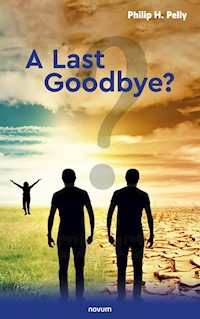
What are the chances that there really is life after death, and that we may meet our friends and loved ones again beyond the grave? What is the likelihood that a benevolent God has made this possible? The author approaches these questions in a way intended to intrigue and challenge even hardened sceptics by drawing together some of the mystifying discoveries of quantum physics (explained simply for non-scientists) and curious experiences from his own life which have had a profound effect on him. This is a book for anyone who is concerned about death, or who is interested in what must be one of the most fundamental questions in life: is death the end?
Das E-Book können Sie in Legimi-Apps oder einer beliebigen App lesen, die das folgende Format unterstützen:
Seitenzahl: 104
Veröffentlichungsjahr: 2022
Ähnliche



















CONTENTS
IMPRINT 2
CHAPTER ONE 3
CHAPTER TWO 20
CHAPTER THREE 32
ACKNOWLEDGMENTS 61
IMPRINT
All rights of distribution, also through movies, radio and television, photomechanical reproduction, sound carrier, electronic medium and reprinting in excerpts are reserved.
© 2022 novum publishing
ISBN print edition: 978-3-99131-168-3
ISBN e-book: 978-3-99131-169-0
Editor: Hugo Chandler
Cover images: Vchalup, Hdsidesign, Kts, Kiosea39 | Dreamstime.com
Cover design, layout & typesetting:novum publishing
www.novum-publishing.co.uk
CHAPTER ONE
In March 1918, at the age of nineteen, my father went off to fight in the trenches of the First World War. As a subaltern, he had a life expectancy of about six weeks. He took in his pocket a little prayer book into which his mother had inscribed in tiny meticulous handwriting Psalms 91 and 121: two of the loveliest poems extolling the power of God to protect us. I have held this prayer book in my hand and looked at it many times; it still brings tears to my eyes. Her desperate hope must have been that somehow God would protect him.
Volume three of “The Grenadier Guards in World War One” gives a written account of my father’s regiment’s exploits over the following months. It makes grim reading. A litany of woundings and deaths in the clipped dispassionate style of the time, with generally only the names of the officers being mentioned. I get the feeling that the deaths of the other ranks were not deemed to be so important, or maybe they were just too numerous to be named. No regrets: not sons or fathers or husbands, but pawns on an unending chessboard where the only rule was to do one’s duty.
It was several months later, in September, in a charge against the enemy line, that my father was struck by a bullet in his chest. He told me that as he lay on the ground his only concern was that people would think he was malingering, funking the rest of the charge. Fear of the shame of not doing one’s duty exceeded any fear of death. The bullet passed through his torso and exited at the back, doing no serious damage to his internal organs. It was a lucky bullet, taking him out of the remainder of the war.
Which is as good a place as any to start this little book. For it concerns death, the fear of death, and the sadness it causes. I have reached an age when it is certainly starkly apparent that there is a lot more runway behind me than in front. My aim in writing my reflections on this is to try to bring some comfort and hope – primarily to people who have reached the same stage in their lives. But it is also for anyone who may be interested in whether at the end of our days on earth we snuff out into oblivion or whether we take off into an entirely new existence of life after death. No one can know for sure, and I do not flatter myself that I can persuade anyone to the high degree of probability with which I hold my belief that we take the latter course. But I do hope that I can help people at least to consider that possibility to be a realistic one. That we and our loved ones may go on to beat death, that there will be no final goodbyes.
We are so certain of things nowadays. No more mysteries, no more wonders. With the click of a mouse, no more not knowing the answers to anything we want to know. We are not used to uncertainties. Apart from our prejudices, we like to have facts which can be proved. We view with amused contempt the superstitions of the past, the egotistical gods of the Greeks and Romans and all those terrifying ancient gods, including the Sun God of the Aztecs who would not rise in the morning without human sacrifice. How we ridicule the old belief that the Earth was flat, and that the Earth was the centre of the universe and that anyone who dared say otherwise deserved to be put to death for blasphemy. Such ignorance. And yet people were no less clever then than they are now. They just knew less about things.
So, what have we got to be so proud of? Here we are, little specks of life stuck by gravity to the spinning ball of the Earth rotating around our Sun. One Sun among maybe two hundred billion or so other suns in our galaxy. One galaxy among maybe one hundred billion or so other galaxies in the Universe. So at least we now know our place in the grand scheme of things, and perhaps we can be proud of that.
Or do we? The trouble is that there is approximately ninety-five percent of the Universe that we know virtually nothing about. We can calculate that it is there, but we don’t know what it is made of, and we can’t even see it. For that reason, it is called Dark Matter and Dark Energy. So, the truth is, the things we actually know about are limited to five percent of all that exists inside us and around us and out there in the furthermost reaches of the Universe, including all those mind-boggling numbers of suns and galaxies. Metaphorically perhaps we are not so very different to those flat earth people, happy in their exalted position at the centre of the Universe. We think we know it all. But clearly we do not.
Consequently, my hope in writing this book is to persuade those sceptical of the existence of life after death that if they are basing their scepticism on scientific or other logic, this basis may be rather suspect. As with a flat earth person trying to argue that life could not exist on the underside of the earth because anything there would fall off, so too it might seem rather futile for someone to argue, based on their experience of only five percent of all that exists, that something else does not exist. Furthermore, our understanding of that five percent is in any event very far from complete.
I find that many people are happier talking about the possibility of some sort of a vague, divine power existing than they are in talking about the possibility specifically of God’s existence. They are content for an unspecified supernatural power to remain buried in the background of their lives as long as it is never allowed out into the foreground. It seems to me that life after death is unlikely without the existence of a divine power which transcends our earthly laws to enable this. What I am discussing here is the God whom I believe to exist, a God who set off the Big Bang nearly fourteen billion years ago and who planted the seeds of our existence when the Earth was formed over four billion years ago. The God I have in mind is so extraordinary that it is not surprising that so many people do not believe in him. This is an all-powerful God who created the Universe, and us, and who provides us with freedom of will and with life after death. This is a God of infinite love and compassion, in common with the beliefs of all the major Abrahamic based faiths. Tempting as it may be to turn one’s back on such a disturbing, mind-bending concept and concentrate instead on what we consider to be the important issues in our worldly lives, if such an all-powerful God does exist, it might be argued that it would perhaps be unwise to ignore him.
Of course, my belief is no more than belief, without proof or provable fact. Why then, you may ask, does an ordinary worldly sort of person such as I consider myself to be, not much given to wishful thinking, hold it? What a curious, anachronistic, perhaps even crazy thing to do, you may think. So let me try to explain.
I accept that my belief was initiated and largely dictated by my upbringing and culture. My parents were conventional Christians. They survived hard, cruel times. My mother was too young to take any part in the war effort. But she was not immune to the harsh brutalities of life in those days. She told me how she remembered seeing the bodies of dead children, I assume victims of the Spanish flu, being trundled away in wheelbarrows for burial. That made a lasting impression on her, and she never stopped worrying about the safety of her own children. My father was rather the opposite. Having survived the horrors of the trenches and then, in the Second World War, having survived the blitz as a firewatcher stationed at the top of St Paul’s Cathedral, I think he understandably took a somewhat relaxed view about any perils that might arise in peacetime.
Before and during the Second World War, my five siblings were born. I was born three years after the war. Shortly after that we all moved from London to a large and glorious old rectory in the beautiful village of Grittleton in Wiltshire. So far as I can remember, we went to church most Sundays. I can’t say that I took any interest in the services, other than when they would finish. The vicar was a kindly old chap, so kind that although he smoked a pipe (Three Nuns tobacco I believe) he always carried a well-stocked cigarette case to offer round. When I was about three or four years old he came to tea and produced the cigarette case. It must have caught my attention, because for some reason he told me that if I could work out how to open it then I could have one of the contents.
It didn’t take me long. Surprised and, since this took place in front of my parents, probably rather embarrassed, as a man of the cloth he obviously felt duty-bound to honour his offer. I seem to remember that my father expressed the pragmatic view that smoking a cigarette would make me sick and put me off smoking for life. Regrettably, he was wrong. I am ashamed to say that from then on whenever the coast was clear my little fingers would remove a cigarette from my father’s gold cigarette case and take it, together with a borrowed box of Swan Vesta matches, to the potting shed. There I would luxuriate in the pungent smoke from the struck match and then deliciously inhale the cigarette smoke.
That was the first time that my life was influenced by a priest in the Church of England. It was also the last for many years.
It was probably about this time that my father became a Lay Reader in the Church. Lay Readers are now known as Licensed Lay Ministers, and usually have to undergo several years training before being appointed. My father was rather proud of the fact that all he had to do was to have tea with the Bishop. In fact, however, I have no doubt that he already had a profound knowledge of the Bible and a very deep faith – which must have been apparent to the Bishop. I suppose that this must, in a small way, have been apparent to me even as a very young child. Every night, he would settle me down as I lay in bed with a hymn which he would sing to me and a prayer which we would say together. His unwavering faith must have had a huge influence on my unquestioning infant mind.
My father’s Lay Readership gave rise to a bit of a coincidence in my life. One afternoon when I was about five, the Rural Dean, Canon Daniel Anthony, and his wife came to tea. Tea must have loomed large in the Church of England in those days, and this must have been a particularly important one. I seem to remember that my ten-year-old brother Roland and I were sent outside to enable the grown-ups to have some peace. The Old Rectory had a large circular drive in front of it and a lane to the side, which passed the garage and led onto the field beyond. This had enabled my father to teach Roland how to drive his Ford Consul. So, with nothing better to do, Roland collected the car key, and we went for a joy ride round and round the circular drive. When we had had enough, Roland brought the trip to a grand finale by showing off his driving prowess by coming up fast behind the Canon’s car parked outside the front door and jamming on the brakes at the last moment.




