


21,99 €
Mehr erfahren.
- Herausgeber: John Wiley & Sons
- Kategorie: Geisteswissenschaft
- Sprache: Englisch
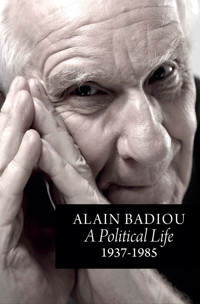
In this book, the renowned philosopher and polymath Alain Badiou tells the story of the first five decades of his life, from 1937 to 1985, setting it within the political history of the twentieth century.
Born in Morocco on the eve of catastrophic conflict, Badiou’s childhood and youth were marked by the Second World War and the Algerian War, experiences that would shape his political consciousness. Badiou honed his political convictions as an activist and organizer among students and workers and in solidarity with the Algerian independence movement, but his life was upended and transformed by May ’68 in ways that were profoundly consequential for his philosophical thought. By weaving his philosophical ideas into the narrative of his life, we see how the concepts for which Badiou is well-known – such as subject, being, event and truth – operate in the domain of experience and history.
Written in an engaging and often playful style, this book illuminates both the unique trajectory of a major philosopher and the turbulent history of the twentieth century, showing how the latter shaped the thinking of a man who has come to embody the very idea of political commitment and radical political thought.
Sie lesen das E-Book in den Legimi-Apps auf:
Seitenzahl: 630
Veröffentlichungsjahr: 2025
Ähnliche

CONTENTS
Cover
Table of Contents
Title Page
Copyright
I. 1937–1971: From Zero to Thirty Years Old, or, From My ‘Colonial’ Birth to the Evental Cut Represented by May 1968
1. Birth, Childhood and World War (1937–1947)
1a. 1937
1b. Morocco
1c. Bellerive-sur-Allier and Pétain
1d. Toulouse and the Occupation
1e. Toulouse and Liberation
1f. Toulouse and My First Newspaper
1g. Autobiographies and Proper Names
1h. Sex and History: The Burghers of Calais
2. The Paradise of the Lycée (1947–1955)
2a. Toulouse, Transitions: Lycée Bellevue
2b. Toulouse, towards the End: The First Glimmers of Politics
2c. Honours Received
2d. A Meditation on the Year 1954
3. Failures and Successes (1955–1956)
3a. Into Action!
3b. Historical Invariants, from Poujade to the Gilets Jaunes
3c. I Preside and Fail; I Compete and Succeed
4. I Become a Socialist (1956–1958)
4a. Budding Politicians at the ENS
4b. Lessons from History: The Category of the ‘Groupuscule’
4c. The Manoeuvrings of the ‘Socialist’ Party
4d. An Obscure Decision?
4e. In the Name of the Father: Adhesion, Structuring, Action
4f. A Subjective Defect: The Oppositional Mentality
4g. Was There Any Point to All of This?
5. 13 May 1958 and its Effects (1958–1961)
5a. Coup d’État and Scission: The PSA
5b. Riots in Budapest, Revolution in Havana
5c. Splits and Fusions: From the PSA to the PSU
5d. 1960–1961 Again: Terray, Verstraeten, Me and Sartre
5e. The Belgian Dimension of My Political Life: Beginnings
5f. Heroes and Martyrs of Our Vision: Castro, Lumumba
5g. The Workers: A Free Inquiry
5h. The Jeanson Network and Clandestinity: The Temptation of the Sublime
6. An Overtly Military Music
6a. Manifesto of the 121
6b. A Handful of Generals Onstage
6c. My France and its Army
6d. A Political Lesson, an Academic Ruse, a Music Exam
6e. An Experience of Mass Alliance: The Army as Seen from Below
6f. The Missile Crisis: The Nuclear War Will Not Take Place
7. A Career of Note in the Champagne Region? (1963–1968)
7a. The Reims Boys’ Lycée as Seen Through a Teacher’s Eyes
7b. ‘Leftist’ Social Democracy: A Stubborn Myth
7c. A Provincial Temptation à la Balzac
7d. A Trip: Bolivia, for Che Guevara’s Tomb
7e. Who Was I in the Spring of 1968?
II. 1968–1985: From Thirty to Forty-Four Years of Age, or, From a Flamboyant Maoism to the Veiled Beginnings of the Ideological and Statist Counter-Revolution
8. ‘Le Joli Mai’ (1968–1970)
8a. Event and Subjectivation Seen from Close Quarters
8b. Two Years that Devastated a Subject: 1969–1970
8c. Provincial Self-Sufficiency?
8d. An Anticipation of Maoism: The Sino-Soviet Controversy
8e. The Creation of Paris-VIII and My Uprooting
9. The Early Red Years (1970–1985)
9a. A Creature with a Very Precise Name: Group for the Foundation of the Union of French Communists (Marxist-Leninist)
9b. An Organization’s First Steps
9c. Two Convictions that Have Become Rare
10. Anarchic Journey into the Work of the UCFml (1970–1985)
10a. The Factory as Political Site: Communist Worker Nuclei
10b. On the Side of the People: The Popular Anti-Capitalist Committees
10c. Maoist Politics in the Countryside
10d. A Subjective Parenthesis on the Political Question of ‘Identities’
10e. University and Youth: Problems of Recruitment
10f. The Maoist Pole
10g. Political Consistency of the International Proletariat of France: The Great Organized Struggle of the Sonacotra Hostels (1975–1979)
10h. Le Marxiste-Léniniste, a Proud Publication
10i. State of the UCFml in the Early 1980s
11. Endgame for the UCFml (1981–1985)
11a. What Was it that Began in the 1980s?
11b. What Did I Begin Again in the 1980s?
11c. The Ideologues of the Counter-Revolution and their ‘New Philosophy’
11d. The Capitalist Media, and Our One Hundred and Forty-Five Newspapers
11e. Creation and Development of the Fortnightly Le Perroquet
Provisional Conclusion for the Present Day
Index
List of Illustrations
Chapter 5
Figure 1
Development of left political parties in France, 1905–1960
Guide
Cover
Table of Contents
Title Page
Copyright
Begin Reading
Provisional Conclusion for the Present Day
Index
End User License Agreement
Pages
iii
iv
1
3
4
5
6
7
8
9
10
11
12
13
14
15
16
17
18
19
20
21
22
23
24
25
26
27
28
29
30
31
32
33
34
35
36
37
38
39
40
41
42
43
44
45
46
47
48
49
50
51
52
53
54
55
56
57
58
59
60
61
62
63
64
65
66
67
68
69
70
71
72
73
74
75
76
77
78
79
80
81
82
83
84
85
86
87
88
89
90
91
92
93
94
95
96
97
98
99
100
101
102
103
104
105
106
107
108
109
110
111
112
113
114
115
116
117
118
119
120
121
122
123
124
125
126
127
128
129
130
131
132
133
134
135
136
137
138
139
140
141
142
143
144
145
146
147
148
149
150
151
152
153
154
155
156
157
158
159
160
161
162
163
164
165
166
167
169
171
172
173
174
175
176
177
178
179
180
181
182
183
184
185
186
187
188
189
190
191
192
193
194
195
196
197
198
199
200
201
202
203
204
205
206
207
208
209
210
211
212
213
214
215
216
217
218
219
220
221
222
223
224
225
226
227
228
229
230
231
232
233
234
235
236
237
238
239
240
241
242
243
244
245
246
247
248
249
250
251
252
253
254
255
256
257
258
259
260
261
262
263
264
265
266
267
268
269
270
271
272
273
274
275
276
277
278
279
280
281
282
283
284
285
286
287
288
289
290
291
292
293
294
A Political Life
1937–1985
Alain Badiou
Translated by Robin Mackay
polity
Originally published in French as Mémoires d’outre-politique: 1937–1985 © Flammarion, 2023
This English translation © Polity Press, 2026
Polity Press65 Bridge StreetCambridge CB2 1UR, UK
Polity Press111 River StreetHoboken, NJ 07030, USA
All rights reserved. Except for the quotation of short passages for the purpose of criticism and review, no part of this publication may be reproduced, stored in a retrieval system or transmitted, in any form or by any means, electronic, mechanical, photocopying, recording or otherwise, without the prior permission of the publisher.
ISBN-13: 978-1-5095-6567-2
A catalogue record for this book is available from the British Library.
Library of Congress Control Number: 2025934799
The publisher has used its best endeavours to ensure that the URLs for external websites referred to in this book are correct and active at the time of going to press. However, the publisher has no responsibility for the websites and can make no guarantee that a site will remain live or that the content is or will remain appropriate.
Every effort has been made to trace all copyright holders, but if any have been overlooked the publisher will be pleased to include any necessary credits in any subsequent reprint or edition.
For further information on Polity, visit our website:politybooks.com
I1937–1971FROM ZERO TO THIRTY YEARS OLD, OR, FROM MY ‘COLONIAL’ BIRTH TO THE EVENTAL CUT REPRESENTED BY MAY 1968
1Birth, Childhood and World War(1937–1947)
1a. 1937
Sometimes it’s only long afterwards that you can work out what kind of world you were born into. That’s how it is for me: since I was born in Morocco on 17 January 1937 only to leave four years later in the midst of global turmoil, I cannot begin this book of memories, at the zero point, with memories. During the first four years of life, we form very few memories, and they are most often buried in the unconscious, from which I have neither the will nor the means to excavate them, having always steered clear of psychoanalysis – a practice for which I have infinite admiration when it comes to anyone but myself.
So I shall open proceedings, the proceedings of my life, by describing the backdrop in strictly objective terms, since today I am well aware of the dark significance of the year 1937, the year when the enthusiasm of the Front populaire – having been stoked by the 1936 electoral victory of the Left, the Communist Party included, by a startling and magnificent national strike, and by paid holidays and rising wages – began to founder, faced with the impotence of a government led by a socialist, Léon Blum, in relation to the crucial question of the Spanish Civil War. In Spain, the Republicans had mobilized the masses against a brutal military coup d’état. They had taken Madrid thanks to volunteers who came from the whole world over to join the cause (the famous International Brigades, perhaps the finest example in history of what Marxist internationalism is capable of), forged a fragile alliance between anarchists and communists, obtained significant support from Soviet Russia to stand against the even greater support obtained by the military factions from Mussolini’s Italy and Hitler’s Germany. But the Spanish Republicans needed more – air power, armaments, etc. Socialist France was unable to make a decision, obsessed as it was by the strategic alliance with the English who, to say the least, were unsympathetic to the cause of the ‘reds’ in Spain. At the end of 1937 the Spanish Republican cause was obviously in serious difficulty, and things only got worse at the beginning of 1938. The total victory of the Nationalists would profoundly alter European power relations, convincing Hitler that his military apparatus, tested out in Spain, was nearly ready for the attacks he was considering.
On the other side of the world, in the Far East, in this same year of 1937, the Japanese militarist hordes pounced upon China, where they would commit unspeakable crimes. Forged in the fury of this conflict, the communist resistance would take as its political and military leader a certain Mao Zedong, whose name was as yet unknown in France, but thirty years later would become, as we shall see below, one of the great names in my life – as it remains today.
In Stalin’s Soviet Russia, 1937 was the year of the Great Purge. One after another the trials came, decimating the army staff, then exterminating almost all those who had led the 1917 Revolution. The use of torture was officially endorsed. It became far riskier to be a member of the incumbent Communist Party than to be a factory worker. Fear, particularly fear of war, dominated the subjectivity of the Communist Party regents, who were also dismayed by the disorder which on all sides seemed set to ruin the great projects of the five-year plans. They lashed out blindly at the ‘culprits’. Paradoxically, one of the causes of this violence was that Stalin himself had proclaimed that the Revolution was essentially over. But it could hardly be said that society had been truly transformed into a communist society – not in Marx’s sense, in any case. Having never had a clear idea of what a real communist movement would be after the seizure of power – namely, a collectivization controlled by the actors of the production process rather than one defined solely by the directives of those in power – it was within the state party itself that the leaders of this same party, having been told that the revolution was over, sought the ‘guilty’ parties who were to blame for all the inertia, irresponsibility and wastefulness. These guilty parties could only be traitors or foreign agents, since the official line was that all revolutionary antagonism had been resolved and all was well on the political front. Consequently, a sort of obsession with the ‘purification’ of the party took hold in the political realm, taking precedence over the economic and productive management of the immense Soviet Union.
And yet it must be recognized that, in spite of all this, and albeit at far too high a price, the regime had succeeded in building a solid industrial base and a powerful education system – which, eight years later, would be instrumental in defeating Hitler’s hordes.
In the United States, which since 1929 had been shaken by an unprecedented economic crisis, the abrupt reformism of Roosevelt, who began his second term in office in 1937, avoided the worst by relying on the unions and holding the trusts and banks to ransom. But it would take nothing less than a world war for the US to regain its pre-1929 momentum and re-establish itself as a dominant power for decades to come.
So: the Front populaire in France, the Civil War in Spain, total war in China, fascists in power in Italy and Germany, Stalin’s power running amok in the USSR, vigorous anti-crisis measures in the US … such was the planetary configuration that presided over my birth.
It didn’t take a prophet to sense that war was on its way. I was born, as it were, into a Second World War that was already effectively underway. All in all, the baby boy that I was, too heavy for his mother as soon as he was born (I weighed in at 5.3 kilos when I was delivered), did not seem to herald anything particularly noteworthy in world history – even if today, retrospectively, as part of the egocentric propaganda that I like to half-jokingly spread about myself, it amuses me to count this birth as one of the many dramatic political symptoms of 1937.
1b. Morocco
My memories of Morocco date essentially from the years 1939–41. The emotions I experienced between 1937 and 1941 were no doubt crucial to my symbolic development. But as the rules of this book dictate, I must confine myself to the surface of memory, centring the bits and pieces I can remember around revelations that are ‘political’ in the broad sense.
First of all, consider this quite obvious fact: prior to the Second World War, Morocco was one of the great jewels of French imperialism. And it was precisely for this reason that my parents, who met there and loved each other forever, lived there. Both were graduates of the prestigious École normale supérieure, but they worked as lycée teachers, in Rabat and later in Casablanca. But in Casablanca even a lycée teacher could afford to live in a large villa with as many domestic staff as they wanted, to go hunting with Arab beaters, and to have as their friends French colleagues of a similar standing – such was colonial life in all its glory.
There can be no doubt that I benefitted from these privileges, but I believe this is tempered, ‘dialecticized’, by a number of other facts, some conscious and perfectly apparent, others less obvious but symbolically important.
The most important thing that established itself during this period was a conflict with my mother which in one way or another would last for more than forty years. You might ask how this could possibly relate to politics. Well, in the following way, I think: the fact that my mother was more often irritated by me than she was tenderly loving towards me gave rise to my early decision to do without ordinary protections, to construct my life entirely independently, including with regard to socially imposed norms, customs and laws. A primitive form of pride for which during my childhood I often paid dearly in tantrums and tears, but which progressively grew into a sort of regal indifference to dominant ideological currents and received wisdoms. In terms of my thinking and my convictions, thanks to what I experienced as a maternal ferocity, I have always been predisposed to go against the grain. Yes, forced to get by without maternal tenderness or admiration, I constructed my own kingdom, something which would soon result in my being considered almost automatically as worthy of being appointed leader whatever the assembly, movement, group, party or faction I ended up joining. Basically, my political predisposition, forged in Morocco, has always been that of an imperial solitude which, paradoxically, often seems to suit the desires of others as well.
But what were the dramas which, during my time in Morocco, cast me in this role? Let’s start with a few facts.
The first, with the deepest roots, is that my mother belonged to that generation of feminists of the 1920s and 1930s – Simone de Beauvoir among them – who led an entirely independent life, took lovers, never married and saw mothering as plain drudgery. Since, happily – yet also unfortunately – for her, she was passionately in love with my father and would remain so for her entire life even though he was a great philanderer, at the beginning of the 1930s my mother married and gave birth. But I remain convinced that whereas my brother was the product of a controlled desire, I was one too many. Conceived in 1936, no doubt amid the eroticized enthusiasm of the Front populaire, a second son rather than the hoped-for daughter, an enormous baby, I didn’t get off to a good start when it came to winning my mother’s favour.
Things didn’t get any better as life went on. Of course, as one would expect in a colony, I was mainly waited on by Arab ladies turned domestic servants and Swiss nannies who supposedly represented the very latest in childrearing. As for my mother, she left for the lycée almost every morning. But, full of anguish provoked by her departure, I’d wake up screaming every day, and cling to her legs to stop her going down the staircase of the villa. When, many years later, she told me of these episodes which had marred her morning routine between 1939 and 1941, I sensed that she was still full of angry indignation at the intolerable child I had been.
On one occasion, my annoying ways culminated in a short-lived attempt to run away from home. Ever since this episode, I think, I have remained haunted by the idea that one must know how to flee: ‘Fuir, là-bas fuir [Flee, far away, flee]’, Mallarmé’s maxim, was also the watchword of my tormented childhood. Similarly, I would learn to flee anything that looks like a political consensus, particularly the maternal, ‘democratic’, typically French consensus which claims to take us all under the petticoats, filthy as they are, of the Mummy called ‘Republic’. In any case, when I was just four years old, one day at kindergarten I just decided to up and leave, on my own, during a recreation period. I got out of the doors easily enough and there I was, walking into the centre of Casablanca, strolling past the shop windows, cool as a cucumber. That is, until my presence in the street worried a few passers-by, who ended up handing me over to the police, who in turn interrupted my poor mother mid-class to tell her that her offspring of barely four years of age was roaming around alone in the perilous streets of the big city. Faced with this inopportune intrusion of her unloved son into her very classroom, the teacher’s inner sanctum, my mother was more humiliated than she was furious. As for me, what stuck with me from this escapade was a taste for disappearing every now and again without anyone in my regular entourage knowing where I am. For me these are the most propitious conditions for writing well. And here is the proof: I am in this state of anonymous dislocation today, 12 November 2018, as I write these lines. No doubt, should politics require it of me – as it did of my father between 1941 and 1944 – I would make an excellent undercover agent. Indeed, I came close to it during the years of opposition to the war in Algeria, as we shall see.
Anyway, thanks to Marshal Pétain, in the end my parents were obliged to quit their colonial paradise. And here is another politically decisive anecdote, albeit one I only learned of much later. In 1940, my father was flagged by Pétain’s regime as an ‘anti-French’ agitator. A mathematician, he was a man who thought slowly, but whose hard-won conclusions were as solid as granite. He was never really an anti-colonialist, but after a few years in Morocco he was on the way to becoming one. One of his students in preparatory class for the grandes écoles was Mehdi Ben Barka – the future Third World leader and champion of independence who would later be assassinated in cowardly manner in France by agents of the post-colonial collaborators and their French accomplices. The young Ben Barka was already a staunch anti-colonialist militant. He was also – I later learned – the best mathematics student my father had ever had. Hence, with that combination of discipline and invention so characteristic of mathematics, my father had slowly edged towards the emancipatory stances of his favourite pupil.
Needless to say, the lesson was passed on to me: without mathematics, no philosophy, this we have known since Plato, Descartes and Leibniz, and I quite naturally saw myself as belonging to this lineage – I know, what arrogance! – via my father, who by virtue of this saved me from my mother.
And perhaps one should even say: without mathematics, no politics. Because if you want to go against the tide, your arguments have to be solid. And you must also not be disappointed if the crowds don’t immediately rally to your cause: Archimedes, the inventor of entirely new mathematical methods, was not really understood and his work was not disseminated until about one thousand eight hundred years after his death. It is with this kind of timescale in mind, perhaps, that one must envisage communist politics finally succeeding in dragging us out of the neolithic triumvirate of private property, family and state which has governed the collective life of humanity for six or seven thousand years now. As Mao said, ‘once they take hold of the masses, correct ideas become spiritual atomic bombs’. Indeed. But Mao also knew that correct ideas can often take a long time to ‘take hold of the masses’. All of my own experience has taught me – and mathematics has helped in this apprenticeship – that political truths almost always arrive slowly, with many backtracks and bumps in the road, and that in consequence, obstinate patience is one of the principal virtues of a militant. It is this patience that enables one – to cite a directive declared before the whole party membership by Zhou Enlai at the 1973 Communist Party Congress – to ‘dare to go against the tide’.
But let’s get back to memory and biography. At first my father resisted, determined that he would leave neither the lycée nor Morocco. He was put on unpaid leave, and the family adapted so as to make it possible to continue this resistance, living on my mother’s salary alone. Then my mother was put on half pay. Still, we held fast (without my knowing what was going on, of course). They put my mother on unpaid leave: at that, we had no other choice but to leave. An exodus in reverse: we arrived back in an occupied France in autumn 1941, having come from a Morocco that was still ‘free’, albeit under the control of a Pétainist clique.
I experienced a certain happiness – which was by no means the dominant tone of my childhood – during the summer of 1941. We had spent our holidays by the seaside, where I ran about with other children on the beach at Casablanca and fished for sardines, and I have a marvellous memory of a white peacock spreading its tail on the sand. But soon enough we had to leave on the train to Algeria, and then the boat to Marseille, and then the train again to Vichy. A gloomy voyage – I sensed it, without understanding why.
1c. Bellerive-sur-Allier and Pétain
In Marseille, there were buildings not far from our hotel blackened by fire or entirely destroyed. ‘We’re at war’, they told me. But what does ‘war’ mean? asked the little boy that I was. Something, in any case, that was quite out of keeping with the bright white unfolded tail feathers of that peacock on the beach. Awoken suddenly in the hotel at night, I saw my mother entirely naked, washing herself before a basin. Certainly a crucial vision for any four-year-old child, all the effects of which were foreseen by Freud, but which for me today remains a perfectly disagreeable memory.
The night train was overloaded with people who had had to deal with various tribulations. In the middle of the night, I heard the piercing voice of a woman saying, at top speed: ‘To Gargilesse, to Gargilesse [à Gargilesse], it’s very pretty, there’s George Sand’s house, it’s very pretty.’ This strident declaration has stuck in my mind ever since, imbuing the signifier ‘George Sand’ with a catastrophic aura only aggravated by the highly obscure signifier ‘Gargilesse’. Of course, it was only the name of a small village in the region, which indeed is not far from George Sand’s house at Nohant, in the Indre department. But my sleepy four-year-old self understood the name as ‘à la gare, j’y laisse’ – ‘at the station, I leave…’. But leave what? The question nagged at me. ‘At the station, I leave George Sand’ was my interpretation at the time. What a great disservice to the writer that, during that nocturnal exodus, I learned that he – sorry, she – would be best left behind, preferably at a station. When I later learned of the repugnant stance taken by this lady in regard to the heroic workers of the Paris Commune, and that therefore one must always remember that ‘George Sand’ was never anything but the pen name of Amantine Lucile Aurore Dupin, Baroness Dudevant, I gained political confirmation of the sentiment that had been forever imprinted upon me on that night on the train – it would indeed be better to leave Baroness Dudevant at the station.
Why had we headed to Vichy, which Pétain and his clique of fascist traitors had taken as their capital after having sold out France to Hitler? Simply because my paternal grandparents, teachers in the Allier department, now retired, lived at Bellerive-sur-Allier, a commune very close to Vichy, just on the other side of the bridge across the River Allier, in fact. Following their expulsion from Morocco, my parents had been forcibly transferred to Toulouse and hadn’t known what to do with their two children when they arrived, having been unable to find any lodgings in this unknown city where they would perhaps be forced to stay for some time at a hotel. They therefore decided to leave myself and my brother Jean-Paul in the strict care of Léon Badiou and his wife.
I very quickly learned two things at Bellerive-sur-Allier, both political in nature. The first, during the meal served by my grandmother a little after our arrival, stood in contradiction to my mother’s harsh pronouncements. She had told me that I would have to get used to a somewhat restricted diet, for severe rationing was in force throughout France. Since I found the soup cooked by my grandmother quite delicious, I remarked innocently: ‘We eat well in wartime.’ To my great consternation, this made everyone laugh. And yet I had touched upon an essential point: France – or at least most of the French people – did not suffer to an unbearable extent during the War and the Occupation, as the Dutch had already suffered, not to mention the Czechs and, worse still, the Russians, many of whom would become victims of a veritable extermination. Generally having close links to the prosperous countryside, the inhabitants of our cities, particularly the provincial cities, knew how to get by. It must be said, however, that the ignoble collaboration with the Nazis also helped alleviate the sufferings of the French people. As a result, this sinister capitulation was seriously contested by only a small minority, and even fewer actively fought against it. All in all, while others fought the war, France went on living its life – a little ascetically, to be sure, but ultimately quite peacefully – at the price of delivering its Jews to mass killers, propagandizing for the Nazis and helping out the militia in its pitiless pursuit of the Resistance. This utter dishonour – which in my view we have still not entirely come to terms with – lasted for a very long time. As late as the beginning of 1944, Pétain was being welcomed by enthusiastic crowds in the major cities of France.
All of which essentially confirmed my childish sentiment, in September 1941, about the quality of my grandmother’s soup. There were many French people who could say: since in this war we are eating, if not as well as my grandmother’s soup seemed to suggest, at least well enough to assuage our hunger, then why risk our lives joining a battle that is already lost?
I would later learn what lies at the bottom of all this: politics is not, and can never be, a mere projection of one’s immediate interests. It involves principles. When in later years I asked my father why he had joined the Resistance almost as soon as he arrived in Toulouse, in doing so risking torture and death, I could see that he didn’t understand the question. ‘Well, you know,’ he told me, ‘the Nazis had occupied France, how could I have just done nothing?’ In short, he assumed that a principle was not subject to circumstantial difficulties or altered by the risks it might involve, nor was it weakened by material advantages. And I believe that this vision of things begins with the refusal to grant unlimited power to good soup. Indeed, in French we say of collaborators and opportunists of all stripes that they ‘aller à la soupe’ – an entirely appropriate phrase, as I have known since September 1941 when, at four years and nine months of age, I was first exposed to the temptation to ‘go where the soup is’.
The other thing I learned back then, this time from my grandfather, was that since Pétain was intolerable to an old patriot ex-combatant like him, I should also detest him. Pétain’s cortege, made up of a long file of cars, passed by Bellerive almost every day as the Marshal of treason travelled from his private lodgings to his office as Head of State. One day I heard my grandfather murmur: ‘Ah! If only I could put a few bags of nails on the road so all their tyres would pop and they’d end up wrecked!’ Distraught, Grandmother exclaimed: ‘Oh! Léon! Don’t say such things! Can’t you see the children are here?’ Too late! Anything that children shouldn’t hear immediately becomes, for the children in question, and for me in particular, an item of the greatest importance. And here is what I heard and understood: Pétain deserved to be popped, in every sense of the word. And I secretly made this my maxim. At the Bellerive kindergarten, we had to learn by heart the hymn ‘Marshal, here we are! Before you, the saviour of France …’. I joined the Resistance: I didn’t really sing; I just mouthed the words. Here I learned that a part of politics consists in subtracting oneself from what is more or less obligatory to think or to do. I also learned not to think about politics in terms of the advantages of which it might deprive you – or those which it might procure you. Once again, I made up my mind not to consent to anything that dresses itself in a specious authority only by virtue of its supposedly being consensual. And today I would not sing a hymn to ‘democracy’, to the ‘Republic’ or to ‘European values’ any more than at the beginning of 1942 I was prepared to sing an anthem to Pétain as the ‘saviour of France’.
Meanwhile, time had passed, and I had learned to read while sitting on the knee of my grandfather, ever the schoolteacher even after all those years.
1d. Toulouse and the Occupation
I arrived at Toulouse for the beginning of the school year 1942–43, a spirited red-haired boy five-and-a-half years of age. I knew how to read and had become sufficiently wary that a significant part of my time was spent hiding from my mother what I was planning to do with it. I was thus continuing, with determination, my apprenticeship in clandestinity.
At the beginning of the school year in October 1942, Toulouse was still part of the so-called ‘free’ zone, i.e. the area that the Germans had handed over to their Pétainist minions as part of the French territory subject to their plundering. It remained under the surveillance of the German army and the Gestapo, who occupied what was known, precisely, as the ‘occupied’ zone, i.e. the whole of northern France. But this concession was not to last very long: on 11 November 1942 the German army invaded the ‘free’ zone.
Pétain and his cronies, who had signed the agreement carving up France, naturally saw no reason to defend against this invasion, or even to rethink their collaboration with the Nazis. For me, however, it was a harsh lesson in what war is all about. Every morning, I set out for the primary school for teachers’ children that was nestled in the grounds of the boys’ lycée. After taking the tram, I walked down a narrow street that led to the glorious place du Capitole, symbolic of the city centre because it is home to the town hall and the opera, two institutions that would become all-important to my future adolescent self. Well, one day in November I found the street barred by heavily armed soldiers clad in green. Without malice, but firmly enough, they told us kids that we had to take a different route. This brutal image made a deep impression on me, which I carry with me to this day as a symbol of what true constraint is, the kind of constraint to which there is no possible response except humiliation: when the path of your existence is simply blocked by a power that you have absolutely no means to oppose.
A little later I learned that the headquarters of the German occupation of the Toulouse region had been set up in the Hotel du Grand Balcon, situated in this street which, in order to protect the officers from any curiosity on the part of the public, had been cordoned off by soldiers. In a sense, then, this was my real entry into the world war.
An even harsher apprenticeship awaited me at the beginning of 1944, the year of the Liberation, in the form of the Allied bombing of Toulouse. The city was of interest to the Germans because it was home to major aeronautical industries, in particular the Breguet factories, as well as decent civilian and military airports and a large gunpowder factory. Accordingly, destroying all of this was of great interest, in turn, to the British and American air forces.
The first bombing came upon us in the middle of the night in April 1944. For the child that I then was, it would be a great lesson in what, today, is still veiled by the language of trivial news headlines such as ‘American Air Force Bombs Mosul’. A bombing raid like the one that awoke me that night – the roar of sirens, the tornado of noise all around, the crackle of machine-gun fire, the thunder of bombs, the abstract stripe of the sky lit up by the beam of the searchlights, the total uncertainty as to where the projectiles will fall, the enormous fires, the need to huddle at the bottom of the garden to avoid, as far as possible, ending up buried in the ruins of your own home – is a moment of pure terror. Today’s Western world, supposedly the world’s police, hypocritically opposes the civilized nature of air raids to terrorism waged with knives, for instance, by groups claiming allegiance to a distorted Islam. But no, no! A bombing raid, or indeed a drone strike carried out from the comfort of an office chair in order to indiscriminately kill people spotted 6,000 kilometres away along with anyone else who happens to be in the area – collateral damage, they call it – these are acts of utter, largely indiscriminate destruction whose perpetrators gladly accept that they don’t know who they are killing and massacre children without even knowing what they’ve done. These are – the word is perfectly accurate – terrorist acts, of which the atomic massacre at Hiroshima remains the perfect exemplar. I was ‘lucky’ enough to experience this at the age of six. Every time someone reports, often with a kind of latent admiration and a feeling of superiority, that some poor city in the Middle East has been bombed by the forces of democracy and human rights, I know the mortal terror that has been visited upon the ordinary inhabitants of that place, and I think of how, in the early hours of the morning, in the ruins, they will count the innumerable corpses, the wounded and the burned, left on the ground by this terror from the skies.
My father, a true mathematician, immediately drew the conclusion from this deadly raid: he set about digging a deep trench at the bottom of the garden. It’s not easy to make the sides of a trench run straight when you’re digging it with a shovel and a pickaxe. My father executed the job with a kind of elegant efficiency, just as he knew how to resole shoes or collect honey from a beehive. I learned from watching him that any task, whether manual or intellectual, can be done well or it can be done badly, and that any difficult work done well deserves respect. No doubt it was at this point, seeing my father, a mathematician, work so rigorously digging a straight line in dry, unforgiving soil, that I first began to see the sense in a fundamental element of the Communist Idea: that an end should be put to all hierarchical evaluations of forms of work, and in particular to the opposition between intellectual work and manual work, as well as that between management and execution. I thank my father, calmly facing this terror from above, for having embodied before my eyes the Marxist ideal of the polymorphic worker.
The third bombardment – in June 1944 – presented an opportunity to meditate on the relations and the disparities between appearance and reality. There we were, the four of us – Mother, Father, my brother and I – in the newly dug trench. It was broad daylight, late morning. Unlike the nocturnal terror of the first raid – low-flying planes, intolerable noise, spectacular fires – this attack was strangely muted. At high altitude in perfect squadrons, the planes dropped their bombs invisibly. The fire of the German air defences seemed to send fine trails of light up into the sky. Even when a plane was hit, it gently detached itself from its neighbours and slowly made its way to the ground, leaving behind it a beautiful trail of white smoke, while the opening of the crew’s parachutes marked the blue sky with small white circles. I openly expressed my relief at seeing the night-time terrors subdued, as it were, by the celestial heights. But my father immediately pointed out that this kind of high-altitude bombing – which he attributed to the Americans, as opposed to the English terror of low-level bombing – was far less precise, often missed its target, and had the very serious disadvantage of causing destruction and death among innocent civilian populations. In short, he instructed me that in war, as in politics in general, one must be systematically distrustful of appearances, and carefully and patiently investigate the real effects behind the soft propaganda and rhetoric of consensus. It was in this way that I learnt that the reality of a situation is only perceptible to those who can relate to the actual participants and actors in that situation. As I would read much later in Mao, the heart of political action is mass alliance, and the rule is: ‘no investigation, no right to speak’.
If I had known at the time about my father’s Resistance activities, which had begun almost as soon as he had arrived in Toulouse, I would no doubt have drawn other, more radical conclusions from my brief experience of that war. But of course, there could be no question of revealing such activities to a five-year-old boy, let alone one considered irresponsible and suspicious by his own mother. And yet my father did give me a kind of head-on lesson in the workings of history. He had put up a large map of Europe in the hall at home, and was marking the line of the Russian front with a long coloured thread stretched between drawing pins. One day, towards the end of 1943, I saw him move this line to the left of the map, towards the west. I was old enough to understand that this meant the Germans were retreating – and indeed, that the Russian troops were advancing into Ukraine. I said to my father: ‘So are we going to win the war?’ Something which seemed rather improbable to me, since every day I could see the Germans strutting through the streets of Toulouse. But my father replied: ‘Of course! You just have to will it.’ Since then I have been immune to accusations of voluntarism – of which there have been plenty – accusations which, incidentally, were also levelled at Mao and the Maoists during the 1970s. Yes, before speculating on the question of whether a given action or thought is viable in the real world, it is always necessary to clarify what it is, in this real world, that we wish to transform. The maxim is that one must have a strategy of will, which, admittedly, is subordinate to the obligatory tactical realism, but which exerts a tight control over its scope, as well as controlling the risks of illegitimate complacency endemic to all forms of ‘realism’.
1e. Toulouse and Liberation
In August 1944, German troops were preparing to leave Toulouse: they were to move northwards to support those trying to contain the advance of the Allies following their landing in Normandy. The local Resistance groups, where mutual distrust was already emerging between those sections dominated by the Communist Party and those that were not, came together – albeit temporarily – in order to enter the city and confront the last detachments of the occupying forces, as well as the cowering collaborators. It was in this context – although I wouldn’t understand exactly what it meant until some time later – that the departmental committee of the Resistance appointed my father as provisional mayor of Toulouse, pending the organization of regular elections. So this man, who was no Toulousain, having neither the loquacity nor the accent characteristic of the locals, found himself launched into a completely unexpected political career in the south of France. ‘The cold mayor’, the local newspapers would often write, also mocking his profession as a mathematician: more interested in fiery rhetoric of great promises and battles between leaders, the provincial brand of socialism – dubbed by its enemies ‘cassoulet socialism’ – was somewhat reluctant to recognize itself in my father’s sternness and severity, or in his propensity for solidly arguing his opinions. There’s a local proverb that says (to be spoken with a strong local accent): ‘A man who can’t promise is poor indeed.’ By this criterion, it could hardly be doubted that Raymond Badiou was ‘poor’ indeed. He had become mayor of a town he had been living in for barely three years only thanks to the contingencies of war – and yet he went on to hold the position for fourteen years. But that’s another story.
I retain one single memory of this episode in History, in August 1944, one which is grandiose enough as far as my family goes: perched somewhere, I can no longer remember where, on the place du Capitole, centre of the city, packed with people, I saw my father appear on the balcony of the town hall. He began to speak amidst a hail of hurrahs. In his usual fashion as a wise, quiet man, he indicated above all the remaining difficulties, the fact that the Germans were not far away and might return, the complexity of the political path that went by the fine name of ‘liberation’. For me he was absolutely representative of the figure of the Father, severe and indubitable.
But he was seen in a different light by the conservative, restorationist tendency, by the followers of Charles de Gaulle, by the whole new Christian democratic movement, the MRP (Mouvement républicain populaire, the Popular Republican Movement), which I heard its leftist enemies call the ‘Machine to Recover Pétainists’. Toulouse was seen as a red city, where communists were rife and the social-democratic barrier set up to oppose their claims was rather weak. It was also said that rough justice was being meted out in the city, that ‘collabos’ and those suspected of collaborating were being put up against the wall without trial. And certainly, as Mao would have said, a liberation of this kind, where rival armed gangs surfed on whatever passing wave of enthusiasm they could catch, was going to be no ‘dinner party’. De Gaulle came in person to re-establish order, at least symbolically, and to make it known that the reds had to be held at bay.
I have a photo of his visit which seems very symbolic to me: de Gaulle is walking in the street, with my father by his side studiously looking in almost the opposite direction to the General. My father always saw de Gaulle as the military man whose role consisted in working from within the spirit of the Resistance to re-establish the old nationalist, colonialist, counter-revolutionary, incredibly bourgeois order which my father and other members of the Resistance had sworn to abolish. Raymond Badiou was an anti-Gaullist in 1944 and would remain so in 1958, when a military coup d’état in Algeria brought the General back into power. At that point he would decide to resign as Toulouse mayor rather than follow the city’s municipal majority as it cravenly rallied to support this new power.
On this point I am a faithful son, a hereditary anti-Gaullist: June 1958 would find me, under cover of night, pasting up little handprinted flyers all over Paris’s fifth arrondissement (I was attending the École normale supérieure at the time) in which I fiercely ridiculed the General’s rhetoric of salvation.
Not that this prevented me from sometimes appreciating the old man’s style. There is one story in particular that I love. It’s true that, since it is told by Malraux, its truth is immediately suspect, but let’s put that aside. Someone (maybe Malraux himself) asked General de Gaulle how he had been able to defend his position in England, standing up to Churchill, ignoring Roosevelt’s distrust, when he had only the slimmest of forces at his disposal. De Gaulle’s response: ‘I was too weak to give in.’ I have often thought about this beautiful maxim, and have been particularly inspired by it in my political activities, in many cases minoritarian struggles fought with slender means. It’s quite true: if you know you are following the correct line and your principles are indisputable, far from tempting you to give in, weakness only confirms your determination to give no quarter.
1f. Toulouse and My First Newspaper
There we were, caught up in that strange sequence of events – between 1944 and 1947 – known as ‘the Liberation’, or more abstractly, ‘creation of the Fourth Republic’, a sequence in which novelty sparred with repetition without one really knowing, at the start, which would win out. Great economic and social reforms were afoot: the nationalization of collaborationist companies, Renault being the emblematic example, a massive state raid on the banks, the establishing of effective social security, child benefit, and so on. In short, the completion of what had begun to happen following the rise of the Front populaire and the strikes of 1936, with paid holidays and limits on working hours, for example. And the guarantor – or feared cause? – of these reforms, the Communist Party, was itself a part of the new government, initially led by the inevitable de Gaulle. This is true. However, an unstable parliamentary political structure, straight out of the pre-war era – except that the right to vote had finally been granted to women – meant that a government generally only lasted a few months. However, in 1946, de Gaulle resigned. However, in 1947, the Communist Party was thrown out of government, not to return until thirty-four years later. However, the ruling coalition, made up of the cassoulet socialists from the Midi, old Radicals and the ‘new’ Christian Democrats, quickly took shelter under the weighty American umbrella, fearful of reds whether local or Soviet. Indeed, more than seventy years after the Liberation, France remains entirely beneath it. However, to justify the preference for decrepit reactionary relics over Communist resistance fighters, the then leader of the Socialist Party – a party that invariably replies ‘all present and accounted for’ when it comes to betraying its own ostensible cause – the sorry figure Guy Mollet, whom we shall meet again in 1956, had these touching words to say: ‘The Communist Party is neither to the right nor on the left. It is in the East.’ However, above all, what remained intact was a colonialism that never baulked at even the worst forms of violence: for instance, in order to put down the powerful Malagasy Uprising, it invented the idea of throwing captives out of planes in flight. And in such intractable wars where entire peoples are involved, it is never long before there is recourse to the use of torture, considered as an inevitability.
All of these ‘howevers’ meant that, in the end, despite the new social laws, the Liberation era ended up being a political rerun of the pre-war period.
As for me, now all of eight years old, during the 1945–46 school year, when I was being taught by an austere schoolma’am – I was in fourth grade, but in the special primary school for children of teachers; we say ‘classe de huitième’ as if we were already in secondary school – I threw myself into militant politics. I wrote a diary in which I spoke in a crude, even meaningless way – in any case not very clearly, but with implacable determination – about the ‘socialists’, the ‘radicals’, the ‘MRP’, all of it picked up from conversations at the family dinner table when my father would inform my mother of the trials and tribulations of the town council over which he presided. I produced my own ‘newspaper’ packed with fulminating editorials against Dad’s enemies. I would sell these remarkable screeds, handwritten in several copies, for a few centimes to anyone who would buy them. I also remember that, against the majority, supporters of the American army that had liberated France, I championed the Russian army that had taken Berlin. On this point I was largely acting out of a spirit of contradiction – I wanted to ‘go against the tide’ – but as a result I found myself ‘objectively’ caught up in the beginnings of the Cold War.
One can’t help but laugh at all this. As the woeful Golaud sings in Pelléas et Mélisande, referring to his wife Mélisande’s flirtations with the young Pelléas: ‘These are children’s games.’ Yes, but that’s not all they are (and what’s more, for Pelléas, Mélisande is certainly no child’s play). For a long time my mother kept a little archive of the energetic activist work I had begun as an eight-year-old, but when she was aged and Alzheimer’s was beginning to take hold, she ended up burning them all, along with all the photos and letters she managed to get hold of despite my father’s attempts to hide these records of the family’s past so as to preserve them.
In any case, it has to be said that newspapers have played an important role in my life. There are the countless articles and commentaries by me or about me that have appeared in the papers at least since my first book was published (Almagestes, in 1964, only eighteen years after my fourth-grade writings). But there is also the fact that, along with various friends and comrades, I founded and/or ran and/or distributed at least six newspapers, reviews or gazettes over the years: Vin nouveau, a cultural and political quarterly, cooked up in the second half of the 1950s by the Christian group at the École normale supérieure, a group in which I played the role of token atheist; Vérité pour, the clandestine newspaper of the group supporting the Algerian National Liberation Front led by Francis Jeanson during the Algerian War, which I edited and distributed (we shall come back to that later); Tribune socialiste, the newspaper of the PSU (Parti socialiste unifié, Unified Socialist Party) when I was an activist for them in the early 1960s; Le Marxiste-Léniniste, the newspaper of the group that founded the Marxist-Leninist Union of Communists of France (Union des communistes de France marxiste-léniniste, UCFml) in the period I call the ‘Red Years’, from 1965 to 1975; Le Perroquet, a general-interest fortnightly run by the UCFml and subsequently by Organisation politique, between 1981 and 1989, and Lettres sur tous les sujets, which succeeded Le Perroquet when UCFml became Organisation politique, from 1985 to around 2005. There was also La Distance politique, the official organ of the latter group. In these capacities I was responsible not only for writing a great many articles and holding numerous editorial meetings, but also for dealing with issues of printing, subscriptions and distribution. I should add that in 2016 Aude Lancelin and myself created the monthly online show Contre-courant. So I think it’s safe to say that I had a real vocation as a journalist, and that the newspaper I single-handedly founded, wrote and sold to my boy- and girlfriends when I was eight years old was a foretaste of things to come. Yes, I did indeed say ‘girlfriends’: at that extraordinary age, politics was already a part of my life, but sex and love were also beginning to make an appearance. And so we come to my misadventures with – she was the same age as me – Miss….
But no! I must add an important parenthesis here.
1g. Autobiographies and Proper Names
It’s a well-known problem: when you come up with the idea of recounting this or that part of your life, what will be the effects upon others? It’s not that I think, like Sartre in the 1930s and 1940s (before he became a communist) that ‘hell is other people’, far from it. There is a whole range of different figures of the Other, from the singularity of the individual with whom one’s life path has crossed to the Other as universal synthesis of otherness. Qualitatively, these Others run the gamut from contempt to admiration, from hatred to love, from esteem to indifference. And all of this is of prime importance in the construction of the individual that one is and the Subject that one hopes to become – that one must become.
The problem, then, is as follows: if you make it public, this profile of an other immanent to the narrative of your own becoming-Subject may seem unpleasant, false, fabricated or slanderous in the eyes of the other in question and of those around them.
One might object that it could just as easily be dismissed as embellishment, empty praise, the result of blind enthusiasm. Which is true, but that would be a less serious matter – I’ve never heard of anyone suing for defamation claiming that they have been the ‘victim’ of exaggerated praise.
The question is obviously that of the wound inflicted upon Y by assertions which, in X’s view, are quite sincerely constitutive of himself. And this is a delicate question, because who is to decide? Who can possibly make Y admit that it is true that, for X, he, Y, really, truly did represent a figure that played some extremely negative role in X’s becoming-Subject, when it is no less true that this figure, seen from Y’s own point of view, as the figure of himself rather than as a figure for X, is both false and highly unpleasant? To Y, then, it seems perfectly legitimate to call it slander and to demand that X answer for it, maybe even in court – even though Y really ought to understand that all of this pertains, in a certain sense innocently, solely to the truth of X as Subject.
When I come to write the memoirs of my love life, if I write it at all, this question will obviously be even more dramatic, since, as Lacan says, in love it is the being of the other that is ‘approached’. Politics is more collective, more diffuse, and is often closer to the feints and semblances of the other than to their being. Nonetheless, it exposes us to conflicts of memory that I have no intention of provoking. And so I find myself in the position of our X who, by imprudently publishing episodes from his life, the life of X, risks opening himself up to serious conflicts with all the Ys he summons into his narrative. What is to be done?
The most common trick has long been to speak ill only of the dead. They can take it. Even the procession of heirs and defenders of memory is no match for living presence and the self-assured speech of a subject mortally wounded by the writings of another subject.
In passing, I should like to make a defensive plea, in the face of the LGBT dictatorship that is now exercising control over syntax, for the word ‘subject’ to be considered not as masculine, but as ‘neutral’, meaning ‘common’: it applies unproblematically to both women and men, and a fortiori to those who are neither. The fact that a subject is injured has nothing to do with their sex. The word ‘subject’ must apply in as sexually inclusive a manner to everything as the word ‘being’ does. And the juxtaposition of the two words – that is, the learned philosophical terminology that allows us to speak of ‘the being-Subject’, will then also be upheld, beyond contemporary quibbles about the sexuation of languages. Which is good news for me, since I have made great use of this compound word in my work.
But let’s get back to editorial precautions against libel suits. Apart from the advice ‘Stick to the dead’, another common technique is to cover one’s tracks by using false names or just initials so as to leave things vague. For example, stories about a Y who I consider to have harmed me and who I want to describe as essentially harmful will become ‘objective’ anecdotes in which an unrecognizable Y harms a Z who looks very much like me, but who is not legally identifiable. In these memoirs, my method will obey four imperatives.




