


0,49 €
Niedrigster Preis in 30 Tagen: 1,99 €
Niedrigster Preis in 30 Tagen: 1,99 €
Mehr erfahren.
- Herausgeber: Booksell-Verlag
- Kategorie: Gesellschafts- und Liebesromane
- Sprache: Englisch
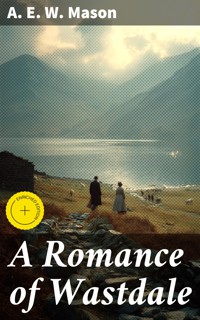
In "A Romance of Wastdale," A. E. W. Mason intricately weaves a tapestry of love, nature, and personal conflict set against the breathtaking backdrop of the Lake District. The narrative showcases Mason's lyrical prose, melding vivid descriptions of the landscape with the intimate lives of its inhabitants. Through the tension of romance entwined with themes of class and ambition, Mason explores the inner landscapes of human emotion, highlighting the transformative power of the environment. The novel reflects the early 20th-century literary movement that emphasizes both individual experience and the surrounding natural world, positioning it within the context of Edwardian literature that sought to balance romantic ideals with social realism. A. E. W. Mason, an author and playwright renowned for his keen observations of human psychology, often drew from his own experiences as a traveler and a resident of the picturesque English countryside. His deep familiarity with the Lake District and his passionate interest in human relationships inspired him to create a narrative rich with complexity and depth. Mason's diverse career and experiences profoundly influenced his writing, enabling him to portray the tensions prevalent in both societal and romantic spheres. Readers seeking a poignant exploration of love against the beautiful yet harsh conflicts of life will find "A Romance of Wastdale" captivating. Mason's deft characterizations and evocative descriptions invite the reader to not only engage with the narrative but also reflect upon their own emotional journeys. This novel stands as a testament to Mason's ability to illuminate the human spirit and the bonds that shape it, making it a recommended read for fans of literary romance and nature writing. In this enriched edition, we have carefully created added value for your reading experience: - A succinct Introduction situates the work's timeless appeal and themes. - The Synopsis outlines the central plot, highlighting key developments without spoiling critical twists. - A detailed Historical Context immerses you in the era's events and influences that shaped the writing. - A thorough Analysis dissects symbols, motifs, and character arcs to unearth underlying meanings. - Reflection questions prompt you to engage personally with the work's messages, connecting them to modern life. - Hand‐picked Memorable Quotes shine a spotlight on moments of literary brilliance. - Interactive footnotes clarify unusual references, historical allusions, and archaic phrases for an effortless, more informed read.
Das E-Book können Sie in Legimi-Apps oder einer beliebigen App lesen, die das folgende Format unterstützen:
Veröffentlichungsjahr: 2021
Ähnliche












A Romance of Wastdale
Table of Contents
Introduction
Where the mountains demand courage, the heart’s measure is taken with equal severity. A Romance of Wastdale unfolds in that double register, where a rugged landscape and a charged intimacy test character to the limit. A. E. W. Mason shapes a compact tale in which the exposure of rock and sky parallels the exposure of motive and desire. The result is not spectacle for its own sake, but the slow tightening of moral stakes. Readers are invited into a valley whose silence amplifies a handful of voices, and into a story in which risk, restraint, and longing are held in taut balance.
A Romance of Wastdale, by A. E. W. Mason, is a short novel of romantic adventure and psychological tension, set in a secluded valley of the English Lake District. First published in the 1890s, during the late Victorian period, it reflects contemporary fascination with mountaineering and the sublime. Mason, a British novelist attentive to courage and conscience, uses the fells and crags as both setting and metaphor. The book belongs to that era’s tradition of compact, morally focused fiction, yet it looks ahead to twentieth‑century interests in interiority. Its publication context matters: leisure, risk, and reputation were being renegotiated in modernizing Britain.
The premise is disarmingly simple and fertile. In the isolation of Wastdale, a small circle of visitors and residents forms around the season’s climbs and quiet evenings. Affection and friendship overlap; an understanding between two people draws attention; and the arrival or return of a figure from the past subtly shifts every relation. Without divulging turns of plot, it is enough to say that the mountains become the stage on which promises are tested, confessions delayed, and courage measured. The book offers the experience of intimacy under pressure, its drama gathering not from coincidence but from choices made in close quarters.
Mason’s narrative voice is restrained and lucid, favoring clean lines over ornament. He frames the fells with economical description, allowing texture—a gust, a ledge, a shadow—to register as pressure on the nerves. The pace is deliberate, moving from pastoral calm toward points of exposure where a single decision can alter a future. Dialogue feels measured, the silences between words as expressive as speech. Descriptions of ascent and approach are less technical than affective, attentive to perception and self-command. The mood is tense but not hysterical, a controlled build that trusts the reader to apprehend what is felt as much as what is done.
Among the themes that emerge, honor and fear stand out as counterweights, each asking a different allegiance. The novel probes how physical bravery may coexist with moral hesitation, and how reputation can both protect and imperil the truth. Jealousy and loyalty are present, but they are rendered with the gravity of conscience rather than melodrama. Secrets in this book are as much about silence as deception, and the consequences that follow feel proportionate to a tightly knit community. The landscape is not mere backdrop; it acts as a mirror and a judge, reflecting inward weather and demanding from each character a reckoning.
Contemporary readers may find the book’s questions strikingly current. What do we owe those we love when our fear collides with our ideals? How do communities negotiate rumor, risk, and responsibility in environments that reward bravado? The novel’s depiction of outdoor culture anticipates ongoing debates about ambition, safety, and the ethics of leading others into danger. Its attention to the performance of courage—public and private—speaks to the social media age as much as to its own period. Read today, A Romance of Wastdale invites reflection on integrity under stress and on the quiet costs exacted by pride, shame, and silence.
As a reading experience, this is a concentrated, atmospheric tale that rewards a single‑sitting immersion or a measured approach across evenings. It offers the pleasures of place—the feel of crag and cloud—alongside the intellectual satisfaction of watching a moral problem unfold with clarity. For admirers of classic British fiction, mountain narratives, or compact psychological dramas, it serves as both entry point to Mason and a distinctive achievement in its own right. Without relying on spectacle, it creates suspense from recognizably human motives. When the last page closes, the questions it raises about love, courage, and truth continue to reverberate.
Synopsis
A. E. W. Mason opens the story amid the stark beauty of Wastdale, the valley of the deep lake and encircling crags where a seasonal colony of climbers gathers. The narrative observes customs at the small inn, the early starts, the weather-watching, and the compact code of trust demanded by the rope. At its center stands a quiet, capable man who divides his time between the city and the fells, seeking steadiness in the mountains. His skill is practical rather than showy, and his sense of duty underlies his choices, setting a measured tone before the emotional plot begins to stir.
In London, he has recently pledged himself to a young woman whose quick mind and independence attract notice. Their engagement is affectionate but new, and delays in plans keep them apart while he returns to Wastdale for a period of climbing. There he is joined by an old acquaintance, a brilliant and persuasive companion whose flair and stories win admiration in the common room. The contrast between the steady climber and his more dazzling friend is drawn with economy, preparing a triangle of affection and esteem in which ideals of courage, reputation, and constancy, rather than explicit declarations, shape the coming tests.
Early chapters interweave scenes of the city and the valley. Letters travel between the lovers; rumors and chance encounters place the friend within the orbit of the woman left behind. Among the climbers, talk turns to notable routes and the margin between prudence and display. Minor misunderstandings accumulate, never dramatic on their own, yet each slightly shifts confidence. The heroine is presented as responsive to generosity and achievement, while wary of extravagance. The hero accepts the quiet discipline of training days on the rock. The sense of an approaching trial grows from ordinary occasions, not melodrama, aligning private feeling with practical risk.
An initial expedition on one of the easier but intricate faces establishes how partnership works on stone. Mason shows the methodical placing of hands and feet, the exchange of short commands, and the unspoken dependence inherent in the rope. A brief slip, contained without harm, reminds them all of what is at stake. It is not a disaster but a rehearsal for judgment. The steadier man advances carefully, the other pushes for a bolder line. The difference registers, first as style, then as philosophy. The woman, learning of the outing secondhand, feels the pull between safety and brilliance without closing her mind.
A moral complication surfaces when fragments of an earlier entanglement come to light. It is unclear at first whose past casts the longer shadow, but talk of debt, obligation, and an unacknowledged promise touches the trio. The reserve of the hero makes explanation slow; the fluent charm of the friend frames events advantageously. Within the climbing circle, hints of self-promotion versus service appear. The heroine is given material that can be read two ways, and her judgment steadies rather than resolves the tension. The narrative maintains restraint, emphasizing that character is revealed not in speeches but in pressure, waiting its chance.
The central ascent is planned on a serious Wastdale crag, chosen both for its difficulty and for what it might prove. Weather windows are narrow, the route exacting, and the party small enough to heighten dependence. The cliff is described in planes, chimneys, and ledges, each demanding decision. Midway, an obstacle forces an improvisation, and the rope briefly becomes more than a convention. The test that follows is not purely technical; it turns on responsibility and the cost one climber may ask another to bear. Mason keeps the moment tight and concrete, showing hands, rock, and air, while withholding grand pronouncements.
What occurs on the wall echoes afterwards in rumor and reserve. Those who were present speak carefully; those who were not fill gaps with supposition. The valley hears one version, the city hears another, and the woman must listen to both. The hero does not accuse; the friend does not confess; each accepts the consequences of the impression created. The community of climbers, with its sharp sense of fairness, proves both jury and chorus. Rather than rest on a sensational reveal, the book attends to how conduct hardens reputations, and how a single hour can redefine years of acquaintance and hope.
A concluding sequence brings the principals together again where the fells fall away to water. Explanations are offered only to the degree required to guide choices. The woman weighs what she has learned against what she has seen, mindful of the difference between courage for an audience and courage under obligation. The men allow the landscape to keep some of its secrets. An understanding is reached that determines future paths without theatrical gesture. Mason lets the resolution arrive through speech plain enough to be believed, and through silences that carry their own meaning, maintaining the narrative economy established from the start.
The book closes on an affirmation of the values it has quietly tested: steadiness, truthfulness under strain, and the kind of love that holds its ground without display. The mountains are not backdrops but instruments of scrutiny, stripping away pretense by insisting on trust. A Romance of Wastdale thus presents romance as a matter of character rather than mere ardor, and adventure as a measure of responsibility. Without pressing for a moral, it leaves a clear impression that choices made in exposed places continue to shape lives, and that honor, once proved, needs little advertisement to endure.
Historical Context
Set in the late Victorian period, A Romance of Wastdale unfolds in the remote Wasdale valley of Cumberland (now Cumbria), centered on Wastwater and the fells of Great Gable and Scafell. The decade of the 1880s–1890s saw Wasdale Head emerging as a climbers’ base while remaining a sparsely populated sheep-farming community. The topography—precipitous crags, narrow passes, sudden weather changes—creates a landscape of isolation and danger that shapes action and character. The novel’s social milieu is that of visiting gentlemen and professionals interacting with local innkeepers and farmers, a microcosm of late Victorian Britain where modern leisure, transport, and class etiquette met an older rural economy.
By the 1890s, improved transport had drawn the Lake District into national leisure circuits. The Whitehaven & Furness Junction Railway (opened 1849) placed a station at Seascale, from which visitors traveled by coach through Gosforth into Wasdale. The Post Office’s national telegraph network (from 1870) and the Bank Holidays Act (1871) made short recreational trips more feasible for the urban middle class. Simultaneously, the Agricultural Depression (c. 1873–1896) depressed rural incomes, pushing valleys like Wasdale to rely more on visitors’ custom. The novel’s movement of characters into and within Wastdale mirrors these concrete changes in access and economy, using travel ease and remoteness to create moral and physical pressure.
The birth of British rock climbing in the 1880s decisively shaped Wasdale and the novel’s ethos. The Alpine Club (founded 1857) had fostered high-mountain ambition abroad, but the Lakes saw a distinct, often guideless, home-grown practice. In 1886, Walter Parry Haskett Smith made the first ascent of Napes Needle on Great Gable, a date often cited as the symbolic start of British rock climbing as a sport in its own right. Wasdale Head Inn became a seasonal hub, with figures like Will Ritson (landlord until 1890) hosting visiting climbers whose names filled early journals. O. G. Jones consolidated the movement with Rock-climbing in the English Lake District (1897), cataloguing routes on Scafell, Great Gable, and the Pillar, and promoting standards of technique and difficulty. The Climbers’ Club formed in 1898, while the Fell & Rock Climbing Club followed in 1906, institutionalizing practices first honed on Wasdale crags. Early ethics embraced minimal artificial aids, long approaches on foot, and considerable objective risk; fatalities and near-misses, whether on the Napes, Scafell’s East Buttress, or later in the Alps, were widely discussed in club circles. This concrete milieu—dates, ascents, clubs, and the Inn—directly informs Mason’s scenes of rivalry, rope-work, exposure, and moral testing on precipitous ground. The book draws on the specific culture of Wasdale climbing in the late 1880s and early 1890s, using the valley’s real crags and weather to stage questions of courage, trust, and the limits of gentlemanly restraint, thereby embedding its romance in a recognizably documented sporting frontier.




