


Erhalten Sie Zugang zu diesem und mehr als 300000 Büchern ab EUR 5,99 monatlich.
- Herausgeber: Luath Press
- Kategorie: Gesellschafts- und Liebesromane
- Sprache: Englisch
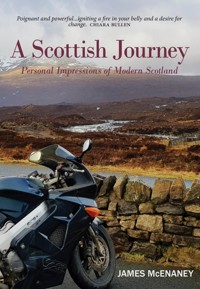
'Scotland as I saw it on this journey is vibrant and exciting and very much alive, a tartan patchwork of the past, present and future of the country woven together by all those people who have ever called it 'home' and all the others who will.' James McEnaney sees Scotland as a 'complicated and conflicted place' that needs a disruption of the status quo. He presents the country as he found it on his journey – struggling with contemporary mistakes and historic wrongs, but also bustling with energy and expectation, ultimately offering glimpses of the better, brighter future which might just be on the way.
Sie lesen das E-Book in den Legimi-Apps auf:
Seitenzahl: 226
Veröffentlichungsjahr: 2020
Das E-Book (TTS) können Sie hören im Abo „Legimi Premium” in Legimi-Apps auf:
Ähnliche




















JAMES MCENANEY is a former secondary school English teacher turned lecturer and journalist. With a focus on education, transparency and freedom of information, he writes regularly for publications including The Herald, The Guardian and the Times Educational Supplement Scotland. In 2017, he contributed a chapter on Scotland’s school system to A Nation Changed? The SNP and Scotland Ten Years On. He lives near Glasgow with his wife, son, dog and rabbit, and still can’t quite believe that he was lucky enough to get the chance to write about this Scottish journey.
First Published 2018
ISBN: 978-1-912147-42-7
The author’s right to be identified as author of this book under the Copyright, Designs and Patents Act 1988 has been asserted.
The paper used in this book is recyclable. It is made from low chlorine pulps produced in a low energy, low emission manner from renewable forests.
Printed and bound by Bell & Bain Ltd, Glasgow
Typeset in 11 point Sabon by Main Point Books, Edinburgh
Text and photographs © James McEnaney 2018
Contents
Acknowledgements
Introduction
Chapter 1: Edinburgh to Gatehouse of Fleet
‘This is a forgotten corner of Scotland.’
Chapter 2: Gatehouse of Fleet to Glasgow
‘So this isn’t exactly ideal, is it?’
Chapter 3: Glasgow to Oban
‘We’ve really loved being in this place.’
Chapter 4: Oban to Skye
‘It’s a different country up here.’
Chapter 5: Skye to Ullapool
‘They call it empowering communities…’
Chapter 6: Ullapool to Kirkwall
‘Make sure you stop for hot chocolate!’
Chapter 7: Orkney Mainland and Wyre
‘He said there’s nothing on Wyre.’
Chapter 8: Kirkwall to Inverness
‘I have no regrets about coming to Scotland.’
Chapter 9: Inverness to Aberdeen
‘No one knows what will happen when the oil dries up.’
Chapter 10: Aberdeen to Edinburgh
‘It’s a beautiful day for the end of a journey.’
Heading Home
Reflections
Sources
For Ruth and Ciaran,the most important people in Scotland.
Acknowledgements
IT IS IMPORTANT at this stage to thank the many people without whom this book would never have happened, but I am unable to list all of those whose assistance and encouragement has been invaluable. The most important of these is my wonderful (and very tolerant) wife, Ruth, whose support means everything to me, and whose opinion I value more than any other, as well as my mum and dad who both supported and encouraged me throughout this process. Then there are the people who welcomed me into their homes all around the country and gave me a glimpse, albeit a brief and fleeting one, of their lives. I can never repay their generosity so instead offer unreserved gratitude for their kindness.
To everyone else who played a part – the people who have given me opportunities to write in recent years; the friends who read numerous drafts of this or that chapter; those who simply took a few minutes out of their day to talk to me along the way; and to all at Luath Press – I wish to say thank you for being a part of my Scottish journey.
Introduction
IT ALL STARTED back in 2012. I was an English teacher at Arran High School and in my first year of being fully qualified was given the opportunity to teach Advanced Higher to a class of three brilliant students. One of the options for the literature component of the course was the great Scottish writer and poet, Edwin Muir, whose work I had first encountered as a teenager.
It was through teaching Muir’s poetry that I first discovered Scottish Journey, a record of his impressions as he travelled through the country in the mid-’30s, from Edinburgh to Orkney via the south, Glasgow and the Highlands. Unheralded at the time of publication and unappreciated, even by the author himself, it is nonetheless a fascinating, insightful and beautifully written account which, in the words of the historian TC Smout – who penned introductions to both the 1979 and 1996 editions – ‘held up a mirror to the face of Scotland all those years ago’. It is, Smout added, ‘frightening to see so many recognisable features in its glass’, an observation which remains true even into the 21st century.
It occurred to me at the time that a modern version of Muir’s book, examining both the striking similarities and profound differences between his Scotland and ours, could be something worth pursuing. In the 1930s, the country was struggling to recover from the Great Depression whereas now it is trying to cope with the consequences of the 2008 financial crash, the resulting worldwide recession and the devastating decision to impose austerity economics. While three generations ago Muir saw the emergence of what would become the SNP, today that party has been in government in Scotland for more than a decade, holds a majority of Scottish seats in Westminster and even managed to deliver not just a historic majority government to Holyrood, but also a referendum on Scottish independence. The twin shadows of deindustrialisation and depopulation loomed large in Muir’s Scotland, destroying the lives of countless people, and they still darken the skies of ours.
Although I could perceive all of these connections, I never expected to have the chance to explore them further. Surely, I thought, such opportunities are only available to the Lesley Riddochs and Neal Aschersons of the world, not an unpublished, 20-something high school English teacher whose most extensive work to date had been an undergraduate dissertation on Frankenstein? So I put the whole idea to the back of my mind and went about my business as a teacher. A few years later, I reluctantly left Arran and returned to Glasgow, taking up a position as a college lecturer while also drifting into journalism, first writing opinion columns for new media sites such as CommonSpace and Bella Caledonia, then building a bit of a reputation as a specialist in Scottish education and Freedom of Information.
All the while, the idea for my own Scottish journey had been bubbling away. In 2017, five years after it had first occurred to me – and after a push from a friend who pointed out the hypocrisy of telling students never to hold themselves back while refusing to have a bit of faith in myself – I started to make tentative plans, trying to figure out what the whole process would involve and whether I might be up to it after all. I was fortunate – and grateful – to be directed to Luath Press, who supported the idea from the start.
When I finally decided to go ahead and attempt to write this book, the idea was very simple: I would retrace the route of Muir’s original journey, following the same roads and making the same stops wherever possible, reporting on the ways in which the nation had changed in the 80-odd years between our respective trips. I spent days trying to plot Muir’s tyre tracks from Edinburgh to Orkney, transposing that original trip onto modern roads as far as possible – but soon realised that I was wasting my time.
One of the most obvious issues I encountered was that Muir’s journey ended in Orkney, whereas mine could not. There are two reasons for this. First, and most obvious, is the fact that I live in Glasgow and would have to return to the Central Belt regardless of how the story in my book ended. Even if the final chapter featured a beautiful Orcadian sunset framing a series of profound, ground-breaking reflections, the next morning I would still be getting back on my bike and heading south. My journey, in a physical sense, would not be over.
Beyond this simple matter of geography, however, lay a more fundamental problem, which also explains why I eventually decided that I would not bind myself to Muir’s long-lost tyre tracks. In travelling to Orkney, Muir was returning to his childhood home for a summer holiday with his family. For those familiar with his work – and especially his poetry – there is a pleasing circularity to this conclusion of his own personal journey around Scotland: he was, in a very real sense, going back to where it all started and using that experience to frame his reflections on the country as a whole. Though my book could conceivably have found some sort of conclusion on Orkney, it would never have felt quite right. It therefore seemed to make sense to incorporate my inevitable travels back to the Central Belt into the whole project. By abandoning the idea of a simple A to B approach, as well as the plan to stick slavishly to the route Muir laid out, and instead setting off on what would ultimately become a circumnavigation of Scotland, I could open up a whole new section of the country as part of my adventure. Crucially, I would also be able to complete my own, personal, Scottish Journey.
That settled, all I needed was a jumping-off point, a start-and-finish location fit for the modern nation through which I would be travelling. As a Glaswegian, I would have liked this to have been somewhere in my home city but, in truth, there was only ever one serious contender: the Scottish Parliament. Founded in 1999 following a landslide referendum two years earlier, and moving into its current home in 2004, it is now the undoubted centre of gravity for Scottish political and civic life; it seemed only natural that any attempt to paint a picture – however flawed, personal and incomplete – of 21st century Scotland had to begin and end in front of the building that has come to symbolise so much of the country. This is especially true for a millennial, ‘post-devolution Scot’ like myself who, having been born in 1986, has never really known a Scotland without its own, distinct voice, even if it does often struggle to tell its own story.
Of course – like any worthwhile journey – not everything went to plan. Days before setting off my motorbike failed its MOT due to issues with the headlights and the throttle cable, while both tyres also had to be replaced; then a forecast for snow and ice across the middle of the country forced me to head to Edinburgh a day earlier than expected, disrupting my preparation. During the first two days of the journey, the weather was so bad – at points dangerously so – that the whole project looked at risk of having to be abandoned. Yet for every unexpected roadblock there were a dozen highlights, from chance conversations to glorious views, from sites reaching into the ancient past to tantalising glimpses of the future.
Like Muir, however, I feel that I should also warn readers of what they will not find in these pages. In his introduction he explained that he was not offering ‘a survey of Scotland but a bundle of impressions’ and insisted that his was ‘not the Scottish Journey, but a Scottish Journey’. The same is true now. This book is by no means an attempt to resolve the endless contradictions of this country – which Muir accurately described as a ‘confusing conglomeration’ – into any sort of definition of either the nation or its people. It is merely a pile of imperfect snapshots, arranged and presented in an attempt to reflect my impressions of the Scotland I encountered in the spring of 2018.
I would also advise readers not to expect a travel guide to the towns and villages through which I passed, few of which could be done justice by the limited time I was able to spend in them. My travels took me in and out of many of these places at random, with rarely any effort made to visit the ‘must see’ attractions that dotted my path. Instead I tried to follow Muir’s advice, taking this road or that depending upon my feelings at the time and, as far as possible, gathering up my impressions as casually as a ‘collection of shells picked up on a sea-shore’.
Finally, I wish to be clear about one thing above all else: despite the assumptions of many of those to whom I spoke in the months leading up to my journey, as well as some of those I met along the way, this is not a book about Scottish independence.
Readers expecting a treatise on the constitutional future of Scotland, or a polemical deconstruction of one or other side of that particular debate, will be disappointed. In fact, if there is a central thesis to this project, a core idea buried beneath the simple joy of spending time on the road and becoming better acquainted with one’s home country, it is that the increasingly obsessive attempts to view Scotland through a narrow constitutional lens are doomed to failure. The unresolved issue of Scottish independence is an important one, but I do not believe that it is necessarily core to most people’s sense of self or, indeed, their sense of Scotland; my experience of travelling through the country, away from the bubbles of both traditional and social media, has only served to sharpen this opinion.
Scotland is as endlessly, wonderfully varied as the people who live here; in the spring of 2018 I was fortunate enough to be able to explore a few fragments of that diversity, gathering my experiences – those snapshots of modern Scotland – together in my own subjective, flawed and deeply personal account of the country I call home.
James McEnaneyGlasgowAugust 2018
1
Edinburgh to Gatehouse of Fleet
‘This is a forgotten corner of Scotland’
I AWOKE ON the first morning of my journey with a sense of dread. The day before, the weather had been awful and by the time I went to bed, incessant rain had turned into thick, slushy snow. I had gone to sleep with no real idea of what I would do if, as expected, the roads were not safely rideable the following day. Moving the trip back by a few days was not an option, not least because I had already arranged to stay with some incredibly generous people around the country and couldn’t expect them to just rearrange their plans to accommodate my delay.
The threat of a serious snowstorm had already changed my plans once – forcing me to come to Edinburgh a day early – and there was no way I’d be able to safely make my way through the 150-or-so miles to Scotland’s south west coast if it finally struck now. My best hope, it seemed, was that any snow would clear by early afternoon, giving me time to get to the parliament and then on to my first overnight stop at Gatehouse of Fleet, even if I would have to take a far more direct route than I had anticipated or desired. It wouldn’t be the ideal start, but it would be a start nonetheless.
When I opened the curtains, however, I felt an immediate sense of relief. The temperature had evidently crept up just enough overnight, replacing the snow that had been falling a few hours previous with heavy rain. It felt strange to be so excited about the prospect of setting off on my journey in the midst of a downpour, but you don’t ride motorcycles in Scotland for more than a decade without becoming extremely well versed in the art of coaxing the bike over soaking-wet, slippery roads. I had never expected to get through the trip without getting drenched anyway, so why not just get it out of the way?An hour later I was off, heading towards the city centre and, beyond that, the starting point of the journey: the Scottish Parliament.
Being a good Glaswegian I am obviously required to dislike Edinburgh. In fact, one of my earliest memories of my grandfather is his response to someone (I can’t remember who) asking if he wanted to go through to the capital for the day:
‘Edinburgh? Don’t be daft. Nothin’ in Edinburgh.’
I certainly couldn’t claim to possess an intimate knowledge of the city, but it is also true that I have never warmed to the place during my visits over the years. Having arrived in Edinburgh a day earlier than expected I had taken the opportunity to explore. My cousin and her husband were away for a few days and had kindly allowed me to borrow their home near Murrayfield, so on my first evening I spent some time wandering alongside the Water of Leith as the sun hovered above, and then dropped beyond, the treelines and rooftops. The next day I walked into the city centre and back in order to meet my wife and son, who had come through for a short visit, but relentless, icy rain made it feel once more that Edinburgh was simply a place to be endured.
On a bike things are even worse. Glasgow’s roads are far from perfect but the grid system on which the city centre is based at least makes it easy to navigate; in contrast, Edinburgh’s incomprehensible junctions, tramlines and occasional cobbled streets (to name just a few challenges) are a nightmare. Even after my desperation led me to use sat nav I still managed to make a few wrong turns as I weaved through the city before the distinctive outline of the parliament building finally came into view.
Delivered three years late and comically over-budget, the Scottish Parliament is one of the most recognisable buildings in the country. It is a staggeringly complex blend of modernism and abstract inspiration, all curves and angles and disparate shapes brought together on a single canvas which, like a magic eye painting, changes as you move around it, each step subtly shifting the angles of light and perspective as the brain struggles to take it all in. It is not, I must confess, entirely to my taste either inside or out (with the exception of the stunning debating chamber, which is superb) and the public reaction to it also remains mixed, even if critics, most notably the judges for the 2005 Stirling Prize, tend to love it.
Of course, the Scottish Parliament is much more than a building and it is what it represents that had really brought me here to start my journey. Although I was born 13 years before the restoration of the parliament in 1999 I am, without a doubt, part of the generation of post-devolution Scots whose whole view of the country has been unavoidably, inextricably shaped by the existence of a national legislature. By the time I went to university, the parliament had been in existence for five years and had already shifted the national consciousness. Now, 14 years on, its absence is simply unthinkable. I cannot say what impact devolution had on older generations but it is clear to me that, for Scots of my generation and presumably those to come, it has secured the idea of Scotland as a nation in its own right, and not one whose existence depends upon the paternalistic generosity of the other parliament in London, the seat of what the poet, Norman MacCaig, in his tour-de-force ‘A Man in Assynt’, called a ‘remote and ignorant government’.
The bike outside the Scottish Parliament building
I wanted a few photographs of the bike with the parliament in the background so I bumped it up on to the kerb near some traffic lights and got off, diving underneath the building’s huge, umbrella-like overhang before taking off my helmet. It was then that I was approached by one of the police officers stationed at the entrance.
‘Hi there, sir. About the motorbike…’
Let us look at the situation from her perspective: I, an unidentified man in a balaclava and lots of loose-fitting, armoured clothing, had arrived unannounced and placed a motorbike (with a bright orange package strapped to the seat) on the pavement between the Scottish Parliament and the Palace of Holyrood House, the latter being the Queen’s official residence in Edinburgh. In retrospect, it is a wonder that I even made it as far as the building.
Promising that I would only be a few minutes, I explained that I was about to set off a ten-day trip for a book I was writing, and that I was just waiting for someone from the publisher’s office to come and take a few photos before departing. She was, to my great relief, very understanding and even talked to me about the project for a few moments until the photographer arrived.
After a few photos and a quick chat, it was time to really get started. I switched on the sat nav – which I would only be using to find my way back out of Edinburgh – and rolled off onto the road, skirting around the north of Holyrood Park and Portobello before eventually reaching the A7 headed south. As I rode out of Edinburgh and into Midlothian, the whole environment through which I passed began to change but as the landscape opened up, the rain became progressively heavier, magnified by a headwind gusting towards me. Barely half an hour down the road I could already feel my gear struggling to keep me dry and had entirely given up on the prospect of staying warm. I was in for a slog, and I knew it.
By the time I passed a sign welcoming me to the Scottish Borders I was surrounded by the snow that I had feared the night before. The fields and hills on both sides of me were painted a tired, greyish-white which matched the low, heavy clouds, blurring the boundary between ground and sky. The road was mercifully clear but was still very cold and slippery, and I was never sure whether I would swing around the next bend to be confronted by a mound of sludgy snow or a patch of half-melted ice. Minute by minute and mile by mile, the near-freezing rain just kept on falling.
I had initially planned to have my first stop of the trip in Galashiels but, conscious of the worsening weather when I arrived, decided to push on to Hawick while the going was bearable. On the way I passed through Selkirk and various little roadside villages, all of which are, I’m sure, far more pleasant and interesting than they appeared amidst the shivering, unrelenting gloom of that particular morning.
As I arrived in Hawick just before midday, the rain, until now utterly incessant, had begun to ease ever so slightly and the clouds ahead were looking marginally less threatening, so I decided to park the bike and find a place where I might be able to spend an hour warming up and, if I was really lucky, drying out a little. By then, I hoped, the weather might have improved enough to make the rest of the day more enjoyable than the first stretch had been.
I had lunch in the Heart of Hawick, a multi-purpose community space housing a heritage hub, a textile museum, a cinema and a café, part of which sits within a little glass-walled annex hanging over the Slitrig Water, just before it joins with the River Teviot in the middle of town. The café itself is bright and welcoming, far more so than is often the case in facilities attached to this sort of enterprise, and, even on a thoroughly miserable day like this one, the space was busy with families out for lunch, friends meeting for coffee and a few individuals simply reading the newspaper with a cup of tea. After ordering a bowl of soup I sat down in the annex (in a seat chosen largely because of its proximity to a radiator) and watched as the falling rain crashed into the glass roof above me, while the river raced by in a swollen, swirling torrent below.
Hawick is, if not quite pretty (at least not in the rain), certainly a rather fine-looking, resolute sort of place, the type of town its people are probably proud to call home. Even with a few empty shop-fronts, it still feels more substantial and alive than many similar-sized towns further north where it is increasingly common to walk down deserted high streets populated by little more than takeaways, charity shops and bookies. This might be down to simple geography – there are, for example, no motorways in this part of the country carrying huge numbers of people to the out-of-town shopping centres so prevalent in the Central Belt – but I suspected that some other factors might also be at play. Either way, the result is a town which I would have liked to have explored with the benefit of a bit more time and a little sunshine.
By the time I had finished my excellent lunch, the weather had noticeably eased and the sky seemed to be clearing, with patches of lighter grey slowly displacing the dark mass smeared overhead. As I got back onto the bike the rain had faded into little more than a light shower, which seemed like a good omen for the rest of the day. Even if the weather didn’t get any better, I reasoned, it would at least be a marked improvement on what I had ridden through to get this far, and so I set off south hoping that the conditions would continue to improve. They did not.
Moments after I departed Hawick, the sky burst in the most spectacular fashion and I found myself riding through a staggering, merciless downpour all the way to the border. Although the road I followed was relatively straight and well-surfaced, the rain had become so heavy that around almost every bend I was faced with water, either pooled on the road or, in the worst cases, actually running across it. Even at relatively slow speeds I found myself aquaplaning – a uniquely unsettling experience on two wheels – as my tyres struggled to cope with the conditions. On several downhill sections I ended up afraid to use the front brake for fear of the bike skidding out from under me, instead depending upon a combination of engine-braking, gear changes and conservative cornering lines to keep the machine, and myself, the right way up.
The weather became so bad it seemed to be affecting the bike’s electronics. Just north of Langholm – a ‘muckle toun’ not far from the border with England – I noticed that the display showing the engine oil temperature, which usually sits at around 80 degrees during normal riding, had gone blank. I presumed that this was a result of the weather, and worried about the rain affecting more of the bike’s electronics, but when the wind eased a little the numbers reappeared, slowly creeping up from 35 degrees, which is the temperate at which the system activates when the bike is first turned on. The electronics, I realised, were fine. I was simply riding through weather so hostile, with such an enormous quantity of water constantly ploughing into me, that it had almost entirely cooled the engine and was now preventing it from properly warming back up.
I had already been riding cautiously but was now forced to slow down even more to protect the bike, thus extending the time I would have to spend exposed to the very conditions which were causing the problem in the first place.




