



0,99 €
Mehr erfahren.
- Herausgeber: e-artnow
- Kategorie: Religion und Spiritualität
- Sprache: Englisch
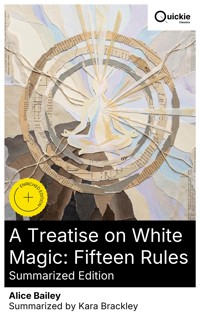
A Treatise on White Magic is a book by Alice Bailey. It is considered to be among the most important by students of her writings, as it is less abstract than most, and deals with many important subjects of her works in an introductory, even programmatic fashion. Bailey promulgated White Magic as a discipline to serve humanity. It is an esoteric text, which Bailey said was dictated telepathically by the Tibetan Master, Djwal Khul. It is offered as a "basic textbook" for the Western aspirant to initiation, and is divided into fifteen rules of magic, each one taking the reader further into the mysteries of spirituality. Topics discussed include: how an aspirant can best prepare himself for service, the various ray types of their influences, the relationship between the macrocosm and microcosm, the spiritual, causal, astral and physical realms and their interactions, the spiritual psychology of man, The Hierarchy of Masters, esoteric groups and schools, the spiritual centers (or chakras), the occult concept of the Seven Rays, meditation work and much more. One of the main themes is that of soul control.
Das E-Book können Sie in Legimi-Apps oder einer beliebigen App lesen, die das folgende Format unterstützen:
Veröffentlichungsjahr: 2020
Ähnliche






A Treatise on White Magic
Table of Contents
Rules for Magic
RULE ONE
The Solar Angel collects himself, scatters not his force, but, in meditation deep, communicates with his reflection.
RULE TWO
When the shadow hath responded, in meditation deep the work proceedeth. The lower light is thrown upward; the greater light illuminates the three, and the work of the four proceedeth.
RULE THREE
The Energy circulates. The point of light, the product of the labours of the four, waxeth and groweth. The myriads gather round its glowing warmth until its light recedes. Its fire grows dim. Then shall the second sound go forth.
RULE FOUR
Sound, light, vibration, and the form blend and merge, and thus the work is one. It proceedeth under the law, and naught can hinder now the work from going forward. The man breathes deeply. He concentrates his forces, and drives the thought-form from him.
RULE FIVE
Three things engage the Solar Angel before the sheath created passes downward; the condition of the waters, the safety of the one who thus creates, and steady contemplation. Thus are the heart, the throat, and eye, allied for triple service.
RULE SIX
The devas of the lower four feel the force when the eye opens; they are driven forth and lose their master.
RULE SEVEN
The dual forces of the plane whereon the vital power must be sought are seen; the two paths face the solar Angel; the poles vibrate. A choice confronts the one who meditates.
RULE EIGHT
The Agnisuryans respond to the sound. The waters ebb and flow. Let the magician guard himself from drowning at the point where land and water meet. The midway spot, which is neither dry nor wet, must provide the standing place whereon his feet are set. When water, land and air meet, there is the place for magic to be wrought.
RULE NINE
Condensation next ensues. The fire and waters meet, the form swells and grows. Let the magician set his form upon the proper path.
RULE TEN
As the waters bathe the form created, they are absorbed and used. The form increases in its strength; let the magician thus continue until the work suffices. Let the outer builders cease their labors then, and let the inner workers enter on their cycle.
RULE ELEVEN
Three things the worker with the law must now accomplish. First, ascertain the formula which will confine the lives within the ensphering wall; next, pronounce the words which will tell them what to do and where to carry that which has been made; and finally, utter forth the mystic phrase which will save him from their work.
RULE TWELVE
The web pulsates. It contracts and expands. Let the magician seize the midway point and thus release those "prisoners of the planet" whose note is right and justly tuned to that which must be made.
RULE THIRTEEN
The magician must recognize the four; note in his work the shade of violet they evidence, and thus construct the shadow. When this is so, the shadow clothes itself, and the four become the seven.
RULE FOURTEEN
The sound swells out. The hour of danger to the soul courageous draweth near. The waters have not hurt the white creator and naught could drown nor drench him. Danger from fire and flame menaces now, and dimly yet the rising smoke is seen. Let him again, after the cycle of peace, call on the solar Angel.
RULE FIFTEEN
The fires approach the shadow, yet burn it not. The fire sheath is completed. Let the magician chant the words that blend the fire and water.
From "A TREATISE ON COSMIC FIRE"
Introduction
Man's Three Aspects
In the study of the ideas outlined in this book and their careful consideration certain basic concepts are borne in mind:
First, that the matter of prime importance to each student is not the fact of a particular teacher's personality but the measure of truth for which he stands, and the student's power to discriminate between truth, partial truth, and falsity.
Second, that with increased esoteric teaching comes increased exoteric responsibility. Let each student with clarity therefore take stock of himself, remembering that understanding comes through application of the measure of truth grasped to the immediate problem and environment, and that the consciousness expands through use of the truth imparted.
Third, that a dynamic adherence to the chosen path and a steady perseverance that overcomes and remains unmoved by aught that may eventuate, is a prime requisite and leads to the portal admitting to a kingdom, a dimension and a state of being which is inwardly or subjectively known. It is this state of realisation which produces changes in form and environment commensurate with its power.
These three suggestions will merit a close consideration by all, and their significance must be somewhat grasped before further real progress is possible. It is not my function to make individual and personal application of the teaching given. That must be done by each student for himself.
You have wisely guarded the teaching from the taint of superimposed authority, and there lies back of your books no esoteric principle of hierarchical authority or support, such as has produced the narrow limits of certain ecclesiastical bodies and groups, differing as widely as the Catholic Church, Christian Science, those who believe in the verbal inspiration of the Scriptures, and numerous (so-called) esoteric organisations. The curse of many groups has been the whispered word that "Those who know wish...." "The Master says...." "The Great Ones command..." and the group of silly sheep feebly and blindly tumble over themselves to obey. They think thereby, through their misplaced devotion, to contact certain authoritative personages, and to get into heaven by some short cut.
You have wisely guarded your books from the reaction accorded to those who claim to be masters, adepts and initiates. My anonymity and status must be preserved, and my rank be regarded as only that of a senior student and of an aspirant to that expansion of consciousness which is for me the next step forward. What I say of truth alone is of moment; the inspiration and help I can accord to any pilgrim on the path is alone vital; that which I have learned through experience is at the disposal of the earnest aspirant; and the wideness of the vision which I can impart (owing to my having climbed higher up the mountain than some) is my main contribution. Upon these points the students are at liberty to ponder, omitting idle speculation as to the exact details of unimportant personalities, and environing conditions.
Our theme is to be that of the Magic of the Soul, and the key thought, underlying all that may appear in this book, is to be found in the words of the Bhagavad Gita which runs as follows:
"Though I am Unborn, the Soul that passes not away, though I am the Lord of Beings, yet as Lord over My nature I become manifest, through the magical power of the Soul." Gita IV.6.
The statistical and the academic is a necessary basis and a preliminary step for most scientific study, but in this book we will centre our attention on the life aspect, and the practical application of truth to the daily life of the aspirant. Let us study how we can become practical magicians, and in what way we can best live the life of a spiritual man, and of an aspirant to accepted discipleship in our own peculiar times, state and environment.
To do this we will take the Fifteen Rules for Magic to be found in my earlier book, entitled A Treatise on Cosmic Fire. I will comment on them, dealing not with their cosmic significance or with solar and other correspondences and analogies, but applying them to the work of the aspirant, and giving practical suggestions for the better development of soul contact and soul manifestation. I shall take for granted certain knowledges and assume the students can follow and comprehend certain technical terms that I may be led to use. I am not dealing with babes but with matured men and women who have chosen a certain way and who are pledged to "walk in the light."
I seek in this book to do four things, and to make appeal to three types of people. It is based, as regards its teaching, upon four fundamental postulates. These are intended to:
1. Teach the laws of spiritual psychology as distinguished from mental and emotional psychology.
2. Make clear the nature of the soul of man and its systemic and cosmic relationships. This will include its group relationship as a preliminary step.
3. Demonstrate the relations between the self and the sheaths which that self may use, and thus clarify public thought as to the constitution of man.
4. Elucidate the problem of the supernormal powers, and give the rules for their safe and useful development.
We stand now towards the close of a great transition period and the subtler realms of life are closer than ever before; unusual phenomena and inexplicable happenings are commoner than at any time heretofore, whilst matters telepathic, psychic, and peculiar occupy the attention even of sceptics, scientists, and religionists. Reasons for the appearance of phenomena are being everywhere sought, and societies are formed for their investigation and demonstration. Many are likewise going astray in the effort to induce in themselves psychic conditions and the energy-producing factors which give rise to the manifestation of peculiar powers. This book will endeavor to fit the information given into the scheme of life as we today recognize it and will show how basically natural and true is all that is termed mysterious. All is under law, and the laws need elucidation now that man's development has reached the stage of a juster appreciation of their beauty and reality.
Three types of people will respond to this book. They are:
1. Those open minded investigators who are willing to accept its fundamentals as a working hypothesis until these are demonstrated to be erroneous. They will be frankly agnostic, but willing temporarily, in their search for truth, to try out the methods and follow the suggestions laid down for their consideration.
2. Aspirants and disciples. They will study this treatise in order to understand themselves better and because they seek to help their brother man. They will not accept its dicta blindly but will experiment, check and corroborate with care the stages and steps laid down for them in this section of the teachings of the Ageless Wisdom.
3. Initiates. These persons will arrive at a meaning which will not be apparent to those in the first group and which will only be suspected by the more advanced members of the second. Within themselves they know the truth of many of its statements and will realise the subjective working out of many of the laws. These laws of nature have effects in three distinct realms:
a. Physically, where they demonstrate as effects in the dense form.
b. Etherically, where they demonstrate as the energy lying back of those effects.
c. Mentally, where they concern the impulses which produce the other two.
The Treatise on Cosmic Fire dealt primarily with the solar system and only touched upon human aspects and correspondences insofar as they demonstrated the relation of the part to the whole, and of the unit to the totality.
The present book will deal more specifically with human development and unfoldment, elucidating the causes which are responsible for the present effects, and pointing to the future and its possibilities, and to the nature of the unfolding potentialities.
This book will be based also upon four fundamental postulates which must be admitted by the student of the succeeding pages as providing an hypothesis worthy of his consideration and trial. No true investigator of the Ageless Wisdom is asked to give blind adherence to any presentation of truth; he is asked, however, to have an open mind and seriously to weigh and consider the theories and ideals, the laws and the truths which have guided so many out of darkness into the light of knowledge and experience. The postulates might be enumerated as follows and are given in the order of their importance.
I. First, that there exists in our manifested universe the expression of an Energy or Life which is the responsible cause of the diverse forms and the vast hierarchy of sentient beings who compose the sum total of all that is. This is the so-called hylozoistic theory, though the term but serves to confuse. This great Life is the basis of Monism, and all enlightened men are Monists. "God is One" is the utterance of truth. One life pervades all forms and those forms are the expressions, in time and space, of the central universal energy. Life in manifestation produces existence and being. It is the root cause, therefore, of duality. This duality which is seen when objectivity is present and which disappears when the form aspect vanishes is covered by many terms, of which for the sake of clarity, the most usual might be here listed:
Spirit
Matter
Life
Form
Father
Mother
Positive
Negative
Darkness
Light
Students must clearly have this essential unity in mind e'en when they talk (as they needs must) in finite terms of that duality which is everywhere, cyclically, apparent.
II. The second postulate grows out of the first and states that the one Life, manifesting through matter, produces a third factor which is consciousness. This consciousness, which is the result of the union of the two poles of spirit and matter is the soul of all things; it permeates all substance or objective energy; it underlies all forms, whether it be the form of that unit of energy which we call an atom, or the form of man, a planet, or a solar system. This is the Theory of Self-determination or the teaching that all the lives of which the one life is formed, in their sphere and in their state of being, become, so to speak, grounded in matter and assume forms whereby their peculiar specific state of consciousness may be realised and their vibration stabilised; thus they may know themselves as existences. Thus again the one life becomes a stabilised and conscious entity through the medium of the solar system, and is essentially, therefore the sum total of energies, of all states of consciousness, and of all forms in existence. The homogeneous becomes the heterogeneous, and yet remains a unity; the one manifests in diversity and yet is unchanged; the central unity is known in time and space as composite and differentiated and yet, when time and space are not (being but states of consciousness), only the unity will remain, and only spirit will persist, plus an increased vibratory action, plus capacity for an intensification of the light when again the cycle of manifestation returns.
Within the vibratory pulsation of the one manifesting Life all the lesser lives repeat the process of being,—Gods, angels, men, and the myriad lives which express themselves through the forms of the kingdoms of nature and the activities of the evolutionary process. All become self-centered and self-determined.
III. The third basic postulate is that the object for which life takes form and the purpose of manifested being is the unfoldment of consciousness, or the revelation of the soul. This might be called the Theory of the Evolution of Light. When it is realised that even the modern scientist is saying that light and matter are synonymous terms, thus echoing the teaching of the East, it becomes apparent that through the interplay of the poles, and through the friction of the pairs of opposites light flashes forth. The goal of evolution is found to be a gradual series of light demonstrations. Veiled and hidden by every form lies light. As evolution proceeds, matter becomes increasingly a better conductor of the light, thus demonstrating the accuracy of the statement of the Christ "I am the Light of the World".
IV. The fourth postulate consists of the statement that all lives manifest cyclically. This is the Theory of Rebirth or of re-incarnation, the demonstration of the law of periodicity.
Such are the great underlying truths which form the foundation of the Ageless Wisdom—the existence of life, and the development of consciousness through the cyclic taking of form.
In this book, however, the emphasis will be laid upon the little life; upon man "made in the image of God", who through the method of re-incarnation unfolds his consciousness until it flowers forth as the perfected soul, whose nature is light and whose realisation is that of a self-conscious identity. This developed unit has eventually to be merged, with full intelligent participation, in the greater consciousness of which it is a part.
Before we take up our subject it might be of value if we defined certain words which will be in constant use, so that we will know what we are talking about, and the significance of the terms we use.
1. Occult. This term concerns the hidden forces of being and those springs of conduct which produce the objective manifestation. The word "conduct" is used here deliberately, for all manifestation, in all the kingdoms of nature, is the expression of the life, purpose and type of activity of some being or existence, and thus is literally the conduct (or outer nature or quality) of a life. These springs of action lie hid in the purpose of any life, whether it be a solar life, a planetary entity, a man, or that Being who is the sum total of the states of consciousness and of the forms of any kingdom in nature.
2. Laws. A law presupposes a superior being who, gifted with purpose, and aided by intelligence, is so coordinating his forces that a plan is being sequentially and steadily matured. Through a clear knowledge of the goal, that entity sets in activity those steps and stages which when carried forward in order will bring the plan to perfection. The word "law", as usually understood, conveys the idea of subjection to an activity which is recognised as inexorable and undeviating, but which is not understood by the one who is subjected to it; it involves, from one standpoint, the attitude of the submersed unit in the group impulse and the inability of that unit to change the impulse or evade the issue; it inevitably brings about in the consciousness of the man who is considering these laws, a feeling of being a victim—of being driven forward like a leaf before the breeze towards an end about which speculation only is possible, and of being governed by a force which acts apparently with an unavoidable pressure and thus produces group results, at the expense of the unit. This attitude of mind is inevitable until the consciousness of man can be so expanded that he becomes aware of the greater issues. When, through contact with his own higher self, he participates in the knowledge of the objective, and when through climbing the mountain of vision his perspective changes and his horizon enlarges, he comes to the realisation that a law is but the spiritual impulse, incentive and life manifestation of that Being in which he lives and moves. He learns that that impulse demonstrates an intelligent purpose, wisely directed, and based on love. He then himself begins to wield the law or to pass wisely, lovingly and intelligently through himself as much of that spiritual life impulse which his particular organism can respond to, transmit and utilise. He ceases to obstruct and begins to transfer. He brings to an end the cycle of the closed self-centered life, and opens the doors wide to spiritual energy. In so doing he finds that the law which he has hated and mistrusted is the vitalising, purifying agency which is sweeping him and all God's creatures on to a glorious consummation.
3. Psychic. There are two types of the above force in manifestation as far as the human kingdom is concerned, and these must be clearly grasped. There is the force which animates the subhuman kingdoms in nature,—the ensouling energy which, brought into conjunction with the energy of matter and self, produces all forms. The effect of this junction is to add to the embryo intelligence of substance itself a latent sentiency and responsiveness that produces that subjective something we call the animal soul. This exists in four degrees or states of sentient awareness:
a. The consciousness of the mineral kingdom.
b. The consciousness of the vegetable kingdom.
c. The consciousness of the animal kingdom.
d. The consciousness of the animal form through which the spiritual man functions, which after all is but a department of the former group in its highest presentation.
Secondly, there is that psychic force which is the result of the union of the spirit with sentient matter in the human kingdom and which produces a psychic centre which we call the soul of man. This psychic centre is a force centre, and the force of which it is the custodian or which it demonstrates, brings into play a responsiveness and an awareness which is that of the soul of the planetary life, a group consciousness which brings with it faculties and knowledge of a different order than that in the animal soul. These supersede eventually the powers of the animal soul which limit, distort, and imprison, and give man a range of contacts and a knowledge which is infallible, free from error, and which admits him to "the freedom of the heavens". The effect of the free play of the soul of man serves to demonstrate the fallibility and relative uselessness of the powers of the animal soul. All I desire to do here is to show the two senses in which the word "psychic" is used. Later we will deal with the growth and development of the lower psychic nature or the soul of the vehicles in which man functions in the three worlds, and then will seek to elucidate the true nature of the soul of man and of the powers which can be brought into play once a man can contact his own spiritual centre, the soul, and live in that soul consciousness.
4. Unfoldment. The life at the heart of the solar system is producing an evolutionary unfoldment of the energies of that universe which it is not possible for finite man as yet to vision. Similarly the centre of energy which we call the spiritual aspect in man is (through the utilisation of matter or substance) producing an evolutionary development of that which we call the soul, and which is the highest of the form manifestations—the human kingdom. Man is the highest product of existence in the three worlds. By man, I mean the spiritual man, a son of God in incarnation. The forms of all the kingdoms of nature—human, animal, vegetable and mineral—contribute to that manifestation. The energy of the third aspect of divinity tends to the revelation of the soul or the second aspect which in turn reveals the highest aspect. It must ever be remembered that The Secret Doctrine of H. P. Blavatsky expresses this with accuracy in the words "Life we look upon as the one form of existence, manifesting in what is called Matter; or what, incorrectly separating them, we name spirit, soul and matter in man. Matter is the vehicle for the manifestation of soul on this plane of existence, and soul is the vehicle on a higher plane for the manifestation of spirit, and these three are a trinity synthesized by life, which pervades them all." (The Secret Doctrine. Vol: I. p. 79. 80.)
Through the use of matter the soul unfolds and finds its climax in the soul of man, and this treatise will concern itself with the unfoldment of that soul and its discovery by man.
5. Knowledge might be divided into three categories:—First, there is theoretical knowledge. This includes all knowledge of which man is aware but which is accepted by him on the statements of other people, and by the specialists in the various branches of knowledge. It is founded on authoritative statements and has in it the element of trust in the writers and speakers, and in the trained intelligences of the workers in any of the many and varied fields of thought. The truths accepted as such have not been formulated or verified by the one who accepts them, lacking as he does the necessary training and equipment. The dicta of science, the theologies of religion, and the findings of the philosophers and thinkers everywhere colour the point of view and meet with a ready acquiescence from the untrained mind, and that is the average mind.
Then, secondly, we have discriminative knowledge, which has in it a selective quality and which posits the intelligent appreciation and practical application of the more specifically scientific method, and the utilisation of test, the elimination of that which cannot be proved, and the isolation of those factors which will bear investigation and are in conformity with what is understood as law. The rational, argumentative, scholastic, and concretising mind is brought into play with the result that much that is childish, impossible and unverifiable is rejected and a consequent clarifying of the fields of thought results. This discriminating and scientific process has enabled man to arrive at much truth in relation to the three worlds. The scientific method is, in relation to the mind of humanity, playing the same function as the occult method of meditation (in its first two stages of concentration and prolonged concentration or meditation) plays in relation to the individual. Through it right processes of thought are engendered, non-essentials and incorrect formulations of truth are ultimately eliminated or corrected, and the steady focussing of the attention either upon a seed thought, a scientific problem, a philosophy or a world situation results in an ultimate clarifying and the steady seeping in of right ideas and sound conclusions. The foremost thinkers in any of the great schools of thought are simply exponents of occult meditation and the brilliant discoveries of science, the correct interpretations of nature's laws, and the formulations of correct conclusions whether in the fields of science, of economics, of philosophy, psychology or elsewhere is but the registering by the mind (and subsequently by the brain) of the eternal verities, and the indication that the race is beginning also to bridge the gap between the objective and the subjective, between the world of form and the world of ideas.
This leads inevitably to the emergence of the third branch of knowledge, the intuitive. The intuition is in reality only the appreciation by the mind of some factor in creation, some law of manifestation and some aspect of truth, known by the soul, emanating from the world of ideas, and being of the nature of those energies which produce all that is known and seen. These truths are always present, and these laws are ever active, but only as the mind is trained and developed, focussed, and open-minded can they be recognized, later understood, and finally adjusted to the needs and demands of the cycle and time. Those who have thus trained the mind in the art of clear thinking, the focussing of the attention, and consequent receptivity to truth have always been with us, but hitherto have been few and far between. They are the outstanding minds of the ages. But now they are many and increasingly found. The minds of the race are in process of training and many are hovering on the borders of a new knowledge. The intuition which guides all advanced thinkers into the newer fields of learning is but the forerunner of that omniscience which characterises the soul. The truth about all things exists, and we call it omniscience, infallibility, the "correct knowledge" of the Hindu philosophy. When man grasps a fragment of it and absorbs it into the racial consciousness we call it the formulation of a law, a discovery of one or other of nature's processes. Hitherto this has been a slow and piecemeal undertaking. Later, and before so very long, light will pour in, truth will be revealed and the race will enter upon its heritage—the heritage of the soul.
In some of our considerations, speculation must perforce enter in. Those who see a vision that is withheld from those lacking the necessary equipment for its apprehension are regarded as fanciful, and unreliable. When many see the vision, its possibility is admitted, but when humanity itself has the awakened and open eye, the vision is no longer emphasised but a fact is stated and a law enunciated. Such has been the history of the past and such will be the process in the future.
The past is purely speculative from the standpoint of the average man and the future is equally so, but he himself is the result of that past and the future will work out of the sum total of his present characteristics and qualities. If this is true of the individual it is then also equally true of mankind as a whole. That unit in nature, which we call the fourth or human kingdom, represents that which is the product of its physical heritage; its characteristics are the sum of its emotional and mental unfoldments and its assets are those which it has succeeded in accumulating during the cycles wherein it has been wrestling with its environment—the sum total of the other kingdoms in nature. Within the human kingdom lie potentialities and latencies, characteristics and assets which the future will reveal and which in their turn determine that future.
I have purposely chosen to begin with the undefinable and the unrecognised. The soul is as yet an unknown quantity. It has no real place in the theories of the academic and scientific investigators. It is unproven and regarded by even the more open-minded of the academicians as a possible hypothesis, but lacking demonstration. It is not accepted as a fact in the consciousness of the race. Only two groups of people accept it as a fact; one is the gullible, undeveloped, childlike person who, brought up on a scripture of the world, and being religiously inclined, accepts the postulates of religion—such as the soul, God and immortality—without questioning. The other is that small but steadily growing band of Knowers of God, and of reality, who know the soul to be a fact in their own experience but are unable to prove its existence satisfactorily to the man who admits only that which the concrete mind can grasp, analyse, criticise and test.
The ignorant and the wise meet on common ground as extremes always do. In between are those who are neither totally ignorant nor intuitively wise. They are the mass of the educated people who have knowledge but not understanding, and who have yet to learn the distinction between that which can be grasped by the rational mind, that which can be seen by the mind's eye, and that which only the higher or abstract mind can formulate and know. This ultimately merges in the intuition, which is the "knowing faculty" of the intelligent and practical mystic who—relegating the emotional and feeling nature to its own place—uses the mind as a focussing point and looks out through that lens upon the world of the soul.
Man's Three Aspects
One of the main means whereby man arrives at an understanding of that great sum total we call the Macrocosm—God, functioning through a solar system—is by an understanding of himself, and the Delphic injunction "Man, know thyself" was an inspired utterance, intended to give man the clue to the mystery of deity. Through the Law of Analogy, or correspondences, the cosmic processes, and the nature of the cosmic principles are indicated in the functions, structure, and characteristics of a human being. They are indicated but not explained or elaborated. They serve simply as sign posts, directing man along the path whereon future sign posts may be found and more definite indications noted.
The comprehension of that triplicity of spirit, soul, and body lies as yet beyond man's achievement, but an idea as to their relationship and their general coordinated function may be indicated by a consideration of man from the physical side, and his objective functioning.
There are three aspects of man's organism which are symbols, and symbols only, of the three aspects of being.
1. The energy, or activating principle, which withdraws mysteriously at death, partially withdraws in the hours of sleep or of unconsciousness, and which seems to use the brain as its main seat of activity and from there to direct the functioning of the organism. This energy has a primary direct relation with the three parts of the organism which we call the brain, the heart, and the breathing apparatus. This is the microcosmic symbol of spirit.
2. The nervous system, with its complexities of nerves, nerve centres and that multiplicity of interrelated and sensitive parts which serve to coordinate the organism, to produce the sensitive response which exists between the many organs and parts which form the organism as a whole, and which serve also to make the man aware of, and sensitive to, his environment. This entire sensory apparatus is that which produces the organised awareness and coordinated sensitivity of the entire human being, first, within itself as a unit, and secondly, its responsiveness and sensitive reaction to the world within which it plays its part. This nervous structure, coordinating, correlating, and producing an outer and inner group activity demonstrates primarily through the three parts of the nervous system.
a. Cerebro-spinal system.
b. Sensory system of nerves.
c. Peripheral system of nerves.
It is closely associated with the energy aspect, being the apparatus utilised by that energy to vitalise the body, to produce its coordinated activity and functioning, and to bring about an intelligent rapport with the world in which it has to play its part. It lies back, if one might use such an expression, of the body-nature proper, back of the mass of the flesh and bone and muscle. It in its turn, is motivated by and controlled by two factors:
a. The sum total of the energy which is the individual quota of vital energy.
b. The energy of the environment in which the individual finds himself and within which he has to function and to play his part.
This coordinating nervous system, this network of interrelating and sensitive nerves is the symbol in man of the soul, and an outer and visible form of an inner spiritual reality.
3. There is finally what might be described as the body, the sum total of flesh, of muscle, and of bone which the man carries around, correlated by the nervous system and energised by what we vaguely call his "life".
In these three, the life, the nervous system and the body mass we find the reflection and the symbol of the greater whole, and by a close study of these, and a comprehension of their functions and group relation, we can arrive at an understanding of some of the laws and principles which direct the activities of "God in nature"—a phrase, sublimely true and equally finitely false.
The three aspects of divinity, the central energy, or spirit, the coordinating force or soul, and that which these two use and unify are in reality one vital principle manifesting in diversity. These are the Three in One, the One in Three, God in nature, and nature itself in God.
Carrying the concept, for the sake of illustration, into other realms of thought this trinity of aspects can be seen functioning in the religious world as the esoteric teaching, the fundamental symbology and doctrines of the great world religions and the exoteric organisations; in government it is the sum total of the will of the people whatever that will may be, the formulated laws, and the exoteric administration; in education it is the will to learn, the arts and sciences, and the great exoteric educational systems; in philosophy it is the urge to wisdom, the interrelated schools of thought, and the outer presentation of the teachings. Thus this eternal triplicity runs through every department of the manifested world, whether viewed as that which is tangible, or as that which is sensitive and coherent, or that which is energising. It is that intelligent activity which has been clumsily called "awareness"; it is the capacity of awareness itself, involving as it does sensitive response to environment, and the apparatus of that response, the divine duality of the soul; it is finally the sum total of that which is contacted and known; it is that of which the sensitive apparatus becomes aware. This, as we shall see later, is a gradually growing realisation, shifting ever into more esoteric and inner realms.
These three aspects are seen in man, the divine unit of life. First he recognises them in himself; then he sees them in every form in his environment, and finally he learns to relate these aspects of himself to the similar aspects in other forms of divine manifestation. Correct relation between forms will result in the harmonising and right adjustment of physical plane life. Correct response to one's environment will result in correct rapport with the soul aspect, hidden in every form, and will produce right relations between the various parts of the inner nervous structure to be found in every kingdom of nature, subhuman and superhuman. This is as yet practically unknown but is rapidly coming into recognition, and when it is proven and realised it will be discovered that therein lies the basis of brotherhood and of unity. As the liver, the heart, the lungs, the stomach, and other organs in the body are separate in existence and in function and yet are unified and brought into relation through the medium of the nervous system throughout the body, so will it be found that in the world such organisms as the kingdoms in nature have their separate life and functions yet are correlated and coordinated by a vast intricate sensory system which is sometimes called the soul of all things, the anima mundi, the underlying consciousness.
In dealing with the triplicities so often used when speaking of deity, such as spirit, soul, and body,—life, consciousness, and form,—it is of value to remember that they refer to differentiations of the one life, and that the more of these triplicities with which one can familiarise oneself the more one will be in rapport with a wider circle of men. But when one is dealing with things occult and subjective, and when the subject about which one writes deals with the undefinable, then difficulty is encountered. It is no difficult matter to describe a man's personal appearance, his clothing, his form, and the things with which he is surrounded. Language suffices satisfactorily to deal with the concrete and with the world of form. But when one endeavours to convey an idea of his quality, character, and nature one is immediately faced with the problem of the unknown, with that undefinable unseen part which we sense, but which remains in a large sense unrevealed, and unrealised even by the man himself. How then shall we describe him through the medium of language?
If this is so of man, how much greater is the difficulty when we seek through words to express that inexpressible sum total of which the terms spirit, soul, and body are regarded as the main component differentiations? How shall we define that undefinable life that men have (for the sake of understanding) limited and separated into a trinity of aspects, or persons, calling the whole by the name of God?
Yet where this differentiation of God into a trinity is universal and age-long in use, where every people—ancient and modern—employ the same triplicity of ideation to express an intuitive realisation, there is warrant for the usage. That some day we may think and express the truth differently may indeed be so, but for the average thinker of today the terms spirit, soul, and body stand for the aggregate of divine manifestation, both in the deity of the universe and in that lesser divinity, man himself. As this treatise is intended for the thinking human being and not for the crystallised theologians or the theoretically biassed scientists we will adhere to the well-used terminology and seek to understand what has lain back of the phrases in which man has sought to explain God Himself.
"God is Spirit, and they that worship Him must worship Him in Spirit and in Truth," states one of the scriptures of the world. "Man became a living soul," is to be found in another place in the same scripture. "I pray God your whole spirit and soul and body may be preserved blameless," said a great initiate of the White Lodge; and the greatest of them all yet present with us in physical form on earth, repeated the words of an earlier sage when He said: "I have said ye are Gods, and ye are all the children of the most High". In those words the triplicity of man, his divinity and his relationship to the life in Whom he lives and moves and has his being, is touched upon from the Christian standpoint, and all the great religions deal in analogous phrases with that relationship.
a. Spirit, Life, Energy.
The word spirit is applied to that undefinable, elusive, essential impulse or Life which is the cause of all manifestation. It is the breath of Life and is that rhythmic inflow of vital energy which manifests in its turn as the attractive force, as the consciousness, or soul, and is the sum total of atomic substance. It is the correspondence in the great Existence or Macrocosm of that which in the little existence or microcosm is the vital inspiring factor which we call the life of man; this is indicated by the breath in his body, which is abstracted or withdrawn when the life course is run.
What this something is, who shall say? We trace it back to the soul or consciousness aspect, and from the soul to the spirit (as we call the three aspects of the one breath) but what these words really signify, who has the courage to declare? We call this unknown something by differing names, according to our particular school of thought; we seek to express it in words, and end by call it Spirit, the One Life, the Monad, Energy. Again we must remember that understanding as to the nature of this one life is purely relative. Those who are engrossed in the form side of existence think in terms of physical vitality, of feeling, impulse, or of mental force and do not pass beyond that unified life-consciousness of which all the above are differentiations. Those again who are interested in the more metaphysical approach and in the soul-life more than in the form aspect express their concept in terms of soul manifestation and—passing beyond the personal selfish reactions of the body nature—think in terms of life, in terms of quality, of group will or power, group coordination or love-wisdom, and of group intelligence or knowledge, covering all by the generic term of brotherhood.
But even that is found to be separative, through the separation into larger units than the lower is capable of grasping. Therefore the initiate, especially after the third initiation, begins to think even more synthetically and to express truth to himself in terms of Spirit, Life, the One. These terms mean to him something significant, but something so far removed from the concept of ordinary thinking humanity that it is needless for me to enlarge further upon it.
This brings me to a point, that should be dealt with here, prior to any further expansion of our subject. In the Treatise on Cosmic Fire and in the above passage it frequently appears that teaching is carried forward to a certain point and then dropped with the statement that, owing to the point in evolution of the average man, his reaction to truth and the reaction of the disciple-student or the initiate will differ. This is necessarily so; each will read into the words his own state of consciousness; each will fail to interpret in terms of the more advanced reaction of those on a higher stage of the ladder of evolution. The average reader, however, objects to being forced to recognise wider points of view than his own, and the phraseology which says: "It is needless to enlarge on this for it would only be understood by the initiate", serves only to aggravate him, tends to make him believe that evasion is intended, and that the writer (having got out of his depth) is seeking to save his face by some such statement. Just as a scientific treatise would prove meaningless and a mere jumble of words to the average grammar school child, but would carry a clear definition and meaning to experts in the subject owing to training and mental development, so there are those to whom the subject of the soul and its nature as dealt with in such an instruction as this is as clear and lucid as current literature is to the average reader, and the best sellers, as you call them, to the general public. Equally, though fewer in number, there are those advanced souls to whom the spirit and its nature is also a rational and understandable subject, to be appreciated and comprehended through the medium of the soul and its powers just as it is possible to arrive at an understanding of the soul through the medium of the mind, correctly employed. On a lower level altogether, we know it is easy to understand the nature of the physical body through a study and right use of the desire nature. It is a form of pride, and a refusal to recognize one's temporary limitations that awakens in readers a dislike for phrases which aptly and truly say: "When you are further developed, you will understand the above." This should be made clear.
To the Master of the Wisdom, the nature of the spirit, or that positive centre of life which every form hides is no more a mystery than is the nature of the soul to the esoteric psychologist. The source of the one life, the plane, or state from which that life emanates is the great Hidden Mystery to the members of the hierarchy of adepts. The nature of spirit, its quality and type of cosmic energy, its rate of vibration and its basic cosmic differentiations are the study of initiates above the third degree and the subject of their investigations. They bring to that study a fully developed intuition, plus that mental interpretive capacity which their cycle of incarnation has developed. They employ the awakened and developed inner light of their souls to interpret and comprehend that life which (divorced from the world of form) persists on the higher levels of consciousness and penetrates into our solar system from some exterior centre of being. They throw this light (which is in them and which they manipulate and use) in two directions therefore, standing as they do in the midmost state and functioning as they choose to function on the plane of the intuition or of buddhi. They cast that light into the world of form and know all things, interpreting all with correctness; they cast that light into the formless realms of the higher three planes (formless from the standpoint of man in the three worlds below the intuitional plane) and seek to understand, through steady expansive growth, the nature and purpose of that which is neither body nor soul, neither force nor matter, but which is the cause of both in the universe.
Eventually, when the initiate has undergone the higher solar initiations and can function in the full consciousness of the monad, awareness of that which is divorced even from group form and from those nebulous sheaths which veil and hide the One, becomes possible. The highest types of consciousness work from the plane of the monad as the initiate of lower degree works from the plane of the soul and uses the organs of perception (if such an unsatisfactory phrase is legitimate) and means of knowledge of which average man has no idea; they penetrate or include within their radius of awareness that sum total of life, consciousness and form which we designate God. These initiates of high degree then begin to be aware of a vibration, a revealing light, a note or directional indicating sound which emanates from outside our solar system altogether. The only way in which we can get an appreciation of the process followed in the expansion of the divine consciousness in man is to study the relation of the mind and the brain and note what follows when the brain becomes the intelligent instrument of the mind; then study the relation of the soul to the mind and what eventuates when man is directed by his soul and utilises the mind to control the physical plane activities through the medium of the brain. In these three—soul, mind and brain—we have the analogy and the clue to the understanding of spirit, soul and body, and their mutual functions. This was the subject matter of the book, The Light of the Sou1. Upon the perfecting of the conditions dealt with in that book there follows still another expansion when the spirit aspect, man's emanating source of energy, begins to use the soul (via the intuition) and to impress upon the soul-consciousness those laws, knowledges, forces and inspirations which will make the soul the instrument of the spirit or monad, just as the personal man became, at an earlier stage (via the mind), the instrument of the soul. In that earlier stage the development was two-fold. As the soul assumed control, via the mind, so the brain became responsive to the soul. Man was awakened to a knowledge of himself as he really was and to the three worlds of his normal evolution; later he became group conscious and was no longer a separated individual. As the soul is brought under the dominance of the spirit, an analogous two stages are likewise seen:
First, the disciple becomes aware not only of his group and allied groups, but his consciousness is expanded until it might be called planetary consciousness.
Secondly, he begins to merge that planetary awareness into something more synthetic still, and gradually develops the consciousness of the greater life which includes the planetary life as man includes in his physical expression such living organisms as his heart or brain. When this takes place, he begins to comprehend the significance of spirit, the one life back of all forms, the central energy which is the cause of all manifestation.
The first reaction of the average student on reading the above is to think immediately of the body nature as it expresses some type or other of energy. Thus the duality is the thing noted, and that which employs the thing is present in his mind. Yet one of the main necessities before occult aspirants at this time is to endeavour to think in terms of the one reality which is energy itself and nothing else. Therefore, it is of value to emphasise in our discussion of this abstruse subject, the fact that spirit and energy are synonymous terms and are interchangeable. Only in the realisation of this can we arrive at the reconciliation of science and religion and at a true understanding of the world of active phenomena by which we are surrounded and in which we move.
The terms, organic and inorganic, are largely responsible for much of the confusion and the sharp differentiation existing in the minds of many people between body and spirit, between life and form, and have led to a refusal to admit the essential identity in nature of these two. The world in which we live is regarded by the majority as really solid and tangible, yet possessing some mysterious power (lying concealed within it) which produces movement, activity and change. This is of course putting it crudely, but it suffices to sum up the unintelligent attitude.
The orthodox scientist is largely occupied with structures and relationships, with the composition of forms and with the activity produced by the component form parts and their interrelations and dependencies. The chemicals and elements, and the functions and parts they play, and their mutual interactions as them compose all forms in all the kingdoms of nature, are the subject of their investigation. The nature of the atom, of the molecule, and the cell, their functions, the qualities of their force manifestations and the varying types of activity, the solving of the problem as to the character and nature of the energies—focalised or localised in the differing forms of the natural or material world—demand the consideration of the ablest minds in the world of thought. Yet, the questions, What is Life? or What is Energy? or What is the process of Becoming and the nature of Being? remain unanswered. The problem as to the Why and the Wherefore is regarded as fruitless and speculative and almost insoluble.
Nevertheless, through pure reason, and through the correct functioning of the intuition these problems can be solved and these questions answered. Their solution is one of the ordinary revelations and attainments of initiation. The only true biologists are initiates of the mysteries, for they have an understanding of life and its purpose and are so identified with the life principle that they think and speak in terms of energy and its effects, and all their activities in connection with the work of the planetary hierarchy are based on a few fundamental formulas which concern life as it makes itself felt through its three differentiations or aspects:—energy, force, matter.
It should be noted here, that only as a man understands himself can he arrive at an understanding of that which is the sum total that we call God. This is a truism and an occult platitude but when acted upon leads to a revelation which makes the present 'Unknown God' a recognised reality. Let me illustrate.
Man knows himself to be a living being and calls death that mysterious process wherein something which he commonly designates as the breath of life is withdrawn. On its withdrawal, the form disintegrates. The cohesive vitalising force is gone and this produces a falling apart into its essential elements of that which has hitherto been regarded as the body.
This life principle, this basic essential of Being, and this mysterious elusive factor is the correspondence in man of that which we call spirit or life in the macrocosm. Just as the life in man holds together, animates, vitalises and drives into activity the form and so makes of him a living being, so the life of God—as the Christian calls it,—performs the same purpose in the universe and produces that coherent, living, vital ensemble which we call a solar system.
This life principle in man manifests in a triple manner:
1. As the directional will, purpose, basic incentive. This is the dynamic energy which sets his being functioning, brings him into existence, fixes the term of his life, carries him through the years, long or short, and abstracts itself at the close of his life cycle. This is the spirit in man, manifesting as the will to live, to be, to act, to pursue, to evolve. In its lowest aspect this works through the mental body or nature, and in connection with the dense physical makes itself felt through the brain.
2. As the coherent force. It is that significant essential quality which makes each man different, which produces that complex manifestation of moods, desires, qualities, complexes, inhibitions, feelings, and characteristics which produce a man's peculiar psychology. This is the result of the interplay between the spirit or energy aspect and the matter or body nature. This is the distinctive subjective man, his colouring, or individual note; this it is which sets the rate of vibratory activity of his body, produces his particular type of form, is responsible for the condition and nature of his organs, his glands, and his outer aspects. This is the soul and—in its lowest aspect—is to be seen working through the emotional or astral nature and, in connection with the dense physical body, through the heart.
3. As the activity of the atoms and cells of which the physical body is composed. It is the sum total of those little lives of which the human organs, comprising the entire man, are composed. These have a life of their own and a consciousness which is strictly individual and identified. This aspect of the life principle works through the etheric or vital body and, in connection with the solid mechanism of the tangible form, through the spleen.
Therefore let us remember that the definition of spirit is not possible of accomplishment, nor is the definition of God. When one says that spirit is the inexpressible, undefinable cause, the emanating energy, the one life and source of being, the totality of all forces, of all states of consciousness and of all forms, the aggregate of life and that which is actively manifested of that life, the self and the not-self, force, and all that force motivates, one is in reality evading the issue, attempting the impossible and hiding truth behind a form of words. This cannot however be avoided until such time as the soul-consciousness is touched and known and the formless One can be perceived through the clear light of the intuition.
One of the first lessons we need to learn is that our minds, being as yet unresponsive to the hidden intuitions, make it impossible for us to say with assurance that such a condition is this, that or the other; that, until we can function in our soul-consciousness, it is not for us to say what is or what is not; that until we have submitted ourselves to the needed training we are in no position to deny or affirm anything. Our attitude should be that of reasonable enquiry and our interest that of the investigating philosopher, willing to accept an hypothesis on the basis of its possibility, but being unwilling to acknowledge as proven truth anything until we know it for and in ourselves. I, an aspirant to the higher mysteries, and one who has searched into them for a longer period than has been possible as yet to many, may write of things as yet impossible of demonstration to you or to the public who may read these instructions. To me they may be and are truth and proven fact and for me that may suffice. For you they should be regarded as significant possibilities and hints as to the direction in which truth may be sought, but beyond that you should not permit yourself to go. The value of these instructions lies in their sum total and is to be found in the underlying structure or skeleton of coordinated and correlated statements which must be considered as a whole and not in detail and this for two reasons:
1. Language, as earlier said, hides truth and does not reveal it. If truth is recognised, it is because the investigating student has found a point of truth in himself which serves to illumine his steps as he slowly and gradually presses forward.
2. There are many types of minds, and it is not to be expected that the information given, for instance, in this Treatise will appeal to all. It should be remembered that all people are units of consciousness breathed forth on one of the seven emanations from God. Therefore, even their monads or spiritual aspects are inherently different just as in the prism (which is one) there are the seven differentiated colours. Even this is so only because of the nature and point of view and the perceiving apparatus of the man whose eye registers and differentiates the varying rates of vibratory light. These seven subsidiary groups again produce a varying outlook, mentality, and approach, all equally right, but all presenting a slightly different angle of vision. When the above realisation is coupled to such factors as the different points in evolution, varying nationalities and characteristics, the inherent distinctions brought about through the interplay between the physical body involved and the environment, it will be apparent that no approach to such abstruse subjects as the nature of spirit and soul could have a general definition and submit themselves to a universal terminology.
b. The Soul, the Mediator or Middle Principle.
There are two angles or points of view from which the nature of the soul must be grasped: one is the aspect of the soul in relation to the fourth kingdom in nature, i.e. the human, and the other that of the subhuman kingdoms in nature, which, it must be remembered, are reflections of the three higher.
It should be borne in mind that the soul of matter, the anima mundi, is the sentient factor in substance itself. It is the responsiveness of matter throughout the universe and that innate faculty in all forms, from the atom of the physicist, to the solar system of the astronomer, which produces the undeniable intelligent activity which all demonstrate. It can be called attractive energy, coherency, sentiency, aliveness, awareness or consciousness, but perhaps the most illuminating term is that the soul is the quality which every form manifests. It is that subtle something which distinguishes one element from another, one mineral from another. It is the intangible essential nature of the form which in the vegetable kingdom determines whether a rose or a cauliflower, an elm or a watercress shall come into being; it is a type of energy which distinguishes the varying species of the animal kingdom and makes one man different from another in his appearance, nature and character. The scientist has tabulated, investigated and analysed the forms; names have been selected and given to the elements, and the minerals, the forms of vegetable life and the varying species of animals; the structure of the forms and the history of their evolutionary progress have been studied and deductions and conclusions have been reached, but the solution of the problem of life itself still eludes the wisest, and until the understanding of the "web of life" or of the body of vitality which underlies every form and links every part of a form with every other part is recognised and known to be a fact in nature, the problem will remain unsolved.
The definition of the soul may be regarded as somewhat more feasible than that of spirit owing to the fact that there are many people who have experienced at sometime or another an illumination, an unfoldment, an uplifting, and a beatitude which has convinced them that there is a state of consciousness so far removed from that normally experienced as to bring them into a new state of being and a new level of awareness. It is something felt and experienced, and involves that psychic expansion which the mystic has registered down the ages, and which St. Paul referred to when he spoke of being "caught up to the third Heaven," and of hearing things there which it is not lawful for man to utter. When hearing and sight on those levels are both producing registered experience then we have the occultist plus the mystic.




