


9,99 €
Mehr erfahren.
- Herausgeber: Titan Books
- Kategorie: Fantasy und Science-Fiction
- Sprache: Englisch
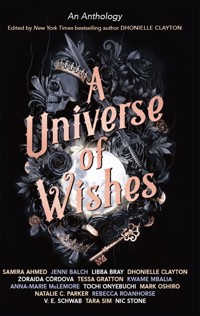
Fifteen diverse stories from the leading voices in YA, including a tale set in V.E. Schwab's bestselling Shades of Magic series. Anything is possible. From We Need Diverse Books fifteen award-winning and celebrated diverse authors deliver stories about a princess without need of a prince, a monster long misunderstood, memories that vanish with a spell, and voices that refuse to stay silent in the face of injustice. Alucard and Prince Rhy's relationship in V.E. Schwab's Shades of Magic series is finally revealed, Anna-Marie McLemore gives "Cinderella" a trans retelling, while letters supernaturally cross borders between Gaza and California in Tochi Onyebuchi's "Habibi". Close your eyes. Make a wish. The universe is yours for the taking.
Das E-Book können Sie in Legimi-Apps oder einer beliebigen App lesen, die das folgende Format unterstützen:
Seitenzahl: 466
Veröffentlichungsjahr: 2021
Ähnliche



















CONTENTS
Cover
Also Available from Titan Books
Title Page
Leave us a review
Copyright
FOREWORD by Dhonielle Clayton
A UNIVERSE OF WISHES by Tara Sim
THE SILK BLADE by Natalie C. Parker
THE SCARLET WOMAN: A Gemma Doyle Story by Libba Bray
CRISTAL Y CENIZA by Anna-Marie McLemore
LIBERIA by Kwame Mbalia
A ROYAL AFFAIR by V. E. Schwab
THE TAKEBACK TANGO by Rebecca Roanhorse
DREAM AND DARE by Nic Stone
WISH by Jenni Balch
THE WEIGHT by Dhonielle Clayton
UNMOOR by Mark Oshiro
THE COLDEST SPOT IN THE UNIVERSE by Samira Ahmed
THE BEGINNING OF MONSTERS by Tessa Gratton
LONGER THAN THE THREADS OF TIME by Zoraida Córdova
HABIBI by Tochi Onyebuchi
ABOUT THE EDITOR
ABOUT THE AUTHORS
About We Need Diverse Books
Also Available from Titan Books
ALSO AVAILABLE FROM TITAN BOOKS
Vampires Never Get Old
Edited by Zoraida Córdova and Natalie C. Parker
A WE NEED DIVERSE BOOKS ANTHOLOGY
Edited by
DHONIELLE CLAYTON
LEAVE US A REVIEW
We hope you enjoy this book – if you did we would really appreciate it if you can write a short review. Your ratings really make a difference for the authors, helping the books you love reach more people.
You can rate this book, or leave a short review here:
Amazon.co.uk,
Waterstones,
or your preferred retailer.
A Universe of Wishes
Print edition ISBN: 9781789098006
E-book edition ISBN: 9781789098013
Published by Titan Books
A division of Titan Publishing Group Ltd
144 Southwark Street, London SE1 0UP
www.titanbooks.com
First Titan edition: July 2021
10 9 8 7 6 5 4 3 2 1
This is a work of fiction. All of the characters, organizations, and events portrayed in this novel are either products of the author’s imagination or are used fictitiously. Any resemblance to actual persons, living or dead (except for satirical purposes), is entirely coincidental.
Jacket art copyright © 2020, 2021 by Katt Phatt
“A Universe of Wishes” copyright © 2020, 2021 by Tara Sim
“The Silk Blade” copyright © 2020, 2021 by Natalie C. Parker
“The Scarlet Woman: A Gemma Doyle Story” copyright © 2020, 2021 by Libba Bray
“Cristal y Ceniza” copyright © 2020, 2021 by Anna-Marie McLemore
“Liberia” copyright © 2020, 2021 by Kwame Mbalia
“A Royal Affair” copyright © 2020, 2021 by V. E. Schwab
“The Takeback Tango” copyright © 2020, 2021 by Rebecca Roanhorse
“Dream and Dare” copyright © 2020, 2021 by Logolepsy Media Inc.
“Wish” copyright © 2020, 2021 by Jenni Balch
“The Weight” copyright © 2020, 2021 by Dhonielle Clayton
“Unmoor” copyright © 2020, 2021 by Mark Oshiro
“The Coldest Spot in the Universe” copyright © 2020, 2021 by Samira Ahmed
“The Beginning of Monsters” copyright © 2020, 2021 by Tessa Gratton
“Longer Than the Threads of Time” copyright © 2020, 2021 by Zoraida Córdova
“Habibi” copyright © 2020, 2021 by Tochi Onyebuchi
The authors assert the moral right to be identified as the authors of their works.
No part of this publication may be reproduced, stored in a retrieval system, or transmitted, in any form or by any means without the prior written permission of the publisher, nor be otherwise circulated in any form of binding or cover other than that in which it is published and without a similar condition being imposed on the subsequent purchaser.
A CIP catalogue record for this title is available from the British Library.
FOREWORD
Dear Reader,
I was a mess as a teenager. Brimming with wishes and wants. Spoiled and grumpy. A misfit loner. Tiny, mad, and full of so many unanswered questions about this weird world. I’d always felt like I’d ended up in the wrong place. The wrong planet. The wrong time. That one day, I’d find my true home.
The only thing that made me happy was reading. I’d hide beneath my grandmother’s mahogany table with a stack of books, a plate of perfect pink-frosted animal cookies, and a glass of sun tea—with the right amount of sugar to suit my taste buds. I found my safe space in stories, away from all the other teens in my school, away from the mirrors, away from the comments.
I fell into fantasy and science fiction books to quench my thirst for other worlds and read as much as I could get my hands on during weekend trips with Dad to the bookstore and the public library.
But after a while, I started to notice that kids who looked like me didn’t get to save the world, didn’t get grand adventures through fantastical landscapes, didn’t get to go to magic camp. My imagination started to shrink. My love of reading dwindled. It felt like a light going out. I was losing the very thing that made me me. All because I was desperately looking for myself in the pages of the stories I craved.
For far too long some of us have been missing from magical worlds. But not any longer. Because the true secret I learned from books is that we all have magic inside us. We all possess the ability to command the failing spaceship, to break the powerful enchantment, and to change our worlds—both fictional and not—for good.
The universe is better because we are here. Because you are here. So let’s get started. Your grand adventure awaits.
Love,
Dhonielle
AUNIVERSEOF WISHES
TARA SIM
He had taken to making wishes whenever he could.
At the last morning star, on the edges of tarnished coins, along the cracks of bones that split in fires.
It was never enough. No matter how often or how aggressively he wished, his words were never heard, his pleas went unanswered.
And then one day, he learned why: wishes could not be made on innocent things, innocuous things, like stars and coins and clovers.
Because wishes were granted only by the dead.
* * *
The city of Rastre was pumping like a heart, people moving through its streets as blood flows through veins. It was the end of the day, and the sun burned copper on the horizon, casting long shadows out of the spires and rooftops around him.
Thorn waited in the shadow of a cathedral’s bell tower, crouched on the slanted roof with his arms braced on his knees. The wind blew, and he huddled deeper into his threadbare jacket. He’d have to get a new one soon.
Eventually the door across the street opened, emitting a tall, slender boy who couldn’t be much older than he was. The boy closed the door behind him, locked it, and headed toward the eastern sector.
Thorn waited several minutes to be sure. When the sun had bled fully into the earth, the sky deepening into a two-day bruise, Thorn slid to the edge of the roof. Jade lanterns flickered to life, casting Rastre in a glowing, starry light.
That light didn’t reach the street below. Thorn hopped down into that welcome darkness. Beyond he could hear the sounds of passersby, a child screaming in delight, the tinny first notes of a street musician.
Thorn popped the collar of his jacket and crouched before the door. He tickled the lock with his pick until it gave way and he could slip inside.
His breathing was loud in the silence that greeted him. Thorn swallowed and willed his heart to slow. He usually prowled the cemetery in the western sector, but one too many close calls with the groundskeeper had made him leery enough to try another approach. That, and he was getting tired of constantly washing grave soil out of his clothes and from the beds of his fingernails.
Not like this was much better—but at least it was cleaner.
The building was modest in size, large enough to contain two stories. The ground floor was used for receiving and accommodating customers. Upstairs was a collection of coffins and caskets.
But he knew, after a week of observation and more than his fair share of peeking through the window, that there was actually a third story. It was just underground.
Thorn moved past an open display coffin and a reception desk, around to the back, where a smaller desk sat covered in papers and parchment and pens. And animal figurines, of all things. Beyond that stood a door, and jiggering the lock rewarded him with a waft of cooler air.
A familiar eagerness filled his belly, the taste of magic already on his lips. He licked them and crept down a wooden staircase, feeling his way through the dark until he found a jade lantern at the bottom. It flared to life when he tapped it, illuminating a couple of autopsy tables and a rack of tools that could have doubled as torture devices.
And rows and rows of crystal capsules.
That was what gave off all this cold. Crystals were used for storing perishable goods, or keeping houses cool in the height of summer . . . or keeping dead bodies fresh.
Thorn approached the nearest capsule. They were built into the wall like drawers. He fumbled with the frozen handle until he could yank it open, pulling out the capsule’s sole occupant.
The man was waxen and stiff. His skin had become a light blue. Thorn had heard people speak of the dead, had heard words like sleeping and peaceful, but this man didn’t fit either of those. He seemed troubled even in death, his thick eyebrows lowered over sunken eyes, his mouth flat and unimpressed.
Thorn paused, looking at the freshly sutured Y-shaped line running down the man’s naked belly. He wasn’t used to this. Touching the dead, yes; digging up bodies, yes. He’d grown accustomed to the smell of earthy ozone and decay, the creeping mold and mulch of graveyards, the chill of stone and nights without moonlight.
This, though, was something altogether different. This was clean and clinical. It was crystal and chalcedony.
It was . . . wrong.
Thorn took a deep breath. He felt that breathing was somehow disrespectful, standing above a body that was no longer capable of the task. And what a strange concept, for this man to have existed only between the span of two breaths—his first and his last—to become merely a thing.
Well, there was still something inside him. And that was the whole point.
Thorn took out his pocketknife and flipped it open. It gleamed in the jadelight, deceptively clean despite its grisly purpose. He ran the knife over the autopsy incision, popping sutures and unraveling flesh. Much easier than hacking his way through dead tissue and muscle.
He peeled back the man’s skin, exposing a torso that had been hollowed out like a pumpkin. The organs had been detached and taken . . . somewhere. Thorn didn’t want to know, and didn’t care. Instead, the man’s body was lined with cotton, as if he were being turned into some morbid doll.
His ribs were still there, however. They curved up like anxious smiles, or the claws of a forgotten beast.
And there, residing between the fourth and fifth rib on his left side, was what Thorn had come here for. It was invisible, but he felt it, a tiny swirling galaxy of potential. It drew him in like a promise. A secret.
Thorn took the obsidian from his pocket and held it against the man’s ribs. The little galaxy continued to swirl between his bones, confused and directionless, but the lure of the obsidian finally caught its attention. It seeped into the black, glassy rock, joining the other little galaxies Thorn had already taken. His own pocket-sized universe.
He wondered if he finally had enough. But maybe, just to be sure, he should—
“What are you doing?”
Thorn whipped around. Standing at the bottom of the stairs was the boy he’d seen leaving the funeral parlor.
He had only a moment to take him in: skin a couple shades browner than his own, hair dark and curling at the ends, eyes that were the gray-green hue of moss. They were wide and spooked, darting between Thorn and the inelegantly opened corpse.
Thorn shoved the obsidian back into his pocket and did the only thing he could think of: he pushed the man’s body off its crystal slab.
The boy cried out in dismay and hurried forward to fix the mess. Thorn took his opening and darted for the stairs, his boots thundering on the wooden planks. He crashed into the desk up above, rattling the little animal figurines on its surface.
He was almost to the front door when a hand clawed at his shoulder. Thorn twisted and reached for his pocketknife, but the boy was stronger than he looked, and one purposeful shove made Thorn stagger farther into the shop. The backs of his knees caught the edge of something, and he fell, landing with a hard thud that winded him.
The lid to the display coffin fell shut on top of him.
Panic welled in his throat. Thorn dropped his pocketknife and banged on the lid, shoving his shoulder against it, but it wouldn’t budge. A creak above told him the boy was likely sitting on top of it, his weight rendering the lid unmovable.
“Who are you?” the boy demanded, voice muffled through the wood.
Thorn didn’t answer. He was breathing fast; the coffin smelled like cedar and linseed oil, and something herbal—maybe rosemary. He tried pushing the lid again, but it gave only a mere centimeter.
“How dare you come in here and deface the dead,” the boy went on. “You realize that brings bad luck, don’t you?”
Thorn was surprised by the rasping laugh that escaped him. “I’m used to bad luck.”
Silence. He could hear his own heart pounding, as if his body wanted to assure him that he was alive, despite his immediate surroundings.
“I’m not going to let you out until you explain yourself,” the boy said after a moment. “Poor Mr. Lichen didn’t deserve what you did to him.”
Thorn was inclined to agree, but sensing the little galaxy in his pocket, he didn’t regret it. He couldn’t say that, though; he’d never be released from this wretched coffin if he did.
When Thorn didn’t reply, the boy drummed his fingers against the lid. “If you don’t explain yourself,” he said softly, almost too softly for Thorn to hear, “I’ll call the city guard.”
Dread pooled in his chest. He’d been evading the guard for two years; he couldn’t allow all his hard work to unravel in a single night.
But he couldn’t easily explain what he’d been doing either.
“I . . .” His face flared hot, though the rest of him burned cold. “I was harvesting magic.”
The boy above him was silent. Thump thump went Thorn’s heart, and Fool, fool went his mind. He worried his lower lip between his teeth and blurted: “It’s for wishes. This magic, it’s not something people understand, so they can’t access it while they’re alive. So it just stays inside them, even after they die. It’s a waste. So I . . . I was collecting it from the bodies. For wishes. It’s what I do.” Then softer, pleading: “Please let me out.”
More silence. Thorn’s breaths were absorbed by the coffin walls. Finally, the boy slid off the lid and opened it. Thorn blinked at the moonlight that spilled through, staring up at the morgue boy. His expression was a slurry of confusion, annoyance, and fascination.
Thorn wondered if it was enough to win his freedom. But then the boy said, almost imperially, “Prove it.”
Thorn blanched. His hand twitched toward his pocket. “Why? Why should I waste a wish on you?”
The boy’s eyebrows rose. “There’s a guard patrol just around the corner, you know. They should be able to hear me shout for help.”
Thorn grimaced, sitting up. “That won’t be necessary.”
“Oh, good.” The boy smiled, and it offset a dimple on one side, a perfect little divot in his cheek. He stepped back to allow Thorn to climb out of the coffin, reversing his momentary death.
“What’s your wish?” Thorn grumbled.
The morgue boy thought, running a hand through his thick, dark hair. His gray-green eyes took in Thorn’s own hair—white, like snowfall and ash, like starlight on water. A rarity in Rastre, when most sported hair in darker shades.
The boy snapped his fingers and gestured for Thorn to follow him. Thorn glanced at the front door—too far to make a run for it, especially if what the boy had said about the patrol around the corner was true—and followed him to the desk in the back of the shop. The morgue boy picked up one of the ceramic animal figurines. It was of a little tiger, painted orange with black stripes, its eyes shining jet.
“Make it come to life?” The boy phrased it like a question, almost shy about it.
Thorn frowned. “I can’t make it live.”
“No, no—I meant make it sentient. Make it move.”
All that hard work to get a wish, and the boy was going to waste it on this? Thorn sighed and rubbed his face, eyes gritty from lack of sleep, hands smelling like Mr. Lichen’s clammy skin.
But then a thought occurred to him, and it was like opening a basement door into sunlight.
“I have a proposition,” Thorn said.
The morgue boy tilted his head slightly. “Are you really in a position to be making one?”
“Look—I need a way to harvest wishes, and you obviously want some of your own. So how about we strike up a deal? I get to come here at night and take the magic from these bodies, and in return, you get three wishes from me.”
The boy’s eyes widened, whether greedy at the idea of more wishes or stunned by the outlandish request. Maybe both. He looked at the figurine in his hand, turning it around in his fingers. “Would this count as one of those three wishes?”
“Yes.”
The boy thought some more, biting his lower lip. Finally, he sighed.
“If you make this wish come true,” the boy said, holding up the figurine, “then yes.”
Thorn smiled in victory. He slipped the obsidian from his pocket and felt the dance of magic inside, his prized universe of wishes, a handful of potential and possibility.
He pulled on a thread of magic, teasing it from its swirling shape and out through the glassy rock. He wrapped that thread around the little figurine, never taking his eyes off it. His lips moved soundlessly, crafting the shape and size of his wish, the parameters of its probability. The magic flared, no longer dormant as it had been between Mr. Lichen’s ribs, but glowing now with purpose.
The boy gasped as the figurine stretched like a housecat and sat back on its haunches in the center of his palm, looking up at him as its striped tail swished from side to side. He lifted it to his eyes and grinned, a world of amazement on his face. Wonder, Thorn realized, was beautiful; it banished what was impossible and made room for belief. When he thought about it, he supposed that could very well be a force stronger than most things—even wishes.
He met Thorn’s gaze with all the weight of that wonder. Thorn felt a quiver of it in his chest, and it was warm.
The boy held out his hand, the one not holding the tiger. Thorn hesitated, then took it in his own. They shook.
“Welcome to Cypress’s Funeral Parlor,” the boy said.
* * *
The boy’s name was Sage. His family owned the parlor, and he’d grown up among coffins and caskets, scalpels and forceps, crystals and incense. The dead did not bother him. In fact, they were considered something sacred, making Thorn’s treatment of poor Mr. Lichen all the more atrocious. Sage made him help stitch the body back up and return it to its capsule before he was allowed to leave for the night.
But Thorn returned the next night, and Sage was waiting for him. The little tiger prowled on his shoulder, occasionally batting at a curl of his hair.
“How many wishes do you have stored in that thing?” Sage asked, referring to the obsidian.
Thorn made a face. “Why, so you can haggle more out of me?”
“I think three is quite enough.” He reached up to pet the little tiger, who allowed it a moment before biting Sage’s finger. “Ow. No, I’m only curious. I’m not sure why you harvest them if you don’t plan on using them.”
“I’m going to use them,” Thorn mumbled. “That’s why I’m saving them.”
For a wish that was bigger than any other he’d made before. A wish that in all likelihood was too improbable, a thing not even belief could conjure.
But he had to try.
Sage shrugged his unoccupied shoulder. “All right, then.”
Thorn frowned at Sage’s back as they made their way down into the morgue. He’d never met someone like this before, all curiosity and no calculation. Who else on earth would think three wishes was “quite enough”? For that matter, why waste one of those precious three wishes on a tiny tiger that bit you if you petted it too much?
Sage tapped the jade lantern on and lit the incense inside a thurible. Its cloudy perfume rose in thin ribbons, infusing the morgue with a dark, hazy scent, like a night without stars. Thorn caught hints of anise and cedar, and the musky, earthen undertone of myrrh.
He followed Sage to a capsule at the far end of the room. Sage opened it to reveal an older woman with long silver hair.
Sage donned gloves of fine black leather and wheeled over a tray of tools. “Where is the magic located, exactly?”
Thorn told him, and he watched as the morgue boy got to work. He was quickly bewitched by him: the focus that hooded his gray-green eyes, the steady, methodical way in which his hands worked. The tiger was still sitting on his shoulder, peering down as if it were just as enraptured as Thorn.
When the woman’s torso was exposed, her ribs standing stark against the incense-tinged air, Thorn felt a curious trickle of self-consciousness go through him. No one had ever observed him do this before. Sage stood on the other side of the crystal slab and looked on just as intently as Thorn had been watching him, which he guessed was only fair.
He licked his lips, tasting the first vestiges of magic as he pulled the obsidian from his pocket. The woman’s magic was weaving across her ribs; unlike Mr. Lichen’s, it seemed restless, and Thorn wondered if she’d been more attuned to the secret power within her than most people tended to be. He’d noticed that women’s connection to magic was always a little stronger, a little more prominent.
Easing the magic across her ribs took a few minutes. It was stubborn, but eventually it gave in and curled itself within the safety of the obsidian. Thorn stepped back and nodded, signaling that he was done.
Sage looked confused. “That’s it? But I didn’t see anything.”
“Did you feel anything?”
“Maybe a bit of goose bumps, but it’s cold down here.”
Thorn shrugged. “Most humans don’t know how to pay attention to magic. If you focused, you’d probably be able to sense it better.”
Sage glanced behind him, at the jade lantern and its steady emerald glow. “So . . . you say that humans don’t know about magic. But the stones are magic, aren’t they?”
“In a sense. At least, it’s the only form of magic that’s readily accepted. We excavate the stones and use them for their different properties, but it’s chalked up to rich soil or unique mining conditions.” Thorn snorted. “If only.”
“What do you mean?” “This.” He held up the obsidian. “This is what makes the stones magical.”
Sage looked between the body and the rock in Thorn’s hand. “I don’t understand.”
“People go on living with this inside them. Different abilities, different strengths.” He touched his side, where he could feel his own little galaxy, warm and sleeping within him, primed for wish making. “Most don’t know about it, or they can’t tap into it. So when they die, what happens? They’re buried in the earth. As they decompose, that magic strays from them and is absorbed into the earth around them. That’s what makes the stones, like lapis for water dowsing, and ruby for heat.” He gestured at the lamp. “Jade for light. They’re just different abilities we carry.”
Sage’s brows furrowed as he thought. “I suppose that makes sense,” he said after a long moment. “But if it’s true, then how do you know about it? How come no one else does?”
Thorn hesitated. Thankfully, he was spared by the sudden growling of his stomach. He flushed as Sage gave him that dimple-inducing smile.
“I figured you might be a little starved,” the morgue boy said.
They cleaned up the body and returned it to its capsule, then ascended from the incense-choked morgue to the cooler, cleaner air of the ground floor. There, Sage produced a basket from under his desk. They sat on the floor by the display coffin, and Thorn watched him carefully set out jars and napkin-wrapped foods. His stomach ached with eagerness.
He didn’t want to admit that, yes, he was more than a little starved. Living on the streets tended to have that effect. Thorn had been lucky enough to find places to sleep: first a derelict apartment (which was, unfortunately, now being repaired), then the bed of a pretty girl who shared the leftovers from the inn where she worked (until she found another pretty girl who showered her with prettier presents), and now he holed up in a small office within an abandoned warehouse.
His mouth watered as Sage uncovered each item. Before Thorn could tell himself to wait, he was tearing into it all: slabs of thick bacon with mint and tamarind jellies, slices of rosewater-soaked apples, soft herb-encrusted cheese, crusty brown bread slathered with fresh butter and sprinkled with black salt.
Sage leaned back on his hands and watched him with a small smile. When Thorn realized he was making a spectacle of himself, he swallowed his mouthful and quickly wiped his fingers on a napkin.
“Sorry,” he mumbled, blushing.
Sage laughed. It was a strangely lively sound for the space they were in, a clear, ringing song. He leaned forward and dug through the basket, pulling out two green bottles. Thorn perked up at the sight of honey beer and eagerly took the bottle Sage handed him.
The first sip was like slipping into a cool lake in the height of summer. “I haven’t had this in so long,” he said.
Sage leaned forward, resting his elbows on his knees. The little tiger was prowling around their picnic, occasionally batting at crumbs. It found a large kernel of black salt and began to play with it, knocking it about like a ball.
“The city guard’s been on the lookout for a grave robber,” Sage said quietly. “A boy with white hair.”
Thorn lowered the bottle of honey beer and stared at him. Sage stared back. Thorn felt oddly vulnerable; exposing your hunger, your thirst, could do that to a person. But it was more than that—he was at this boy’s mercy, kept safe only by the promise of two more wishes.
And when those wishes were granted, then what?
“I won’t report you,” Sage said, reading the despair on his face. “That’s not what I was implying. I just meant that you should be careful.”
“I’ve survived this long,” he muttered.
Sage nodded. He picked up his bottle and clinked it against Thorn’s.
“To wishes.”
Thorn hesitated, then clinked his bottle with Sage’s again.
“To the dead.”
* * *
It became a routine: Thorn spent his days sleeping and his nights harvesting wishes with Sage. The morgue boy would open the bodies, and Thorn would extract the magic from within them. Sometime in the night they’d have a picnic, which was usually Thorn’s only meal.
Thorn also told Sage more about magic. “You’ve heard the legend of the titans, haven’t you?” he asked after Sage inquired about humans having magic in the first place.
“They were gods, right?”
“In a sense. They were great beings of magic. One of them died and fell to Earth, and the Earth swallowed him.”
“And his skeleton makes up the core of the Earth.” Sage nodded. “I’ve heard the story.”
“Well, it’s not a story. When the titan decomposed, he released all the magic within him into the soil. Humans ate the plants and crops that came from that magic-enriched soil.” Thorn gestured at the balsamic-glazed tomato slices before them. “The magic found a place to sit inside them, unused and dormant.”
“So you’re saying my garden is magic?”
Sage had told him about the overgrown garden he kept behind his family’s house, crawling with tomatoes and grapevines, wild with patches of strawberry and pumpkin. It was where most of the fare for their picnics came from.
“Yes, to some degree.”
Sage’s eyes were wide, and his mouth perked up like a child who’s learned a secret. “Fascinating.”
Thorn wasn’t sure if Sage actually believed him, but he seemed happy to indulge the possibility, which was enough.
Days passed, until eventually, Thorn began to worry about when Sage would demand his second wish. The morgue boy didn’t seem eager to call it in yet, content with his first wish. But it still put Thorn on edge. What would he ask for next? Something innocent, like the little tiger, or something sinister? Or maybe he was secretly greedy and would ask for money or jewels or power.
But still they crept down to the morgue and ate their picnics, and still Sage kept his second wish to himself.
They were eating sugared berries one night when Thorn thought to ask, “When did you start doing this?” He nodded toward the morgue door.
Sage licked the sugar from his fingertips. “I think I was five.”
“Five?”
“It’s a family business. My parents wanted me to get used to it. I’ll admit, it was scary at first. I had nightmares for a while. But the more I watched my parents work, the more I came to realize it’s an art. It’s sacred, what we do. The dead are to be respected.”
Thorn winced. What he and Sage were doing wasn’t exactly respecting the dead.
Sage must have interpreted his expression. “It’s not as if we’re desecrating them,” he said fairly, then quirked an eyebrow. “Not after Mr. Lichen, anyway.”
“I apologized, didn’t I?”
Sage made a humming noise and stared out the window. It was high on the wall, casting moonlight down onto the remains of their picnic. The little tiger was curled up within a mushroom cap.
“Thank you,” Thorn said after a moment. “For helping me do this.”
Sage looked at him. His eyes were pale and vivid, moss climbing over gravestones. Thorn had come to realize that Sage had his own scent, beneath the incense that crept into his clothes: something warm and clean like rosemary or lavender. When he stood or sat next to him, Thorn could smell it, and feel the heat of his body, pleasant after standing so long next to cold crystal.
“Thank you for showing me magic,” Sage replied softly.
And then, somehow, they were crossing the small distance. The warmth of Sage’s mouth on his was another reminder that Thorn was alive, that he was made up of so many parts, from the wild pumping of his heart to the buzzing tips of his fingers. He felt as if he had been spooled out into the universe only to come back to a body that was lighter and more extraordinary than the one before it.
Sage’s lips tasted like sugar. Thorn ran his tongue over them and collected all the stray granules, and allowed Sage to do the same to him, as if they were sweet things to be savored. And then they were kissing in earnest, beneath the waning moonlight and an open display coffin.
When they pulled back a few minutes later, Thorn was out of breath and happy for it. He was dazed, drunk on the heat of Sage’s mouth. The honey beer seemed flavorless and weak in comparison.
Sage watched him under dark lashes, fingers brushing back Thorn’s pale hair. Thorn allowed himself to be touched and petted, distantly thinking that these same hands opened up the dead. But they were so attuned to living flesh, from the pulse at Thorn’s neck to the soft underside of his jaw.
“I wish you would tell me who you really are,” Sage whispered. “And why you’re doing this.”
Thorn’s eyes shot open. Sage looked confused at his shock until he realized exactly what he’d said, slapping a hand over his mouth.
But it was too late. The magic began to seep out of the obsidian in his pocket, recognizing the cadence of a promised wish. Just as the thread of it had wound around the tiger figurine, it looped around Thorn’s neck, tickling his throat with words. Thorn clenched his teeth and kept them trapped for as long as he could, eyes burning at the strain, at his inner plea of No, please, stop.
There was no fighting the magic. It wrenched his jaw open, and the words spilled out.
“My name is Rowan Briar,” he said, his voice the monotone of one reciting information. “I come from a family of researchers who lived outside the city. They tested the properties of the stones until they realized the secret behind them. They discovered the magic that created them.”
Sage knelt there, hands held up ineffectively between them, unsure how to make Thorn stop. He couldn’t wrench his gaze away from Thorn’s face, tight with grief and humiliation.
“They wanted to tell everyone,” Thorn went on. “They wanted to spread the word. But the owners of the stone quarries didn’t want the truth getting out. One of them hired a mercenary. He killed my parents.”
A tear began to roll down his face, body shaking at the strain of trying to shut up. “They would’ve killed me too, but my mom helped me escape before they got into the lab. I ran to the city and hid, and I’ve been here ever since. I knew about the magic—I overheard them talking about it often enough—so I decided to test it out. I dug up my first body. I made my first wish.
“But wishes have properties, like anything else. You can’t make a wish on yourself. I tried to wish to change my hair, so that it wouldn’t stand out, but it didn’t work. I wished to go back in time, to save my parents. That didn’t work either. I wished for money, for food, for strength, and none of it came. So instead, I wished for the next body to be dug up, and that came true.
“I wanted—” His voice faltered, but the magic pressed the words on regardless. “I wanted to bring them back. My parents. But a single wish couldn’t achieve that, so I needed more of them. A whole universe of wishes. I began to collect them, hoping I could get enough. And I’m still collecting. That’s why I came here. Why I continue to come here.”
The magic lifted from him, and Thorn took a deep, shuddering breath. The silence after his words was terrible. Sage was no longer looking at him, but rather at Thorn’s pocket where the obsidian was hidden. After a moment, Sage opened his mouth.
“Thorn . . . Rowan . . .”
Thorn pushed himself to his feet. He was unsteady, his head spinning from the aftereffects of the magic. It was usually sweet, but now it tasted bitter and ashy.
“I’m sorry,” Sage hurried to say. “I didn’t mean—Thorn, wait!”
Thorn ran out of the funeral parlor, into the city cloaked in midnight. The air was thick from recent rainfall, the paved streets dark with water. He couldn’t draw enough of that ozone-heavy air into his lungs, but he kept running, driven by a single stabbing thought: Get away.
Desperation grasped at him. He tripped and nearly fell to his knees. He sobbed in a breath, stumbling madly through the city and the night, shrinking away from jadelight and the sound of voices. If anyone saw him, they likely thought him drunk.
He was choked with memories. His mother’s white hair in its usual braid, her dark eyes fixed on his. Rowan, go! Her strong hands pushing him out the window. The sound of glass breaking from within, beakers and cylinders and whatever else his father had thrown at their attacker. It wasn’t enough. Arcs of blood, the thud of bodies. Thorn, cowering in the birch grove beyond the house, watching the first flames lick up the walls. Consuming his mother and father and all their work.
Leaving only him, and what remained of their voices in his mind, in the shapes of secrets and stones.
But not for long. Thorn finally reached the abandoned warehouse and made his familiar scramble through the broken planks. Up the creaking stairs, into the dusty, empty office that boasted merely a thin straw pallet on the floor, a cracked jade lantern, and a small barrel of rainwater that tasted of iron.
He fell to his knees, fumbling with the obsidian. He drew in sharp, rasping breaths, and it was hard to believe that just moments ago he’d been kissing Sage, warmth and sugar and the edge of possibility. There was none of that now—just cold ash on his tongue in the wake of the truth, and the weight of the impossible in his hands.
He held the obsidian before him. Hundreds of galaxies contained between his palms.
“I wish,” he croaked, but he had to stop, to close his eyes tight and simply allow himself to shake under the thrall of wild despair. How cruel it seemed for it to walk hand in hand with hope. “I wish . . .”
He forced himself to breathe, to let the tears escape, to think only of his mother’s dark eyes and his father’s loud laugh, and the big and extraordinary way in which he had once been loved. The magic swirled against him, almost as if raising its head, almost as if taunting, Yes?
“I wish,” he whispered, curled around the obsidian, his lips nearly brushing its glassy surface, “for my parents to be alive.”
He waited. Despair and hope. Hope and despair. The magic swirled, as if thinking.
And then it sank back down into the rock, unused.
His universe had rejected him.
Thorn allowed the stillness to become its own living thing, a silence that was made for boys like him, with nothing and no one. His tears dried, and his mind was quiet. The moonlight crept across the floor through the window, and although it could have whispered all his secrets back at him, it, too, was silent.
His hands tightened around the obsidian. Sage. He had used one of the wishes, diminishing the power he’d been building for so many nights. If he collected more—if he tried again—
He eased back into motion, shedding the stillness, the silence, until he was running back out the door.
* * *
Thorn made sure to grab the shovel on his way out. The night was still heavy over Rastre, but dawn was a few hours off, and he didn’t have much time to work.
He couldn’t go back to the funeral parlor. He couldn’t.
Even though a part of him—a traitorous, weak part—wanted to.
Instead, he took his familiar route to the graveyard, shovel slung over one shoulder and determination calcifying his heart.
Belief was stronger than wishes, and he believed that his family’s death would not be in vain.
Trees blotted out the moonlight as he stole through the boundary of the cemetery. It was a verdant block within the city, a walkable path from the park. The citizens of Rastre didn’t shy away from death; they didn’t cart out their dead or burn them. They preferred to visit, to make outings of it. Thorn had watched families gather around tombstones and lay out offerings: flowers, candles, incense, coins, food. They would linger and sit on the grass above their late loved ones, sharing lunch and stories, their laughter like birds taking flight.
Thorn would never have that experience.
Gritting his teeth, he waded through the shrubbery and made it to the central plot. Grave markers stood in neat rows, occasionally interrupted by statues limned in moonlight. A carving of a girl with smooth marble limbs held a hand outstretched as if to tell him, Go back, Thorn.
He trudged into the forest of stone. His eyes swept the ground, looking for the telltale signs of a new grave: disturbed earth, the smell of restless soil and newly shed tears.
Dig it up, take your wish, and get out.
He didn’t hear the rustling grass behind him. He didn’t see the shadow rising up beside his.
A hand smothered his mouth before he could cry out. Another strong hand took hold of his arm and wrenched it up behind his back.
“Got you,” said a voice in his ear, low and male and like the scraping of metal on metal. Thorn’s eyes widened; it was a voice he associated with breaking glass and the crackling of fire, a voice woven with memories of blood and loss.
“They said there was a white-haired boy sneaking about the cemetery,” the mercenary drawled. “I was about to give up, but now here you are at last.”
Thorn couldn’t breathe. His valor turned to terror.
But something else filled him. Not vengeance—what was that, really, but the expulsion of helplessness and anger? He wasn’t helpless, and he wasn’t angry. He was livid with loss, and brimming with power.
He didn’t want more death, he wanted life. He wanted his parents alive.
And this man had taken that away from him.
Thorn swung the hand that still held his shovel and knocked the spade against the man’s head. The mercenary grunted and staggered, loosening his grip enough for Thorn to tear free. Gasping for breath, he turned and finally looked at his parents’ murderer: dressed in black, hair shorn close to his scalp, eyes tight with pain.
Thorn grabbed the obsidian in his pocket. “I wish—”
“What’s going on here?”
Two members of the city guard were stalking over, weaving through the tombstones. Thorn cursed under his breath.
No time to make a wish. He turned to run, to hide, to do again what he’d been doing over and over for two years.
But before he got very far, the mercenary lunged and grabbed him again, and Thorn felt the sharp kiss of a knife at his throat.
How ironic, to die in a cemetery.
Before he could close his eyes against the inevitability that glinted along the blade’s edge, he heard another voice, familiar and clear. It rose above the confused shouting of the city guards. It rose above the fear that he was about to die, and all his family’s secrets with him.
Sage stood at the edge of the graveyard, chest heaving and eyes wide with horror. He called Thorn’s name, and it was its own kind of magic.
“Thorn!” Sage called again.
The mercenary growled. The knife dug into Thorn’s skin.
“I wish everyone knew the truth!” Sage shouted.
The night froze. Thorn’s heart faltered. Everything turned fragile, the city as delicate as a lacework of sugar.
In his pocket, the universe of wishes swirled and lifted. The magic leaked out of the rock, up into the air, dancing and darting higher. And, like a firework, it blew apart and rained down over Rastre, sparks of glittering possibility.
Thorn heard twin gasps behind him from the guards. Even the mercenary’s grip had grown slack. Thorn pushed himself away and ran to Sage, nearly collapsing into his open arms.
They watched as the guards touched their sides. There was wonder and uncertainty in their expressions. The mercenary’s brow was furrowed, the tip of his knife red with Thorn’s blood.
What exactly had been Sage’s wish? There were mechanics to these things—there were rules. I wish everyone knew the truth. The truth Thorn had told him hours ago? The truth about magic?
He had his answer when the guards’ eyes focused on the mercenary and hardened. They hurried forward and pinned him to the damp cemetery grass, wrestling the knife out of his grip. They claimed he was wanted for the murders of Dr. Ash Briar and Dr. Tansy Briar, and that one way or another, he would lead them to his employers.
Their words blended and lost shape in his mind. All he heard was Justice, justice, justice.
But the taste of it was not sweet. He was scraped out, hollow. Defeated.
Because the truth was out, his wishes were gone, and he was falling into the reality he’d refused to believe, even when he’d always known: his parents were never coming back. Not even wishes could raise the dead.
He didn’t realize he was shaking until Sage wrapped him in his arms, and they swayed together. The little tiger padded from Sage’s shoulder onto his. Thorn felt like a flame blown out, charred and tired, and the only thing he cared about was that the boy who held him smelled of lavender and life.
Thorn would have gladly stayed there all night, but there was a cough behind him and he had to draw back from Sage’s embrace. A guard was looking at him strangely, as a dreamer woken abruptly from sleep. It was the wish; it had been sloppily crafted, and she likely had no idea why she was doing what she did. But the guard knew what had happened to him. He could see it in the pity on her face.
“Rowan Briar?”
His chest tightened. “Yes.”
“Can you come with us, please?”
Sage held on to his wrist, a question and a promise.
Thorn met his gaze. “I’ll find you,” he said.
Sage nodded. Thorn turned to go, stopping with a muttered “ow” when the tiger bit his earlobe. He returned it to Sage and followed the guards and their prisoner out of the cemetery, looking over his shoulder at boy and figurine. Even from a distance he could read the trepidation on Sage’s face. But Thorn believed that everything would be all right.
And after all, belief was stronger than wishes.
* * *
The tall, slender boy closed the door to the funeral parlor behind him, digging out his keys to lock up for the night. He didn’t see the other boy across the street, leaning against the wall with his arms crossed.
“You know, you’re really bad at making wishes.”
Sage jumped and whirled around, dropping the keys with a clatter. His eyes widened when he saw Thorn.
“You’re all right,” he whispered. The little tiger poked its head out of his pocket.
“I said I’d find you.”
Sage’s mouth trembled, as if wanting to smile, but he didn’t give in to the urge. His gray-green eyes looked Thorn up and down. Looking for signs of injury or worse. But there was only the cut on his neck made by the mercenary, and it was already healing.
“Well, it’s been a while,” Sage said. “You can’t blame me for worrying.”
Thorn ducked his head. He should have sent word to Sage somehow, but it had been a busy few days. Days of talking to the authorities, higher and higher up the chain of command until he was pulled into a meeting with the chief inquisitor, a severe woman who was now rounding up the stone quarry owners and questioning them for their involvement in his parents’ deaths. For their part in concealing the findings of the Briars’ research.
Justice. It still felt like a hollow word. Strangely, he was happy for the pain of the cut on his neck, the bold red mark it made. It was physical proof that he had fought for this and won.
Sage wandered over to him, from the moonlit-drunk side of the street to Thorn’s shadowed one. “And I’m not bad at making wishes.”
“No?”
“Just take a look around.”
Thorn had. All of today he’d wandered Rastre in a daze, hardly believing what he was seeing. Magic. It was everywhere. With Sage’s third and final wish, he had unleashed this upon the city: the knowledge of what sat between a person’s ribs, the swirling little galaxies of possibility. He’d seen a little girl channeling her power of heat, laughing with glee when her fingertips came alight with flames like birthday candles. He’d seen an elderly man glowing like a jade lantern. A harried mother accidentally frosting over the front of her house until icicles hung from the eaves. He’d seen . . . so much.
The result of his parents’ work.
In this way, he thought, perhaps they were brought back after all. He saw them in people’s smiles, in their wonder.
“And you?” Thorn asked. “What trick can you do?”
Sage took the tiger from his pocket and placed it on his shoulder, where it sat and swished its tail from side to side. “Life.”
“Life?”
“My garden. My parents always thought it was odd that it bloomed through winter. I didn’t think much of it—just thought I was good with plants, like how I was good with animals.” He patted the little tiger’s head. “I guess I was tapping into a bit of me I didn’t understand.” He looked up at Thorn through his lashes, his dimple returning with his smile. “Until now.”
Thorn’s heart beat. He was alive. The simple fact rushed through him, spectacular and surreal, like a word you say too many times until it’s lost its meaning. But this, this was nothing but meaning, and he felt it from crown to toes.
Magic, he realized, took so many forms.
And when Sage leaned into him and their lips met, it was more powerful than any wish.
THESILK BLADE
NATALIE C. PARKER
The Bloom of Everdale is ready to choose a consort, and I have come to win his hand.
The Garden Palace is sculpted in the likeness of the summer star flower, its walls overlapping like petals as they curl and climb toward the center, where a thin spire of glass glitters in the sun. It is surrounded by a wide canal painted silver along the bottom to give the running water a perfect iridescent shimmer. Thin bridges arch elegantly over the canal, leading to one of the six gates that give entry to the palace, each one more delicately constructed than the last.
My invitation directs me to the Silk Bridge, and as I step onto the pedestrian pathway, I am amazed to discover that the name refers not only to the fine weave of jewel-toned pennants flying above my head but also to the bands beneath my feet. What at first glance I took to be narrow boards of wood are layers of silk pressed and bound into planks that extend the width of the bridge. For an instant, I forget my purpose here and stoop to run my fingers over the material. It is both soft and worn from years of foot traffic, while also as firm and strong as a plank of wood might be. It is a metaphor for our nation, and I am astonished at its quiet perfection, astonished to find it directly beneath my feet.
If I win the Bloom of Everdale, if he chooses me to be his consort, this bridge will be a part of my home. I will walk across silk boards, learn the layered corridors of the Garden Palace, even feel the kiss of sunlight through the glass spire daily if I choose. And I will bring my mother with me. If I win.
When I win.
Of all the warriors who answered the first call and endured weeks of trials and dozens of opponents, only three of us have been invited to compete before the Bloom. We are the finest, the strongest this nation has to offer, but only one of us is his perfect balance, the force to his precision, the protective wall to his perfect vulnerability. When this started, my mother rushed home with a flyer crushed in one fist and my sword clutched in the other. Her eyes were a little wild, her cheeks glowing as she exclaimed, “You will change the path of our family walks now and forever! Pack your things.”
I’d answered the first call with a trembling kind of desperation, my mother’s hopes always stirring in my heart. Now I don’t feel desperate at all. After weeks of trials, dozens of opponents, and a lifetime of thin soup, I know I can win.
“Strength in the slight,” I whisper in an attempt to release the swell of love that threatens to unsettle me.
“Grace in the might.” The answering voice is both reverent and amused, like silk itself in my ears.
I raise my eyes, knowing my moment of admiration has exposed me as one who has never before tread so near the Garden Palace, to find a girl standing over me. And for a moment, I do not breathe.
Her eyes are a golden honey brown, barely darker than the sun-warmed tan of her skin. Her round cheeks perch above lips pressed into a lopsided smile. Only her top lip has been painted in a dark berry purple to signify she is unpaired, and I don’t think I have ever been so grateful to see an unpainted lower lip. It is full and pale peach, and I immediately wonder what it would taste like between my teeth.
She is dressed like me, to boast the obvious strength of her body, as is traditional for those who follow the way of the sword. A bodice fits against her breasts and her belly, tight enough to cling to the muscles there, but not enough to restrict her movements. Ochre bands tied around her bare upper arms highlight the dip and valley of her biceps, and a skirt of flawless purple damask splits over each of her thighs, where four matching ochre bands sit above and below her knees.
With her standing over me, I forget my entire reason for being here.
“Are you lost?” she’s asking, and I realize at once that she has been speaking to me for, well, I don’t know how long.
“I am not lost,” I say, feeling as though for the first time in my life I have found my way. “At least, not yet.”
I rise slowly to my feet, noting the way my head spins. Whether it’s from spending so long crouched on the ground with my hand pressed to the deceptive layers of silk or from my proximity to her, I cannot tell. Now that I’m standing, it’s I who looks down and she who looks up with a squint of her golden-honey eyes that makes my mouth go dry.
“This must be your first time. Most people don’t stop to bless the bridge.” She says it all with an amused twist to her mouth. “Though I suppose they really should. It is a marvel. Perhaps even more so than the Winged Bridge or the Bridge of Whispers.”
But not more marvelous than you.
I want to say something she’ll remember. I want to make myself a landmark in her mind, but don’t know how, and I settle on a request. “I think neither would compare to you. May I have your name, lady?”




