


Erhalten Sie Zugang zu diesem und mehr als 300000 Büchern ab EUR 5,99 monatlich.
- Herausgeber: Influx Press
- Kategorie: Gesellschafts- und Liebesromane
- Sprache: Englisch
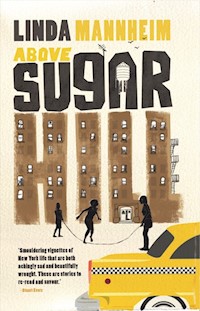
Above Sugar Hill is an unforgettable collection of short stories set in Washington Heights, New York, in a place no one from outside the neighbourhood is expected to visit. It is a visceral, vital work of site-specific fiction. These tales take place between 1973 and 2001 – a Puerto Rican Independentista fends off the FBI, a young girl spots Marilyn Monroe more than ten years after her suicide, an opera-singing housing activist goes missing, presumed to have been murdered. Here is a literary map of Upper Manhattan, uncompromising narratives and complicated truths.
Sie lesen das E-Book in den Legimi-Apps auf:
Seitenzahl: 189
Veröffentlichungsjahr: 2014
Das E-Book (TTS) können Sie hören im Abo „Legimi Premium” in Legimi-Apps auf:
Ähnliche



















Published by Influx Press
Studio 25, The Heartspace, Hackney Downs Studios
15—17 Amhurst Terrace, London. E8 2BT
www.influxpress.com
All rights reserved.
© Linda Mannheim 2014
Copyright of the text rests with the authors.
The right of Linda Mannheim to be identified as the author of this work has been asserted by them in accordance with section 77 of the copyright, designs and patent act 1988.
This book is in copyright. Subject to statutory exception and to provisions of relevant collective licensing agreements, no reproduction of any part may take place without the written permission of Influx Press.
First published 2014
Ebook conversion by leeds-ebooks.co.uk
ISBN (pbk) 978-0992765521
ISBN (ebk) 978-1910312001
This book is sold subject to the condition that it shall not, by way of trade or otherwise, be lent, re-sold, hired out, or otherwise circulated without the publisher’s prior consent in any form of binding or cover other than that in which it is published and without a similar condition including this condition being imposed on the subsequent purchaser.
Above Sugar Hill
Linda Mannheim
Influx Press, London
For Abby
Contents
Marilyn Monroe on 165th Street
Once
The Street
The Dust That Rises From Bombs
Business
The Song Jimmy Used to Sing to Drown Out the Sound of the TV Coming From Next Door
Tenor
When it Breaks
Dropping
Above Sugar Hill: An Afterword
Acknowledgements
Above Sugar Hill
Linda Mannheim
Marilyn Monroe on 165th Street
When Silvia was a little girl, her sister used to scare her to tears by telling her Marilyn Monroe was coming. Their mother would be off cleaning someone’s house, and Silvia would be sitting on the dirty carpeting in the living room, cutting shapes from construction paper, lost in thought. And maybe Maria would spot her like that, through the glass-paned door. She would choose just that moment to burst in and scream, ‘Run! Run! Marilyn Monroe is coming!’
And Silvia, the fear stopped up in her throat, would drop her blunt scissors to the ground and go running down the long, dark hallway, nearly sliding on the speckled linoleum in her half-off socks. She would hide behind the smelly wool coats and the old leather shoes in the front closet, and Maria would call to her, ‘Don’t come out yet! Marilyn Monroe is still here!’
Silvia would stay there, quaking with fear and sobbing softly while Maria watched The Carol Burnett Show and Mary Tyler Moore. That was how I found them when I went downstairs to their apartment and Maria opened the door. The TV was on, and next to the couch there was an open box of Capt’n Crunch. Maria looked at me like she was all pissed off that I’d interrupted her show and was waiting for me to explain why I’d come so I could leave again. Silvia’s sobs came softly from the closet.
‘My mother said to tell you that your mother called, and she wants me to tell you that she can’t come home for another hour more, and she said that you should take the chicken out of the freezer and go put it in a bowl of hot water now,’ I reported, with the plodding efficiency of an undertaker.
Really, I did not want to speak to Maria at all, but because her family’s phone had been disconnected, I was assigned to convey messages to Maria’s family that came in on our phone. I decided that conveying these messages or talking to her during emergency situations did not really constitute ‘speaking’ with her. But I would never say anything nice to her or to the mean girls in hot pants she hung out with at school. ‘How come Silvia’s crying?’ I asked.
‘Because she’s stupid,’ Maria said, tossing back her dark, wavy hair that fell down to her butt.
‘You’re stupid,’ I told Maria. ‘You’re as stupid as your platform shoes.’
‘You better go,’ Maria said, glaring at me, as she backed off to the kitchen. ‘You better get out a my house.’
From inside the closet, I could hear Silvia sob, the sound leaking as if it came from a wound.
I opened the closet door, which was hard to do because all the layers of paint along the door frame sometimes made it stick. But once a crack of light made its way into the darkness, Silvia started to scream. And then she collapsed into a series of sobs. ‘Querida,’ I asked, pulling her out into the dim hallway light. ‘What’s wrong?’
She held onto me in that way that little kids do, their weeping all getting under your skin and right in the cavity of your chest so that it becomes all the weeping you ever did too. ‘Marilyn Monroe is coming,’ Silvia explained, in a little gasp.
‘What?’ I asked, lifting up Silvia and letting her cry into my shoulder. ‘Who’s’at?’ I asked. ‘What? Marilyn Monroe. What’s she? She’s just an old movie star, right? She’s not even alive anymore, I bet you.’
‘She’s dead,’ Silvia confirmed, tears still running down her face. ‘She’s a ghost.’
We had to go to Westchester to see my Uncle Teo perform with his band. I’d seen them before. It was stupid. My Uncle Teo would make his hair all greasy and comb it back so it looked just like the hair that all the men had on the old TV shows. All these people were my parents’ age and they’d wear really ugly clothes, like poodle skirts and little tight pants that were too short. On the way there, I sat in the back seat of the car and looked out the window, asking my parents how come we had to do this, and what was the big deal? It was nostalgia, my mother explained. I would understand when I got older. But I knew that I would never like bobby socks, which were too much like the socks I had to wear when I was little. And how come they always started cheering when the band played ‘Wake Up Little Suzy’ and ‘Rock Around the Clock’? What was wrong them?
This time, there were all these striped awnings set up outside, and the air smelled like beer and freshly cut grass. We sat at a round white metal table and I drank eight Shirley Temples. Afterwards, on our way back into the city, we stopped at Caldor’s Department Store. I wandered over to a corner of the store where, on a table, someone had arranged copies of a book called Marilyn. A blonde lady, slightly dazed-looking, lips parted, stared at me from the book’s cover. She had fake eyelashes on and held a slightly see-through scarf over her breasts. You could see her belly button, and she had one arm lifted, her hand folded against her forehead as if she had a headache. I looked at the price. My parents would never get it for me. I took off my sweater and tried to bunch it up around the book so that no one would know I was hiding anything inside. This was 1973. Out in places like Westchester then, there weren’t tags that sent off theft detectors. Security guards didn’t follow you around the way they do now. It was amazing what you could get away with. Once, in Woolworth’s, on 181st Street, my cousin and I carried out a red beanbag chair and never got stopped. Things were there for the taking then.
At home, I looked at the book with my back to the door, hunched over it as I sat cross-legged on my bed, so if anyone came in, they couldn’t see what I was reading. Marilyn Monroe was supposed to be beautiful, but I didn’t think she was beautiful. Her hair looked tired like my mother’s, pushed into shapes that weren’t right. She was too heavy, wasn’t slinky the way actresses should be. And that mole on her cheek, was that a beauty spot? I’d heard women call them beauty spots on TV; seen them draw the dot on with an eyebrow pencil. Was that supposed to be beautiful? If I kept looking in the book, would I see why everyone said she was beautiful?
Marilyn Monroe was walking across a beach, a short, white terry cloth robe around her, her legs covered with sand. Was that sexy? You could keep the sand off your legs by getting back in the water and then putting on flip flops and drying off as soon as you got out again. Didn’t she know that? Marilyn Monroe was putting her arms around a tree, elated at something, but I didn’t think it was real elation. Marilyn Monroe was standing above a subway grate, her skirt blowing up as she grinned with glee. Didn’t she know you should never ever stand or even walk on a subway grate? They could cave in. You could fall through down to the subway tracks. Why were they taking pictures of her doing these things?
Then I looked at a picture way in the beginning of the book. Marilyn Monroe was standing in a pair of blue jeans and shirt made out of bandannas. She was smiling, and she didn’t look all spaced out. Her hair looked normal. It was brown, and wavy, and tied back, just the way Silvia’s was. And then I thought she was beautiful.
I would have to show this book to Silvia, show it to her so she would know Marilyn Monroe was nothing she had to be afraid of. She would see that once Marilyn Monroe was a pretty girl, and then she just looked tired like our mothers. Everything about her was really familiar.
I read through the book to find stories I could tell Silvia about Marilyn Monroe. Her name wasn’t even Marilyn Monroe, but Norma Jeane Baker. She was in an orphanage for a while and had to bathe in water that some other girls had bathed in first. Someone shot her dog. She got married when she was sixteen, five years older than me. I didn’t want to tell Silvia these stories.
‘You should come over to my house later ‘cause I got something to show you,’ I told Silvia, in the schoolyard during lunch. She was playing double dutch with some other little kids.
‘What?’ Silvia asked.
‘You come to my house after school today,’ I told her.
‘Okay,’ Silvia said.
Once school was done, after Silvia dropped her books and her lunch box downstairs, she came up to my apartment. My parents were both at work, so no one else was home. Silvia stood in the living room, her big eyes all expectant, and I told her, ‘Wait right here.’
Then I went and got the book. She stared at the lady on the cover.
‘That’s Marilyn Monroe,’ I told her.
For a minute, her lips turned down with fear.
‘Don’t be scared,’ I told Silvia, bringing her closer. ‘She’s just a lady. See?’
I put the book on the coffee table and turned the pages while Silvia stared. Marilyn Monroe in an evening gown. Marilyn Monroe pushing her shoulders forward as if she wanted the person taking her picture to go away, but was too polite to say so. Marilyn Monroe drinking champagne with an old man, a white-blonde tuft of hair falling on her forehead.
I said to Silvia, ‘Marilyn Monroe.’
Then, near the end of the book, a picture of a man whose face was folded in grief. Joe Dimaggio, I read. Once, when I’d heard a Simon and Garfunkel song about him, I asked my mother who he was, and she told me he was a famous baseball player, that he played right across the river in Yankee Stadium.
‘Where did he go?’ I asked her.
‘What do you mean?’
‘Did he die?’ I asked. I told her about the song.
‘Laura,’ she said, shaking her head. And then the doorbell rang so I never got to hear what her explanation was.
Now, as Silvia and I bent over the book, I read that Joe Dimaggio was married to Marilyn Monroe once, and that last picture was taken at her funeral. I read that you were supposed to see the grief of the entire nation in his face.
The doorbell rang. Quickly, I hid the book under the couch and went to answer the door. It was Maria. She had on blue eye shadow and kept flicking her hair back while she stood. ‘You better come downstairs,’ she said, looking past me, to Silvia.
‘Marilyn Monroe isn’t a monster,’ Silvia said accusingly, her small chin in the air.
You could see something taken from Maria, her eyes tightening. ‘You don’t get downstairs, Marilyn Monroe is gonna kill you.’
‘Liar,’ Silvia accused. ‘Laura showed me the book. Marilyn Monroe is just a lady.’
I stood against the wall, my arms folded.
‘What book?’ Maria asked.
‘This book,’ Silvia said, walking back to the living room and pulling the book out from under the couch. Maria and I followed and watched Silvia pull the book onto the coffee table.
Maria kneeled before the table and leafed through the book slowly, staring at the pictures: Marilyn Monroe as a tiny bride, a veil shaping her face into a heart; Marilyn Monroe sitting on the floor in a filmy red gown, looking as if she’s trying to talk down someone who’s going to hit her; Marilyn Monroe stretched out naked on a red satin sheet, like a woman who’s trying to show you what a woman’s body looks like in profile.
Maria flipped back to the book jacket and saw the price. ‘You stole this,’ she accused.
‘Did not,’ I told her.
‘I’m gonna tell everyone unless you loan it to me.’
So I did.
And that was how it started, how me and Maria started talking to each other. We started talking about Marilyn Monroe.
She was still a bitch. If she knew something about Marilyn Monroe I didn’t, she acted like Marilyn Monroe told her this stuff personally. She read all this other stuff about Marilyn Monroe, and then she found out there was gonna be this TV show on Marilyn Monroe. Maria wanted to go to Anita Navarro’s house to watch it because Anita had a color TV. All during the show, Anita kept touching up her nail polish and the air smelled bad from it. The TV announcer said Marilyn Monroe was going to sing ‘Happy Birthday’ to President Kennedy, then introduced her by calling her ‘The late Miss Marilyn Monroe.’
I let out a little gasp.
‘She didn’t get there on time,’ Anita pointed out, working on her last nail. ‘It’s a joke.’
Then Anita turned to me and stared, eyes popped wide, as if she wanted to see why I was stupid.
Maria angrily said, ‘Shhh.’ She sounded so much like her mother that, for a minute, I was scared.
Marilyn Monroe sang ‘Happy Birthday’ to the president in a little, breathy voice. She was standing on stage in a slinky, shiny dress, but she was just singing the regular birthday song. ‘This is bizarre,’ I concluded.
The first time I saw Marilyn Monroe in real life, she was walking down 165th Street toward St. Nicholas Avenue. She was wearing a white halter dress, just like the one she wore when she stood over the subway grate and her skirt went up. She walked fast, the gray July air kissing the skin of her upper arms and shoulders. The men hanging out on the stoops called out to her. She just smiled and kept walking. I couldn’t follow her. I wasn’t supposed to go down to St. Nicholas Avenue by myself. It was one of the few warnings I listened to. Dos Puertas was on St. Nicholas Avenue, the bar where Maria and Silvia’s father got shot. I hung off the side of the steps to my building and watched Marilyn Monroe disappear as she turned the corner. Then I ran upstairs to tell Maria what I’d seen.
It was when I got to the part about Dos Puertas that Maria’s face broke, and she said, sharp-voiced, ‘You lie, Laura.’
‘You lie,’ I said back. ‘You think you know everything.’
‘Stupid,’ Maria told me. ‘Marilyn Monroe is dead, and even if she was alive, she wouldn’t come here!’
That night, I lay in bed thinking of all the things I could have said back to Maria Cuellar. Of course Marilyn Monroe had come here. How else could they have filmed her with her skirt getting blown up over a subway grate? She’d lived in New York once, hadn’t she? Everyone did sooner or later. But I knew what Maria meant. She meant I was stupid to think we’d see any of those people where we were. She meant Marilyn Monroe wouldn’t come uptown.
I hooded the lamp next to my bed with a blanket and looked at the book again: Marilyn Monroe getting out of a pool, one arm and one leg slung over the swimming pool’s lip. Marilyn Monroe in a bathtub, her head and legs sticking out from the bubbles, her expression asking, Is this okay? Marilyn Monroe clutching a sheet to her chest while she kissed an older man with a mustache. What was wrong with everyone? Why did they all want to look at pictures like these? How come they showed her like she was gonna walk out naked any minute instead of just showing her naked and getting it done with?
I looked out the window at the purple and gray night, a few people leaning against parked cars, and a brown Lincoln with New Jersey plates gunning up toward Broadway. The only light came from the bodega on the corner, its boxes of plantains and Puerto Rican grapes out front still, and, inside, its cut melon surrounded by flies and dried ham sliced into portions too small to be good for anything. It was open all night. The cashier there once whapped Maria’s chest with a long stretch of tape from the cash register. He’d be doing what he always did that night, keying numbers in as he moved the food from one side to the other, wiping the dust off the top of soda cans when people complained ‘bout the dirt. And Maria, she’d be upstairs doing her nails again. Everything would go on same as it was before for them, But not for me. Out there, nearby, was Marilyn Monroe.
‘Come with me,’ I told Silvia, the next day. ‘She may be back.’
When we sat down at first, the cement steps were too hot to stay on, so we stood sometimes. And Maria stood with us. ‘But don’t think I’m waiting to see Marilyn Monroe,’ she told us. ‘Because I’m not. Because she’s dead.’
Two o’clock came, and there was no Marilyn Monroe.
We bought those icies that cost a nickel and get squeezed out of a tube. The acid tang hit the back of my throat and I coughed. ‘Don’t you go coughing on me,’ Maria said, glaring at me. The blue icies were the best; we all got blue tongues. We were waving our tongues at one another when she came again: Marilyn.
This time, she was wearing a black sequined gown, and the strap started to slide off her shoulder. She stood where she was, wiggling slightly, as she pushed the strap back up. The men across the street went crazy. One screamed for water, and said, in Spanish, that he was getting too hot. Marilyn said to him, in her breathy little voice, ‘I like it hot.’ Then started walking again, wiggling as she went.
Maria was drop-jawed, her eyes big. Silvia’s chin was clenched in triumph. Marilyn Monroe had come, but Silvia had not succumbed to fear. And I was not awestruck to stillness this time. I ran after her. I followed Marilyn Monroe to where she was turning the corner at the end of the block. When I got down to St. Nicholas Avenue, I stood stock still on the west side of the street. I turned and saw Marilyn Monroe keep going down the sidewalk, through the crowds. I watched as she disappeared in the Dos Puertas bar.
I ran back to my building and stopped off at Maria and Silvia’s house to tell them what I’d seen. Silvia went right back to watching I Dream of Jeannie as soon as she opened the door. Maria was in the kitchen, her face as dry and tight as the towel draped over the radiator.
‘You’re not supposed to go there,’ she said accusingly, before I could even tell her what I’d seen. She swallowed as if there was a hard candy stuck in her throat, and continued making thin, gray hamburgers.
‘I didn’t go there,’ I responded, adamantly. ‘I just went down to the corner, and I watched her go into the bar:’
‘Which bar?’ Maria asked, looking at me as she squeezed a chunk of hamburger with one hand. When I didn’t answer, she whispered, ‘Stupid.’
‘I didn’t go there,’ I said again.
‘I’ll tell your mother on you!’
‘I only came down to tell you your mother called, and she said she’s gonna be late and you should put the French fries in at twenty to six.’
Maria stared at me, her eyes popped wide and burning dark.
‘I didn’t go there,’ I repeated. I backed away from Maria and the Formica table with its aluminum trim.
Marilyn Monroe walked past in next afternoon’s yellow sun, her hair burning white blonde in the heat, dark glasses obscuring her eyes. She had on a big white shirt and black pedal pushers. She carried a beige bag by its looped strap. This time, when the men called after her, she didn’t turn and she didn’t smile. She just kept walking on ahead, grim-faced, tight-lipped. Then she turned to me, and said softly, ‘Hello.’ And she almost smiled, but she kept walking. I watched her go. I watched the seams of her pants shift with her angry wiggle. I decided I would catch up with her and talk. I tore from my place by the stoop and felt a hand close on my wrist, got yanked back, into the shadow of my Uncle Teo. He felt his unshaved face with his free hand, squinted, and asked, ‘Where you going, Laura?’
‘Nowhere,’ I told him.
‘Where you going just now? You’re not going to talk to that lady, hah?’
‘No,’ I told him.
‘She’s crazy,’ he told me. ‘Sick in the head. You stay away from her. Understand?’
I nodded. Teo let go of my wrist.
I should have asked someone for protection, something to make the bad things stay away. That’s what I thought as I walked down to St. Nicholas Avenue, my heart growing bigger and bigger as I neared the bar. It was very hot, and I kept bumping into people on the street when I tried to get south. Traffic moved slow around all the double-parked cars, horns honking and music coming from the store with all the eight track tapes in the window.
When I first stepped into Dos Puertas, it was dark and cool and quiet. Yellow shapes swam before my eyes and I couldn’t see. An oakey liquor smell filled the air.
A man’s voice asked, ‘What do you want, boy?’
A breathy voice said, ‘That’s not a boy. That’s a little girl.’
Ever since I’d gotten my shag haircut, people kept thinking I was a boy.
‘Are you Marilyn Monroe?’ I asked the breathy voice.




