


18,49 €
Mehr erfahren.
- Herausgeber: Nick Hern Books
- Kategorie: Poesie und Drama
- Sprache: Englisch
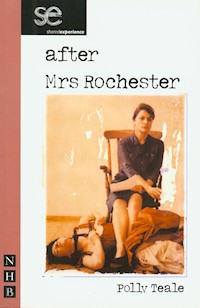
The hit show from Shared Experience Theatre Company based on the tortured and passionate life of Jean Rhys and her most famous book, Wide Sargasso Sea, the prequel to Jane Eyre. In Wide Sargasso Sea – 'one of the works of genius of the 20th century' The Times – Jean Rhys first gave voice to Bertha Mason, Mr Rochester's first wife in Jane Eyre. Polly Teale's play is a dramatisation of Rhys' life, placing Bertha on stage throughout as Jean's alter ego, and giving full vent to her obsession with the 'mad woman in the attic'. After Mrs Rochester was first staged at the Duke of York's Theatre in the West End in July 2003 by Shared Experience Theatre Company.
Das E-Book können Sie in Legimi-Apps oder einer beliebigen App lesen, die das folgende Format unterstützen:
Veröffentlichungsjahr: 2016













AFTER MRS ROCHESTER
a play by
Polly Teale
based on the life of Jean Rhys
NICK HERN BOOKS
London
www.nickhernbooks.co.uk
Contents
Title Page
Original Production
An Interview with Polly Teale
Jean Rhys: A Chronology
Note
Characters
After Mrs Rochester
About the Author
Copyright and Performing Rights Information
After Mrs Rochester was first performed by Shared Experience Theatre Company at the the Royal Theatre, Northampton on 6 March 2003 and subsequently at the New Wolsey Theatre; Oxford Playhouse; Stages at Thoresby Park; Lyric Hammersmith, London; and Guildford’s Yvonne Arnaud Theatre. The cast, in alphabetical order, was as follows:
LANCELOT
David Annen
BERTHA
Sarah Ball
TITE / META
Syan Blake
MOTHER / STELLA
Hattie Ladbury
DAUGHTER / JANE EYRE
Amy Marston
ELLA
Madeleine Potter
JEAN
Diana Quick
GENTLEMAN
Simon Thorp
All other parts are played by members of the company
Writer and Director
Polly Teale
Designer
Angela Davies
Movement Director
Leah Hausman
Composer
Howard Davidson
Lighting
Chris Davey
Dramaturgy
Nancy Meckler
Many thanks to Ellen Moerman for her permission to quote from Jean’s writing. Thanks also to Carole Angier for her wonderful biography of Jean Rhys which was published by Penguin Books (permission given by Rogers, Coleridge and White Ltd).
Interview with Polly Teale
as printed in the programme for the Shared Experience production, 2003
What made you decide to write a play about Jean Rhys?
I read Jean’s novelWide Sargasso Seawhilst doing research for my own adaptation ofJane Eyre. I was immediately moved by the intensity of the writing, the profound sense of loneliness, of dislocation. The introduction to the novel contained a few details of Jean’s life and it intrigued me. As I began to read the rest of her novels, and find out more about her, a picture began to emerge of an extraordinary life. I was struck by the parallels between her own story and that of Mr Rochester’s mad wife – the woman who would become the heroine of Jean’s late masterpiece,Wide Sargasso Sea. Like Jean, Mrs Rochester was a white Creole born in the West Indies who ended her life isolated in the remote English countryside.
Tell us more about Mrs Rochester – why was Jean drawn to write about her?
Jean first readJane Eyreas a young woman. I have often thought how startling it must have been to discover a West Indian character hidden amongst the pages of English literature, which made up her father’s library. It is not surprising that this creature took hold of Jean’s imagination. She too was rebellious. She too felt misunderstood. She too was prone to fits of violent temper. Years later Jean would be sent to Holloway Prison for biting a neighbour who she said had made too much noise and disturbed her writing. Mrs Rochester used a similar method of attack on unwanted intruders into her attic.
By the time we meet Mrs Rochester inJane Eyre, she has become a monster, scarcely recognisable as human. It is not surprising that Jean felt a desire to rewrite Mrs Rochester’s story, to tell it from the beginning. To tell it from the inside.
Why the locked room? Where did that idea come from?
As I found out more about Jean’s life I was struck by the number of relationships she had had (including three marriages and many affairs) but how rarely she had ever felt close to anyone. She wrote, ‘I’ve always felt best when I was alone. Felt most real. People have always been shadows to me . . . I have never known other people.’
Her own daughter never lived with Jean. She found it hard to get to know her mother. Her visits often ended in acrimony. The metaphor of the locked room began to take hold. Whilst Mrs Rochester was literally locked up and held captive, Jean was also a prisoner; a prisoner of her own psyche, of the conditions that had created her unhappy life, the schizophrenia of growing up as a poor colonial, her critical controlling mother who convinced her she was unlovable.
Jean’s mother seems to be a key figure . . .
I wanted Jean’s mother to represent that whole system. The fear that underlay so much of the way colonials behaved – their obsession with control and order in the face of the unknown. Although she behaves monstrously, I see her as a tragic figure born into a regime that was based on repression.
So it was Jean’s mother that instilled these fears into Jean?
It must have been very confusing for Jean, she saw – and longed for – the freedom of the islanders, yet her head was crammed full of Western notions of respectability and superiority.
Do you think this schism partly explains Jean’s unhappiness?
In Carole Angier’s excellent biography she describes how the novelist Rosamund Lehman met Jean in later life, having admired her novels. They met for tea in a smart London restaurant. She was expecting to meet a bohemian, a kindred spirit, but Jean was a picture of poise and elegance. She was charming but distant and refused to talk about her work at all. Later, when Rosamund was invited to Jean’s home, she met a different woman. Jean’s husband answered the door. His face was scratched. Jean was drunk and dishevelled, muttering angrily; only half aware of her guest, whose visit she had forgotten. Rosamund stayed only a few minutes.
The need to conceal the parts of herself that she knew to be unacceptable was a constant theme in Jean’s life. Her obsession with her appearance and her clothes was in part due to this. Yet in spite, or perhaps because of, her need to hide, she spoke the truth in her novels. They are as vivid an account as you will find of the dark underside of human experience, the voice of the underdog, the outsider. She speaks for anyone who has ever felt alone or afraid.
For Jean writing was not a choice but a necessity. Through it she tried to exorcise her demons. She once said, ‘When you’ve written it down it doesn’t hurt any more.’
She was not always successful. She also wrote, ‘If I could put it into words it might go. Sometimes you can put it into words and get rid of it. But there aren’t any words for this fear. The words haven’t been invented.’ (The Sound of River).
And yet Jean did find the words. With extraordinary honesty she strips away the layers of social behaviour and shows ourselves at our most naked, our most alone.
Jean Rhys: a Chronology
1889(Nov) Older baby sister dies (before Jean’s birth).
1890(August) Born in Dominica – Ella Gwendolen Rees Williams.
1896Sister, Brenda, born.
1904(May) Goes to board at convent.
1904Meets Mr Howard.
1905/06Leaves convent.
1907Sent to England.
1907/08The Perse School, Cambridge.
1909(Jan-July) RADA. Leaves – becomes a Chorus Girl, touring the UK.
1910Meets Lancelot Gray Smith.
1912Affair with Lancelot ends, although he supports her financially until 1919.
1913Late abortion, paid for by Lancelot.
1914Works as artists’ model and ‘escort’.
1917Meets and starts affair with John Lenglet.
1919Moves to Holland with John.
1919(April) Marries John. They move to Paris.
1920/21Moves to Vienna, then Budapest.
1922Maryvonne born. Jean puts her in a Paris clinic.
1923/24Works as shop receptionist, tour guide, artists’ model, mannequin.
1924John arrested in Paris. Sentenced to eight months in prison. Jean moves in with Ford Madox Ford and Stella Bowen. Affair with Ford Madox Ford starts. First writing published inTransatlantic Review. Name changed from Ella Lenglet to Jean Rhys.
1926Affair with Ford Madox Ford ends.
1927Jean’s mother dies in London.
1928Jean returns to England. Moves in with Leslie Tilden Smith, her agent. Sells her first novel –Postures(later published asQuartet).
1929After Leaving Mr Mackenzie published.
1933Divorced from John.
1934Marries Leslie Tilden Smith. They are very poor and move at least three times that summer.Voyage in the Darkpublished.
1935Jean and Leslie arrested after drunken brawl in street. Spends night in police cells and is fined for being ‘drunk and disorderly’ the following morning.
1938Throws Leslie’s typewriter out of the window during row.




