


9,99 €
Mehr erfahren.
- Herausgeber: Atlantic Books
- Kategorie: Gesellschafts- und Liebesromane
- Sprache: Englisch
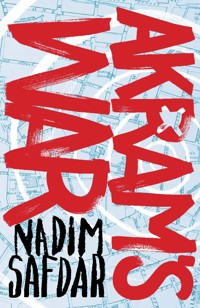
One night, Akram Khan walks out of his house towards an appointed time and place where he is supposed to detonate a bomb that will end his life and that of many innocent bystanders. As he wanders through the town he encounters Grace, whose life has been marred just as his has, forming an unlikely closeness borne of need and necessity. Akram tells Grace about his seemingly inexorable journey towards radicalization: a childhood within the tight-knit Pakistani community, his complex friendships among outcasts, his disastrous years in the army, and his empty arranged marriage to a woman who remains a stranger. Delicately drawn, Akram's War is an honest and shocking kaleidoscopic portrait of contemporary Britain, and of the ways in which the twists and turns of fate can scar and mark a life.
Das E-Book können Sie in Legimi-Apps oder einer beliebigen App lesen, die das folgende Format unterstützen:
Veröffentlichungsjahr: 2016
Ähnliche




















For Sahar, Zain, Iman and Zakariya
Contents
Prologue
Chapter 1
Chapter 2
Chapter 3
Chapter 4
Chapter 5
Chapter 6
Chapter 7
Chapter 8
Chapter 9
Chapter 10
Chapter 11
Chapter 12
Chapter 13
Chapter 14
Chapter 15
Chapter 16
Chapter 17
Chapter 18
Prologue
Grace stood directly before the memorial steps. A slow wind buffeted her bare legs and the cold of the tarmac had seeped through the thin soles of her shoes, spreading upwards until her legs felt like stone. The memorial had three steps on each of its four sides, leading to a square plinth several feet high, and above that, as though reaching for the heavens, stood a tall grey cross. One simple wreath decorated the base of the plinth, surrounded by red paper poppies stirring gently in the breeze. Her gaze shifted down a granite face carved in relief; towards the bottom of a long list it stopped at PRIVATE A. HARTLEY, THE QUEEN’S OWN YEOMANRY, 2003. She clenched her teeth and closed her eyes, feeling a renewed blast of damp air against her cheeks.
At precisely nine that morning, Grace had telephoned the social worker who was to bring her daughter Britney and supervise their contact. Nervously, Grace had suggested a change of venue, hoping the voice at the other end of the telephone wouldn’t object. For two hours on the second Sunday of each month Britney was brought to her at McDonald’s, the only place the social worker could think of that was reliably public and warm. The woman had been brusque, complaining that she would have to find a winter overcoat and provide breakfast for the child before they left the home. Before Grace could go into a long, rehearsed soliloquy of her reasons for the alteration, there was a deep sigh at the other end and the call was terminated.
Grace had arrived early, the chill slowly freezing her face into an expressionless mask with a brim of stinging ice settling on her lower eyelids. She had witnessed a white coach pull up. From it the members of a military band had alighted. After putting out a trestle table, bread rolls and a large urn from which steam rose, they had quietly breakfasted standing. Then from cellophane wrapping they had pulled out splendidly bemedalled tunics in hues of brown and green and black, pulled them on snugly over their fleshy girths, and it seemed to Grace that with each brass button fastened the men and women stood further towards full extension. Finally, as though to affirm a sort of confident power, peaked caps with polished badges were squeezed onto heads.
The band had tuned their instruments, the sharp notes mixing with the voices and footsteps of the gathering crowd. Afterwards the band members had filtered through the growing assembly, trading jokes and laughter and pressing hymn sheets into waiting hands.
Stepping away from the memorial, Grace looked around, her spine as erect as anyone’s there present, and searched expectantly among the crowd. She observed the purposeful stride of young men in uniform, some with their girlfriends or wives and children. She saw elderly men propped on walking sticks or sitting in wheelchairs, behind them stoical women, their heads wrapped in silk scarves. Brass instruments and buttons glittered in the cold sunshine, and shiny medals and colourful ribbons dangled off chests; the emblems these people carried, she thought, to them they represent life.
However, among a shifting focus of stiffened backs in ceremonial dress and peaked caps gazing poignantly upwards, Grace did not see the particular peaked cap she was looking for. She was troubled. Here, a solitary brown face should be easy to spot – so where was he? He had said he would be at the ceremony. She hardly knew him, had only met him in the early hours of the morning, and had slept for some of their time together. But still, the thought of introducing him to Britney, as she knew she would, filled her with tense anticipation. Fleetingly she pictured the three of them standing before the cross like witnesses bound by some solemn oath.
The band sergeant issued a sharp order, followed by a crack of boots as some stood to attention. Immediately, the assembly, both civilian and military, removed their hats, tucking them under an arm or holding them solemnly at the waist.
The call of a bugle started up. Its lingering, spaced notes left goosebumps on the nape of Grace’s neck and somehow made her feel important. She realized that if the notes were for Adrian Hartley then they also belonged to her.
With the last note of the bugle still ringing in her ears, there followed a silence broken only by the occasional muffled cough and, once only, the cry of a baby. The silence amplified the sound of the wind and she thought about Adrian Hartley, suddenly grateful that in a profound way, one she had discovered only hours earlier, he had left her with something that she might use: hope.
She had hardly slept and had woken with a fog of fatigue circling her head, and that morning she had forgotten to take her pills. While she wasn’t entirely convinced that everything had changed overnight, for once – if only for today – she felt part of something, although she couldn’t articulate what it was. She listened intently as a prayer was read.
Ever-living God, we remember. . .
The words seemed to pass through her like an instruction written in electrical current, and she vowed that now she had missed her dose she’d give it a week and see how she felt.
. . . from the storm of war into the peace of your presence. . .
Grace felt a small squeeze of her hand and turned away from the cross. ‘Hey,’ she whispered. Her heart leapt like cold steel in her chest and a grin spread across her face. Taking half a step backwards to accommodate the short space between herself and the girl, she stared lovingly into her daughter’s eyes.
Britney’s hair had grown, the wind picking at fine blond filaments across her brow. Her cheeks, suffused with cold pink, momentarily trembled and then, screwing up her face as though deep in thought, she said, ‘I’m cold. Why are we here, Grace?’ Her voice too seemed to have changed, her words articulate with a confident glottal stop.
The social worker held the girl with an arm around her shoulders. Britney shook free of her chaperone. She retrieved a poppy from her coat pocket and held it out towards her mother.
The prayer concluded: Through Jesus Christ our Lord.
Grace swallowed hard and checked her tears. ‘Amen.’ She took the poppy and reached for her daughter’s hand, feeling the small fist curl into her own.
Britney seemed to be searching for words. Anxiously the child tucked the loose hair on her forehead into a woolly hat and cocked her head up at the social worker as though seeking permission. Then, addressing Grace, she said slowly, ‘Mum.’
Grace felt a surge of pride. Mum. There it was. She was Mum. Again. For two brief hours: Mum. She tasted the word in her mouth.
As conductor, the sergeant major threw his hands into the air, summoning a short triumphant chord from the horn section that punctured the cold atmosphere. The remainder of the band raised their instruments to their lips and the crowd seemed to brace itself.
‘What now, Mum?’
Grace bent down and whispered, ‘Do you still like to sing?’ She enjoyed saying that. It seemed like a connection between the two of them, however small.
Britney nodded, a bashful smile quivering on her lips.
Grace looked down at the hymn sheet clutched in her fingers. The paper flapped in the breeze. Summoning what seemed to Grace the sort of mother’s voice the social worker might approve of, she said, ‘Now, my love, now we sing a hymn.’
1
I am Akram Khan, formerly Sergeant Khan of the Queen’s Own Yeomanry, and in a short number of hours, at a place not far from here, loaded and enabled, I will submit.
My wife Azra sleeps in our bed, a white linen sheet pulled tightly around the bony geometry of her figure. Her thin hand, curled into a fist, is wrapped in the sheet, her wrist weighted with gold bangles. In profile, her nose is studded with a pinprick of gold. I lie next to her, every muscle contracted towards a knot in my gut, and although our bodies at their nearest point are merely an inch apart, I am careful not to touch her. I lie as though trapped, perfectly still under a shared sheet. When Allah wills it, and soon He will, it will be my time for eternal sleep, my conclusion. As I pass into the hereafter the brothers will wrap me in a shroud of linen, and they will chant the names of Allah as they lower my remains into the earth. And over my body they will heave a single slab of stone.
For Azra the membranous sheet is protection against my efforts to consummate our marriage. I have tried. For a time my hands were hopeful: brushing against her shoulders, playing with a loose strand of her hair, twisting it around a digit as tightly as I dared; when feeling bold my fingers would trace the bony contours of her spine. In the cold house, listening to the rain lash against the bedroom window and feeling lonelier than I imagined possible, again and again I would try.
The strength of my want surprised me. Even as I trembled, perspired, clutched myself to still my jerking muscles, the sensation felt decent. Later, shamed by her and branded a failure, a humiliation tempered only by the cumulative incantation of a thousand Bismillahs, I abandoned my earthly desires and accepted the inch or so between us. She snores lightly, contentedly, still a virgin.
She is not for me. Not in this life. I tell myself: I am saving my pleasures for when I am dead.
It is time to make ready, and carefully I swing my feet to the floor. A bullet fired from close range has left me with titanium and gristle for a knee joint. Below it I have no feeling, and I move awkwardly, trying not to wake her. I make it to the door and take one last look at Azra. She has turned away, her long black hair falling across the pillow, one knee bent up to her chest, stretching the sheet taut. By day my bedfellow covers herself in a black burqa that, save for a rectangular screen through which she sees, completely enfolds her body. She says the burqa is to conceal her from the lustful eyes of men. I say that her virtue is a strange game.
The narrow hallway is dark, and with the help of a walking stick that I leave by the door, I carefully place each step, keeping to the edges to avoid creaky floorboards. My fingertips brush against the wall for orientation and balance. I hear a faint rumble as the last train from Birmingham slows, ready for a last draw of breath as it pulls into Rowley Regis station, its great energy transmitting through the house.
The railway came first, then factories and workers’ houses, small damp houses like the one I have lived in my entire civilian life. In the early days the voice of our street was the echo of great steam-powered hammers and bubbling fires of molten steel, and to us this was regular and bucolic, as birdsong might have been for others. It was a disembodied noise, one I heard but could not see, shielded as it was by high perimeter walls. Children would assemble as the factory gates drew open at the changing of shifts, hoping that their fatigued and oil-stained fathers would buy them a pop on the short walk home. But more than that, we gathered for an opportunistic glimpse through a gap in the gates, of giant hammers and spitting fire.
The carpet is threadbare underfoot and the wall rough and crackly beneath my fingertips, and it startles me that there is knowledge here I have yet to acquire, and that the house has silently aged, sagged and worn. I hear a gentle sound of stretching bedsprings as my mother or father turns in their sleep. Reaching blindly into the room I pull at a light cord, then take a sideways stride into the loo and ease the door closed. A small extractor fan cut into the window picks up speed and settles into a constant rhythm. The overhead light blinks, casting the movement of my limbs in slow motion.
I look into the mirror on the small cabinet above the sink and clutch my beard. Abruptly the flicker flatlines to a thin fluorescent beam. My beard is thick and densely black. It has grown to just beyond the length of one fist and is immediately recognizable from a distance. It marks me as one who has rejected the vanity of the infidel. One who has chosen. I release the hot tap. Pipes rumble as though summoning strength from distant corners of the house. A jet of water issues, becoming scalding; as it meets the cold parabola of the sink it generates steam. I turn it off and watch it glut.
From the cabinet I select a small pair of scissors, a disposable razor and a can of shaving foam, placing each item on the porcelain ledge between the taps. I pinch at a tuft of beard and take a swipe at it with scissors – a sinful thing. Out in the street I hear a cat cry and then all is silent save for the mash of the scissor blades. Short clumps of hair collect on my palm stretched below. I whisper a short prayer, ‘Bismillah ir-Rahman ir-Rahim’, a consolation for my loss.
About prayer I am superstitious, and superstition is a magic not permitted to the believer. Although we are born perfect, few of us remain in that state, and it is enough to reach out, to strive, to hope for forgiveness. At night I leave a gap in the curtains, and the very moment I awaken, raising my head from the pillow, I catch a piece of morning sky and whisper, ‘Bismillah ir-Rahman ir-Rahim.’ It is like saying hello to Allah, and every new scene seems to warrant it. A thousand times a day, maybe more – tucking into breakfast, pulling my trousers over my bad knee, leaving the house, sidestepping a crack in the pavement, seeing someone I know or don’t know, putting a fruit to my nose, watching a bent old lady crossing the street, washing my hands or rubbing my sore knee. Remembering Allah lends a kindness to each scene, slows down our fast lives, so that even the little things are lived in a state of suspended grace. And the more I say the Bismillah, the more it seems necessary. It is instinctive, important. It reminds me of the vastness of I, a mobile dot under the spread diaphragm of a ceaseless heaven.
I snip carefully around the vermilion border of my lips where brown skin meets pink flesh. Between my fingertips the hair feels thick and wiry. It is densely black, glossy from the application of palm oil scented with sandalwood and something else, something eastern and exotic, an oud, a pleasant odour, something like night-blooming jasmine, a scent that keenly fills the air wherever a group of brothers assembles.
Brothers: drawn from distant corners of the world and merged in Cradley Heath. United beyond blood and flesh, the strongest of brotherhoods falling under the cast of Allah’s love. Brothers at the mosque, and afterwards brothers walking hand in hand and arm in arm, brothers brimming with excited thoughts as we repair to the Kashmiri Karahi House and Sweet Shop. Brothers who, before a word is said, upon the instructions of Brother Mustafa (our first-in-command) scan the sparsely furnished kebab shop, sweep memory for the slightest change in the walls, look underneath green plastic tables and chairs, patrol behind a counter at the far end, and unscrew, inspect and replace a solitary pendant light bulb.
Under a dim fluorescent light at the Karahi House the brothers and I (although I no longer wear three stripes, clearly I am second-in-command) feel safe. We talk about martyrdom and search each other’s eyes for the difference between doubt and sincerity.
‘What would it be like?’ Second-in-command.
‘Who will go first?’ First-in-command.
‘Will Allah greet us personally?’ That could be any one of the brothers, lightly swaying to a scene secured under clamped eyelids.
And, although no one will say it out loud, we are each picturing voluptuous houris, their bodies stretching against the slippery silk of the most exotic garments – and we each struggle to hide that thought from our brothers.
‘Boom. Boom.’ That’s Ali, the Karahi House proprietor. He is a joker and speaks carelessly as though to shame us. ‘I can see ladies dancing in your eyes.’ A spatula in one hand gesticulates lewdly while with the other he flips lamb chops on a sizzling grill. ‘Their feet, garlanded in silver anklets, dancing on your filthy souls.’ Oily spice fills the room.
Carefully I drop the hair into a plastic Ziploc bag retrieved from my pyjama pocket. The uneven crop of close-cut bristle now reveals something of my former face. I have a square jaw, full lips, and eyes a girl once described as gentle. When it mattered to me, I considered myself handsome. It flashes across my mind that before I shave it all off I could groom myself something fashionable. A goatee, perhaps? Just for a minute, to see what it would look like. But those thoughts are the diversions of Beelzebub, a temptation to infidelity, and to compensate I whisper a quick Bismillah. Staring into the mirror, I allow myself a small smile. A smile in recognition of the unfortunate fact that we can never be truly faithful to Allah, that within my weak mind there is still resistance, rebellion.
I shake my head vigorously as though it will scatter those thoughts, and with the razor I cut neat tracks into what remains of my beard, dispersing shaving foam thick with black hair under the running tap. The skin underneath is smooth and stretched taut like a canvas over my chin. Already I feel colder without the beard. My face itches and burns and I rub and press at it as though kneading dough, leaving behind short-lived, thumb-shaped welts. The image staring back at me is boyish: it is the vanity of the infidel and reminds me of my earlier self, of a time before belief in the one and true God. That there was a time before belief seems hardly possible, and I turn my eyes away.
I rub in a splash of Cologne, gritting my teeth as it stings. It has been a long time since I felt that particular pleasurable pain.
My gaze tilts upwards, squinting through a small rectangular window to the marbled black sky, imagining the hazy horizon, the join between sky and land that determines the end of the visible world. A scene that Allah will illuminate at dawn. ‘Bismillah ir-Rahman ir-Rahim.’
I concentrate my eyes into the distance, connecting with what I cannot see, the great invisible being just beyond. I am barely conscious that I am standing before Allah. I see through the clouds to a crescent moon. As I concentrate harder, I view a colourful scene of an orchard with round bushy trees of a wonderful brightness, the likes of which I have never before seen. Bulbous red pomegranates grow on the trees, and in the air is the scent of sandalwood and jasmine and roses. A stream flows across the foreground. On its golden waters glides a wooden barge propelled by a fisherman punting with a long pole. In the background, as though painted in, are the snow-capped peaks of the Himalayas, places colder and more isolated than man could ever stand. As I now look down, out from this dizzying height, a wind spurs like sharp knives at my face, and as my arms waver for balance I open my mouth for one final breath of thin, giddy air.
I feel a knot in my throat; my heart races and a surge of adrenaline makes my whole body shiver. Despite the coldness of the bathroom, strangely I feel warm. It takes all my control not to cry out loud.
And suddenly an ugly pain works my knee. A familiar antagonist that is worse between the hours of sunset and sunrise. The doctor assured me that all pain increases at night-time, but its eagerness surprises me. Sweating, I rest on the edge of the toilet seat and clutch at my artificial knee and hope that might banish the sensation that grips, like the branches of an electrical tree, the nerves above and below the wound.
When finally it eases, I pull down my pyjamas, letting them drop to my ankles. My cock I shield with one hand and, with the other, first trim the hair, snip and deposit. I adjust my position, but very carefully in case I reignite the pain, bending low to my task. I rub in a very thin layer of shaving foam and carefully guide the razor around the curves, pulling and tweaking at my anatomy, stretching the skin flat.
The razor, sealed into the Ziploc bag, I dispose of in a pedal bin under the sink. The shaving foam and scissors are replaced in the cupboard. It is better to return things to where they came from, always better.
Quietly I unlock the bathroom door, turn off the light and step into the hallway. It wasn’t as satisfying as I would have had it. I had imagined an overwhelming serenity, but it was more practical than that, and at times, shivering in the cold bathroom, I had wanted it to be over as quickly as possible. I have to admit, the martyr’s penultimate scene would, to an infidel, seem a strange one. But that is the point, the very point that only true believers in the one true God understand. It is the very thing that separates the martyr from the infidel. It is about faith – a compulsion elevated above all others. About doing what Allah wills. And belief, belief is faith, believing in His justice. Like any soldier in war, orders must be followed. Not satisfying nor serene, but successful. No razor cuts. Not a drop of blood.
I turn one last time and see a patch of sky through the window. Bismillah.
I smile. Not a drop, not yet.
2
Briefly I look in on my parents sleeping. I am not yet dead and cold and devoid of feeling, and I regard them with pity. Pity for their worn ageing bodies and pity that there will be no one to care for them. Azra I do not wish ever again to gaze upon. Instead, as I pick up my number two dress uniform from a wardrobe on the landing and descend the stairs, I imagine her body twisted into the sheets and feel a bitter resentment in the knowledge that she will stop only long enough to collect her inheritance, my army compensation money. Again I am leaving my parents, and this time forever, or at least forever in this world. If they are heaven-worthy then I will see them, and if they are not, I as a heaven dweller may have it in my power to summon them. Or I may not. There are many contradictions. Many unknowns.
Downstairs, before a tinsel-garlanded picture of Mecca above the mantel, I dress quickly. My father’s snores reverberate through the ceiling above, and in the loneliness of the night every sound grows, its significance amplified.
I leave the house, creeping out like a soldier on manoeuvre. The clouds are dense and the air dewy grey; absent is the crescent moon of my imagination. Part way down the street a fox slinks nervously across the tarmac, its beady eyes caught by the light of a street lamp, momentarily glowing a bold yellow. It stops briefly to consider me leaning on my stick and then skulks on. My best army boots clink on the pavement, their polished toecaps twinkling beneath the same street lamp under which the fox paused moments earlier.
On my head I wear a peaked sergeant’s cap. It is black and across it runs a red sash. In its centre, like a third eye, is a brass cap badge bearing the emblem I once earned, a double-headed eagle. My tunic is olive green, with many utilitarian pockets, all of them empty save for a little money and another cap badge that I have, since my return, kept in an inside pocket next to my heart. The tunic is tight over my bulging waist, yet still I feel strong in it, as though the chest is padded with plates of steel. It was hand cut precisely to fit my body, my body in its prime, and wearing it for the first time on parade was my proudest moment. I stood a good inch taller than I actually was. Squinting into the sun, I saluted Her Majesty, our Colonel-in-Chief, and swore I would defend Great Britain, her territories and dominions, with my life.
I don’t look back, picturing instead how the house diminishes from view. It grows not only smaller, but somehow also less significant. As I cross the road and take a left turn, already it feels as though the house, to which I will not return, is a place I never inhabited. The streets are deserted, yellow where illuminated, and seem to pulse quietly as though resting for the night. On the distant peak of Turner’s Hill flashes an orange beacon mounted on an aerial, a tiny, almost imperceptible dot of light, one I watched as a child looking out of my bedroom window, mesmerized.
The soles of my boots are plated with steel and my footsteps clatter in the night air. I wore them often on a parade ground where noise mattered, my buddies and I falling into step, rehearsing complex manoeuvres until our legs, arms and eyes were in perfect sync. The boots are solid and hard, and when they were first issued (to one Recruit Akram Khan), several of my toenails bruised so badly during route marches that they fell off. Each night I polished the boots to a mirror shine then stuffed them with newspaper soaked in leather-softening tea and urine, and like a trophy I put them in a closet bearing my rank, name and number. Working them to a shine was competitive, an act akin to pleasing God, and deprived a recruit of sleep. A mixture of spit and boot polish dried to a crust and then, with a clean cloth, rubbed in small circles until the new layer reflected resplendent. To a soldier, looking after kit is a precious and satisfying act akin to worship, and these particular boots that I first trained in I later kept aside for special occasions. They shine again as they catch thin yellow windows of light.
I turn into Coopers Street. Ahead, perhaps fifty yards, is the figure of a female. Narrowing my eyes, I make out a shortish woman in a red miniskirt and a cropped denim jacket. The volume of her wispy hair catches the light. She walks slowly, her legs balancing on what look like pins, her arms swimming for balance. I slow, adjusting my pace to hers. It would be indecent to catch her up, and I might frighten her. But at the same time I know immediately and without question that, like a chaperone and from a safe distance, I will follow her.
It is three in the morning and at eleven I must be at the war memorial two point five miles from the house I left minutes earlier. Two and a half miles, even with my bad leg, even with a small detour to pick up ordnance, will take no more than an hour.
The woman stops below a pub sign. Crouching down, she rubs the back of her ankles, muttering something I cannot make out. I catch up a little and get a clearer view. The miniskirt exposes thick white thigh flesh and her low-cut top squeezes folds of skin at her waist. On her feet are stiletto heels. She stands, struggling in her seemingly drunken state to stay upright, and carries on up the street.
I can smell her perfume as I reach the pub sign. It is a pub I know. I know everything here. Every bend, every shopfront, every wall and the quality of the brickwork, and I have seen it age, but that is not a comfort. Maley’s dad would drink in this pub, drinking being a preoccupation of all grown white men akin to reading the daily paper. They were men who measured time by when and with whom they last drank, and distances by how far someplace was from the nearest pub. Now the pub is derelict, shuttered with a zigzagging pattern of plywood planks, although its sign is still intact: The Gate Hangs Well. Azra does not wear western perfume; she wears an oud purchased in tiny vials, purportedly from the city of Mecca. This female wears an English perfume blended with alcohol, rose-tinted and volatile, an alluring, ruinous scent.
She stops again and I do too. Flattening myself against a wall, I watch her intently. I feel my heart thump inside the confines of my chest, a strange thing, as though once again I am watching the enemy. This time she slips off her stilettos and places them to one side. Squatting, she squeezes each ankle in turn. She is caught under the yellow orb of a street lamp, her only concern the discomfort of her feet. She seems cast free but dangerously alone and trusting, and unlike the fox she appears to be blind to risk. Only English women go out at night – it is a common refrain among us brothers. I first heard it as a child, a saying that is passed down the generations.
The female stands up, lifts her chin and carries on along the pavement, forgetting the shoes. After fifty short strides I halt and stare at them, abandoned as though something sinister has befallen their owner. Ahead and unburdened, she is walking faster and gaining distance. I wait for her to disappear around a bend in the road. Then I pick up a shoe and stare at it, turning it over in my hand. Tentatively I raise it to my nostrils, smelling her sweat and traces of iron where her ankles had bled. I have a nose for blood. And then, as though I crave ruin, I inhale deeply. The action seems involuntary and surprises me. I thrust my nose into the triangular enclosed part where her toes were. The inner sole feels warm, the satin finish of the shoe gratifying to the touch. Its heel ends with a sharp point. The toe is blunt but perfectly smooth as it sweeps a pleasing curve.
‘You a perv or something?’ The female puts a hand on her hip and leans back a little to look up at me. She is even smaller close up, her eyes just level with the sergeant’s emblem on my arm. I haven’t known many girls, and I search her up and down, looking for some flaw that will diminish her to a level I feel more comfortable with. Her hair parts in curled waves from a perfectly straight midline. Her face, not beautiful, is more naive than pleasant, with blunted smooth contours, blue paint smudged under her eyes and red gloss on her lips. She has a brief nose and small circular eyes.
‘Could I have my shoes back, please?’ Her thin lower lip, held tight, still trembles. I look down at her feet where two cracks in the pavement run parallel.
‘You shouldn’t be out this late on your own. It’s not safe.’
‘Fucking minicab driver tried it on. Had to get out.’ She takes in my attire, her face expressing surprise. ‘Grandma always said I’d find my knight in shining armour.’
Self-consciously, I shrug my shoulders. ‘Paki driver tried it on?’
‘Shhh,’ she says, putting a finger to her lips and looking around as though someone might be listening. ‘You can’t say things like that!’
I say in a mock Pakistani accent, ‘Most trustable minicab, madam.’
That makes her laugh. She laughs uninhibited like a drunk, the still night extending the sound. When she stops she gathers me in her eyes and with a sharp intake of breath says, ‘What’s your story?’
I shake my head.
‘A good story is as good as it gets, and I know you’ve got one.’
‘Got to crack on.’ I extend the shoes towards her but she doesn’t take them.
‘Went out with a Pakistani once. Bloody secretive bastard.’ She pauses to think, a thin parting in her smile. ‘Had a nice car.’
‘Must have been a Muslim,’ I say.
‘He was a lot of things but not much of that.’
I tut. ‘What type of car?’
‘Went back to his wife.’ She laughs again, her mouth wider and more expansive, as though I have gained her trust. Curiously, she has what appears to be a silver tooth in the front of her mouth.
‘Was that not expected?’
She shrugs her shoulders, says ‘It’s just life,’ and turns to go.
I call after her, ‘You shouldn’t be out alone like this.’
‘What you waiting for then? You walking us home or what?’
For a while we walk in silence save for the clang of my parade boots and the soft yet audible pad of her feet on the tarmac. We are no longer walking in step and I feel an urgent desire to hear the press of her feet in between that of mine, as though that almost imperceptible sound is confirmation that alongside me walks a woman. Not Azra, a figure in a burqa, but a woman with flesh and arms and legs, smeared high-gloss red lips and sweat on her brow.
As she walks she veers briefly from side to side. I feel an instinctive urge to reach over and steady her but keep my hands to myself. I compare our shadows: hers short and squat, mine upright with a peaked cap.
She pauses for a moment. ‘I’m Grace.’
‘That’s the best name a girl could ever have.’ I shake her hand; soft and small and curiously warm.
‘You got cold hands. Warm them in your pockets.’
‘Army don’t do that.’
We walk the length of Forge Row and then cross into Albert Road. During the day, we wouldn’t be doing this. Not Grace and I, not together.
Even in daylight little can be seen through the windows of any of these houses, dirty lace curtains slung across each one. The doors are locked, and five times daily they open as the men escape for prayers at Best Street mosque or any of the five other mosques within a mile (some converted from previous incarnations and others cavernous, purpose-built institutions) that now compete with the original. Behind the lace curtains could be a birth, a wedding, a hundred women mourning a death, but you wouldn’t know it as you pass by outside. It occurs to me that Grace is right: we Pakis are secretive. Brightly coloured cars fitted with extra-wide plastic wheel arches sit quiet and innocuous as their owners sleep, yet during the day these lads are always coming up fast, nodding to a beat, engines revving out of flared exhaust pipes and loud Indian music playing on custom sound systems. They wear a permanent scowl and have hungry, suspicious eyes. Their thin territorial ambitions and short-cropped hair remind me of the skinheads that moved on after the developers levelled the Mash Tun.
Seeing Grace and me together, the locals would jeer and laugh, shout insults, take off their shoes and show us their soles, lob stones from across the street, chase us out of their territory – and before I got home the scandal would have reached my parents and Azra.
Grace stops outside a narrow Victorian house part way along the third terrace we come to. She must be one of the few gora inhabitants still here. A poster has been placed in next door’s window – the familiar white face of our first-in-command fills the frame, airbrushed to thin down his rotund cheeks and disguise the easy-blue blemish of the albino. His eyes, normally milky, have been painted the faintest brown – brown for the people – and somehow they appear sincere and kind. Above his bearded, benevolent face are the words ‘Bismillah Events Presents – Live in Conversation with Dr Mustafa Al-Angrezi (the English)’. The event is to be held at a community centre this evening; brothers are instructed to pass through security at the front entrance and sisters at the rear. So my brother Mustafa who mourns his brother Faisal the martyr will at six o’clock mourn another, and he will have a twinkle in his eye and spout propaganda and they will listen; yes, after my shahid at eleven, they will prick up their ears and listen.
Mustafa is barely recognizable in the altered image. It is also vanity that compels him to take the appellation Al-Angrezi. Of course, he would justify himself in his usual wily way, perhaps squeezing my bicep while whispering, Brother Akram, we each tweak our assets. He is correct, of course. In war each side takes what advantage it can.
I turn towards Grace. She stands perfectly still outside her house staring back at me, perhaps wondering what I make of the poster. The light from an upstairs window bisects her face, dark and light. She fumbles in her pockets for keys then inserts one into the lock.
She turns the key and stops. ‘What is your story?’
I shake my head.
‘You can’t be right, walking around at this time of night dressed like you’ve got an appointment with the Queen. I’ll do you a tea.’
‘Got to crack on.’
She adds quickly, ‘There’s toast, if you want it?’
‘We Pakis only accept at the third time of asking.’
‘Suit yourself.’ The door opens and without another word she enters and closes it behind her. I stare at the green paintwork, wet with dew.
Moments later the door reopens. ‘Shoes?’ she requests.
I hand them over and smile.
‘No story, and by the looks of it, no car,’ she continues in a sterner tone. ‘You had better come in out of the cold.’
I hesitate. Suddenly I am aware of a hot prickly sensation where I earlier shaved off the beard. I imagine welts spreading across it and self-consciously knead it with my fingertips.
‘Come in or we’ll have the Pakistanis talking.’ She stands to one side to let me in.
To slow the action down I whisper a Bismillah.
The front door opens directly into a living room. She fumbles for a light switch, races to a corner to turn on a table lamp and turns off the main light. Then she looks at me, clearly pleased with her efforts. There is a small sofa in a blue fabric with an ample scattering of cushions, a wooden coffee table, and a sideboard on which is placed a small television set. Two shelves above the television contain a collection of porcelain dogs. The walls are painted pink. I stand, waiting to be asked to sit.
‘You want a story and the only story I can think of is this, but don’t take offence.’ My gaze moves across the dogs. They come in various colours and sizes and some are arranged around a ceramic feeding bowl. ‘A prostitute happens to pass by a dog, its tongue lolling out with thirst. Taking off a shoe, she fills it with water from a nearby well and offers it to the animal. For her act of kindness, Allah forgave her for being a prostitute.’
Grace notices me eyeing the arrangement. ‘Collect them, when I’m good. Not always good, though – I can go for months under my duvet.’ She laughs. ‘You’re lucky, you’ve caught me good.’
It’s a long time since I have been this close to a white person, and I shiver. Now that I can see her in the light, she is fatter than I thought. Her face, although young, appears marked as though underneath the thick layer of make-up she has bad skin. She smiles, exposing the silver front tooth. It seems to move, and then, with a practised motion, flips onto the tip of her tongue. She retrieves it and rolls it between her fingers into a ball.
‘Kit Kat foil,’ she says, exposing a gap in her mouth. There it is – the flaw I wanted – and feeling immediately more relaxed I offer her a broad smile.
‘Milk and sugar, or do you want something stronger?’ Her shoes drop to the floor and she kicks them underneath the sofa. With one hand smoothing the cloth around her rump, Grace swivels on her toes and goes into the kitchen, leaving the door between the rooms ajar.
The ceramic dogs feel smooth and cold to the touch. I hear the kettle boil in the next room, the hot liquid pour, and the rattle of teaspoons against porcelain. Grace returns with two steaming mugs and places them on the coffee table. She lands heavily on the sofa. ‘So the prostitute thing – would I be forgiven?’
‘If you believe in that sort of thing.’
‘What you doing dressed like that? You been to a party or something?’
‘It’s the armistice remembrance event at eleven,’ I say.
‘Yeah, what for?’
‘It signifies the cessation of hostilities. In World War One.’
Grace gazes at her watch. ‘Good eight hours until eleven.’ She sighs and continues in a louder voice, ‘Take your hat off, and drink up, it’s better while it’s hot.’
The tea has been mixed with whisky and burns my throat.
‘How come you don’t have a car? Pakis always have cars.’ As she lifts the mug to her face a shadow falls across her pale chin, and where her fingers wrap around the mug there are thin, stained creases between the joints, blue and brown, as though coloured in with pencil. Her hands grow visibly redder as they grasp the warm mug. It startles me that gora skin is so permeable, soaking up like a sponge, and as though to confirm my sudden theory, when she puts down her mug and smiles, the lower part of her face is flushed from the conducted heat.
I notice a photo in a frame next to the TV. It is of Grace, younger and slimmer. She is holding a small child, a girl of about two.
‘That your kid?’ I ask.
‘Man in your condition, thought you’d need a car.’
Grace’s reference to my leg reminds me that it is hurting. I knead at the knee joint, more out of habit than in expectation of alleviating the pain. Sometimes I am hopeful when it hurts, as though pain signifies that there is still life left in that part of my body. In the bedroom Azra and I share is a full-length mirror. When I look into it, it is perfectly possible to squint out my bad leg. Tricking myself, I feel pride in the condition of my body, not quite as muscular as it was and sporting a decadent paunch, but otherwise buff.
‘I did a course once,’ Grace says, dropping to her knees.
I watch as her fingers work around my knee joint, the unexpectedness of her touch making me lean back against the sofa and close my eyes. Gradually the pain subsides, and as it does so, as if something else is switched immediately on, I feel a sliver of wet and a hardening between my legs.
‘Thanks,’ I say, opening my eyes and trying to wriggle free. ‘It’s better now.’
She ignores my statement and slowly rolls up my trousers to a point above the knee. I expect her to be horrified – the leg is a mass of dark keloid scarring, and the titanium articulation bulges from the skin at an unsettling angle – but she simply resumes massaging the affected area, the pain now replaced by pleasure. She wears no rings and the sight of her colour pressing into mine, alternately turning white and returning to pink, seems somehow wrong; I almost expect a dark brown to rub off me and creep up her fingertips. Her touch is soft and warm. My heart races and I clench my entire body as though my hands might jerk out to where they have not been invited.
‘Armistice Day.’ She sighs. ‘Your leg’s fucked and still you glorify the maiming and the killing.’
Through a gap in the curtains I can see still an unchanged black sky, ominous, a sky to die under. I recite, ‘Bismillah ir-Rahman ir-Rahim.’
‘You what?’ Her hands release my knee and she returns to the sofa. We sit pressed against each other and drain our mugs in one large gulp.
‘You’ve got to have respect for the dead.’ I feel light-headed from the alcohol.
Grace puts her knee to her chest and rubs her ankle. ‘Been working since lunchtime,’ she complains. ‘Respect for what?’




