


0,99 €
Mehr erfahren.
- Herausgeber: Josh Parker
- Kategorie: Geisteswissenschaft
- Sprache: Englisch
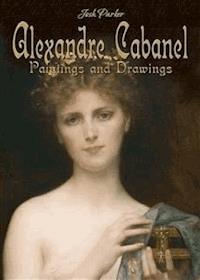
Alexandre Cabanel is the best representative of the L'art pompier and Napoleon III's preferred painter. His work displays originality and sincerity fixed with a deep sense of respect for the great art of the past. His drawing is excellent, expressive and informed by personal selection, knowledge and a quest for both natural and ideal beauty. His design is sophisticated and his color is pleasant, natural, and ornamental, as needed. His method varies from smooth naturalistic to virtuoso paint handling. He was an artist of truth, a positive and competent master of his art. He was elected regularly to the Salon jury and his pupils could be counted by the hundred at the Salons. Through them, Cabanel did more than any other of his generation to form the character of belle époque French painting.
Das E-Book können Sie in Legimi-Apps oder einer beliebigen App lesen, die das folgende Format unterstützen:
Veröffentlichungsjahr: 2015
Ähnliche













AlexandreCabanel:Paintings and Drawings
ByJosh Parker
First Edition
Copyright © 2015 byJosh Parker
*****
Alexandre Cabanel:Paintings and Drawings
*****
Foreword
Alexandre Cabanel (1823 – 1889) was a French painter who painted historical, classical and religious subjects in the academic style. He was also famous as a portrait painter. According to Diccionario Enciclopedico Salvat, Cabanel is the best representative of the L'art pompier and Napoleon III's preferred painter.His work displays originality and sincerity fixed with a deep sense of respect for the great art of the past. His drawing is excellent, expressive and informed by personal selection, knowledge and a quest for both natural and ideal beauty. His design is sophisticated and his color is pleasant, natural, and ornamental, as needed. His method varies from smoothnaturalisticto virtuoso paint handling. He was an artist of truth, a positive and competent master of hisart.
Cabanel entered the École des Beaux-Arts in Paris at the age of seventeen, studied with François-Édouard Picot and exhibited at the Paris Salon for the first time in 1844. He won the Prix de Rome scholarship in 1845 at the age of twenty two was elected a member of the Institute in 1863. Cabanel was appointed professor at the École des Beaux-Arts in 1864 and taught there until his death. He won the Grande Médaille d'Honneur at the Salons of 1865, 1867, and 1878 and was closely connected to the Paris Salon: "He was elected regularly to the Salon jury and his pupils could be counted by the hundred at the Salons. Through them, Cabanel did more than any other artist of his generation to form the character of belle époque French painting". His refusal together with William-Adolphe Bouguereau to allow the impressionist painter Édouard Manet and many other painters to exhibit their work in the Salon of 1863 led to the establishment of the Salon des Refusés by the French government.
A successful academic painter, his 1863 painting The Birth of Venus is one of the best known examples of 19th century academic painting. The picture was bought by the emperor Napoleon III; there is also a smaller replica (painted in 1875 for a banker, John Wolf) at the Metropolitan Museum of Art in New York City. It was gifted to them by Wolf in 1893.
Paintingsand Drawings
Self Portrait as a Child,1836
Oil on canvas
Self Portrait (aged 17), 1840
Oil on canvas
Oedipus Bids Farewell to Jocasta (study), 1843
Oil on canvas
Christ in the Garden of Olives, 1843-1844
Oil on canvas
Envoys of the Senate Offer the Dictatorship to Cincinnatus, 1844
Oil on canvas
The Mocking of Christ, 1845
Oil on canvas
Head Study,Soldier Insulting Christ, 1845
Charcoal, pencil and white chalk on pape




