


Erhalten Sie Zugang zu diesem und mehr als 300000 Büchern ab EUR 5,99 monatlich.
- Herausgeber: Nick Hern Books
- Kategorie: Poesie und Drama
- Serie: NHB Modern Plays
- Sprache: Englisch
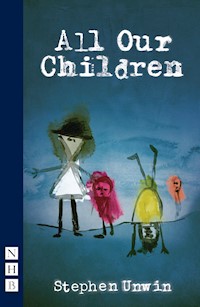
'I used to be scared of them. They seemed so different. They don't scare me any more. They're just children, aren't they? Just children.' January 1941. A terrible crime is taking place in a clinic for disabled children. The perpetrators argue that it will help struggling parents and lift the financial burden on the mighty German state. One brave voice is raised in objection. But will the doctor listen? A moving examination of a terrifying moral dilemma, and a powerful story that shows what it takes for humanity and decency to be restored in a world that has abandoned them. First produced by Tara Finney Productions, Stephen Unwin's debut play All Our Children premiered at Jermyn Street Theatre, London, in 2017.
Sie lesen das E-Book in den Legimi-Apps auf:
Seitenzahl: 96
Veröffentlichungsjahr: 2017
Das E-Book (TTS) können Sie hören im Abo „Legimi Premium” in Legimi-Apps auf:
Ähnliche










Stephen Unwin
ALL OURCHILDREN
NICK HERN BOOKS
London
www.nickhernbooks.co.uk
Contents
Title Page
Original Production
Epigraph
‘Lives Unworthy of Life’
Dog Fox Field
Dedication
Characters
Act One
Act Two
About the Author
Copyright and Performing Rights Information
All Our Children was first produced by Tara Finney Productions in association with Jermyn Street Theatre, and was first performed at Jermyn Street Theatre, London, on 26 April 2017. The cast was as follows:
ERIC
Edward Franklin
MARTHA
Rebecca Johnson
ELIZABETTA
Lucy Speed
VICTOR
Colin Tierney
BISHOP VON GALEN
David Yelland
Director
Stephen Unwin
Designer
Simon Higlett
Lighting Designer
Tim Mascall
Sound Designer
John Leonard
Casting Director
Ginny Schiller CDG
Associate Director
Nathan Markiewicz
Costume Supervisor
Karen Large
Casting Assistant
Amy Beadel
Stage Manager
Lisa Cochrane
‘The unexamined life is not worth living.’Socrates
‘Lives Unworthy of Life’
The persecution, sterilisation and murder of hundreds of thousands of disabled people is one of the most overlooked chapters in the whole ghastly history of Nazi Germany.
Between 1939 and 1941 as many as 100,000 people with a wide range of disabilities were dismissed as lebensunwertes Leben (‘lives unworthy of life’) and systematically killed in six converted psychiatric hospitals across Austria and Germany. Initially, lethal injections were used but soon, at Hitler’s personal recommendation, carbon monoxide was employed.
Aktion T4, as the programme was called, was a logical extension of the eugenics movement, which had attracted support from a wide range of people, many with impeccable liberal credentials, across Europe and the United States. Few had suggested murder (although Virginia Woolf, confronted by a group of ‘imbeciles’, wrote in 1915 that ‘they should certainly be killed’), but the Nazi programme of compulsory sterilisation of people with ‘congenital conditions’ was widely accepted.
With the outbreak of war, the persecution escalated dramatically and, on September 1st, 1939 (the day of the invasion of Poland), Hitler signed his notorious Euthanasia Decree which stated that, ‘after a discerning diagnosis’, ‘incurable patients’ should be ‘granted mercy death’. Intellectually justified by Social Darwinism, this policy received popular support on the grounds of cost, with a poster claiming that a man ‘suffering from a hereditary defect cost “the People’s Community” 60,000 Reichmarks during his lifetime’. As a leading Nazi doctor said, ‘the idea is unbearable to me that the best, the flower of our youth, must lose its life at the front in order that feebleminded and irresponsible asocial elements can have a secure existence in the asylum.’
By early 1941, 5,000 children, many only a few months old, with a wide range of conditions – Down syndrome, ‘idiocy’, cerebral palsy, and so on – had been assessed, registered and murdered. Initially, their parents were asked for their consent and a panel of three ‘medical experts’ was convened to agree on the course of action. In due course, however, deception and social pressure were deployed, and children were sent to so-called ‘special sections’, apparently to receive medical treatment, but instead bussed off to their deaths.
Public opposition to the programme was limited. Probably the most striking intervention came from the churches, especially the Catholic Bishop of Münster. Clemens August Graf von Galen (1878–1946) belonged to one of the oldest aristocratic families in Germany. He spent twenty-three years (1906–29) working as a parish priest in a poor district in Berlin but, as a staunch conservative, had opposed what he perceived to be the immorality of the Weimar Republic. Indeed, the Nazis, who saw him as an ally, welcomed his installation as Bishop of Münster in 1933. From the outset, however, he objected to many aspects of the regime, and took editorial responsibility for a volume of essays criticising the paganism of the philosopher and ideologue Alfred Rosenberg. He voiced his disapproval of Nazi racial theories and helped draft Pope Pius XI’s anti-Nazi encyclical Mit brennender Sorge (1937).
He is best known, however, for his criticism of the murder of the disabled and, in July and August 1941, delivered three sermons which didn’t just criticise the programme: they challenged the entire Nazi value system. In one of them he asked why these ‘unproductive citizens’ were killed:
The opinion is that since they can no longer make money, they are obsolete machines, comparable with some old cow that can no longer give milk or some horse that has gone lame. What is the lot of unproductive machines and cattle? They are destroyed. I have no intention of stretching this comparison further. The case here is not one of machines or cattle which exist to serve men and furnish them with plenty. They may be legitimately done away with when they can no longer fulfill their function. Here we are dealing with human beings, with our neighbours, brothers and sisters, the poor and invalids… unproductive – perhaps! But have they, therefore, lost the right to live? Have you or I the right to exist only because we are ‘productive’? If the principle is established that unproductive human beings may be killed, then God help all those invalids who, in order to produce wealth, have given their all and sacrificed their strength of body. If all unproductive people may thus be violently eliminated, then woe betide our brave soldiers who return home, wounded, maimed or sick.
Thousands of copies of the sermons were illegally circulated and local protest groups broke the silence that surrounded the programme. Copies were also dropped by the RAF and inspired various resistance groups.
The Nazis were in two minds about how to respond to the ‘Lion of Münster’. Some advised Hitler to execute von Galen or, at least, send him to a concentration camp; but others, especially Goebbels and Bormann, recognised the danger of alienating German Catholics, and von Galen – a close friend of the new Pope, Pius XII – was subjected to house arrest from late 1941 onwards. Hitler declared ominously in a private conversation that ‘the fact that I remain silent in public over Church affairs is not in the least misunderstood by the sly foxes of the Catholic Church, and I am quite sure that a man like Bishop von Galen knows full well that after the war I shall extract retribution to the last farthing’. Von Galen survived Hitler, dying of natural causes in 1946, and was beatified by his fellow German, Pope Benedict XVI, in 2005.
Astonishingly, partly as a result of von Galen’s intervention, the programme was formally discontinued in August 1941. It would be overstating the case to say that he stopped the murder (a further 100,000 disabled people were killed before the end of the war in less formal settings), and many of the techniques and personnel were employed in the far greater Jewish Holocaust that escalated so dramatically after 1941. Nevertheless, his denunciation was one of the most courageous and outspoken acts of resistance in Third Reich.
All Our Children is very much a work of fiction. There is no evidence that von Galen had a meeting of the kind that I have dramatised (though he did talk with senior figures in the SS) nor do we know of a doctor involved in the programme having qualms about what he was doing. What’s clear, however, is that his intervention raised the most profound questions about the innate value of the human being, regardless of cost or productivity, and his voice, for all its stubborn absolutism, deserves to be heard.
It would be absurd to claim that disabled children face anything like this level of discrimination today. Nevertheless, there is a huge amount to be done to ensure that they’re given the same opportunities as their able-bodied siblings. It’s often said that you can judge a society by the way that it treats its most vulnerable. If Nazi Germany failed that test in the most abject way imaginable, we should never forget its terrible lessons.
Stephen Unwin,London, 2017
A reading of an earlier draft was held at English Touring Theatre on 23rd September 2014, under the title of T4, with the following cast:
VICTOR
Guy Henry
MARTHA
Lucy Briers
ERIC
David Dawson
ELIZABETTA
Kelly Hunter
BISHOP VON GALEN
Simon Russell Beale
Dog Fox Field
The test for feeblemindedness was, they had to make up a sentence using the words ‘dog’, ‘fox’ and ‘field’.
‘Judgement at Nuremberg’
These were no leaders, but they were firstinto the dark on Dog Fox Field:
Anna who rocked her head, and Paulwho grew big and yet giggled small,
Irma who looked Chinese, and Hanswho knew his world as a fox knows a field.
Hunted with needles, exposed, unfed,this time in their thousands they bore sad cuts
for having gazed, and shuffled, and failedto field the lore of prey and hound
they then had to thump and cry in the vansthat ran while stopped in Dog Fox Field.
Our sentries, whose holocaust does not end,they show us when we cross into Dog Fox Field.
Les Murray
To Joey
Characters
VICTOR FRANZ, a doctor, Director of the Clinic
MARTHA, a maid
ERIC, Deputy Director, Administrator
ELIZABETTA, a mother
BISHOP VON GALEN
Setting
Winkelheim, 6 January 1941
Music
Winterreise, Franz Schubert
This ebook was created before the end of rehearsals and so may differ slightly from the play as performed.
ACT ONE
VICTOR’s office. Dawn.
On one side, a large desk, window behind it. Heavy curtains. On the other, two comfortable chairs and a small round table beside a stove. One double door into the room. There is a wall with a large number of box files. Medical certificates. A painting. Comfortable fittings. Radio and phone on his desk.
VICTOR is asleep by the stove. The curtains are shut. The stove has burnt out. The room is dark.
MARTHA comes in. She doesn’t see VICTOR at first. She goes over to put some letters on VICTOR’s desk, and opens the curtains. Brilliant winter sunlight floods in. She turns and is very surprised to see him.
MARTHA. Oh, Doctor, you gave me such a shock.
VICTOR. I’m sorry, I must have –
MARTHA. Haven’t you been back to your room?
VICTOR. Herr Schmidt and I had a chat last night, and I never managed to –
MARTHA. Let me clear that up.
She clears up the remnants of sandwiches and beer from the table.
VICTOR. Good beer, by the way, Martha.
MARTHA. Not much of that cognac left, I see.
VICTOR. It was mostly me, I’m afraid. Herr Schmidt didn’t stay long. And I sat here reading and –
MARTHA. Fell asleep?
VICTOR. Yes.
MARTHA. You should sleep in your own bed, Doctor, or you’ll get ill. Then where would we be?
VICTOR. Indeed.
Coughs.
MARTHA. It’s terribly cold this morning. I slipped on the ice. Bit of a bruise, actually, here.
VICTOR. You be careful, Martha. I’ve got some cream somewhere for –
MARTHA. Oh don’t you worry. I’ll get you your breakfast.
VICTOR. And some water, I think, so I can wash my face.
MARTHA (smiles). Righty-ho.
Leaves. There is a pause. VICTOR picks up a box file at his feet, and glances at a page.
VICTOR. Oh Christ.
Closes the file and takes it over to the bookcase. MARTHA returns with a jug of water and a towel.
Thank you.
She goes. He takes off his shirt and washes himself. She returns.
That’s better. Healthy mind in a healthy body.
He dries himself.
Thank you.
He starts to cough.
MARTHA. Oh dear: that cough of yours. It’s not getting better, is it?
She leaves.
VICTOR




