


9,59 €
Mehr erfahren.
- Herausgeber: Pocket Essentials
- Kategorie: Geisteswissenschaft
- Sprache: Englisch
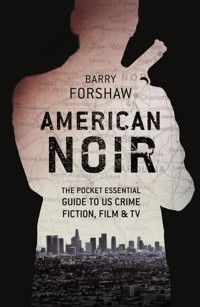
Barry Forshaw is acknowledged as a leading expert on crime fiction and film. Following his books on Nordic Noir, Brit Noir and Euro Noir he now tackles the largest and, some might argue, most impressive body of crime fiction from a single country, the United States, to produce the perfect reader's guide to modern American crime fiction. The word 'Noir' is used in its loosest sense: every major living American writer is considered (including the giants Harlan Coben, Patricia Cornwell, James Lee Burke, James Ellroy and Sara Paretsky, as well as non-crime writers such as Stephen King who stray into the genre), often through a concentration on one or two key books. Many exciting new talents are highlighted, and Barry Forshaw's knowledge of - and personal acquaintance with - many of the writers, grants valuable insight into this massively popular field. But the crime genre is as much about films and TV as it is about books, and American Noir is a celebration of the former as well as the latter. US television crime drama in particular is enjoying a golden age, and all of the important current series are covered here, as well as key contemporary films.
Das E-Book können Sie in Legimi-Apps oder einer beliebigen App lesen, die das folgende Format unterstützen:
Seitenzahl: 347
Veröffentlichungsjahr: 2017
Ähnliche












AMERICAN NOIR
Barry Forshaw is acknowledged as a leading expert on crime fiction and films from Britain and the European countries, but a further area of expertise is American crime fiction, film and TV, as demonstrated in such books as The Rough Guide to Crime Fiction and Detective. After the success of earlier entries in his ‘Noir’ series – Nordic Noir, Brit Noir and Euro Noir – he now tackles the largest and, some might argue, most impressive body of crime fiction from a single country, the United States, to produce the perfect reader’s guide to modern American crime fiction. The word ‘Noir’ is used in its loosest sense: every major living American writer is considered (including the giants Harlan Coben, Patricia Cornwell, James Lee Burke, James Ellroy and Sara Paretsky, as well as non-crime writers such as Stephen King who stray into the genre), often through a concentration on one or two key books.
Many exciting new talents are highlighted, and Barry Forshaw’s knowledge of – and personal acquaintance with – many of the writers grants valuable insights into this massively popular field.
But the crime genre is as much about films and TV as it is about books, and American Noir is a celebration of the former as well as the latter. US television crime drama in particular is enjoying a new golden age, and all of the important current series are covered here, as well as key recent films.
About the author
Barry Forshaw’s books include Brit Noir, Nordic Noir, Euro Noir, British Crime Film and Death in a Cold Climate: A Guide to Scandinavian Crime Fiction. Other work: the Keating Award-winning British Crime Writing: An Encyclopedia, The Rough Guide to Crime Fiction, and the first biography of Stieg Larsson. Non-crime books include Italian Cinema,British Gothic Cinema, Sex and Film and a study for the BFI of HG Wells and The War of the Worlds. He writes for various newspapers, edits Crime Time, and broadcasts for radio and TV both in the UK and abroad. He has been Vice Chair of the Crime Writers’ Association.
Praise for Barry Forshaw
CRITICAL ACCLAIM FOR ITALIAN CINEMA
‘Italian cinema is celebrated here with astute analysis in the sharply informative essays of Barry Forshaw’ – John Pitt, New Classics
CRITICAL ACCLAIM FOR EURO NOIR
‘An informative, interesting, accessible and enjoyable guide as Forshaw guides us through the crime output of a dozen nations’ – The Times
‘Entertaining, illuminating, and indispensable. This is the ultimate road map for anybody interested in European crime books, film, and TV’ – Euro But Not Trash
‘An exhilarating tour of Europe viewed through its crime fiction’ – Guardian
‘Exemplary tour of the European crime landscape… supremely readable’ – The Independent
‘This is a book for everyone and will help and expand your reading and viewing’ – We Love This Book
‘Like all the best reference books, it made me want to read virtually every writer mentioned. And, on another note, I love the cover’ – crimepieces.com
‘If I did want to read something so drastically new, I now know where I would begin. With this book’ – Bookwitch
‘Barry Forshaw is the master of the essential guide’ – Shots Mag
‘This enjoyable and authoritative guide provides an invaluable comprehensive resource for anyone wishing to learn more about European Noir, to anticipate the next big success and to explore new avenues of blood-curdling entertainment’ – Good Book Guide
‘Fascinating and well researched… refreshing and accessible’ – The Herald
‘An entertaining guide by a real expert, with a lot of ideas for writers and film/TV to try’ – Promoting Crime Fiction
‘… a fabulous little book that is like a roadmap of Europe crime fiction’ – Crime Squad
‘Fascinated by Scandinavian crime dramas? Go to this handy little guide’ – News at Cinema Books
CRITICAL ACCLAIM FOR NORDIC NOIR
‘Entertaining and informative companion… written by the person who probably knows more than anyone alive about the subject’ – The Times
‘Highly accessible guide to this popular genre’ – Daily Express
‘The perfect gift for the Scandinavian crime fiction lover in your life’ – Crime Fiction Lover
‘A comprehensive work of reference’ – Euro But Not Trash
‘Readers wanting to get into Scandinavian crime fiction should start with Forshaw’s pocket guide to the genre’ – Financial Times
‘Essential (book) not only for lovers of Scandinavian crime fiction but also for anyone who appreciates and wants to expand their knowledge of the genre’ – Shots Mag
‘If you feel drowned by the tsunami that is Nordic Noir but want to know who or what is the next big thing, get this book’ – Evening Standard
CRITICAL ACCLAIM FOR BRIT NOIR
‘Unsurprisingly Barry Forshaw’s Brit Noir is a wonderful reference book that any self-respecting and serious connoisseur of crime fiction needs to have on their bookshelf’ – Shots Magazine
‘Brit Noir is a book to dip into but also, as I did, to read from cover to cover. I’ve always considered Forshaw to be an honest reviewer and the book very much reflects his personality. It made the book a stimulating and, at times, amusing read’ – Crime Pieces
‘UK critic-author Barry Forshaw long ago established himself as an authority on English-translated Nordic mysteries, producing the guide Nordic Noir in 2013, which he followed up a year later with Euro Noir. Now comes Brit Noir: The Pocket Essential Guide to the Crime Fiction, Film & TV of the British Isles (Oldcastle/Pocket Essentials)’ – The Rap Sheet
‘… very glad indeed to have a copy of this short and snappy book on my shelves’ – Do You Write Under Your Own Name?
‘A must-have for crime fans: for reminding yourself about old favourites, for finding new authors, and for that “What shall we watch?” moment’ – Mystery People
‘Funny, analytical and always interesting’ – The Catholic Herald
Foreword: Showdowns on Main Street
James Sallis
America is a nation founded at one and the same time on violence and high ideals. Both run in our blood. Is it any wonder we’re forever off kilter? A strange tribe, this, wishing to be left alone and apart in one breath, tasking itself to repair the world around it in the next, Henry David Thoreau and Clint Eastwood riding double.
The American detective novel developed in synch with our nation’s movement from a rural to urban society. By definition, it concerned itself with the dark corners, basements and back rooms of our national experience – those poor stitches and loose seams that held the thing together. What you saw was never what you got. American life wasn’t about apple pies, proper behaviour in the Hamptons and drinks at the club; it was about the repudiated, the pushed-aside, about men and women and communities on the run, never knowing which would happen first, if the sky would fall on them or the ground give way beneath their feet.
Coming as I did from a dual background in poetry and realist fiction, crime stories first attracted me for the power of their imagery and their underpinning. Mythopoetic, my professors back at university would have said. Tapping the subconscious: buckets lowered into a well of archetypes hardwired in us all. These stories were about the things that scare us most, as individuals and as a society, and at the same time about all the things, material and non, we believe we most want. Soon I began to understand, as well, that they are our truest urban fiction, that these stories speak of our cities and our civilisation, address what we have made of them and of ourselves, as do no others.
The quantity of fine work being done today, as you’ll see within, is extraordinary. So is the wealth of viewpoints, voice, ambition and sheer reach – such that genre seems profoundly lacking to describe so rich a body of work. All writing, be it literary fiction or epic poetry, is genre. Over the years, both as writer and as critic, I’ve come to think of crime fiction simply as a literary mode. A mode is a specific manner in which something is experienced or expressed, a particular set of notes comprising the scale from which melodies and harmonies derive. Which seems to me a more fruitful way of thinking about and approaching the grand array of crime fiction.
The arts do not progress, they develop by accrual: circling back, refitting old clothes, refurnishing rooms. But there is today in crime fiction some of the best writing being done anywhere, work that honours its past while reaching far beyond.
Finally, any body of work depends for its vitality and enrichment as much on its readers as upon its writers, and the ones taking point there, making all our lives richer, are the critics, editors, commentators and anthologists. As editor of Crime Time and as wearer of many hats, Barry Forshaw has introduced us to the best of current writing, helped us parse the roots and branches of the Nordic mystery, again and again has led us to broader understandings of films and novels.
When quite young I was oddly short and small for my age. My woodworking father, who’d given me the nickname Runt, built a pair of stilts so that I could be, in my mind and in my secret life, taller. What my dad did for me, our arts do for us all. They give form and vitality and validation to secret lives within us. Barry knows that. He has never, even for a single moment, lost sight of how important it is.
1: Introduction
The Big Country
The best crime novels can provide – as well as consummate entertainment – incisive and penetrating guides to the countries in which they are set. And nowhere is this syndrome more true than in American crime fiction, which freights in among the detection, betrayal and rising body count a detailed picture of US society. And it’s a picture, moreover, that provides unforgiving psychological and societal insights into this big country, a world away from the more constrained parameters of the UK. And the impulse behind this painting on the largest of canvases? Very often anger at political corruption, beginning with the scorching Red Harvest and The Glass Key of Dashiell Hammett. But that progenitor of the genre is not to be found within these pages – American Noir attempts to tackle the contemporary scene. You will find such writers as James Ellroy and James Lee Burke, both of whom write novels powered by indignation (Burke’s contempt for the George Bush regime practically leaps off the page, and Ellroy loathes political correctness). In the twenty-first century, there are signs that writers are beginning to examine their divided country’s dark comedy of the Donald Trump era; it’s surely only a matter of time before such sardonic crime writers as Carl Hiaasen tackle this. But American writers have always been good at skewering demagogues (think of – in the non-crime field – Sinclair Lewis’s Elmer Gantry,Budd Schulberg’s A Face in the Crowd orRobert Penn Warren’s All the King’s Men), just as the books of Scandinavian writers such as Jo Nesbo anatomised the rise of the far right in their own countries.
Issues
The genre has often tackled hot-button issues affecting society – often more keenly than in more avowedly ‘serious’ fiction. Readers are given an imaginative access to the various strata of US society – from the alienated underclasses to the upscale haunts of the rich – and a complex panoply emerges. Several writers have used the apparatus of the crime thriller to examine post-Vietnam America, social instability and modern fears of terrorism. Such writers as George Pelecanos have tackled issues of race in uncompromising fashion, and the problems facing modern women in the US are rigorously addressed in the work of writers such as Sara Paretsky, while the role of professional women is central to the novels of Patricia Cornwell. None of these writers, however, have forgotten the first imperative of crime fiction: keeping the reader transfixed with a powerful, page-turning narrative.
The formidable bestselling authors mentioned above are the merest tip of the crime fiction iceberg; the American crime-writing fraternity is exhilaratingly wide and provocative, with edgy new writers constantly emerging, not least in the currently popular domestic noir genre. Let’s face it, a book such as American Noir can only ever be a snapshot of a given moment in crime fiction, but I’ve tried to cover as many writers as I can. I’ve also included some interviews I’ve conducted with writers including James Ellroy and Karin Slaughter.
Definitions
As with the other books in my ‘Noir’ series, the ‘reader’s guide’ format I’ve used has entries ranging from expansive to capsule form. The remit of this study, though, has been as wide as possible: every conceivable genre that is subsumed under the heading of American crime fiction is here, from the novel of detection to the blockbuster thriller to the occasional story of espionage (although they are the exception). And, again, as with other books in the series, several of the authors included here stretch the definition of ‘noir’ to breaking point (and beyond). My aim once again was to include as many writers as I could (although there are virtually no historical crime novelists, whom I hope to cover in a later book). And the spectrum ranges from the truly dark noir region to its less unsettling polar opposite, in whose pages bloodshed is notably less copious. And although they receive a separate mention along with other crime fiction colleagues at the end of this book, I feel a keen need to give a preliminary tip of the hat to my confrères J Kingston Pierce and Craig Sisterson for their invaluable input and suggestions. Thanks, gents.
American Noir is principally designed to be used as a reference book to contemporary US crime fiction. And ‘contemporary’ here means ‘living’, at least at the time of writing – if the Grim Reaper has been a-roving since I began the book, that’s beyond my control. So, don’t look for Dashiell Hammett or even (more recently) the late James Crumley – it was damned difficult just fitting living writers into the allocated page count here (and my Rough Guide to Crime Fiction covers the hard-boiled and pulp era). And, as always with this series, the text is not designed to be read straight through from cover to cover – though that’s up to the reader. You pays your money, you takes your choice.
Brit Noir had a layout based on the locations in which UK crime writers set their books, while Nordic Noir and Euro Noir were arranged by country; it seemed to me that the most useful order for American Noir, however, was a straightforward alphabetical one (to avoid, for instance, a humongous mass of author entries under ‘California’).
But now, it’s time to take that Greyhound on Route 66…
2: American Crime Writers
JEFF ABBOTT’s publishers prided themselves on how their strikingly designed new jackets helped sell his books (the strategy was even used as a blandishment to lure new authors to the imprint: ‘Join us and we’ll give you Jeff Abbott-type jackets!’). But finally, of course, it’s the writing that counts. Abbott, in fact, is an exemplar of one of the several ways in which a writer of crime thrillers can guarantee one crucial imperative: the reader turns to the next chapter. James Patterson (discussed later) has a simple strategy: extremely short chapters that invariably end with a cliffhanging situation. Harlan Coben and Gillian Flynn (ditto) tease the readers with a series of perfectly timed revelations that keep us glued to the page. But Jeff Abbott, in such books as Panic and Fear, has a double-pronged tactic: establish a tense and unusual situation in the first chapter, then orchestrate the developments in hypnotic fast/slow segments. Panic used this alternating tempo to deliver the taut tale of a man struggling to find out the truth behind the disappearance of his father and the death of his mother, and the lean, polished storytelling surprised those who thought Abbott was a debut author. In fact, he had seven books under his belt; efficient enough, though they hardly hinted at the top-notch practitioner he’d become. If Fear wasn’t quite in the same league as Panic, it was still pretty galvanic stuff. The protagonist, Miles Kendrick, starts the book at the end of his tether – and things get worse from then on. In an echo of Fight Club, Miles is being taunted by his best friend Andy, who is threatening him with humiliation and violence. But Miles has killed Andy – or so he believes. Andy isn’t there, except as a taunting voice in his mind. Miles is in the witness protection programme, concealing his whereabouts from mob killers, even as he tries to deal with the guilt he feels at his friend’s death. He has one ace in the hole: psychiatrist Allison Vance, trying to pull him back to some kind of mental equilibrium while sorting out the traumatic events of the night of his friend’s death. But an explosion in her office kills Allison and destroys Miles’ chance of regaining his sanity. He finds himself in a desperate cat-and-mouse game with FBI operative Dennis Groote, a man whose own madness takes a much more lethal form than that of Miles. The key to his survival lies in cracking the truth of just how his friend Andy died. If the levels of tension engendered here don’t match those of Abbott’s Panic, that’s principally because the earlier book set the bar high for any follow-up. Forget direct comparisons, and you’ll find that those tube or bus stops will fly by unnoticed.
One of the most astute of psychological crime novelists, the energetic MEGAN ABBOTT is responsible for such trenchant and commanding books as Queenpin, The Song Is You, Die a Little, Bury Me Deep, The End of Everything, Dare Me and The Fever, the latter selected as one of the ‘Best Books of the Summer’ by TheNew York Times. A native of Detroit, she received her PhD in English and American literature from New York University. She has taught at NYU, the State University of New York and the New School University. Apart from her nuanced and incisive novels (more interested in the complex psychology of her characters than many of her confrères, who sketch such things in), Abbott is also the author of an influential non-fiction book, The Street Was Mine: White Masculinity in Hardboiled Fiction and Film Noir – notably more sympathetic to her male subjects than much feminist writing in this area – and the editor of A Hell of a Woman, an anthology of female crime fiction. Talking to her at the inaugural ‘Noirwich’ crime fiction festival, I found her depth of genre knowledge was quickly apparent. She has been nominated for many awards, including three Edgars, the Hammett Prize, the Los Angeles Times Book Prize and the Folio Prize.
CHARLES ARDAI may also be award-winning mystery writer Richard Aleas. Or he might like us to think it’s the other way round. Ardai’s pithy writing has appeared in publications such as Ellery Queen’s Mystery Magazine and Alfred Hitchcock’s Mystery Magazine and has graced anthologies including Best Mysteries of the Year. His first novel, a quirky piece entitled Little Girl Lost, was published in 2004 and was nominated for both the Edgar Allan Poe Award from the Mystery Writers of America and a Shamus Award from the Private Eye Writers of America; his second, bearing the Blakean title Songs of Innocence, was selected as one of the best books of the year by Publishers Weekly and won a Shamus Award. Both books were written as ‘Richard Aleas’.
Routinely hailed (along with such masters as Ross Macdonald) as one of the heirs apparent of Raymond Chandler, Robert B. Parker sustained a truly impressive level of invention over a long career, his death in 2010 seemingly bringing to an end the classic tradition of the tough and sardonic private eye. But Parker’s gumshoe was revivified in the talented hands of ACE ATKINS, one of whose Spenser novels, titled Robert B. Parker’s Wonderland, had all the hallmarks of the original creator, with the detective encountering a mysterious and seductive woman (par for the course), a terrifying Las Vegas criminal and a plot involving some suspect land development. If the truth be told, even the great Parker’s invention was flagging a touch on some of his later books, but his new amanuensis/successor has conjured all the energy of his predecessor’s best work. What’s more, Atkins has added a quirky new perspective of his own. Reader response was along the lines of ‘Welcome back, Spenser.’
PAUL AUSTER has long been a writer who inspires a keen following among those drawn into the dark world of his novels. Auster readers accept both ambitious, exuberant books presented on large canvases and pared-down, lean fables that demand total concentration. Travels in the Scriptorium lies firmly within the latter category of Auster’s work, and while its rewards are many, it’s a novel for those coming to the author as long-term aficionados rather than new converts. It begins with an ageing man sitting in a room, with no conception of how he arrived there or how long he will be there. The room is sparsely furnished, and suggests both a hospital and a prison. There is a manuscript on a desk – and the old man (who we learn is ‘Mr Blank’) starts to read it, only to find that it begins by describing his exact situation. Various familiar characters drift in and out of this enigmatic narrative – the protagonists of early Auster novels (a familiarity with the writer’s other work is a definite help here) – and the narrative itself begins to assume a variety of shapes. Is this a detective story, a genre of which Auster has proved himself to be a master? Or is it an existential fable, a modern-day equivalent of the philosophical investigations of meaning that Jean-Paul Sartre and Albert Camus specialised in? The answers are not readily forthcoming, but diehard Auster fans will be well disposed towards the challenge of identifying precisely what his agenda is.
Oh no! Not another serial killer thriller! If this was your response to Hour Game by DAVID BALDACCI, you were not reckoning on the fact that this one was written by a man who would rather give up writing than too obviously repeat himself – or, for that matter, copy other writers. Yes, admittedly, a lot of the territory here has been traversed before, but this isn’t Thomas Harris-lite – Hour Game bristles with innovations that obliterate any sense of overfamiliarity, even if the grisly opening chapters come perilously close to things we’ve read about before.
Baldacci is a member of an army whose numbers appear to grow daily: lawyers who have forsaken the legal profession for the blockbuster thriller. A lot of forests have been needlessly felled to produce some very mundane work in this field, but Baldacci is one who made the right career move. In such books as Absolute Power (filmed by Clint Eastwood, playing a burglar who witnesses a US president becoming involved in a murder) and Saving Faith, the author has made his mark as a writer of great narrative drive. Split Second introduced Baldacci’s series characters: the tall, athletic Michelle Maxwell and the brilliant aesthete Sean King, both ex-Secret Service personnel who were obliged to leave their jobs under a cloud. The duo encountered some pretty nasty things in that first book, but Hour Game added new levels of gruesomeness. Maxwell and King, having inaugurated a partnership that will utilise their individual skills, look into the disappearance of some highly confidential papers owned by the well-placed Battle family. The decomposed body of a young woman is found, arranged in a bizarre position, and two teenagers are bloodily slaughtered while having sex in a car. It seems that a serial killer is at work – and King and Maxwell soon learn that the Battle family is (needless to say) in it up to their necks.
So what’s new here? Baldacci has come up with something we haven’t encountered before: a murderer who utilises the various modus operandi of famous serial killers, such as the highly intelligent psychopath Ted Bundy and several other real-life monsters. And it goes without saying that the horrific narrative is dispatched with maximum effectiveness by the author. But then the question was: what else could he do to reinvigorate the serial killer genre?
With the genre-bending Wish You Well, Baldacci built in new layers of understanding in the characterisation. The Cardinal family suffers a terrible car accident in which the children (12-year-old Lou and seven-year-old Oz) survive, but their father is killed and their mother left in a coma. Despite the destruction of their lives, the children are offered hope when their great-grandmother decides to take them to live with her on her farm in Virginia. Soon, they settle into a happy rural routine until natural gas is discovered on the mountain, and their bucolic peace is shattered by local opinion condemning Louisa Mae for refusing to sell. Soon, the Cardinal family is locked in a bitter courtroom battle in which their survival is at stake. As in his previous work, Baldacci is particularly good at the dynamics of conflict within a family as much as external threat, and without ever trying to manipulate the reader’s emotions, he soon has us involved in a dramatic and affecting narrative that deals with issues of personal choice quite as cogently as with the large-scale emotions of the plot.
The gifted LINWOOD BARCLAY is generally regarded as a Canadian author, although he is in fact US-born (and hence included in this study), and he locates his books in the northern US states bordering Canada. Barclay’s speciality is to take ordinary people and gradually dismantle everything in their lives that gives them meaning. It’s an ironclad tactic that worked repeatedly for Alfred Hitchcock, who is cannily evoked by the publishers. In A Tap on the Window, Cal Weaver picks up an injured female hitchhiker on a rainy night, one of his son’s classmates. But when she asks to use a restroom, the nervous young woman who emerges no longer has the bloody hand injury that she had earlier – it is not the same girl. And when a woman is found savagely killed, Cal is in the frame. This is the reliable Barclay firing on all cylinders, and is a reminder that implacable storytelling skill remains the single most important component of any crime writer’s curriculum vitae.
Fear the Worst? Isn’t that what all good crime novels should make the reader feel for the beleaguered protagonist – vicariously, at least? In this book, Barclay proved once again to be adroit in the strategies of putting the reader through the wringer (via the problems of his central character), and it’s a trick that Aristotle knew all about: catharsis. Certainly, that thoroughly purged feeling (in a strangely pleasant way) is precisely what Barclay’s writing delivers, very much in the fashion of the author’s earlier No Time for Goodbye – a considerable success in Britain. His hero, Tim Blake, wakes up to what he thinks will be an ordinary day. It will, in fact, be a prelude to a nightmare. His teenage daughter, Sydney, is staying with him while holding down a job for the summer at a nearby hotel. He is suffering the customary divorced parent’s guilt, and is hoping for a bonding period with his daughter. He is not worried when she does not return from the hotel, assuming that she is spending time with friends. But then it becomes clear that she is not coming home at all – and, to his horror, he finds that nobody at the hotel where Sydney Blake was supposed to be working has heard of her. The nightmare has begun – and in a deftly modulated progression from unease to tension to terror, Barclay takes the reader towards Tim Blake’s final engagement with some very sinister people. It’s a journey in which Blake is obliged to reassess everything he thought he knew about his daughter (and, inter alia, himself).
There is a particular kind of popular writing, unpretentious and couched in functional prose, which has just one agenda: to stop you turning off the bedside lamp, however heavy your eyelids. Ira Levin was the exemplar in this field (with such books as A Kiss Before Dying and the expertly crafted Rosemary’s Baby). Barclay has got within hailing distance of the Levin class, taking his own sweet time in building the levels of apprehension in Fear the Worst, and some readers may become a little impatient. But those on board for the author’s slow-burn tactics find that considerable dividends are paid.
Before penning her inaugural standalone, the intriguing The Perfect Ghost, LINDA BARNES wrote 16 mystery novels, a dozen featuring her tall, red-headed private eye Carlotta Carlyle (a distinctive character), and four featuring actor/amateur detective Michael Spraggue (shades of the UK’s Charles Paris, as penned by Simon Brett). Barnes has also written award-winning plays and short stories. In the 1980s, Barnes won the Anthony Award for best short story (‘Lucky Penny’) and the American Mystery Award for best private eye novel (A Trouble of Fools).
NEVADA BARR is the writer behind the popular Anna Pigeon series, which is set – unusually – in various US National Parks, where the author has worked. There have been 19 books in the series, which began in 1993; Boar Island appeared in 2016. Barr has also written standalones. She has won the Anthony Award, Agatha Award and Barry Award for various books in the Anna Pigeon series, and has multiple Anthony, Dilys and Macavity Award nominations. Barr was born in the small western town of Yerington in Nevada, grew up on a mountain airport in the Sierras, and has an interest in the environmental movement.
The storytelling in such ‘Body Farm’ novels as Bones of Betrayal by JEFFERSON BASS (aka Jon Jefferson and Dr Bill Blass) is of the punchy and emphatic variety, with a nicely judged acceleration of tension; this will come as no surprise, of course, to those who have read other novels by the accomplished Bass. Deadly radiation has been found on a body, and Dr Bill Brockton and his assistant have to deal with it – despite the grave danger it places them both in. Tense and atmospheric fare with good detail.
BRETT BATTLES was born in southern California. His first novel, The Cleaner, was nominated for the 2008 Barry Award for best thriller and the Shamus Award for best first novel. He followed this up with The Deceived, which won the 2009 Barry Award for best thriller. Battles admits to a variety of influences, from Alistair MacLean, Robert Ludlum, Stephen King, Graham Greene and Haruki Murakami to the science fiction authors Isaac Asimov and Robert Heinlein. His own work is lean and efficient.
An elderly father and his son. An unburied body in a coffin. A fogbound airport… From The Iliad onwards, readers have always been in thrall to the sheer power of incident-packed narrative. And this is not a skill possessed only by the writers on the slopes of Mount Parnassus: James Patterson has it, as does JK Rowling. Even Jeffrey Archer had it in his early books. But there is another riskier strategy for keeping the reader turning the pages, one inaugurated by the French nouveau roman and given an audacious reworking by the American writer GREG BAXTER in Munich Airport: ditch plot and action, and look at how the characters’ surroundings – the world – influence their behaviour. Little happens here; basically, the principal figures are trapped in the eponymous airport with no chance of getting a flight – but the steady accretion of detail slowly reveals to us the secrets of their lives in quiet but mesmeric fashion. Baxter brought off this singular trick in the earlier The Apartment, and while the later book will certainly not be to every taste, those prepared to open themselves to Baxter’s unspectacular method will find plentiful rewards. The narrator is an American expat who has been living for years in London. A phone call from the police informs him that his sister Miriam has been found dead in her flat in Berlin. And the cause of his sister’s death is incomprehensible: starvation. A fortnight later, the narrator’s ageing, difficult father and a sympathetic female American consular official are marooned in a strange and alien world – Munich airport – waiting for bad weather to clear and allow them to take Miriam’s coffin to the US. We follow their attempts to discover what led to Miriam’s appalling death.
If the above sounds unpromising as a scenario for a novel, that is to ignore the sheer authority with which Baxter marshals his material. The three central characters are beautifully drawn, their personalities unveiled for us not in artificial, melodramatic fashion but by understated revelation. Both Miriam and her brother had left America years before and were living (respectively) in Germany and London. They had grown apart from their father since the death of their mother, and via the novel’s flashback structure we begin to learn what made them the people they became. Without a trace of sentimentality we realise that this is a novel about the importance of family and how the existential loneliness of each of the characters has impoverished their lives. Greg Baxter paints this as a modern malaise, and the airport – fogbound, surrealistic and unwelcoming – becomes a metaphor for the outwardly well-ordered but empty lives of the protagonists. And although the novel is a study of grief and familial dysfunction, the final effect is life-enhancing. Baxter sometimes channels Robert Frost’s ‘road not taken’: there is a melancholy element present in Munich Airport suggesting that certain journeys might have changed the fate of the protagonists. But there is, at the last, a hopeful epiphany…
As JOSH BAZELL no doubt expected, his publishers tried to build a head of steam for his debut novel, Beat the Reaper, the actual quality of the book hardly an issue. Fortunately, the book turned out to be a critical success, even if sales were not quite commensurate. What marked Beat the Reaper out from the rest of an increasingly overcrowded field was its nicely honed prose – streaked through with a mordant wit (highlighted by a series of pithy, and highly entertaining, footnotes – an unusual element in the thriller genre). The plot? Peter Brown is a young Manhattan intern who is not all he seems to be. He has a past – and as any reader of crime novels knows, the past never stays buried for long. Peter has had an edgy run-in with a mugger and a more congenial elevator one-to-one with a female pharmaceutics rep. But his most significant encounter is to be with a new hospital patient, Nicholas LoBrutto, a man who knows the truth behind Peter’s artificially contrived façade. The young intern is, in fact, in the witness protection programme, and he remains in the gunsights of some unpleasant New Jersey heavies. And things are about to get very hot for both Peter and LoBrutto. Lively and inventive fare.
Readers might have been forgiven for groaning at the notion of yet another feisty female forensic scientist, particularly as ELIZABETH BECKA’s (aka Lisa Black) publishers hopefully invoked an ace practitioner of that genre, Kathy Reichs. But just a few pages into Becka’s Trace Evidence dispelled doubts: the author (herself a forensic scientist) has parlayed her medical know-how into something that functions strongly in its own right, familiar though the material is. Evelyn James, pathologist for the Cleveland Medical Examiner, is investigating the death of a young girl who has been pulled from the river. The victim is chained, with her feet embedded in concrete. Then a young woman from the upper echelons of society vanishes, and Evelyn finds herself drawn into a case that exposes multiple layers of corruption and deceit. All of this is handled with an assurance that belies the fact that this is a debut novel.
Best known in the UK for his Bond pastiches, RAYMOND BENSON is the author of the ‘Black Stiletto’ sequence, the first of which was The Black Stiletto in 2011. He was the first American writer to be commissioned by the James Bond literary copyright holders, between 1996 and 2002, to take over writing the 007 novels. He published six original 007 novels, three film novelisations, and three short stories. Based in the Chicago area, Benson is a member of International Thriller Writers and Mystery Writers of America. He served on the board of directors of the Ian Fleming Foundation for 16 years.
New York-born ALEX BERENSON joined The New York Times in 1999, covering everything from the drug industry to Hurricane Katrina; in 2003 and 2004, he served two stints as a correspondent in Iraq, an experience that inspired his debut novel, The Faithful Spy, which won an Edgar Award from the Mystery Writers of America. He has since written a lengthy sequence of novels featuring his CIA operative John Wells as well as a work of non-fiction, The Number.
Regarding BILL BEVERLY, I suppose I should declare an interest: I was one of the Crime Writers’ Association judges who decided that the author was deserving of the 2016 Dagger award for the remarkable Dodgers – at a judging lunch at which that decision was arrived at very quickly, even before the first course. As I wrote in the Financial Times, Beverly’s road trip from hell has quickly acquired a cult following. Its hero, East, is 16 and a lookout at a Los Angeles drug house. He is dispatched to Wisconsin to murder a witness, and the nightmare journey that follows is written in an unadorned style that is both poetic and caustic.
Beverly was born and grew up in Kalamazoo, Michigan (yes, UK readers, there really is such a place). He studied literature and writing at Oberlin College, including time in London studying theatre and the Industrial Revolution. He then focused on fiction and pursued a PhD in American literature at the University of Florida. His research on criminal fugitives and the stories surrounding them became the book On the Lam: Narratives of Flight in J Edgar Hoover’s America. Beverly now teaches American literature and writing at Trinity University in Washington DC. After Dodgers, UK crime readers are keen for more from this unusual writer.
Surely everything that can be tried has been tried in the field of crime fiction? Hasn’t every possible genre been exploited down to the last bullet and falling body? Not quite, as FRANK BILL’s Crimes in Southern Indiana satisfyingly proved. What we are given here was described by its publisher as ‘Hill-Billy Noir’. And if that particular designation doesn’t appeal, you are doing yourself a disservice if you avoid the book; this really is something new and exciting in a field that – it appears – is still capable of renewing itself. The setting is the heart of America in the present, struggling to come to terms with the changes and innovations (not all of them welcome) that have come with the modern age. The world that Frank Bill presents for us is a bizarre combination of old and new: modern technology and hi-tech laboratories coexist with dungaree-clad gunrunners and ruthless bare-knuckle fighters. The dramatis personae whose paths cross dizzyingly in this fizzing book is a memorable one. Scoot McCutchen’s life is thrown into chaos when his wife becomes terminally ill; Scoot ends up savagely killing her (along with her doctor) and tries to hide in his home town before he decides (it seems) to atone for his crimes. Or, in another story (this is a collection rather than a novel), a man moves from respectable dog breeding to providing canine candidates for brutal fights, before his destiny intertwines with a Salvadorian criminal and the backwoods drugs trade. And these, amazingly, are two of the least scabrous entries in the book. Perhaps the most striking characteristic of Frank Bill’s magnum opus is the surprise that the reader feels when discovering that, however outrageous that tale we have just read, the author is able to top it with the next one. It’s not a book (as they used to say) for the squeamish, but readers of gamey, pungent crime writing will be in seventh heaven.
CARA BLACK’slong-running Aimée Leduc private eye series, set in Paris, has accrued a considerable following. Black has collected multiple nominations for the Anthony and Macavity Awards, a Washington Post Book World Book of the Year citation and the Médaille de la Ville de Paris. Black was born in Chicago but has lived in California’s Bay Area since she was a child. Her Francophile instincts were kindled by the Prix Goncourt winner Romain Gary, but her work has a highly individual character, with few discernible influences.
The talented JAMES CARLOS BLAKE’s The Rules of Wolfe was long-listed for the UK’s 2015 Crime Writers’ Association’s Goldsboro Gold Dagger. The book is a powerful chronicle of the violent Mexican drug trade, and The House of Wolfe is equally memorable. There are so many disparate elements crammed into Blake’s remarkable novel that it is at times in danger of bursting at the seams. But just when the reader might think that the author has over-egged the pudding in this catalogue of kidnappings, torture, gunplay and death, he unerringly steers the helter-skelter narrative back on course. And there is a highly distinctive voice at work; admittedly, Elmore Leonard and Cormac McCarthy seem to be in the DNA here, but Blake is his own man. The rain is pouring down in Mexico City when the members of a wedding party are kidnapped at the mansion of the groom’s family. Low-rent gangster El Galán has ambitions to join a major cartel, and sees the kidnapping as a PR stunt as much as a money-maker. But one of the captives belongs to a family of outlaws, so things are about to become chaotic and bloody. The House of Wolfe is pungent and exhilarating.
STEVEN BOCHCO has been silent as a novelist for a dozen years, but his unusual debut novel Death by Hollywood enjoyed some attention, as it was from the creator of LA Law and NYPD Blue




