



2,00 €
Mehr erfahren.
- Herausgeber: Oi Makarioi
- Kategorie: Fantasy und Science-Fiction
- Sprache: Englisch
Ghost is an outsider with no tribe, no home, and no name, living on the edge of a quiet backwater village.
Then a dying man comes in the door, and everything changes, for he is one of the Three Men—a legendary brotherhood of adventurers, bodyguards, trackers, smugglers, and even occasional assassins, if you believe the stories.
Death opens a door and Ghost makes his escape, joining the Three Men in their search for a missing crown princess, while still silently seeking the name he's never had, and the family he's never known.
To find the princess and his own identity—before the twin losses collide in a spiral of treachery, magic, and death—Ghost must pass through fire, body and soul.
Das E-Book können Sie in Legimi-Apps oder einer beliebigen App lesen, die das folgende Format unterstützen:
Veröffentlichungsjahr: 2024
Ähnliche



















Amiant Soul
Deborah Makarios
This work is licensed under the Creative Commons Attribution-ShareAlike 4.0 International License. To view a copy of this license, visit https://creativecommons.org/licenses/by-sa/4.0/
© 2024 Deborah Makariosdeborah.makarios.nz
OI MAKARIOI
A catalogue record for this book is available from the National Library of New Zealand. ISBN (paperback): 978-0-473-70614-2 ISBN (ebook): 978-0-473-70615-9
Front cover typography by Evelyn Doylehttps://evelyndoyle.com
Cover image adapted from an image by CDD20 (used under the Pixabay Content License)
To all my families
Blood is thicker than water.
The blood of the covenant is thicker than the water of the womb.
The Dying Man
It was the first chill night in autumn, the night the dying man came in. I sat in the back corner of the tavern, listening to the men gossip around the fire. Murders on the roads, those who’d talked to the merchants said. Sometimes they never even found the body. Arsons, and abductions, too.
How they could tell the difference between an abduction and a murder with no body, I didn’t know, but there’s nothing like talking over someone else’s problems around a crackling fire. If you can get near it enough to feel the warmth.
“The Queen of Souls should do something about it, that’s what I say,” said one of the older men, a doddering old fellow who spent most of his days at the tavern, making a mug of cider last half the day. “She’d teach them what’s what soon enough!” Whoever they were.
“Job for the Three Men, if you ask me,” a younger man put in, to an appreciative murmur.
Every young man in the village fancied himself joining the Three Men, even if he’d never actually seen them. After all, what would bring them to a place like this? They were adventurers, trackers, bodyguards, smugglers, and even occasional assassins, if you believed the stories. Wherever they were, that’s where things were happening, and nothing ever happened here.
The door creaked open. I looked up from my corner as an old man staggered through the door, grabbing the bar to keep himself sort of upright. Landlord Jeq half rose, one hand reaching for his club, then settled back into his chair. The old man was no threat, then.
Jeq whistled, but I was already picking my way through the crowd. Any time anything heavy needed moving—barrels, furniture, drunks—it was me that got to do it. What was the point, Jeq used to say, of having a giant hairless freak from who knows where hanging about the place, if you don’t put him to work? I was careful not to shoulder anyone as I moved across the room.
“Get him out,” Jeq said, jerking a thumb at the tangle of white hair clutching at the end of the bar.
Long white hair, long white beard—this man hadn’t seen a razor in a long time. If ever. I put a hand on his heaving shoulder. His head tipped back, showing me his face. Even in the lamplight there was an unhealthy tinge of green under the natural light brown, and a whitish rime round his mouth. Poison?
His eyes dragged open, and his tiny pupils focussed on my face. He looked baffled, even shocked. I get that a lot. Most people who aren’t from this village have never seen a person with grey skin before, and they don’t look like they enjoy the experience.
“You’re still here,” he said in heavily accented Road, and collapsed, eyes rolling back in his head.
My mind spun as I automatically caught him. Had that accent confused me or—?
“Did he—did he just say—” I started.
“You’re still here,” Jeq agreed. “Why are you still here, anyway? Didn’t I tell you to turf the old sod out?”
“He’s poisoned—he’s dying!”
“Not in here he isn’t,” Jeq said firmly. “Out.”
“You can’t just throw a dying man out in the street!”
“I’m not going to—you are,” Jeq said, getting a laugh from one or two of the village men. I’d know Tenna’s laugh anywhere. Never heard him laugh at something actually funny, though.
“But—but—” I didn’t even know where to start. I swung round, but the room was full of closed faces.
“He’s not Kelanti,” Jeq said, as though explaining to a stupid child. “And he doesn’t look like he’s in the market for spun goods, does he? Doesn’t even have a coin bag on him.”
You’ve got to hand it to him, Jeq can calculate the contents of a stranger’s pockets in the time it takes them to come through the door.
“Foreigners mean trouble,” Tenna growled, looking at me, not the old man. “Best if everyone keeps with their own.”
“That’s very true what you say there,” Jeq said. “What’s the chances this old fellow would have been poisoned if he’d stayed at home, eh? And if he’s the sort of man his own people would poison, he’s certainly not the sort we want round here. I’m not a harsh man, but these are troublesome times. We’ve all heard the news.”
Rumours, more like. Not much news comes in from outside that isn’t carried by merchants coming to buy the village’s ropes and threads, and by the time they get here they’ve had time to get bored with the plain version.
“Disappearances. Kidnappings. Murders,” Jeq said, rolling the word round his mouth like it was his best dry cider. “We don’t know anything about this fellow. For all we know he’s the one behind it all, getting just what’s coming to him.”
There was a murmur of agreement.
I stood there with the old man in my arms like an overgrown baby, trying to think what to do.
“So get him out!” Jeq finished.
“I can’t,” I said, staring at the floor.
Jeq got slowly to his feet, one hand going to the polished staff he kept handy for whacking the rowdy when I wasn’t there to do it. “Your feet stuck to the floor?” he demanded. “Walk out the door, walk down to the edge of the village, and drop him! How hard could it be? You can take the body up the mountain tomorrow.”
I felt sick—hot and cold at the same time. For a horrible moment I wondered if it wasn’t poison, but something infectious, but no—it had been just like this the last couple of times too.
“I—I—” I forced it out. “I won’t.”
“Get him out,” Jeq grated through clenched teeth, “or it’ll be you who’s out. Of a job.”
I stared at him for a long time, then turned around and stumbled out of the door.
🙑 🙕 🙖
“Ammi, I lost my job,” I said as I pushed the door open with one foot.
Ammi’s whirling spindle stopped dead and toppled over, rolling across the floorboards towards the hearth. Ammi stared, not at me but at the old man I was carrying. Looked like I’d finally found the way to distract her. Could have been useful to know that the last couple of times.
“What are you bringing a dead foreigner into my house for?” she demanded in her I am a poor old put-upon woman voice.
“He’s not dead—is he?” I hoisted him closer to my ears and listened. No, he was still breathing.
“As good as,” she said sourly. “What is this, the foreigner house now? I should go into the street and see if anyone will take in a poor woman who’s only lived here all her life?”
“I’ve lived here all my life too.”
“That’s what you think! Anyway, you can’t put him in here. It’s not healthy, keeping a dying person in the house.”
“But people always die in the house,” I said, confused. “Unless there’s an accident or something, and even then—”
“It’s different when it’s your own house! You don’t know where this man’s been. Or why someone poisoned him. He could be a bandit for all you know. He could be shamming to fool you and he’ll murder us all in the night.”
“You said he was as good as dead just now,” I argued.
“Hmpf.” She glared at me, a sure sign she was weakening. “Put him in your own bed, then, if you’re that set on it! I’m not going to stop you sleeping on the floor.”
“Yes, Ammi.”
“And don’t be expecting an old woman like me to wait on him hand and foot!”
“No, Ammi.” I had plenty of spare time now, after all.
“Well, go on then! Thread doesn’t spin itself,” she said, drawing her spindle upright with a jerk.
It just about does, if you’re from round here. It’s the magic of the Kelanti, the spinning of threads and ropes. They’re born with it, barely out of the crib before they’re twisting grasses into a rope to trip someone up. Now there’s a joke that never gets old.
I backed out of the door and felt my way round the side of the house. Most families keep a longhair goat in their lean-to. Ammi kept me instead. Not so useful for spinning yarn from, being bald as a boulder, but at least I don’t eat the linens off the clothesline. It only took a moment to settle the old fellow on the pile of worn blankets that makes up my bed.
“Try some goat milk on him, if you must,” Ammi said as I returned to the main room for a light and some water for my patient. “There’s some under the floor.”
“You have a kind heart, Ammi,” I said as I lifted the trapdoor and poured a bowlful from the earthenware jug keeping cool there. “I always knew it.”
She snorted. “Soft old fool is more like it. It’s my tragic flaw, never to resist an armful of trouble when it’s carried through my door. That’s how I wound up with you.”
I froze at the door, cup of water in one hand, bowl of milk in the other, and the rim of the candleholder between my teeth. Ammi didn’t often speak of my past, how I came to be here, long before I could remember. I waited, flinching when the candle dripped hot tallow on my nose.
Ammi sighed. “Just a scrap you were, wrapped in piss-soaked rags, and the colour of a corpse. Men are all fools,” she added, which was a jump I didn’t follow. She turned her attention back to the spindle and it began to whirr again. That was that, then.
I wriggled my way out the door and round to the lean-to for the second time. The comforting glow of the candle fell on the old man’s face, his eyes thin glittering lines between their lids. Awake? Not dead, anyway. I carefully set the water down in the corner, then nearly choked on the candleholder when the old man’s hand moved.
Almost as though it was acting on its own, it lifted from his chest and moved about, like that dancing snake that came through with its owner once when I was a child.
I could see it was magic, but it wasn’t anything to do with threads or spinning. Well, of course it wasn’t, he wasn’t from round here, but… As I watched, his hand swayed round towards the cup of water, reaching out for it. One of the Paura—a waterfinder! I quickly put the milk and candle down without making too much of a mess, and lifted the water to his lips. He drained about half the cup, then his eyes flickered open, looking at me like I was a long way off.
“Warn—two and three,” he grated out, and sank into what I hoped was a healing sleep. The milk would have to wait.
I put what was left of the water back down and stared thoughtfully at it, and at my hand. Then I closed my eyes and took a deep breath.
🙑 🙕 🙖
The old man was no better the next morning, but at least he wasn’t dead. I got as much milk and water into him as would go before he was too far asleep again to swallow.
Ammi stuck her head in, midmorning, and wrinkled up her nose. “He needs a wash,” she said, backing out again.
I gave him a wash as best I could without shaking him awake, but every now and again his eyes would drag half open and he’d mutter something, most of it in a language I didn’t even recognize. Or possibly two languages. Hard to tell. Not that I missed much, because the few bits that came out in Road didn’t even make sense. But then, he probably wasn’t even talking to me. He probably didn’t even know I was there. But he seemed troubled. Very troubled.
The sun slid slowly around and away from the door of the lean-to, and the old man slowly sank into a deeper sleep, or something like it. His breathing seemed louder than the night before, but maybe that was because I’d had nothing else to listen to all day. Whether it was a good sign or not I didn’t know, but Ammi just grunted whenever I asked her, and carried on spinning in a pointed way.
There was only one sure way to get back on Ammi’s good side, but it would mean leaving the old man—and what if she got someone to chuck him out while I was gone? On the other hand, what if she got grumpier and grumpier and did it anyway? It was her house, after all. I had to risk it. I quietly lifted the rod and net down from the wall behind Ammi’s back, and snuck away.
I’ve always gone fishing when people get to be too much for me. The way to the river from Ammi’s house doesn’t pass through the village, and if you’re careful, you won’t be seen at all. Even if you are ridiculously big and an unnaturally pale colour.
No sooner was I under the trees than I heard a familiar chirrup, and Bok dropped onto my head. He isn’t my treebaby, exactly. You can’t own a wild animal. But you can save its life when it’s an orphaned infant, and that’s very nearly as good. He clambered down the side of my face and perched on my shoulder, making little congratulatory noises to himself.
Ammi says I shouldn’t have praised him so much for every little thing he learned when he was little, because that’s why he’s so impressed with everything he does now.
Bok is always happy to go fishing. He sits on my shoulder and watches the eddies in the stream, or dips his fingers in the water and chatters about their wetness, or stalks the water insects and pretends he’s going to pounce on them. He never actually does. He hates to get his fur wet.
Of course, when you most want a fish quickly is when they are hardest to catch. The afternoon was passing, and still no bites, and who knew how the old man was getting along without me? The sun kept sliding down the sky, and I started to wish I’d worn my surcote. This time of the year, just a kamis wasn’t enough to keep warm when the sun got low.
At last my luck changed. But by the time the fish was netted and cleaned, it was getting on for the time when people think about starting supper. I wasn’t halfway home when a little knot of boys jumped out and screamed at me. Tenna’s boys. I wouldn’t have flinched—it wasn’t the first time—but Bok’s sharp little claws raked my scalp in his fright.
“Ghosty ghosty Ghost!” the three boys chanted. “Scary wary Ghost!”
I kept going.
“Is it true,” said a giggling voice behind me, “that ghosts can’t die?”
Then a stone hit me sharply in the back. It wasn’t a big stone. It never was. I kept going. The next moment Bok gave a sharp yelp, tumbled off my shoulder, and scuttled away into the trees.
I stopped, and turned around slowly.
“You shouldn’t have done that,” I said quietly.
“You can’t talk to my brothers like that!” the older boy snapped, stepping in front of the little ones and glaring at me.
Brothers. I’d walk through fire for a brother.
“Anyway, what’re you going to do about it?” big brother sneered. “Haunt us?”
I dropped into a crouch, eyes wide, teeth bared, and roared at them. They shrieked and ran away. Not exactly scared, maybe, but scared enough to go home and pretend to their father they’d been terrified. That was going to come back to bite me, I could be sure. I called gently to Bok, but he was up in the trees now and wouldn’t come down. Can’t say I blamed him. Still, if he could get up a tree that fast, the stone couldn’t have done too much damage.
I hurried the rest of the way, thinking I’d just have a quick look in on the old man before going into the house and giving Ammi the fish. Her surprise at a nice fresh fish could wait another minute or two. She wouldn’t have started cooking supper yet. That was my job.
I peered through the doorway. It was dark in the lean-to, and the low autumn sun had dazzled my eyes. As I waited for them to adjust, a disturbing feeling crept over me. Something was wrong. Then it hit me: I couldn’t hear the old man breathing. I strained to hear a single sign of life, holding my breath until my blood pounded in my ears, but there was nothing: the room might as well have been empty. And as my eyes got used to the darkness, I saw it was. The old man was gone.
🙑 🙕 🙖
Grabbing up the fish, which I had dropped in my surprise, I hurled myself out of the lean-to, round the house, and in to what I saw at a glance was another empty room. Where was everybody? A thought rose up, freezing me for a moment.
Disappearances.
I already knew there was something strange going on, and something strange with the old man—what if his enemies had tracked him down and abducted him, and taken Ammi too? But then, what could they want with a dying man and an old woman who wasn’t up to much but spinning any more?
I heard a shrill but distant cry from the village and took off in that direction, my legs occasionally tangling with the fish. Finally I slipped it down the front of my kamis and ran. Not a pleasant thing to have a cold wet fish slapping against your chest with every step, it turns out, but at least I could run faster.
“There he is!” called one of the young women as I burst into the street.
I stopped dead. She’d never even bothered to notice I existed before. Who did she think needed to know where I was, all of a sudden? Was Tenna out for blood on his boys’ account already? It looked very much like it, as a wave of men came down the street from the tavern, Tenna among them.
No use running. I braced myself, and the next moment I was being hustled along the street back towards the tavern, no doubt looking the complete bemused idiot.
Now that I looked around, it seemed like everyone was on the street—young, old, men, women. There was Ammi, leaning on her stick and taking the scene in with a smug smile. And there were Tenna’s boys, racing up to him as the crowd jostled around the tight corner by the tavern. This couldn’t be good.
“Adda, he shouted at us!” the eldest said, pointing accusingly. “The little ones were scared!”
“And they weren’t very big stones we threw,” the littlest one added sulkily.
Tenna barely looked my way before giving his sons a quick clip around the ear and a firm shove away. Their mouths opened in shock, but they couldn’t have been more shocked than I was. If the fish had shot out of my kamis I could have swallowed it whole, my mouth was hanging open so far. Tenna looking apologetic! Not at me, exactly, but still, this was all beyond me. I gave up trying to understand and let the crowd hurry me up to the tavern door.
Standing at the door was the biggest man I had ever seen. Taller than me, and easily as wide in the shoulder, he was a mass of muscle from turbaned head to booted toe.
The last time I’d seen someone of his tribe—in fact, the only time up until now—was when the troupe of travelling entertainers passed through town when I was a little boy. The Kriu strongman bent iron bars into hoops and broke logs with a single kick and won a race against the fastest men in the village—with both hands tied behind his back. I had the unpleasant feeling that I had just been chosen as the helpful assistant in this new strongman’s show.
By now, of course, the crowd in front of me had melted away. I came up with a jerk, practically nose to nose with this giant. Nose to collarbone, anyway. There was an unpleasant clammy sinking feeling at my belly, which might have been fear but was actually the fish sliding out from under my kamis.
We both looked down at it lying open-mouthed in the dust. There wasn’t the shadow of a laugh, which worried me. People round here will laugh if their own grandmother falls flat on her face. A freak like me giving birth to a fish should have had them doubled up for days.
The strongman bent down and stared in my face like he was looking for something.
“This is the one, is it?” he asked.
Everyone assured him that yes, indeed, this was the one.
“What is your name?” he asked me, still speaking Road.
“Um…” I flushed. “They call me Ghost.”
He nodded, slapped a hand on my back and pushed me inside, ducking as he passed through the doorway.
Halfway up the stair to the good front bedroom we were met by a man so black you expected to see the night stars in their courses cross his face. His voice filled the stairwell with an order for water—plenty of hot water—first in Road and then in perfect Kelanti.
I blinked with surprise. I’d heard the power of his people was in languages—some of the Mentun became high merchants of Road and Sea, and once or twice I’d even heard of one coming here to buy the finest of threads—but I’d expected at least some kind of accent. People even said I had an accent, and I’d lived here all my life. As far as I knew, anyway.
The strongman said something in a grating language I didn’t know, the Mentun whirled, sending his hair-cords flying out around his head, and the next thing I knew we were all in the front bedroom. There were a cluster of women clucking over something in the great bed, but the Kriu still had hold of the back of my kamis, and he half pushed me over towards the window.
The Mentun—older than I’d thought, he had the first streaks of grey appearing at his temples—examined my face thoughtfully.
“Your name?” he asked, and then, when I hesitated, repeated it in Kelanti.
“They call me Ghost,” I said, replying in Kelanti. Easier for me, not having much practice with Road, and apparently no trouble to him.
“That is your Kelanti name? Do you have another?”
I stared at the floor. I wish I knew.
“What did you do with the old man?” the Kriu interrupted in Road, clearly impatient.
“I—I gave him some milk—no, water—well, water first, and some milk as well, the next day, I mean, today, and I gave him a wash. And put him to bed last night,” I added, my stumbling Road making me feel more of an idiot every moment. “I’m—I don’t know what happened to him, I’m sorry. Not after that. Not before that, either,” I added, in case they thought I was the person who was going around poisoning people and disappearing them. A man without a tribe can get blamed for anything.
“Did he say anything?” the Mentun asked intently.
“Um…” I racked my brains.
The strongman looked like he’d happily rack my brains for me, and a very thorough job he’d do of it, too.
“He said a lot of bits of things in some sort of language I didn’t know,” I said.
“Like this?” and the Mentun spoke a line of the same grating language the Kriu had used.
“Something like that, yes,” I said.
“Sea,” he said. “Did he say anything you did understand?”
“There was some stuff about numbers,” I said. “I don’t think it made any sense, though.”
“That doesn’t matter. Tell us anyway,” the Mentun said quickly.
“He said ‘he was only six’ a couple of times. Like it was…horrifying, maybe? That was this morning. And last night he said something about two and three—warn two and three, I think it was.”
“Warn us of what?” the Kriu demanded.
“Us?” I stared blankly at him.
“I am Two, and this is Three,” the Mentun said, with a short gesture in the direction of the strongman.
A gap appeared between the backs of the women busy about the bed, and there was the old man.
“The man you nursed is One,” said Two, “and we are the Three Men.”
Aquila Rises
Ammi was still there when I stumbled out of the tavern a few minutes later, after telling the Three Men everything I could about One’s sickness. I’d done pretty much the right thing in giving him water and milk, it turned out, though by the sounds of Two’s instructions to the waiting women I should just about have been pouring the stuff down his throat with a funnel, night and day.
“To wash out the poison,” Three said, giving me a funny look as he said it.
I was glad to get out in the fresh air again. Ammi had managed to scoop up my fish before it was trampled by the whole village. Not that I needed it to sweeten her now: I couldn’t have been any more in her good books if I was made of solid silver and not just silvery grey. I was her own dear boy, the one who saved the village from the disgrace of having killed one of the Three Men.
A nice fresh fish would have been nothing to that, and this fish wasn’t even nice and fresh, after all the crashing about in my kamis and falling on the ground it had been doing.
But I did my best with it. Slivers of citron and plenty of coriander laid inside, and put to the fire just long enough, and it would be very tasty, never mind its adventures. Choosing my moment carefully, I reached into the fire and whipped the fish out.
“I don’t know how you do that without getting burned,” Ammi said for the thousandth time. “Fool don’t feel, I suppose.”
“It was mostly coals,” I said, opening up the fish. “Hardly any flame at all. Ouch.”
Ammi snorted gently as I blew on my fingers. “How many times have I told you? Steam may be water, but it still burns! But that’s boys for you. Always think they’re armour plated.”
I served up a generous portion of fish to distract her. It worked. I cook a good fish dish, if I say so myself.
Supper over, Ammi sat back in her chair with a pleased sigh. I stretched out by the cooking fire, and she rocked gently in her chair. It should have been peaceful, but there was still a strange tension in the air. Suddenly Ammi struck the arm of her chair with a flat palm, and I jumped. Her eyes gleamed in the firelight.
“What is it?” I asked, feeling more anxious than I knew any reason to.
“It was that beard that led me astray,” Ammi said. “All that white beard! He didn’t look like that the last time he was here, believe you me.”
“The Three Men? They were here before?” I could hardly believe it. The tavern practically ran on gossip—I would have heard if they’d visited the village. I would have heard nothing else for weeks. Months.
“Yes and no,” Ammi said annoyingly. “Not the big strong fellow, or the dark one. But the old man—he’s been here before. Before he was old, that was, which is why I didn’t recognize him sooner. Nothing like a beard for changing a man’s looks, is there?”
I didn’t want to talk about hair. “What were they here for?” I asked, leaning forward.
“Well, you likely don’t remember,” Ammi said, “but this village was once home to a very distinguished man. Very distinguished indeed. He’d travelled, and learned all sorts, and brought back all manner of curious things when he settled back at home. He lived in the big house—”
“The big house?” I wrinkled my brow. “The only big house in the village is the tavern.”
“Tavern now,” Ammi snapped, “but that was only after he died and the house was sold, since he had no close kin and his heir was some nobody from another village who had a house of his own there and cared more for the money. And Jeq was the man who could buy, since every man in the village is fool enough to pour their pay in his pockets every week.”
That was a bit of an exaggeration, but I wasn’t fool enough to say so.
Ammi settled herself back in her chair. “Where was I before you stuck your great foot in it? Oh, yes. He lived in the big house, the whole house to himself, and every room had the most remarkable things in it. And a great deal of dusting they needed, believe you me.”
She sighed. “And every last one of them sold off when he died. Not so much as a remembrance for a faithful housekeeper. Every last one of them sold to one travelling merchant or another.”
Dusting…housekeeper… “You were his housekeeper—you were there?” I asked, eagerly. “You saw them—the Three Men?”
“I served them tea,” Ammi said smugly. “And all the women in the village were eaten up with envy, you may be sure. Enough sneering words when I took the job—though I kept my own home here—but the bitches were eating every one of them when the Three Men came to call.” She smiled sharply at the memory. “As though I’d be after another husband, with the trouble I’d had with the first! Fooling about and broke his neck and left me a widow with a child on the way.”
My mouth dropped open. I suppose I knew Ammi had been married once upon a time, or she wouldn’t have worn widow’s weeds, but a child? She had no child that I knew of, unless you counted me, and—well, there’s not much of a resemblance. I look more like the big boulder in the middle of the stream than I do like Ammi.
“It was just a few days before the Three Men visited that my baby…” She broke off and was silent for a moment. “They could see I was in mourning by my dress, and very kind and gracious they were to me, too. There was another of those dark fellows who speak Kelanti so nicely—he was the oldest—and a tubby fellow who they said could tell truth from lie, which would be enough to sour any man, I would think, though he seemed cheerful enough.”
“And the old man with the white beard?” I said at last, to jog her memory.
“No white beard then,” she snapped, “and not so old, either. He could have been the youngest of the three—well under forty.”
I turned this over in my head. Illness doesn’t do anything for the looks, and the life of the Three Men probably made you a bit weatherbeaten—but then, it wasn’t a job for an old man, either. We sat in silence by the fire while I puzzled it out.
“So…” I said at last, “their last visit must have been not long before I was born.”
“Not long after, you mean,” Ammi corrected. “How do you think you got here?”
I couldn’t have been more stunned if the fish dinner had come back to life and smacked me in the face.
“It seemed like fate at the time,” Ammi went on, as I sat at her feet in a daze. “There was I with a babe just…gone to the mountain, and there were you in dire need of a woman’s care, for there’s some things no man can do, be he one of the Three Men or no. Kept you alive with milk begged from one mother or another along the road, would be my guess.”
I managed to find my voice in a croak. “Along the road from where?”
“How would I know?” she asked, as though I was daft to even ask. “I wasn’t there, wherever there was.”
She carried on, but what she said after that I didn’t hear, because I was out the door and heading for the tavern at a stumbling run, trying to get into my surcote as I went. And as I ran, the words pounded in my head, “You’re still here. You’re still here.” I’d completely forgotten about what One had said in the tavern that night, when Two had asked me. “You’re still here.” He was here because he was looking for me—he must have been!
There was a jumble of voices and surprised faces as I charged through the tavern’s main room, and then I fell up the stairs, barking my shins. It was dark in the stairwell, and my eyes aren’t as good as my ears, especially at night. No one appeared at the top to light my way, which surprised me. You’d think the Three Men would be on the alert for any thumps and bumps in the night. But then, they were probably scarier than whatever was thumping. Especially when it was me.
I found my way to the top of the stairs at last. There was a light under the door of the front room, which was a good sign. It was closed, which wasn’t. I knocked, and hadn’t quite got my breath back by the time Three opened the door a crack, lantern in hand.
“You’re still here,” I gasped, using Road as One had done.
“What did you expect?” he asked.
“One said it to me—when he arrived here at the tavern.”
“You weren’t here when Gruus was brought to the tavern,” Three said, looking suspicious.
“When he arrived here the first time,” I said, wishing—not for the first time—that I was better at Road, or with words at all. “He looked at me and he said ‘You’re still here’ like he was surprised, and then he…passed out.”
“He looked at you in particular?” He was looking really suspicious now.
“He brought me here—as a baby. I only just found out. With the Three Men. The other Three Men. Before, I mean.” Well, if that didn’t convince him I was a babbling idiot instead of whatever kind of threat he was suspicious of, nothing would.
He was looking thoughtful. Undecided.
“Please,” I said, looking as unthreatening and pathetic as I could, “can I speak to him?”
“No,” Three said, without the slightest hesitation.
“But—he’s the only one who knows! Just a word!” I pleaded.
“No words,” he said soberly. “He will never speak again.”
I stood staring like I’d been whacked round the head with Jeq’s staff. The door opened wide. There was Two, and beyond him, One, laid out on the bed with his hands folded over his ribs.
“I think it is we who want a word with you,” Two said softly, and a moment later Three had whisked me over the threshold like a hooked fish. The door thudded closed behind me.
🙑 🙕 🙖
I stumbled home with my head in a spin, tripping over roots I’d stepped around every day of my life. Two and Three—even dead, One was still One—had asked me to come with them. The Three Men had asked me to come with them. Me! Not as a Three Man, of course. As…
Now that I thought about it, they’d never exactly said what I’d be coming with them as. I shivered as a thought struck me. What if they were still suspicious—wanted to keep a close eye on me in case they decided I was the one to take revenge on?
Not that it made any difference, because of course I’d said I couldn’t. You can’t just go off and leave an old woman like Ammi to fend for herself. She’s…well, old. And used to having me around to do things for her.
But as I stuck my head around the door to find she’d fallen asleep in her chair again, I found myself hoping she wouldn’t find out about the offer. It wasn’t that she’d be upset—I think. I just didn’t want her to know.
I crept away to the lean-to, shook the smell of sickness out of my blankets, and went to sleep. When I woke, the sun was blazing in. That was odd. Normally Ammi would be at the door long before, prodding me awake with her stick and asking if I thought I was a prince in his palace, to sleep half the day away. But maybe after everything that happened yesterday she’d decided to let me sleep late for once. Or more likely, slept late herself.
A quick splash of face and hands from the water barrel, a dive back into the lean-to for my surcote—the morning was cold—and I went to bid Ammi a good morning.
She was still in her chair by the fire, but the fire was cold. And when I took her hand, so was she.
I don’t know what I did then. I must have gone outside, called out maybe, got someone’s attention somehow. The next thing I knew there was a crowd gathered outside the door, looking in with pursed lips, murmuring to each other in low voices. They didn’t say anything to me. I crouched on the hearth, and the stone was cold. I’d never known it cold before. Never once. I crouched there, and I held Ammi’s hand, and I looked into her face.
Someone cleared their throat in the doorway. I looked up. It was Jeq.
“I told you this would happen,” he said.
I blinked. This didn’t make any more sense than anything else that had happened lately.
Jeq took a quick look over his shoulder and dropped his voice. “I told you to take that old man up the mountain. But no, you had to keep him here in the village, along with whatever strange thing it was he died of, and now look!” He gestured at Ammi. “You wouldn’t take him up the mountain, so now you’ve got to take her. Clear the infection out.”
There were murmurs of agreement from behind him.
“Clear the infection out,” several voices repeated.
“All of it,” said Tenna meaningfully, as he looked in over Jeq’s shoulder.
One had died of poison. I knew that. The Three Men had said so, and they’d know about such things. But what if…? The Three Men weren’t Darians, after all. What if…? I carefully gathered Ammi into my arms, and turned to the door. Tenna and Jeq stepped back from the doorway, and a path opened up before me as people shrank away.
Once or twice, as I plodded up the steep path towards the top of the mountain, I looked back. No one was following. Fear of disease? Or maybe Ammi taking pity on a strange baby had made her nearly as much of an outsider as me. I didn’t like to think it was that.
Anyway, Ammi had had her friends—friends of her own age, some gone now, and the rest wouldn’t be likely to follow her up the mountain path. It’s a long way if you’re old, and no one likes a reminder that the next time they make it to the top it could well be on others’ shoulders.
I found a nice place to lay her—looking out to the southwest, towards the sea she’d never seen. Away from the village. And then I had to leave her there. I didn’t look back.
There was no one on the path on the way back down, either. I walked on in a daze, barely noticing Bok dropping onto my shoulder as I passed under the trees.
There were still a few men hanging around outside Ammi’s house, but each one suddenly remembered, as I got closer, that he had somewhere else he needed to be. I heard a hum of voices and the rasp of brooms. The women of the village, cleaning Ammi’s house. A nice gesture of respect, I thought, but I didn’t want to talk. I slid past the door and ducked into the lean-to.
It smelled. And it bleated.
The goat and I stood there, staring at each other, as the truth slowly sank in. This wasn’t Ammi’s house any more, now that she’d gone to the mountain. They weren’t cleaning for her, they were cleaning her out. Moving in. And they’d made it plain, without a word, that there wasn’t any room for me here any more.
🙑 🙕 🙖
You can’t stand staring at a goat all day, especially with a treebaby getting nervous on your shoulder. Bok didn’t like being inside, especially if it was cramped and dark. I couldn’t blame him. Treebabies are made for branches and fresh air and sunlight dancing through the leaves.
I turned and walked away, not knowing where. It was a beautiful day, I noticed at last. The sun blazed on the yellowing leaves. I wandered on, through the trees, past the stream. I stopped when I realized where my feet were taking me. Towards the mountain. There was nothing for me up there. Or anywhere else. Everything I owned—kamis, breeks, hooded surcote, and knife—I was wearing.
I might have stood there for the rest of my life, but then Two stepped out of the trees. One moment he wasn’t there and the next moment he was, a bundle of dry branches under one arm. Bok shot up into the trees in alarm.
“Will you help us collect wood?” Two asked.
I had nothing else to do, and I wanted to get on the Three Men’s good side. But every man in the village was busy about the same job: collecting dry wood and lugging it up the mountain. That was the Three Men’s way. They didn’t leave the body to the winds and the silence (and, of course, the birds, but people didn’t like to talk about that); they burned it on a pyre of wood. That was how they joined the stars, Two said, but you could see people didn’t like the idea.
“Doesn’t seem natural,” Tenna said—behind Two’s back—but he and his boys gathered wood along with everyone else.
The old men stood about, giving advice and drawing diagrams in the dust with twigs, while the little boys mucked about dragging branches that were far too big for them to have any chance of getting them all the way up the mountain.
I stooped and added another abandoned branch to my shoulderful as I sweated up the mountainside. It was just my luck that Jeq should be coming the other way at the narrow bit where the big rock sticks into the pathway. I edged as far to the side as I could, and he nodded like it was no more than he’d expected.
“Cheer up, corpse-face,” he said as he passed. “Anyone’d think it was your funeral.”
I wished it was. My life here was over. I even looked dead. I just didn’t get to enjoy any of the benefits.
I reached the top of the path and turned my head quickly to avoid seeing the birds coming and going by Ammi’s piece of the plateau. Blinking hard in the sun, I added my load to the pile.
Two barely gave me another look all morning, and I might as well have been a ghost for all the notice Three took of me. But maybe you’d never know if the Three Men were watching you. The sun slid across the sky, dark wet patches spread across every kamis in the work party, and I never caught so much as a look. The Three Men had made an offer, I’d turned it down, and that was the end of it.
Maybe I could run away. Where to? At least everyone knew who I was here—I mean, they were used to me. Other villages might not react so well to a man without any explanation for himself, without a tribe, without even a proper answer to the first questions people ask: who are you, and where are you from?
Lucky One, I thought, going off to become a star. Nice and quiet up there, I’d reckon. Peaceful.
Once Three decided the pyre was big enough, the men went home to wash and change into something more respectable. I sat on the rock by the path and waited. No home, and nothing to change into.
The whole village turned out at twilight to follow One in procession up the mountain. Partway, anyway. You could see there weren’t nearly so many people at the top of the path as there had been at the bottom. The smaller children weren’t there—those with watchful parents weren’t, anyway—and the elderly would have been comfortably at home long before.
Two and Three laid One carefully in place atop the pyre, and the crowd suddenly got thicker at the top of the path back down the mountain. All very well to pay your respects, but no one wanted to be there when someone got set on fire. On the other hand, no one wanted to look like they were running away, either, which made for a lot of pretending not to care while keeping as far away as possible.
Two and Three took their places by the pyre, standing in a way which said there would be speeches first. More than a few shoulders relaxed at the sight, but then they all jumped when Three suddenly bellowed “Gruus!” to the night sky.
“Your brother Pavo swears that he will know no rest but death,” he continued in Road, his voice billowing into the night, “until he uncovers the truth of your murder and brings your killer to meet justice!” Then he said what I guessed was the same thing again, first in what I now knew was Sea, and then in another language—Kriu, no doubt.
My heart was still thudding when Two lifted his head.
“Gruus!” he called, his voice making the air vibrate around us, “Your brother Robur swears that he will know no rest but death until he uncovers the truth of your murder and brings your killer to meet justice!” He repeated it in Sea, too, and then again and again in what had to be every language he knew. Twelve? Thirteen? I lost count.
I’d like to think it wasn’t fear that made the back of my neck prickle. Any man would be in trouble with the Three Men on his trail, but a man who’s instantly recognizable might as well give up now. I told myself that if the Three Men were the sort to leap to conclusions, they’d have probably killed me by now. Unless, of course, they had some tradition of revenge coming after—or during—the funeral. I inched away from the pyre.
The wind dropped to stillness, and silence fell across the plateau. Then, with a rush and a roar, fire leapt up into the sky, with a strange core of blue forming in the middle of the flames. You wouldn’t think a wood fire would get that hot so quickly.
But the blue flame grew and grew, then it rose, lifting out of the fire like a bird from its nest, and it was a crane—a crane made of blue light, many times larger than any crane of bone and feathers. It beat its wings twice and circled in the heat rising from the pyre, rising higher and higher until it was lost among the stars.
Two and Three stood and watched it, unmoving, dark silhouettes against the flame. Very dramatic, but also very useful for those who wanted to quietly disappear, which a good many people suddenly did. The rest stood silently as the hours passed and the pyre burned and the rising wind licked at the flames. No one moved as the chill of the night bit in. Better to be cold than warm yourself at that fire.
I edged towards where I had laid Ammi out. I didn’t want to look like I was trying to fit into the village crowd, but I didn’t want to get far enough to see what wasn’t Ammi any more, either. She might have been sharp-tongued and quick with a clip round the ear, but she was the only mother I’d ever known—and the only home I’d ever had. I turned my back on the pyre and stared out into the darkness until my eyes stopped dazzling from the flames.
Or had they? Down in the southwest I saw a bluish light rising, and made out two wings—the crane, circling back again? It slowly soared up from the lowlands, and it wasn’t the right shape for a crane at all.
“What’s that?” I asked, turning back towards the pyre.
Two turned to look. He took a step back—out of sheer surprise, it looked like—and grabbed Three’s arm with a grip that had to hurt. Three looked at his arm, at Two, and then up, following Two’s line of sight. The bird soared over us—an eagle, massive, and burning with silent blue flame.
“Aquila!” Two said.
“Aquila rises!” Three cried, in a voice like a thunderclap, and faster than seemed possible he was standing in front of Jeq with his hands gripping the collar of Jeq’s cloak. “Your horses—we’re hiring them.” And he was gone like an eel over the rocks and into the darkness.
Jeq hadn’t got his mouth back in working order before Two was right in front of him.
“You will gather the ashes,” Two said, and he wasn’t asking.
Jeq nodded again. Two tossed him a small clinking bag and darted after Three. I stumbled after him, blundering down the path. The eagle had driven the darkness away, but it was already flooding back.
“Take me with you,” I blurted as Two reached the pen at the back of the tavern. Three already had their bags packed and slung on two horses.
Two was over the fence as he looked back. “There’s no time.”
“And only two horses saddled,” Three added as they both swung into their saddles.
I grabbed a fistful of hay from the nearby manger and teased it out, spinning it into a spiralling rope that curled around the nearest horse’s neck. Two’s eyebrows rose, Three’s mouth dropped a little open, and the horse continued chewing, being used to this sort of thing.
“Just as far as…” I stopped. Where, exactly?
Two and Three exchanged a look, and nodded.
I scrambled onto the fence. The rope wouldn’t hold for long, but I could always fix it as we went along.
“You have much you need to go back for?” Three asked.
“Nothing,” I said, and dragged myself onto the horse’s back. Three opened the gate and we rode out.
“He was spinning, Adda!” a little voice shouted shrilly behind us. “He’s not allowed!”
I looked over my shoulder—Tenna and his youngest!—and turned back just in time for the stone to hit my ear instead of my eye.
“What was that?” Three demanded, scowling fearsomely.
“No time!” Two snapped, gathering speed.
“I’m used to it,” I said, and then we were hurtling along the way that leads to the Road. I held tight to the neck of the horse—the first horse I had ever ridden. I wasn’t going to tell the Three Men that, though they’d see it for themselves if they ever looked back.
We passed under the trees as we left the village, and something soft landed on my head. I didn’t have the courage to let go of the horse’s neck, even with just one hand, to feel what it was. But two little hands gripped my forehead, and two large eyes lowered slowly in front of mine. It was Bok. So I had something to show for the twenty-odd years of the life I was leaving behind.
The moon was setting on my first ever view of the Road, but there was no slowing in the pace. The stars shone out above us, and by their light we rode hard for the southwest, the Three Men and I.
Also by Deborah Makarios
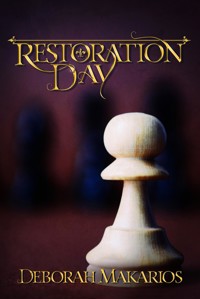
Restoration Day
Princess Lily escapes her overprotective guardians on a quest for the three Requisites of Restoration Day, the rite which renews the life and magic of the land. But she’s been away too long… The stakes are higher than she knows—and Restoration Day can’t be delayed.
The Wound of Words
Andrei just wants to settle down with the girl he loves, but when the cursed Czar calls for his death, fleeing is his only option. Now he must find the curse’s cure before it’s too late for them all.
The Ambition of a Potato
The best of seven years of eccentric humour from author Deborah Makarios’s blog (cats! crochet hooks! crumpets! cuttlefish!), plus bonus assassination-adjacent materials.
[Ebook only.]




