


106,99 €
Mehr erfahren.
- Herausgeber: Wiley-VCH
- Kategorie: Wissenschaft und neue Technologien
- Serie: Wiley Series in Atmospheric Physics and Remote Sensing
- Sprache: Englisch
Provides in-depth knowledge of the physics of radiative transfer
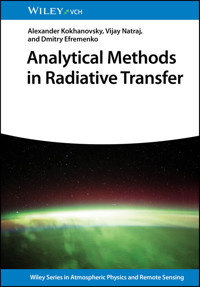
In Analytical Methods in Radiative Transfer, a team of distinguished researchers delivers a comprehensive exploration of solutions to practical problems of modern atmospheric optics related to solar light interaction with the terrestrial atmosphere and the remote sensing of clouds, aerosols, and gases. The authors describe analytic methods in radiative transfer that help explain atmospheric phenomena.
The book includes discussions on the interaction of solar light with the atmosphere. Readers will also benefit from thorough reviews of various analytical radiative transfer techniques, for various turbid media, including media with phase functions extended in the forward direction, and also semi-infinite, non-absorbing, weakly absorbing, and strongly absorbing light scattering media.
Analytical Methods in Radiative Transfer also includes:
- A thorough introduction to exact solutions of the radiative transfer equation, including situations of single scattering, as well as isotropic and Rayleigh scattering
- A comprehensive exploration of approximate solutions for scalar radiative transfer, including single and multiple light scattering separation and the case of semi-infinite media such as snow
- In-depth examinations of the applications of analytical methods in atmospheric radiative transfer, including aerosol remote sensing, cloud remote sensing, and the remote sensing of trace gases
Perfect for meteorologists, climatologists and graduate students studying physics, Analytical Methods in Radiative Transfer is also an indispensable resource for geophysicists seeking a practical exploration of modern atmospheric optics.
Sie lesen das E-Book in den Legimi-Apps auf:
Seitenzahl: 234
Veröffentlichungsjahr: 2025
Ähnliche

















Table of Contents
Cover
Table of Contents
Wiley Series in Atmospheric Physics and Remote Sensing
Title Page
Copyright
Dedication
Preface
Acknowledgments
Chapter 1: Introduction
1.1 Historical Background
1.2 What Is Radiative Transfer About and What Is It Good For?
1.3 Phenomenological Radiative Transfer
1.4 Microphysical Approach
1.5 Atmospheric Remote Sensing
1.6 Radiative Transfer Models in Atmospheric Remote Sensing
1.7 Electromagnetic Spectrum
1.8 Why Do We Need Analytical Models in Radiative Transfer?
1.9 Radiative Transfer and Climate Modeling
1.10 Remote Sensing of Trace Gases
1.11 Remote Sensing of Clouds
1.12 Remote Sensing of Atmospheric Aerosol
Notes
Chapter 2: Radiative Transfer Equation
2.1 Introduction to Radiative Transfer Theory
2.2 Formulation of the RTE
2.3 RTE with Thermal Source
2.4 Optical Thickness and Single-scattering Albedo
2.5 Single-scattering Phase Function
2.6 Orders of Scattering
2.7 One-dimensional RTE
2.8 Formal Solution of the RTE
2.9 RTE for Azimuthal Harmonics of the Intensity
2.10 Radiance Moments
2.11 Light Reflection from Layered Media
Note
Chapter 3: Optically Thin Media and Media with Strongly Anisotropic Scattering
3.1 Single-scattering Approximation
3.2 Second-order Scattering Approximation
3.3 Small-angle Approximation
Chapter 4: Semi-infinite Media
4.1 Milne Problem
4.2 Light in Deep Layers of Semi-infinite Turbid Media
4.3 Light Reflection from Semi-infinite Media
Note
Chapter 5: Optically Thick Media
5.1 Nonabsorbing Media
5.2 Weakly Absorbing Media
5.3 Optically Thick Turbid Media with an Arbitrary Level of Light Absorption
5.4 Asymptotic Equations
Chapter 6: Turbid Media with Arbitrary Optical Thickness
6.1 Sobolev Approximation
6.2 Two-stream Approximation
6.3 Four-stream Approximation
6.4 The Spherical Harmonics Method
6.5 Phase Function Truncation Methods
Note
Chapter 7: Radiative Transfer in Gaseous Absorption Bands
7.1
k
-Distribution and Correlated-
k
Methods
7.2 Exponential Sum Fitting of Transmittances
7.3 Spectral Mapping
7.4 Optimal Spectral Sampling
7.5 Double-
k
, Linear-
k
, and Low-streams Interpolation Techniques
7.6 Computations in a Broad Spectral Range: 400–2500 nm
7.7 Concept of Dimensionality Reduction
7.8 Principal Component Analysis of Spectral Radiances
7.9 Principal Component Analysis for Differential Optical Absorption Spectroscopy
7.10 Principal Component Analysis of Optical Parameters
7.11 Neural Networks
Note
Appendix A: Legendre Polynomials
Note
Appendix B: Computations of Local Optical Parameters
Bibliography
Index
End User License Agreement
List of Illustrations
Chapter 1
Figure 1.1 The first reference to the fourth degree law – an excerpt from the article of Jo...
Figure 1.2 Example of an infrared image from a thermal imager. The skin has the highest tem...
Figure 1.3 Scattering sequences: (left) self-avoiding scattering path, which is allowed by ...
Figure 1.4 Feynman diagrams: (top) in the case of the ladder approximation, (bottom) with c...
Figure 1.5 Example of an image (originally in color; rendered in grayscale for print) prov...
Figure 1.6 Schematic illustrating passive remote sensing: (left) a sensor onboard a satell...
Figure 1.7 Schematic illustrating active remote sensing.
Figure 1.8 Forward and inverse problems.
Figure 1.9 Radiative transfer model in remote sensing.
Figure 1.10 Examples of solar spectra at the top of the atmosphere and at sea level.
Figure 1.11 Annual number of objects launched into space.
Figure 1.12 Transmittances for different gases in the spectral range 400–2500 nm.
Figure 1.13 Measured PRISMA top-of-atmosphere (TOA) spectral reflectance (crosses) for a sol...
Figure 1.14 TOA radiance in the O
2
A-band for different values of cloud optical t...
Figure 1.15 Global distribution of fine particulate matter at the surface before and during ...
Chapter 2
Figure 2.1 Schematic showing the definition of specific intensity.
Figure 2.2 Absorption of light intensity while passing through a medium.
Figure 2.3 Illustration of the formal solution of the RTE corresponding to Eq. (2.12).
Figure 2.4 Illustration of one-dimensional geometry.
Figure 2.5 Illustration of spherical symmetry.
Figure 2.6 Attenuation of the radiation and internal sources. The downwelling radiation is ...
Figure 2.7 Schematic diagram of reflection from two slabs.
Figure 2.8 Schematic diagram of transmission from two slabs.
Figure 2.9 Reflection coefficient as a function of the number of layers.
Chapter 3
Figure 3.1 Trajectories of photons experiencing single- and multiple-scattering processes.
Figure 3.2 Single scattering (SS) and multiple scattering (MS) components of radiance as a ...
Figure 3.3 Ratio between single- and multiple-scattering components of radiance. The top pa...
Figure 3.4 Reflected (top) and transmitted (bottom) radiances computed by the single-scatte...
Figure 3.5 Same as Figure 3.4, but for an optical thickness of 0.3.
Figure 3.6 Same as Figure 3.4, but for an optical thickness of 1.0.
Figure 3.7 Single-scattering phase function for a cloud consisting of an ensemble of spheri...
Figure 3.8 Transmitted radiances computed using the small-angle approximation. The computat...
Figure 3.9 Comparison between solutions derived using the discrete ordinates method and the...
Chapter 4
Figure 4.1 Angular dependence of light intensity in deep layers of turbid media with isotro...
Figure 4.2 Illustration of the invariant imbedding method: four processes occurring in an i...
Figure 4.3 Intercomparison of reflection functions of nonabsorbing semi-infinite media comp...
Figure 4.4 Dependence of the escape function on the cosine of the solar zenith angle for th...
Figure 4.5 Dependence of the reflection function of a semi-infinite medium on the cosine of...
Chapter 5
Figure 5.1 Dependence of diffusion exponent on the probability of photon absorption ...
Chapter 6
Figure 6.1 The dependence of the reflection function on the viewing zenith angle (Eq. (6.39...
Figure 6.2 Same as Figure 6.1, but for an optical thickness of 1.0.
Figure 6.3 The relative error of the Sobolev approximation for computing the reflection fun...
Figure 6.4 Comparison of phase function truncation methods for a Henyey–Greenstein phase fu...
Figure 6.5 Same as Figure 6.4, but for a water cloud phase function.
Chapter 7
Figure 7.1 Transmittance comparison between LBL and far-wing scaling calculations. The soli...
Figure 7.2 Cooling rate profiles for the 800–1380 cm
−1
spectral range calculated using LBL ...
Figure 7.3 A synthetic spectrum generated using spectral mapping, compared to a high-resolu...
Figure 7.4 Comparison between LBL radiative transfer model (solid) and OSS (dashed) Jacobia...
Figure 7.5 Vertical distributions of oxygen absorption at five wavenumbers with the same to...
Figure 7.6 Error in Stokes parameter
I
for two-stream calculations compared to high-accurac...
Figure 7.7 Illustration of the method. Here the sampling rate is .
Figure 7.8 Radiance spectra for (a) clear-sky, (b) aerosol, and (c) cloud scenarios convolv...
Figure 7.9 Mean spectrum and first three EOFs computed in the Huggins band.
Figure 7.10 Explained variance in percentage as a function of the principal component index....
Figure 7.11 Schematic representation of the PCA-based radiative transfer model with precompu...
Figure 7.12 Same as Figure 7.11, but showing the online phase.
Figure 7.13 Error in the radiance for PCA calculations compared to LBL calculations in the (...
Figure 7.14 Schematic structure of a neural network used for spectral radiative transfer mod...
Figure 7.15 Ratio of UV index calculated with and without use of the neural network algorith...
Figure 7.16 Number of records in the Web of Knowledge database corresponding to the topics o...
Appendix B
Figure B.1 The dependence of the single-scattering albedo on the wavelength for various eff...
Figure B.2 The same as in Figure B.1, but for the probability of photon absorption.
Figure B.3 The same as in Figure B.1, but for average cosine of scattering angle.
Figure B.4 The same as in Figure B.1, but for attenuation parameter.
Figure B.5 The same as in Figure B.1, but for similarity parameter.
Figure B.6 The same as in Figure B.1, but for spherical albedo.
Guide
Cover
Table of Contents
Wiley Series in Atmospheric Physics and Remote Sensing
Title Page
Copyright
Dedication
Preface
Acknowledgments
Begin Reading
Appendix A: Legendre Polynomials
Appendix B: Computations of Local Optical Parameters
Bibliography
Index
End User License Agreement
Pages
ii
iii
iv
v
ix
x
xi
1
2
3
4
5
6
7
8
9
10
11
12
13
14
15
16
17
18
19
20
21
22
23
24
25
26
27
28
29
30
31
32
33
34
35
36
37
38
39
40
41
42
43
44
45
46
47
48
49
50
51
52
53
54
55
56
57
58
59
60
61
62
63
64
65
66
67
68
69
70
71
72
73
74
75
76
77
78
79
80
81
82
83
84
85
86
87
88
89
90
91
92
93
94
95
96
97
98
99
100
101
102
103
104
105
106
107
108
109
110
111
112
113
114
115
116
117
118
119
120
121
122
123
124
125
126
127
128
129
130
131
132
133
134
135
136
137
138
139
140
141
142
143
144
145
146
147
148
149
150
151
152
153
154
155
156
157
158
159
160
161
162
163
164
165
166
167
168
169
Wiley Series in Atmospheric Physics and Remote Sensing
Series Editor: Alexander Kokhanovsky
Wendisch, M. / Brenguier, J.-L. (eds.)
Airborne Measurements for Environmental Research Methods and Instruments
2013
Coakley Jr., J. A. / Yang, P.
Atmospheric Radiation: A Primer with Illustrative Solutions
2014
Stamnes, K. / Stamnes, J. J.
Radiative Transfer in Coupled Environmental Systems An Introduction to Forward and Inverse Modeling
2015
Tomasi, C. / Fuzzi, S. / Kokhanovsky, A.
Atmospheric Aerosols Life Cycles and Effects on Air Quality and Climate
2016
Weng, F.
Passive Microwave Remote Sensing of the Earth for Meteorological Applications
2017
North, G. R. / Kim, K.-Y.
Energy Balance Climate Models
2017
Kokhanovsky, A. / Natraj, V. / Efremenko, D.
Analytical Methods in Radiative Transfer
2025
Analytical Methods in Radiative Transfer
Alexander Kokhanovsky
Philipps-Universität Marburg, Department of Geography, Laboratory for Climatology and Remote Sensing, Germany
Vijay Natraj
Jet Propulsion Laboratory, California Institute of Technology, USA
Dmitry Efremenko
Remote Sensing Technology Institute (IMF), German Aerospace Center (DLR), Germany
Authors
Dr. Alexander Kokhanovsky
Philipps-Universität Marburg
Department of Geography
Laboratory for Climatology and Remote Sensing
F|14, Deutschhausstr. 12
35032 Marburg, Germany
Dr. Vijay Natraj
Jet Propulsion Laboratory
California Institute of Technology
4800 Oak Grove Drive
Pasadena
91109 CA, USA
Dr. Dmitry Efremenko
DLR
Münchener Str. 20
82234 Weßling, Germany
A book of the Wiley Series in Atmospheric Physics and Remote Sensing
The Series Editor
Dr. Alexander Kokhanovsky
Philipps-Universität Marburg
Department of Geography
Laboratory for Climatology and Remote Sensing, Germany
Cover Design: Wiley
Cover Image: © NASA (public domain)
All books published by WILEY-VCH carefully produced. Nevertheless, authors, editors, and publisher do not warrant the information contained in these books, including this book, to be free of errors. Readers are advised to keep in mind that statements, data, illustrations, procedural details or other items may inadvertently be inaccurate.
Library of Congress Card No.: applied for
British Library Cataloguing-in-Publication Data
A catalogue record for this book is available from the British Library.
Bibliographic information published by the Deutsche Nationalbibliothek
The Deutsche Nationalbibliothek lists this publication in the Deutsche Nationalbibliografie; detailed bibliographic data are available on the Internet at http://dnb.d-nb.de.
© 2025 Wiley-VCH GmbH, Boschstraße 12, 69469 Weinheim, Germany
All rights reserved (including those of translation into other languages, text and data mining and training of artificial technologies or similar technologies). No part of this book may be reproduced in any form – by photoprinting, microfilm, or any other means – nor transmitted or translated into a machine language without written permission from the publishers. Registered names, trademarks, etc. used in this book, even when not specifically marked as such, are not to be considered unprotected by law.
Print ISBN 9783527411436
ePDF ISBN 9783527698943
ePub ISBN 9783527698974
oBook ISBN 9783527698950
Dedication
We dedicate this book to our families for their patience and support.
Preface
This book serves as a foundational guide to analytical techniques in radiative transfer theory, focusing on solving the radiative transfer equation (RTE). The RTE is crucial across diverse research fields, including atmospheric optics, astrophysics, and nuclear reactor design. It plays a pivotal role in interpreting the interaction of radiation with heterogeneous media such as clouds, snow, ice sheets, atmospheric aerosols, and oceans, among other applications. Typically, the RTE is addressed through numerical solutions, supported by various robust and swift radiative transfer codes, many of which can be found online.1
Solving the RTE enables detailed analysis of radiative transfer problems, including the determination of the spectral and angular distribution of radiance (or light intensity) across the boundaries and within the body of turbid media. A significant aspect of this field is the employment of analytical models, especially useful under conditions of small or large parameter values, such as the likelihood of photon absorption, optical thickness, or the average cosine of scattering angle. These models are not just grounded in sophisticated physical concepts but also facilitate a profound comprehension of radiative transfer theory, showcasing its elegance and significance.
Analytical models hold immense importance as they offer a balanced mix of simplicity and accuracy, making them indispensable for situations where exact solutions are infeasible due to computational constraints or a lack of detailed information about the medium. They enable researchers and practitioners to predict and analyze radiative characteristics efficiently, fostering advancements in both theoretical understanding and practical applications.
The significance of analytical models extends beyond academic interest, influencing practical decision-making in environmental monitoring, climate change predictions, and even in medical imaging technologies. By enabling quicker and more accessible analyses, these models facilitate the timely assessment of critical phenomena, such as the assessment of sunlight penetration in oceans affecting marine ecosystems or the evaluation of atmospheric conditions for climate modeling. Their adaptability and efficiency make them invaluable tools in the quest to understand and mitigate complex environmental challenges.
As the volume of data collected from satellites continues to expand exponentially, there is a pressing need for more rapid techniques to interpret this vast influx of information. This challenge has spurred researchers to explore innovative solutions, often revisiting and adapting analytical models developed in the 20th century to meet contemporary demands. By integrating these traditional models with cutting-edge machine learning algorithms, researchers are achieving breakthroughs that not only match the accuracy of more time-intensive approaches but also dramatically reduce processing times, often by several orders of magnitude.
By emphasizing these models, this book aims to provide an exhaustive overview of analytical RTE solutions, aspiring to motivate future scientists to pioneer in utilizing the RTE for solving both direct and inverse radiative transfer problems. Through this endeavor, we hope to contribute to the ongoing development and application of radiative transfer theory, underpinning new discoveries and technological innovations.
We hope that newcomers embarking on their journey into the field of radiative transfer will find this book engaging and enlightening. It is designed to provide simple expressions that demystify the subject, enabling readers to grasp its core physical principles rather than getting bogged down in complex mathematical formulas. Our goal is to make the foundational concepts of radiative transfer accessible and comprehensible, offering a practical approach that enhances intuitive understanding. This approach allows those just starting out not only appreciate the elegance and relevance of radiative transfer but also apply its principles effectively across a variety of scientific and engineering contexts. By focusing on the physical rather than purely mathematical aspects, we aim to inspire broader application of radiative transfer theory.
Marburg, Pasadena, Herrsching A. Kokhanovsky, V. Natraj, D. Efremenko
July 2025
Note
1
https://en.wikipedia.org/wiki/Atmospheric radiative transfer codes
Acknowledgments
A portion of the research involved in writing this book was carried out at the Jet Propulsion Laboratory, California Institute of Technology, under a contract with the National Aeronautics and Space Administration (80NM0018D0004).
Chapter 1Introduction
1.1 Historical Background
Perhaps the theory of radiative transfer originated at the dawn of human civilization at the moment when a person thought about why the Sun warms. The gradual realization of what radiation is eventually led to the birth of quantum mechanics. Probably among the three types of heat transfer (thermal conduction, convection, and radiation), it was the phenomenon of radiation that was the most mysterious for ancient researchers. Hippocrates of Kos, an ancient Greek physician and philosopher (460–370 BC), said, “Light is a mystery to us. We do not understand what it is, or how it can be. We know only that it exists, and that it is beautiful.”
Several early researchers made significant contributions to our understanding of radiative transfer. Their work continues to influence research in this field even today. Johann Lambert (1728–1777) studied how the incident light reflects from a surface depending on the angle of incidence. He found that the radiant intensity or luminous intensity observed from an ideal diffusely reflecting surface is directly proportional to the cosine of the angle between the observer’s line of sight and the surface normal (Lambert, 1760):
where is the intensity of the reflected light, and is the intensity of the incident light. A surface that obeys Lambert’s law is said to be Lambertian and exhibits Lambertian reflectance. Such a surface has the same radiance (luminance) when viewed from any angle. This means, for example, that to the human eye it has the same apparent brightness. It has the same radiance because, although the emitted power from a given area element is reduced by the cosine of the emission angle, the solid angle, subtended by surface visible to the viewer, is reduced by the very same amount. Because the ratio between power and solid angle is constant, radiance (power per unit solid angle per unit projected source area) stays the same. Despite its simplicity, the Lambert cosine law has found many practical applications, such as lighting design, solar energy collection, and computer graphics. In remote sensing, this law is used to model the reflection of electromagnetic radiation as it interacts with the Earth’s surfaces. Lambert introduced two axioms of photometry: light travels in a straight line in a uniform medium and rays that cross do not interact. It was also shown that light intensity decays exponentially in an absorbing medium. All results of Lambert were summarized in his book Photometria, which is considered a landmark in the field of photometry, as it introduced several important concepts and techniques that are still used today.
Pierre-Simon Laplace (1749–1827) made significant contributions to the theory of radiative transfer. Laplace was interested in understanding the nature of energy transfer in the Earth’s atmosphere. He was one of the first scientists who realized the important role of radiative transfer in the energy balance of the Earth system. Laplace developed the theory of probabilities for describing the processes occurring in nature. He formulated what became known as the central limit theorem and proved that the distribution of errors in large data samples from astronomical observations can be approximated by a normal distribution. The description of the behavior of radiation, as it interacts with matter using probabilities and statistics, appeared to be very useful and became the fundamental concept of radiative transfer.
One of the first scientists during the late modern period who investigated the properties of radiation and conducted a quantitative study of radiative transfer was John Tyndall (1820–1893). One of his experiments involved measuring the infrared emission of a platinum filament and observing the corresponding color of the filament. A platinum wire was placed inside a glass tube filled with nitrogen gas. An electric current passed through the wire heated it, causing it to emit radiation. Tyndall used a thermopile to measure the intensity of the radiation emitted by the wire. He also observed that as the wire was heated, it first appeared red, then orange, yellow, white, and finally blue-white. This sequence of colors is referred to as the Tyndall effect. Tyndall measured the intensity of the radiation emitted by the wire at different wavelengths using a prism and a spectroscope. He found that as the wire was heated, the intensity of the radiation increased at shorter wavelengths, corresponding to the blue end of the spectrum. This experiment demonstrated the relationship between the color of a heated object and the wavelengths of radiation emitted by the object. It also provided important insights into the properties of infrared radiation, which is invisible to the human eye but plays a crucial role in many physical processes, such as heat transfer and climate change.
Based on experiments of Tyndall, Josef Stefan (1835–1893) found the proportionality of the intensity to the fourth power of the absolute temperature (see Figure 1.1). Later, Ludwig Boltzmann explained this result theoretically, what is now referred to as the Stefan–Boltzmann law (Boltzmann, 1884). It states that the total radiant heat power emitted from the surface of a blackbody across all wavelengths is proportional to the fourth power of its absolute temperature :
where is the Stefan–Boltzmann constant. The discovery of Stefan–Boltzmann law made it possible to estimate quite accurately the temperature of the Sun’s surface (Stefan, 1879). Now we know that any object emits radiation. It is even possible to visualize radiation using thermal imagers. As shown in Figure 1.2, faces and hands are the warmest “objects” and hence have the most intensive emission.
Figure 1.1 The first reference to the fourth degree law – an excerpt from the article of Josef Stefan (Stefan, 1879). Translation: “To obtain the amount of heat which the same surface radiates at a temperature of 100°, this number must be multiplied by and 1.6644 is obtained. The difference between the two 0.889 gives the amount of heat, which is given off per minute by the unit surface of a glass sphere at a temperature of 100° in a glass envelope at 0°. This number agrees well with the one calculated earlier with the correction for heat conduction. If one chooses the formula of the fourth power of the absolute temperatures for the law of radiation, then , .”
Figure 1.2 Example of an infrared image from a thermal imager. The skin has the highest temperature and hence the highest emission.
In 1900, Max Planck formulated his law as part of his efforts to solve the problem of blackbody radiation, which had puzzled physicists for decades. Planck’s law is based on the assumption that electromagnetic radiation is quantized, or composed of discrete packets of energy, rather than being continuous. According to Planck’s law, the spectral density of energy emitted by a blackbody is proportional to the frequency of the radiation, and it is also affected by the temperature of the blackbody. This was a revolutionary concept in physics, which required a revision of most fundamental concepts. The mathematical expression for the Planck’s law is:
where is the spectral radiance, is the wavelength of the radiation, is the Planck’s constant, is the speed of light, and is the Boltzmann constant. It can be shown by integrating Eq. (1.3) across all wavelengths that the Stephan–Boltzmann law is a consequence of the Planck’s law.
Wien’s displacement law reveals that the peak wavelength of blackbody radiation shifts in a manner inversely proportional to the temperature, indicating that with higher temperatures, the radiation peak moves toward shorter wavelengths, namely
where is the wavelength at which the radiation curve has a peak, while is the Wien’s displacement constant. This fact is derived directly from the Planck radiation law. However, Wilhelm Wien (1864–1928) formulated his law years before Max Planck introduced his more comprehensive formula. In his derivation, Wien was based on the so-called thermodynamic argument.
Wien considered a cavity filled with electromagnetic radiation in thermal equilibrium at a certain temperature. He then imagined adiabatically compressing or expanding the cavity. According to the laws of thermodynamics, such an adiabatic process would change the frequency of the photons inside the cavity (due to the Doppler effect and the change in boundary conditions affecting the standing wave modes of the cavity), but it would not lead to any exchange of heat with the surroundings. The adiabatic compression or expansion of the cavity causes a proportional shift in the frequency (or wavelength) of the radiation inside. Because this process is adiabatic, the frequency shift is directly related to a change in the temperature of the radiation. The functional form of the radiation spectrum must therefore change in a specific way to maintain thermal equilibrium at a new temperature. Wien reasoned that the spectral distribution of radiation in the cavity must scale in a specific way with temperature to satisfy the requirements of thermodynamics. This led him to conclude that the product of the peak wavelength of the radiation and the temperature of the blackbody must be constant. This relationship is now known as Wien’s displacement law. Peak wavelengths and temperatures for some objects are shown in Table 1.1.
Table 1.1 Objects, their temperatures, and peak wavelengths of thermal emission.
Object
Cosmic microwave background
2.725
1062.88
Neptune
59
49.15
Earth
288
10.06
Human body
310
9.35
Cool red star (Proxima Centauri)
3050
0.95
Venus
737
3.93
Sun
5778
0.50
Hot blue star (Rigel)
11000
0.26
White dwarf (Sirius B)
25200
0.11
Finally, in the 1860s, James Clerk Maxwell developed a theory that described the behavior of electric and magnetic fields and their interactions with matter. Maxwell’s theory is considered one of the most significant achievements in the history of physics and laid the foundation for much of modern electromagnetism and telecommunications. Maxwell’s theory is composed of four partial differential equations that relate the electric and magnetic fields to their sources, which can be electric charges or currents1:
Gauss’s Law for Electricity:
where is the electric field, is the electric charge density, and




