


2,99 €
Mehr erfahren.
- Herausgeber: Elm Grove Publishing
- Kategorie: Fantasy und Science-Fiction
- Serie: The Death of Rock 'n' Roll
- Sprache: Englisch
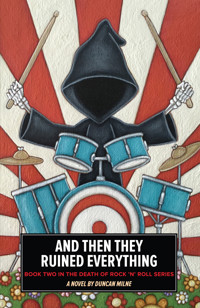
Having overcome the impossibility of time travel, Kenneth Ramsayer and his best friend exist to relive past rock ’n’ roll gigs. Everything is going well; they’ve become heroes, they’ve discovered love, they had the world by the tail, and then they ruined everything. Based on what is left of their music collections, it appears that rock ’n’ roll died in 1984.
Their unassailable knowledge of music, leads the boys to recall that in 1984 an unknown patron made a bootleg recording of a "Replacements" gig. This cassette was recovered and became the live album “The Shit Hits The Fans”. The history of rock ‘n’ roll was forever changed. Now in a viciously evil plot, a thief has absconded with the recording. But what if the death of rock ’n’ roll isn’t connected to the missing cassette? Seeking help from unlikely sources and following fading memories, the boys travel across America in a bid to save rock ’n’ roll.
The second novel in "The Death of Rock ’n’ Roll" series, “And Then They Ruined Everything” cleverly uses the concept of time travel in a rock ’n’ roll setting as an examination of choices and the power of art in society.
Das E-Book können Sie in Legimi-Apps oder einer beliebigen App lesen, die das folgende Format unterstützen:
Seitenzahl: 443
Veröffentlichungsjahr: 2016
Ähnliche

















What readers said about Duncan Milne’s first book The Death of Rock ‘n’ Roll, The Impossibility of Time Travel...and Other Lies:
“If you love a dry wit and share the author’s love of (good) music then this is the book of the year... did I mention it was funny too?”
– David
“What a great and delightful read... great job in developing the characters and piecing together the history of rock n roll...”
– Andrew
“A coming of age novel that has an encyclopaedic knowledge of rock and roll!...Duncan Milne provides a lot if insight into the human condition. It reminds me of Black Swan Green by David Mitchell. I recommend this to anyone who enjoys adventure, angst, or a fast paced narrative.”
– Cemery
“What a wonderful read. The incredible descriptions transport the reader ‘right there’ and anxious for the ‘next crossing.’
– Lois
“Duncan Milne has written a very interesting read here about Rock ‘n’ Roll and traveling through time to see rock shows... very well researched and accurate.”
– Julie
“If you dig Chuck Klosterman’s superb work in rock literature, if you felt a kinship with Cusack’s character in High Fidelity, or if you just want to grab a slice of pizza and travel through time to some great gigs, you’ll be highly entertained. Looking forward to the next one!”
– Steve Dodd
“One man’s anthology of rock ‘n’ roll with fun characters that take you on their journey through society now and in the past. Keep pen and paper handy so that you can take notes about which songs you’ll want to download later!”
– Janette
Also by Duncan Milne
Novels:
The Death of Rock ’n’ Roll,
The Impossibility of Time Travel and Other Lies
Short Stories:
Grizzly
Any Day
Hard Nine
The Halloween Meeting
Measured By Your Weight
The Departure
Interstitial
Copyright © 2015 by Duncan Milne
This is a work of fiction. It includes references to well-known people, events, bands, and places; however, all dialogue, interactions, and context are fictitious. Any resemblance to current events, locales, or living persons is entirely coincidental.
If you suspect that any reference in this novel is about you, please consult Carly Simon’s “You’re So Vain.” Failing that, or if the feeling persists, please contact me.
ISBN 978-1-943492-14-5 (hard back)
ISBN 978-1-943492-15-2 (soft cover)
ISBN 978-1-943492-16-9 (ebook)
“Skins and Bones” is original art by Peter Wyse. Rights reserved.
www.peterwyse.com
Spine image courtesy of DoddMusic. Rights reserved.
http://doddmusic.tumblr.com
Cover design by C7 Design
www.cseven.co.nz
www.elmgrovepublishing.com
San Antonio, Texas
www.elmgrovepublishing.com
To all who try to make the world a better place, regardless of their reason. Especially when such kindness is done unexpectedly, without provocation but simply with a view to leaving the world better because that’s where they live.
In addition, to Nicole and Spencer, who constantly remind me to see the world in a better light. They inspire me to be kind and find a voice for something I would be proud of.
There are heroes everywhere, if you can’t find one; be one.
Thank you.
The Story So Far
This is a story about time travel.
This is a story about rock ’n’ roll.
This is a story about life and art, and is now the second book in a series. Literature like life, music, art, or time travel, it doesn’t really matter where you start, just so long as you do. Welcome.
If you are starting here, this is a story in which two friends have discovered a means of traveling through time utilizing the video game Guitar Hero, coupled with a mixing table affectionately, maybe sardonically, called Louie Louie, a reference to the Kingsmen classic and Satan, the latter to whom DJs have often been compared.
Starting as a lark to attend gigs throughout time and space, the device allows Kenn Ramseyer and his best friend to enjoy a richer rock ’n’ roll experience. However, before long they discover that certain situations need a nudge to return to the correct path. Sometimes more than a nudge is required, such as when they have to kidnap a British prime minister to restore the natural order of things.
Although typically painfully awkward around women, both of the boys find themselves infatuated by different women at the end of the first novel. The real trouble begins there, which is where the story resumes.
PROLOGUE:Hell City, Hell
Good evening, this is Sid Itious, guest DJ at WNYU 89.1 FM. I love a good prologue. It’s the equivalent of watching the roadies set up for a band. It builds anticipation, but sometimes it goes too far and feels like hell.
Even better than a prologue is being here with Kenn in New York. I now understand why people don’t own cars here: finding parking is hell. In fact, it’s what I really expect hell to be like—having to circle the block with a cumbersome, squealing, borrowed Oldsmobile that’s running low on gas, the AC isn’t working, and you can’t roll the windows down to see where the curb is. You’re late for an appointment and you need to park, so you have to keep circling. I envision people pointing and laughing as I pass for the gajillionth time.
OK, let’s get the hell theme going. Up next is a lovely little collaboration with Zeke picking up with the Supersuckers hitting “Hell City, Hell.” Let’s go!
FCC transcript WNYU 89.1 FM 11.25.2017 0103
File as: “Occult”
Unbidden. Trespassing as an unwanted guest was how I felt moving through my life, at least most of the time. My outlook on life wasn’t quite that stark perhaps, but it was certainly lacking a clear view as to the meaning of life or what I was destined to become.
Being dismissed by Kenn was bizarre, frustrating my clarity. Sure, friends clash, but this was different. Events had taken an uncanny turn, and I was now facing something never seen before, a standard that for us was higher than other people we knew.
My best friend Kenn and I no longer had a benchmark for the unusual. Although it was autumn of 2013, the event leading to my expulsion was a gig from 1988.
Through the convenience of time travel, we had returned from seeing a Tracy Chapman show in San Francisco to our hometown in Oregon within moments of leaving, without the aid of anything other than our love for music.
Time travel certainly started as odd for us, but we had been doing it for so long now that it had become more nuanced than strange. Naturally, benchmarking the unusual had become difficult. One such nuance was that we could only cross into gigs and couldn’t control when we returned home.
We had tried to extend our journey past rock ’n’ roll into sports betting, patent discoveries, and entry into the stock markets. Even with knowledge sure to profit us, it was not to be; inexplicably time travel never lived up to our dreams. It was a force of nature in its own right, one that would grant us access only to music. Ultimately music was enough for us and led us to meeting our heroes and others we didn’t expect.
Meeting a girl in a bar who changed our lives was unexpected, and things became increasingly strange from there. Unbeknownst to me, the conflict with Kenn and the challenges we would face were still gathering energy.
Despite the multitude of challenges that I had with finding friends, or fitting in, or getting along with my parents, at least I could take solace in knowing that Kenn and I were friends and that we’d always be there for each other. But even that didn’t last forever, and the trouble with time travel is that I can’t really say when things fell apart between Kenn and me. I would say it was sometime between 1988 and the present day, but closer to the present. Maybe that’s always the way: the past is always closer than it seems.
“Yeah, I’m good,” he said with a detached coolness. “I can clean myself up. I’m good. I’ll see you tomorrow. You should just leave.”
“Nah, it’s OK, Kenn. I’ll call in some pizzas and set up a record. Maybe a little Joy Division to start things off?” I offered.
“Actually, just leave. Leave now.” And with that, for the first time in our friendship, I was dismissed. Excused. Unequivocally told to leave.
Is that what hell was like? You might think searing fires of molten sulfur or waves of freezing rain fraught with pestilence and plagues. Whatever your imagination came up with, you could be certain that suffering would be involved. But being cast off from Kenn was the deepest cut. I suppose at the same time, being around him was never easy.
Kenn always had a conspiracy. He had asked, “You know why the government is so eager to prosecute obscenity in music?”
“Kenn, stop it,” I would often find myself saying. “Dude, look, can we just take our coffee and talk about this somewhere that isn’t so busy?” It was as though he were physically incapable of recognizing that the weight of people’s glares wasn’t a reflection of the whetted anticipation of hearing his views but rather the scorn from those who didn’t understand us. In a crowded café, derisive glares would cause me to squirm. It was bad enough that we skirted around the margins of society, but being overheard only served to gain the unwanted focus of others.
Undeterred, he would continue, always. There was always something with Kenn. “It’s the same as the War on Drugs. The government isn’t really after a solution; they’re not even worried about it. They just want some high-profile arrests and lawsuits so that when American voters heave themselves out of their La-Z-Boys during halftime, they can hear sound bites that their government is effective. People are stupid.” Kenn motioned his arm across the café, gaining momentum and passion. “Look at everyone else around us; do they really give a hot flash for what’s going on? Do you really think that they spare a second’s thought to their freedom, or what’s happening with the economy? Nope. As long as they can see some easy points go up on some clever-sounding stand for morality in music, then, like a cow with its cud, they’re happy.”
I never was particularly popular, unless you considered being a target for school bullies, but being Kenn’s friend never helped. Kenn had a precise view of life. His was a view that included a vast array of theories to explain certain facets of life. Conspiracy theories that often included reference to a ubiquitous “they” or “them.” Control was always being exerted by “the Man” at the behest of “the government.” Kenn considered these theories to be explanations, and I suppose I should concede that sometimes they even proved to be right.
I’ve given considerable thought to the conditions of hell in my time. My liberal arts education, a scholarship teeming with works such as Faust, Paradise Lost, and the writings of Joseph Conrad, informed my views of the conditions that the damned faced. Other works such as Moby-Dick or The Lord of the Rings placed me in greater proximity to torments that seemed never to end.
Hell wasn’t limited to bearing witness to Kenn’s antics; no, for me hell seemed to be everywhere.
“What do you mean you’re not going to law school?” my father, or maybe it was my mother, would start. “You mean next semester. Right? You’re not going next semester, but you’re going after that, right? Seriously. You’re wasting your life. And after all the school that you’ve completed, what? Are you just going to throw it away?”
It was sort of a fair question. I didn’t know what I wanted to really do, which was hell enough, but in trying to discover the missing piece, I had dallied through college, taking any number of courses that seemed interesting but easy. But what did I really have to show for it?
“Maybe he just needs to move out,” one of my parents would say to the other, initiating the sort of amorphous conversation in which their voices and views became inseparable. My indifference mirroring their contempt for my choices, eroding any bond that might have existed between us. Like letting go of a tether during a space walk, bodies in motion drifting apart without any reason or particular direction.
My parents threatened me with all sorts of punishments aimed at attacking my liberty. It was the usual battery of threats for the usual transgressions.
“You know, he’s just not being serious enough at school.”
“Well, you know he’s just wasting our money on [insert “beer,” “pot,” or “rock ’n’ roll”].”
“It’s not like he has any friends.”
“At least no decent ones.”
Being friends with Kenn. Not assuming my expected role. Not moving out of the house soon enough. Moving out of the house too soon. Not being a lawyer. Or an accountant, or a —.
My American parents. Patriots who vocally supported the fundamental freedoms incumbent to America, but yet somehow justified engaging in tyranny to abridge my freedoms.
“You know the Constitution says I don’t have to live under tyranny.”
“The Constitution doesn’t say you have to live here.”
“If you continue to threaten my liberty, I could offer your names to the congressional Committee on Un-American Activities.” What often seemed well strategized merely resulted in greater reprisals. I tried to plead my case, I tried to utilize the formal logic that I had been taught in my philosophy courses, but my parents were impermeable to such tactics. Hell was like that.
Threats and expectations became the materials from which my parents built my own personal Sisyphean existence. Depeche Mode had a Personal Jesus; I lived in the bespoke conditions of damnation, but for an occasional hall pass into the world of rock ’n’ roll.
Dante visualized hell as a place of personalized torment; not only did this concept of hell engage my imagination, it sort of appealed to me. I thought it actually might be my kind of place. You know, with members of all the best rock bands, the Ramones, the Cramps, the Beatles, the Divinyls, and really anyone who was remotely interesting paying for their sins, sins that I would later gladly die for. In fact, I was betting on the concept that a fitting punishment for these bands could result in an eternity of great gigs. But maybe not. Because for such a result to occur, I would have to be rewarded while the others were being punished, unless playing gigs was a reward, so then the Ramones would actually be in heaven. But why?
All of my philosophical inspiration came from the closing view of Dante’s Paradiso, where all the rewarded souls are gathered in a catatonic-like state of grace; I knew where I wanted to go. At least at first. As always, I wanted to be amid the smoke, haze, and noise that hell and rock shows share.
The problem arose from the ashes of the urban legend about the answer to a final physics exam question: “Was hell an exothermic or endothermic system?” A student answered by applying Boyle’s Law and the fact that he’d slept with someone who’d claimed that she would only put out once hell froze over.
Without knowing what either system was, an awareness of the exothermic/endothermic paradox dawned upon me as I was considering my own mortality. If Dante was right, then hell would be neither exothermic nor endothermic but rather characterized by a lack of order, except as required for the purposes of tormenting souls. Thus, any of the obsessive personalities such as lawyers or engineers who found themselves in hell would discover they were beset with randomness and unpredictability: clocks that functioned poorly, demanding schedules that were impossible to meet, and rules incapable of being complied with.
Conversely, all the anarchists would find unity and conformity at every turn, queues upon queues where their existence was choreographed to the second for the rest of eternity. These condemned souls would be free to act and behave however they wished but would be met with tolerance, understanding, and accommodation to such a degree that frustration would be overtaken by mind-numbing despondence.
Sometimes I merely thought that hell was just specific moments in my life. Being with Kenn was sometimes like that. But not always.
The latest of these experiences happened in 1988 in San Francisco, but the impact upon today was unmistakable. Kenn and I had crossed to see a gig and then remained caught in the past for a while, a while that ended up with him falling in love with a girl who was equally aggressive with her upright bass and her Taser. It was a remarkable sight. It was another example of how close we always seemed to hell, but also to a state of grace.
Always missing the bigger picture, I reached these conclusions while I was preoccupied by the fear that Armageddon and Judgment were at hand. I should have been considering the pending crisis with Kenn, my relationship with Pyrah, and the significance of my record collection, but it’s often the smallest details we overlook that lead to the larger crisis. The truth was that Armageddon, Judgment, Kenn, Pyrah, and my record collection were all related. As strange as that might be, the importance of my radio show also played a role.
I wanted to be like the guy in Paul Westerberg’s song “My Road Now”—you know, brave, so that people wouldn’t call me “chicken”—but instead Kenn and I became like the pair in David Bowie’s “Heroes.” Maybe this was fitting, because while I thought that parts of my life, or at least episodes of it, were hell, and while I didn’t know what the meaning of life might be, I understood that Kenn and I would endure Armageddon. We would face our Judgment. We would host radio.
How did it all start? Well, it started on very familiar territory for me: being thrown out of somewhere. Unbidden. But this time it was different; this time Kenn dismissed me.
He met a girl, and with Kenn’s words reverberating around my cranium as I walked away, I realized that I was truly unbidden.
PART 1ISOLATION
Isolation:
A noun referring to the state of being separate from other like things;
A sense or state of being or existing alone; and
A form of punishment or deterrent used to control actions or emotions.
Isolation was a way of life, living in a small college town in Oregon.
Isolated from larger centers, we were distinguished by what we didn’t have.
“Isolation”: a song by Alter Bridge from the 2010 album AB III.
“Isolation”: a song by Joy Division from the 1980 album Closer.
1 Unbidden
Radio is a metaphor for my life. A narrative with a sound track, an empty discourse that may or may not be shared. Ripples radiating from the station perhaps affecting someone along the way. Do my interventions really mean anything to anyone? At least the music is good.
I’m going to start the next set with some monster rock. The Forbidden Dimension, all the way from some two-bit Canadian town. Here’s “Unbidden.”May it send shivers down your spine.
FCC transcript KQOO 90.9 FM 07.04.1996 0149
Operator’s Comments: “Station ID fail”
Unbidden? I walked home shocked. Stunned. Never before had I seen Kenn like this. For years, Kenn and I had been of like mind and singular in purpose. Sure, we had arguments and heated discussions, but these, more often than not, were simply part of the repartee that had always been a pillar of our relationship. Ways of challenging each other and enlivening the discourse around the discovery of rock ’n’ roll—it was more than what we did to pass the time; it was the connection between us. But now . . . now things were different.
My body felt like it had been thrown on a pile of rocks. Abandoned and aching with that sort of jarring pain that seems to resonate from the marrow of your bones, and Kenn’s voice echoing in me like the sound of breaking glass in an abandoned church. The conclusion was clear: Kenn had changed.
No question; anyone would expect that having mastered time travel would change a guy. How could it not? Time travel itself was a concept at the pinnacle of fantasy. Not only could Kenn and I time travel, we possessed the Holy Grail of science fiction. Ours was an unparalleled accomplishment, used unselfishly to make the world better. But it was also strange because Kenn and I couldn’t share it with anyone else. It wasn’t like there was a focus group for time travelers or anyone that we could tell.
I mean, really, the only people that Kenn and I could confide in about time travel were each other. It had been years now since Kenn had spoken with his parents, and mine wouldn’t listen to anything that I had to say anyway. And what? You’re going to tell a friend or parent, really? What would you say? “Hey, guess what! Kenn and I—yeah, you know my buddy Kenn, the one you think is an idiot, yeah, right, him. Well, as it turns out, we’re not wasting our time together; we’re time traveling. That’s right, he’s blurred the line between genius and idiot, and as a result, he and I have been traveling through time to see rock bands. Look, we’re going to go see T. Rex sometime this week. You want us to get you a T-shirt?” You’d be loaded into a padded room before you finished your explanation.
Originally, Kenn discovered that playing the Guitar Hero MC5 module hurtled him through time into the gig. Unfortunately, that discovery was limited to only the gigs that MC5 were a part of. Later, after a series of trials, we discovered that by processing the Guitar Hero video game through a mixing table we could move through time into any past gigs. All we needed was a recording of the band we wanted to see. Kenn called the mixing table Louie Louie, because of his view that DJs are devils, but tolerated its imposition since it facilitated combining MC5, Guitar Hero, and any other music we wanted. The history of rock ’n’ roll was unlocked and laid before us.
I suppose it was to be expected that becoming heroes was going to be lonely, but I didn’t expect this isolation to extend to Kenn.
It was more than the vacant and discarded feeling of being unceremoniously thrown out of Kenn’s house. He was now distracted and distant. Kenn was changing; now, suddenly, he was smitten with a girl, and ironically a girl who had also smote him. Sure, she was some girl, but still, a girl? Kenn’s theory of rock ’n’ roll and girls was well developed and fiercely held; now I started feeling like Peter Hook must have, watching Ian Curtis being led astray from his wife—and even worse his band, Joy Division¬—by Annik Honoré.
Maybe Kenn was right. Girls were merely set on the destruction of rock ’n’ roll. Refusing to explain the exceptions, like Poison Ivy, Cat Power, Feist, L7, Kirsty MacColl, or Ann Magnuson of Bongwater, as anything other than merely outliers. I thought something else was at play. Maybe it was better to judge on the merits of the person, rather than her gender, religion, race, or belief. But with girls, Kenn was having none of it. This wasn’t even a discussion that we would have had on prior occasions—another challenge that Kenn presented.
Kenn would always challenge me, but now, after these crossings, it was more than that. Like he had to be Batman and I had to be Robin. But I didn’t know what it was that he needed to prove. Why now? Maybe I wasn’t even Robin; maybe I was just Alfred, Batman’s butler.
Without immediate plans for crossing and now suddenly exiled from Kenn, I felt my mind start to drift. My thoughts were a dried leaf on an autumn breeze, something that once had purpose but was now on the cusp of ruin, floating between freedom and abandonment. But this was a good thing. I would have time for myself, my radio show, for lectures from my parents, for . . . for Pyrah. Shit! How had I forgotten about Pyrah? As I kept my world with her apart from Kenn’s and mine, the details were falling through the gaps. Although my heart now raced with thoughts of seeing her again, I couldn’t remember how long it had been since we had been together. Days? Weeks? Hours? Time travel had left my world disjointed and confused. History was present and the future malleable.
As I reached into my pocket, my phone, as if confirming my decision to call Pyrah, began to vibrate and ring, the ringtone from the Stone Roses’ “She Bangs the Drums.” I thought, I wonder if I should change that to “Love Me” by the Cramps. All the same, Pyrah had reached out to me first.
“Hi. Do you know who this is?” she asked demurely. “Got some time for me?”
What could I say to such a clear sign from the cosmos that we were destined to be together? My heart leaped as my isolation was being dispatched. “Hey, I was just thinking about you. Funny, I had just reached for my phone to call. Of course I’ve got time. Should I come by? I could pick up pizza.”
“Well, I guess we’re thinking the same thing. I’d love if you’d come by. Sure, bring pizza. I’ve got a box of white zin’ in the fridge.”
Within moments, my apprehension and anxiety had been shed like a heavy jacket with the first warmth of spring. Pyrah was happy just talking to me; it was as though virtually no time had passed since we had last spoken; suddenly the details didn’t matter.
The conversation continued without much substance or depth but had a palpable effect upon me. Pyrah’s manner, at once both reserved and enticing, electrified me. It was like every ounce of her being was focused on me. I loved it. Within a few moments, the abrupt dismissal from Kenn was forgotten and we made plans for dinner, or a movie or something. Whatever it was, it involved Pyrah and me being together.
That night became the morning after, which then became breakfast, coffee, late lunch and another dinner, drinks, and then magically it all repeated. Soon we had drained the week of its days like the wine boxes cluttered around her recycling bin. I was coming and going from Pyrah’s apartment as though it were my own. I would go to work, or call in sick, as the case might be, all from the sanctuary of Pyrah’s home. I would plan my radio show and search for new music using Pyrah’s laptop. Everything that I did, I did in close proximity to Pyrah. Our relationship blossomed, awakening unanticipated feelings in me. Sure, I had been close to Kenn and shared a bond, maybe even a kinship, but this was different, a different kind of intimacy that lacked the challenge that things with Kenn always held. I was happy. Content. All because I had Pyrah with me, and strangely I thought very little about Kenn and my unceremonious dismissal.
While at first I was concerned about what Kenn might think, I actually convinced myself that it would be OK. In fact, I resolved to tell Kenn about Pyrah—soon—just not now. First I had to work my way back to talking to Kenn, but I was sure that was going to happen, not only because we had been friends for so long, but also because of how electrified he had been about the bartender/bass player. It would be all right. Everything made sense, because this, too, was rock ’n’ roll. Kenn would not only understand but also welcome the broadening of our horizons.
I didn’t know when I would talk to Kenn about Pyrah but suspected that soon enough we would be sharing pizza and Frank’s RedHot and a few beers and talking about rock ’n’ roll. Maybe even planning our next crossing. Soon enough, if I only knew, but for now things just continued around and around like a record being played, and as always when a record was spinning I was content.
My contentedness was reinforced with the ringtone of my cell phone announcing, “Do You Remember Rock ’n’ Roll Radio?”
“Kenn, how you doing, buddy?” I was trying to sound like nothing had happened.
“I’m good. Where have you been, Dick? I’ve got a couple of pies being delivered—a Hawaiian and a Kitchen Sink. Why don’t you grab some beer and we’ll go see the Stooges tonight.”
I cast a furtive look toward Pyrah, and without needing more explanation she motioned, “Go, go.”
“I’ll be over in ten. Still got some Mountain Dew in the fridge? So I just need to grab beer?”
“Yeah, that’s what I said. You’ll be here in five? I’m not waiting on the pizza for you.”
Of course he wouldn’t wait; it was never about anyone other than Kenn.
“That was Kenn, he wants me to come by.”
“You should go. Have fun. I’ve been spoiled by your affections, if you’re not careful, I might grow accustomed to it.”
“Thanks, Pyrah. I might be late; you wanna do something tomorrow?” I asked, pulling her close for a long embrace.
Walking toward the door with me, she said, “Of course. You haven’t seen Kenn for weeks, and I’m not really the same to talk about music with.” Handing me a key, she continued, “I’ve got to go out for a while anyway. Let yourself back in when you’re done with Kenn. Don’t worry if you’re late; I’ll be in bed. Wake me up and you’ll be glad you did. In fact, now you’ve got a key you can wake me anytime you want! Maybe you can call in sick to work again tomorrow.”
Pizza, live music, and seemingly assured sexual congress; I was holding a winning trifecta ticket. My life wasn’t hell; I was in a state of grace.
Letting myself into Kenn’s, I called out, “Hey, man, gonna grab a Dew. Want one? You’ve got mail.” I grabbed the handful of mail that had been blowing around Kenn’s front door and headed toward the music.
“Didn’t hear you,” Kenn said. “What’s going on?”
“Highlights: I’m here; afternoon of music, pizza, and beer; here’s your mail; your copy of Rolling Stone looks like the mailman tried to eat it.” I was referring to the most significant piece of mail that I had picked up for Kenn: the January 2014 issue of Rolling Stone. “You had shit blowing all over your yard. You gonna put cars up on blocks next?”
“I don’t read Rolling Stone. It’s a rag.”
“What?”
“Rolling Stone is a waste of time; it’s a rag. I don’t read it. Do you need a picture? Get it out of my house.”
“Kenn, what are you talking about? When did this happen? I’ve got your copy right here. You’ve subscribed for years.”
“Canceled. It’s shit. I’m not reading it. Not after the Rollins interview.”
“You mean his rant about not following the music featured in Rolling Stone?”
“Maybe.”
“Kenn, I get that he’s a hero of yours from way back to the Black Flag days—”
“The guy’s an icon. A rock ’n’ roll legend.”
“Sure, but do you really think that he needs you to take a stand for him against major publications?”
“It’s a fact. People are vulnerable to the media. If the common man doesn’t stand up for what’s right by rejecting publications that prey on the vulnerable, there is nothing to check their actions. Look at the Duck Dynasty guys who were threatened with the ax from A&E for expressing their views. As far as I know, we still enjoy free speech in America. The swing taken at Rollins was just as bad as the paparazzi preying on Suri Cruise. It has to stop, and the only way it will is if the little guy stands up.”
“Listen, I’m not sure you’re ever going to convince anyone that Henry Rollins is vulnerable, or at least as vulnerable as Suri Cruise.”
“It doesn’t matter. It’s the same as Snowden: if people don’t take a stand against the Man, society is going to go to hell in a handbasket. I do what I do because it’s right. Rollins deserves respect. If he said ‘hi’ to us when we were walking down the street, we’d both lose a big load in our adult incontinence shorts.”
“Kenn . . . imagery I don’t really need. But sure, Rollins is a big deal—bigger for you than me, but still it would be pretty cool to talk to him.”
“Big deal? Rollins is a rock god. He shouldn’t have to justify himself to Rolling Stone or anyone else for that matter. Rollins has done more for music than the entire boreal forests of America have for carbon dioxide exchange.”
“Agreed, but he could have reached a little further in that article. I mean, stating that David Bowie’s album The Next Day is brilliant? Come on, what’s the next big reveal? That fish live in water? Of course, a Bowie album that people have been waiting ten years for is going to be brilliant. Reznor said the same thing days earlier.”
“I don’t watch TMZ and I won’t read Rolling Stone. Rollins is a legend,” Kenn stated. “Leave it alone.”
I agreed, but still eager to antagonize Kenn, I said, “So I suppose we’re not listening to Daft Punk tonight.”
“What are you doing about the pizza? You just lookin’ at, it or are you havin’ a piece? Throw out that fucking rag before I become ill.”
Falling back into our normal banter—eating pizza, listening to music, drinking beer, and otherwise forgetting about San Francisco—rock ’n’ roll regained the day.
That night we saw the Stooges in Germany, and everything, at least for a while, seemed to make sense. Life was going our way, but we didn’t dwell on it. After all, it was too much fun soaking in the gigs; that’s just who we are.
2 Who We Are
The rules of society form us. They direct us and control not only how we act, but the context that we understand our world in. This is Sid at KQOO 90.9 at 1:35 a.m.
It’s the context and our experiences that inspire our views and our expression. That last set was finished off by Arcade Fire. Can you believe that they managed to get David Bowie to collaborate with them? Talk about making it big. OK, let’s listen to Imagine Dragons and consider “Who We Are.”
FCC transcript KQOO 90.9 FM 09.05.2014 0135
Search Term: existential
Operator’s Comments: redacted
Who we are? I always thought that I knew, and maybe I did. Or at least maybe I knew who Kenn was and lied to myself only about who I was. If I didn’t always know who I was, I at least usually knew what I was.
I was hot and sweaty, as though I had the flu or was watching one of the late-night offerings from Showcase with Pyrah. As the sensation of discomfort and disorientation bled away from me, I realized Kenn and I were standing on sand. Soft sand that caused discomfort through the bottoms of my Chuck Taylors.
As we did so often, Kenn and I had been ruminating over pizza and beer about the state of rock ’n’ roll. About why gigs never came through town and how we had revolutionized our experience by discovering time travel. Before long, we were loading the album Battle Born, by the Killers, into the mixing table that I had attached to Kenn’s Guitar Hero console with the intention of crossing into a Killers show.
“Once that demonic mixing table of yours is ready, you can count us in,” Kenn said.
“I like calling it ‘Louie Louie’ better,” I responded, before counting out a fierce “One, two, three, four . . . Kick out the jams, mother f—,” and as I heard the thundering guitars of MC5 mixing with the Killers, the floor began to move. Slowly I started spinning as my nerves screamed at the bombardment of light and sound. Time travel, or crossing, was something I hadn’t gotten used to. There was a sensation of being shot through a garden hose, or being trapped inside a piece of fabric that was disintegrating around you. Never the same, yet not unpredictable. Worse if we were listening to something nuanced or ethereal like the Cocteau Twins or Brian Eno. Some of Stewart Copeland’s post-Police work left us staggering as though the mushrooms on our pizza had been spoiled. I certainly found the experience was always uncomfortable and bordering on violent, and now I felt as though I had been hit in the chest with a concrete block. When I tried to move my feet, they resisted, sinking further into the ground as though I were melting. Hot lead flowed through them instead of blood, or so I thought. Worried that our dalliance with time travel had failed desperately, I looked to Kenn.
“Look, dude, we’re at the Atlantis Hotel,” Kenn enthused while clipping my arm.
I turned around to survey our surroundings; Kenn was indeed right. We were on the massive grounds of the Atlantis, and the Killers appeared to be taking the stage.
“Awesome.” Kenn continued, “This must be Sandance. We’re in Dubai. Did you know that you can see these man-made palms from space?”
“So what? Kenn, you’re rambling.”
“So what, what?”
“So what that you can see the palms from orbit.”
“Are you kidding me? That’s cool. They’re manufactured features that you can see from space. That doesn’t impress you?”
“I don’t know. Maybe, but I thought that you and Vinnie said a few weeks ago that the NSA can read license plates from space, or watch people cross intersections. To me, if the NSA can do those things, they should be able to see a giant artificial island.”
Kenn gave up on the discussion shortly after that point, but I didn’t care. I was starting to feel better, and my focus was turning from sensations of nausea to the reason we had crossed: to see the Killers.
This crossing had been my idea from the start. I had wanted to see the band once Brandon Flowers returned from his solo “experiment.” Looking around, I tried to anticipate what we were in for. I was thinking about the gigs that Kenn and I had attended under the guise of the Little Red Hen theory, where we helped the roadies and watched the soundmen set up. I always found this fascinating, some times it was the best part of the gig.
In David Byrne’s book How Music Works, the main theme is how musicians craft their art to match the venues that they play. The acoustics, the audiences, the instruments, and the processing capacities are all part of the context that molds the song. Art and politics become the same. You play to your audience.
Byrne even suggests that live performances are often balanced by soundmen to sound like studio sessions. I never understood if this was to placate an audience that was familiar with the recordings or for the band to retain control over their art. Regardless, somewhere someone is always controlling what you’re listening to.
A vigorous opening of the Killers’ debut single, “Mr. Brightside” banished my contemplative thoughts. Ever since learning that they took their name from the fictional band in the New Order video for “Crystal” I’ve loved the Killers. The fact that the Killers were also interesting enough to collaborate with Lou Reed and seemed to head in a different direction on most new albums was even better.
Kenn and I made our way through the eclectic throng of sweaty Killers fans. America is supposed to be a melting pot of cultures, unified in the pursuit of liberty and all that, but here the desert was a pressure cooker of diversity. You would expect people to be crowded together for a gig, but even after the departure of the hot sun, which spent the day pouring its energy into the sand, the result remained. More than just the sand, the bodies around us were hot, and moving to the music and all getting hotter, like a visualization of boiling molecules. But heterogeneous molecules moving in such a manner as to make a single body of rock ’n’ roll fan.
Looking around, I saw a mix of cultures as diverse as the United Nations. Pale-skinned or sunburned expats ostensibly from Europe or North America, shrouded Arab men with garish watches and fancy-looking leather sandals, and then a collection of Indo-Asian men and women—indiscernible, from my sheltered Oregon perspective. Striking diversity in contrast to the relative uniformity of my American melting pot experience, this was a real mix, joined under one desire, a love of rock ’n’ roll. Ironically, the band with the violent name found its way past rhetoric, unifying an otherwise divergent group. It was another example of the influence of rock ’n’ roll and the power of the Killers.
Flowers was captivating, alternating between strutting around with his microphone in tow, vigorously playing behind a lightning-bolt keyboard stand, and hopping up onto the black crates assembled on stage—spurring the crowd into a fervor under the hot setting sun. Before long he discarded his leather jacket onto the stage, sweltering in Dubai’s heat, providing a short distraction to the audience while he interjected some dialogue, further engaging the Sandance patrons. It was the usual paint-by- numbers intervention that fills the pause for a band, the fermata that allows a band to regroup and unleash another torrent of music, while making the audience feel connected to the performance. For me, this wasn’t a pause but a reminder of my own black jeans and heavy shirt, which were draining the life out of me faster than a Winnebago burning gas in the Grand Canyon.
Ninety minutes later, Kenn and I were walking away, looking for Gatorade or at least bottled water, and hoping to return to his basement. Predictably, we didn’t notice that we were becoming dehydrated as we discussed the stunning performance; Kenn and I were still laughing over the whimsical rendition of Tommy James’s “I Think We’re Alone Now.” The Killers. Pure showmen.
“Kenn, have you noticed we haven’t crossed back?”
“Yeah, Dick, I’ve noticed that the streets of Dubai are markedly different from my basement. But thanks all the same for pointing out the obvious. What’s next? You’re going to tell me that we’re surrounded by sand? I’ve got an idea. Let’s grab a taxi and some beer.”
It wasn’t that Kenn’s idea was so bad. Kenn’s ideas often flirted with the line between reckless and idiotic, but I felt as though our options were limited. Although I always had a choice, a choice to check his recklessness or offer an opinion, it was easier to let someone else take control. Easier to say, “We really didn’t have any other options,” even though I knew that I did. Again I would pay for my complacency with Kenn as we all pay for complacency, even when we dress it up as a lack of choice.
Outside the hotel gates, we found buses idling along the road, with a long line of Sandance patrons waiting to board, all with concert passes on flashy lanyards.
“Kenn, this isn’t us. They’ll never let us on the bus.”
“Let’s go inside and see if we can get a taxi.”
Eventually a taxi was arranged, with the reluctant assistance of an indifferent concierge. It was all about how the concert had resulted in road closures isolating this section of Dubai, so he said. It sounded dubious to me, but it allowed Kenn and me to grab a few beers while I cooled my feet in the pool.
“Racist pig,” Kenn hissed under his breath as we moved away from the cab into the hot night air of Dubai.
“Kenn, you offended him.”
“How?”
“Probably when you asked, ‘Dude, where can we score some beer?’ We’re in a country governed by Islam, where you can’t just walk around and buy a can of beer like back home.”
“We got beer at the hotel.”
“Yeah, but they would have a different license and they cost about twenty bucks each.”
“He’s still racist.”
“Yeah, I’m not feeling you on this,” I continued. “Racism is when you’re treated differently because of your race, not because you’ve pissed someone off. Prejudice isn’t the same as racism.”
“So?”
“So, I’m just saying that I’m not sure we’ve got the same rights here as we might enjoy in America, but regardless I think you pissed the dude off.”
“So you think he’s got a right to hate Americans? Or white kids from Oregon? He doesn’t even know me.”
“Kenn, there’s lots of people who know and hate us. I’m not sure that I’d say ‘a right to hate,’ but people hate and have prejudices. Prejudice actually comes from the act of prejudging, and while it may have undesirable consequences in some cases, it’s often expedient and actually linked to our survival as a species.”
“So evolution is based on prejudice? Now you’re promoting hatred, or defending a bigoted jihadist? I thought you were an artsy college kid. Are you the last non-liberal to have a degree? You really did waste your time getting those degrees.”
“No. Not bigotry or hatred. And just because someone doesn’t like American kids doesn’t make him a jihadist. I’m just saying we have the right to prejudge. Look, it’s how we know a situation is dangerous when looking into a dark cave, or why people don’t usually venture into dark alleyways without reason. We assess situations based upon our experiences and make conclusions. In fact, you’ve done that with your Eve theory.
“The Eve theory is sound. Anyway, racism can’t be contingent on legal protection. You’re confusing the motivation with the context. This isn’t “Know Your Rights” by the Clash. I thought you always said that there are certain non-alien rights.”
“Inalienable,” I corrected. “Certain rights are inalienable. They can’t be taken away.”
“Well that’s bullshit, too. Anything can be taken away, dude. Rights or otherwise.”
“OK. I suppose I should have said ‘should not’ or ‘ought not.’ Certain rights should be inalienable.”
“You should never confuse what ought to be with what is. Pizza ought to be good, but too often it’s not; live music should always be awesome, but it sometimes fails; and the CIA ought to come clean about assassinating Tupac.”
“Really? We’re back to the kid of parents with the Black Panthers thing again with Tupac? I thought we were talking about inalienable rights.”
“Like being prejudiced?”
“Kenn, are we going to keep circling the block looking to park this conversation or are we going somewhere?” I asked, following him along a dusty lane, trying to split my attention between “Should prejudice be a protected right” and why the hell were we still in Dubai and where were we going?
“There ought to be an underground punk gig here.”
“Really? Ought to be?”
“No, Dick. I’m still looking for beer.”
“Fuck off with calling me ‘Dick.’ So you really think that going to an underground punk gig in Dubai is a good idea and going to help us cross back?”
“How bad could it be? Plus, what else are we doing? A punk gig seems as good a place as any to find our way back. Worst case, we see something we otherwise wouldn’t and carry on our search for a way home. Besides, you know how this works: if we’re left behind from a crossing, it means that something or someone needs our attention. But I have to tell you, there has to be another beer in the city that wants my love.”
Beyond the spill of the city lights, an indigo sky stretched above us, sprinkled with stars brighter than I had ever seen. Dubai. We were in the Middle East looking for beer, a punk gig, talking about racism, and the air held a dry crispness, like a warm sheet that had just come out of a dryer. What a funny existence. Kenn was right. Time travel was a limited experience: we had vague control over the band we’d cross to see, but not where or when. Returning to Kenn’s seemed random but always involved passage through a door of some kind; it just didn’t always happen on our terms, sometimes even leaving us temporarily trapped in a past.
“So you don’t know where we’re going? We’re just going to wander around until you piss someone off enough for us to get hurt? Maybe we’ll end up at one of those rendition compounds operated by the NSA. You’ve heard Vinnie’s theories.”
“We’re not going to end up in an NSA rendition camp for looking for beer; those are for non-Americans. Americans are interned at Area Fifty-One. Don’t you pay any attention to our discussions, or is it just about the coffee at Ka’Fiend for you?”
“The coffee and the music. I tolerate Vinnie because he owns the café and seems to know a lot about music.”
“Whatever. Vinnie also mentioned punk shows in the UAE, so show some respect. Appreciate the artistry. Apparently, there’s a whole underground movement, mostly in basements away from casual inspection, but if you know what you’re looking for you can . . . Hey! Do you hear that? It sounds loud, and it’s coming from behind that door. Let’s check this place out.”
Kenn started moving toward a dilapidated red door. The paint was fading, likely from years of neglect, the searing Arabian sun, and what I could imagine were sandstorms that felt like industrial sand blasters in a metal fabrication shop.
Immediately behind the door, we found a small foyer with a podium-style desk attended by a slender youth who looked calm, yet studious and resolute. Low seating and mirrors extended the sense of the space beyond its narrow physical constraint. It dawned on me while looking at a reflection that the despite the illusion, the foyer operated to physically control traffic, like the smallest hole in a dike, regulating passage into illicit acts beyond the door.
“Hey, dude, we’re looking for live music,” Kenn said.
“Good evening, gentlemen, I’m Youssef,” the slight man said. “You’re in the right place. But you must mind our rules.”
Youssef spoke articulate English with a soft, discernible accent suggesting that he had been educated in England or on the Eastern Seaboard. He was casually dressed but poised, with impeccable posture.
“Look, we’re not here for any trouble; we just want to check out the local scene and listen to some rock ’n’ roll.”
“Certainly,” continued Youssef. “I’m always here to help, that’s what we do. Cover charge is five American dollars or twenty UAE dirham. Unlike the gigs that you might have been to before, things in the Emirates are a bit different.”
“We’ve got American cash,” I said, handing a twenty across to Youssef.
As he was providing change, he said, “No alcohol is allowed on the premises; we do not have a hotelier’s license, this isn’t America you can’t just buy beer or guns at any shop on any corner. There will not be any inebriated audiences causing trouble. There are no mosh pits, stage diving, or any other activity that might cause harm or injury to our patrons; the expectation is that you will observe these rules and enjoy yourself, without disturbing the peace of the imarah. Your enjoyment shall not impinge upon that of others. If you want to dance, dance. If you want to sing, sing. If you are asked to leave, you leave. If you refuse . . . well, since you boys don’t look equipped for time in the desert, you won’t refuse. It’s important that you understand all of this, as underground clubs are tolerated in Dubai so long as they don’t offend social rules. So then it’s agreed?”
Kenn said something and I nodded.
Having passed through the foyer, Kenn and I took in the show.
Here we were, a world apart from our lives in Oregon and worlds apart from the Killers gig that we had just seen, but all the same a punk gig where we’d least expect it. Punk rock, in stark contrast to my conjured images of Dubai’s conservative restraint. Immaculate order, planning, and affluence, from the artificial palm fronds visible from space, past the massive highways that bisected an ordered urban plan, to the architecturally and aesthetically magnificent skyline. The conditions were unlike those of Southern California, Washington, DC, or throughout the UK that incubated punk rock; I saw no natural connection to punk rock here. Yet there was something that welcomed the seed of punk on the barren, inhospitable sands of the desert, and while this all seemed foreign to me, it also seemed familiar because rock ’n’ roll had long been my sanctuary.
Punk in Dubai was a variation on a theme, not a response to the deprivation of affluence, but a response to cultural rigidity. Punk, like life and music, functioned through building and releasing tension.




