


15,49 €
Mehr erfahren.
- Herausgeber: Nick Hern Books
- Kategorie: Poesie und Drama
- Sprache: Englisch
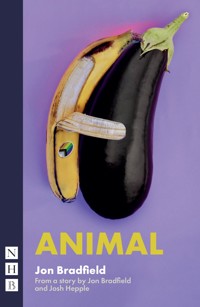
David is gay, disabled and profoundly horny. He can't eat, drink or shower by himself – or wank. Totally inexperienced, he embarks on a sexual and romantic odyssey, armed with a fierce brain, and dick pics that he has to get someone to take. Can he keep it casual whilst also relying on round-the-clock care? And will he manage the thrill and uncertainty of random hook-ups after a lifetime of knockbacks? Animal is a hilarious, challenging and heartbreaking play by Jon Bradfield, from a story by Bradfield and Josh Hepple. It won the inaugural Through the Mill Playwriting Prize, was shortlisted for the Papatango Prize, and was first performed at the Hope Mill Theatre, Manchester, and Park Theatre, London, in 2023.
Das E-Book können Sie in Legimi-Apps oder einer beliebigen App lesen, die das folgende Format unterstützen:
Veröffentlichungsjahr: 2023
Ähnliche











Jon Bradfield
ANIMAL
From a story by
Jon Bradfield and Josh Hepple
NICK HERN BOOKS
London
www.nickhernbooks.co.uk
Contents
Introductions
Original Production Details
Characters
Suggested Doubling
Setting
Performance Notes
Animal
About the Author
Copyright and Performing Rights Information
Introductions
I was a reviewer at the Edinburgh Festival Fringe for a number of years, and I always had the idea that I wanted to write something on disability and sexuality from a semi-autobiographical perspective. I would always give this ambition everything I had for the two weeks after the Fringe, but would quickly be consumed by law school starting again at the end of September.
During the Christmas period of 2014, I went to see a pantomime version of Treasure Island with a group of friends at Above the Stag Theatre in Vauxhall, London. I naively thought that it would be a children’s panto, so was startled to find myself in an audience of gay men. I loved the show. Despite having been a reviewer for many years, I had never seen comedy which chimed with my own sense of humour as well as this pantomime did. I went back to the annual panto each Christmas, whilst also working at the Edinburgh Fringe in various capacities every August. The idea for my own play was becoming stronger and stronger, but I had no experience as a writer and the hours I was putting into the writing felt futile and unproductive. I had many other things I could get on with, where I knew what I was doing.
With absolutely no expectations, I reached out to Jon Bradfield, the co-writer of the pantos I kept returning to and enjoying so much, and asked him to have a look at what I had written. Naturally, there was no funding available for Jon, no official commission, so I knew that I had contacted him on a whim – but the more that we spoke, Jon began to seriously consider taking on this project as a writer.
It was the start of a very close friendship, and I enjoyed how curious Jon became about certain parts of my life. I had already written quite openly in the Guardian about sex, so I was used to being quite public about my intimate life. I spent lots of time with Jon talking about different ideas and experiences I had. Jon did a fantastic job at keeping my ideas authentic while creating a fictional narrative. We created a semi-autobiographical character, David, and we made every effort to ensure that he was not any type of angelic saint or victim, but a character who had the ability to love and hurt others while having cerebral palsy.
It has been amazing to work with Jon. I made sure to grant him the creative freedom he asked for and was grateful that he would always check with me to see that what he’d written was authentic and reflected the ideas I wanted to convey. It is not a surprise that Animal has expanded dramatically from my initial starting points, but the story Jon tells is better, thanks to which those ideas are explored in a more beautiful and artistic way.
Thanks to everyone who has been involved in bringing this play to the stage, especially Daniel Cooper and Bronagh Lagan. I want to dedicate this to Jonathan Cooper who I miss every day. We became very good friends after working together for ten years as lawyers on criminalisation of same-sex activity. Jonathan encouraged me to talk about sexuality and use it to create empathy and change. Jonathan, I’m sorry you won’t get to see it. You were right, I have no desire to become a nun and do not regret anything you encouraged me to do.
Thanks also to all those wonderful men who I have met. No conversation in Animal is based on a real conversation and no character is based on any real individual.
Josh Hepple
Commissioners, look away now: I’m not great at big ideas. Perhaps it’s why I’ve adapted so many fairytales. So to have Josh bring me such an eye-opening suggestion – and to trust me with such a personal project – was a gift. I’d never have thought of writing about a man who can’t wank, nor would I have felt entitled to, but I was instantly smitten. After all, a protagonist needs both a desire and an obstacle, and here were both, entwined.
Neither of us wanted our play to be ‘about disabled people’, plural. That wouldn’t be a project for me to write, and I was glad to stick to the tantalising brief: to tell a story about wanking, and sex, and reliance. The play – Animal – isn’t activism, and it isn’t agitprop. Like most plays, it asks for nothing but your empathy. But Josh’s act of willing Animal into existence is a kind of activism. It’s saying that someone ‘like’ David is worth our time and attention; worthy of being centre stage as the complex, unique central character in a play, representative of nobody and yet – I hope – relatable in some ways to anyone reading or watching the play. When discussing the play recently, Josh said eloquently that giving and receiving sex, love and affection – and being seen as deserving of them – are a big part of the human experience. Take that away, and you take away a part of someone’s humanity.
Before I wrote a single word I spent a lot of time getting to know Josh, discussing his initial ideas (which kick the play off and resurface at a number of important moments), as well as his philosophy about disability and the practicalities of his life as someone who relies on people almost round-the-clock for essential things that many of us take for granted – and how that intersects with having a sex life.
As Josh says, he was excited by the idea that a play about sex and disability could have some of the comic spirit, unabashed humour, open-hearted warmth and big characterisations that he’d seen in the adult pantomimes I had co-written with Martin Hooper. But he was clear that the humour mustn’t be at the expense of disability; that we shouldn’t invite people to laugh at impairments to make them palatable, even if our central character’s insecurities mean he is sometimes painfully self-deprecating.
David’s impairments and practical circumstances are similar to Josh’s, and a few moments in the play are inspired by moments in his life. But David isn’t Josh, and couldn’t be. Character is born of story and action, and this story is a fiction. From the start, I was determined that to whatever degree Animal was rooted in the specifics of someone’s life, it should stand as a piece of drama in its own right. I wanted the freedom to throw characters at each other, each with their own conflicting needs, and see what I could grow from that – writing being, at least in the first place, improvisation. I thought the subject deserved that, and that I did too. I wanted to write a play with a satisfying shape, with a beginning, middle and end. Life isn’t like that.
(It’s worth noting that, for simplicity, in some ways I’ve given David an easier ride than he might have ‘in real life’. Arranging the care he relies on – employing personal assistants, engaging agencies or asking friends for help – can be a Sisyphean task. A lack of money and an apparent dearth of casual workers mean that, on a bad week, almost all of David’s energy might be spent on the vital but dehumanisingly boring task of ensuring he’ll be able to eat, drink and go to the toilet tomorrow.)
Of course, the play isn’t only a reflection of Josh’s experience of the world. It’s informed by my own perspective of becoming friends and collaborators with someone with severe impairments. All of which makes this a deeply weird experience for him. After all, here is a character who inhabits a body like his and a world like his, but who wilfully speaks and acts differently to him. Here are experiences – however fictionalised – that are immediately familiar to him, but which pepper a narrative he hasn’t lived. Here are characters – an assistant, a housemate, lovers – who fulfil roles that people in his own life have occupied, but who refuse to behave like them. It must feel simultaneously exposing and erasing. For his willingness to go on that journey, for his bravery, for his ability to push me further, and for his frequent and often creative insight, I’m grateful.
For Josh’s part, I think there’s something very cool about someone who loves theatre, but who is neither a writer nor a producer, nevertheless manifesting a play by persuading someone to write it. Josh is a persuasive guy. He has to be. He’s used to recruiting people, formally and informally, to make things possible that he can’t do by himself. Perhaps this play is an extreme example of that. We talk a lot about access in theatre, but real access is complicated and requires flexibility. Theatre has very prescriptive roles and established ways of doing things. Josh isn’t a writer, or a producer, or a director, and yet with Animal he has been, in a unique and valid way, a theatre-maker.
In praise of prizes: You’re watching or reading Animal thanks to the Hope Mill Theatre’s Through the Mill Playwriting Prize, created in association with Jonathan Harvey. This is possibly the sort of thing one shouldn’t say publicly, but the truth is, by the time it won the award, Animal had been submitted without success to pretty much every funded theatre or company producing new writing that you can think of. That’s not an anomaly – few new plays begin their journey to production by landing unsolicited in a theatre’s inbox. But prizes, unlike theatres, are free to assess plays on their own terms, outside of such considerations as: Is it affordable? Will it sell? Who is the writer? Does it fit within our programme? Even if you don’t win, they’ll often give you helpful feedback (thanks Papatango team!). If you’re a playwright – or trying to be: look for writing prizes, make their deadlines your deadlines, and submit.
Thank you: I’m grateful to the following, whose thoughtful and expert feedback has helped shape this script: Matt Applewhite, Daniel Cooper, my kind, patient and hilarious agent Alec Drysdale, Jonathan Harvey, Laura Klimke, Bronagh Lagan, Noemi Spanos and Daniel Raggett.
Jon Bradfield
Animal was first performed at Hope Mill, Manchester, on 9 March 2023. The cast was as follows:
DAVID
Christopher John-Slater
DEREK/NUNO
Matt Ayleigh
JILL
Amy Loughton
LIAM
Joshua Liburd
ROB/RAY/ALAN/DAD
William Oxborrow
MANI/MICHAEL
Harry Singh
Writer
Jon Bradfield
Story Originator
Josh Hepple
Director
Bronagh Lagan
Set and Costume Designer
Gregor Donnelly
Video Designer
Matt Powell
Lighting Designer
Derek Anderson
Sound Designer
Julian Starr
Assistant Director
Teenie Macleod
Movement Director
Cathy Waller
Access Consultant
Cathy Waller
Intimacy Director
Robbie Taylor Hunt
Production Manager(Manchester/London)
Ian Taylor (For E-Stage)
Production Manager (Bristol)
Tabitha Piggott(For E-Stage)
Casting Director
Jane Deitch
Assistant Designer
Ryan Webster
Costume Supervisor
Nicole Bowden
Company Stage Manager
Mel Berry
Assistant Stage Manager
Reuben Bojang
Assistant Stage Manager
Elsie O’Rourke
Producer
Daniel Cooper
Assistant Producer
Ellen Harris
Characters
DAVID, twenty-five. David has cerebral palsy. He uses a powered wheelchair, he has a speech impairment, and he has uncontrollable bodily movements. He can type with his fingers on a phone but cannot use a pen or hold a pint
JILL, thirties or so
DEREK, thirties
MANI, twenties, British Asian. Dresses playfully LIAM, twenties. Muscular build
MICHAEL, early twenties
DAD, fifties
Hook-ups:
ROB
RAY
NUNO
ALAN
HELPLINE ADVISER (voice only)
Suggested Doubling
The actor playing Mani can play Michael; the actor playing Derek can play Nuno; the actor playing Dad can play Rob, Ray and Alan. If the adviser’s dialogue is live rather than recorded, she can be voiced by the actor playing Jill.
Setting
The play starts in winter and ends in late summer. Most scenes take place in David’s two-bedroom, ground-floor flat, in his living room or bedroom. The final scene is set in his garden.




