


18,49 €
Mehr erfahren.
- Herausgeber: Nick Hern Books
- Kategorie: Poesie und Drama
- Sprache: Englisch
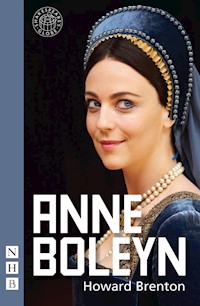
A celebration of a great English heroine, Anne Boleyn dramatises the life and legacy of Henry VIII's notorious second wife, who helped change the course of the nation's history. Traditionally seen as either the pawn of an ambitious family manoeuvred into the King's bed or as a predator manipulating her way to power, Anne – and her ghost – are seen in a very different light in Howard Brenton's epic play. Rummaging through the dead Queen Elizabeth's possessions upon coming to the throne in 1603, King James I finds alarming evidence that Anne was a religious conspirator, in love with Henry VIII but also with the most dangerous ideas of her day. She comes alive for him, a brilliant but reckless young woman confident in her sexuality, whose marriage and death transformed England for ever. Howard Brenton's play Anne Boleyn was first performed at Shakespeare's Globe, London, in July 2010, and was named Best New Play at the Whatsonstage.com Awards in 2011. The play was revived at the Globe in 2011 and toured regionally in 2012 in a joint production between Shakespeare's Globe and English Touring Theatre.
Das E-Book können Sie in Legimi-Apps oder einer beliebigen App lesen, die das folgende Format unterstützen:
Veröffentlichungsjahr: 2012
Ähnliche







Contents
Title Page
Preface
Original Production
Characters
Act One
Act Two
About the Author
Copyright and Performing Rights Information
Preface
Howard Brenton
Every year on the 19th of May flowers are delivered to the Tower of London. Queen Anne Boleyn, Henry VIII’s second wife, was executed on that day in 1536. The flowers have been arriving for forty years and no one knows who sends them. They are put on the floor of the small Chapel of St Peter ad Vincula, beneath which Anne’s body – and head – were buried in a wooden chest, without a plaque or stone. All traces of her were then obliterated with a Stalinist ruthlessness: all of the pictures, but perhaps for one, all of the images of her crest of arms. Henry had his ‘H’ and her ‘A’ carved entwined on panels and embossments throughout Hampton Court. They were all removed – though one was missed: it can be seen in the Great Hall, high up to the right on the wooden screen.
Today there is a fast-growing Anne Boleyn cult. She appeals both to adolescents and to ageing romantics. Her story has a Wagnerian intensity of love, death and betrayal, shot through with a very un-Wagnerian sense of reckless fun, of daring sexiness. But there is a deeper reason for the growing obsession with her. The flowers acknowledge an unease; we love her story but feel guilty toward her. I think I’ve understood why and it’s made me a paid-up cult member.
Anne was convicted of adultery, incest and treason. At her trial she had been accused of being her brother’s mistress, of being a witch, of sleeping with a hundred men while married to the King. She had been Queen for three years. In the glow of her husband’s devotion she was the most powerful woman in the Kingdom, a force in her own right against whom no one dared speak openly. But when the protective veil of the King’s affections evaporated she became ‘the Concubine’, the great whore of the age. It was the Devil’s work that she could not give the King a male heir. Wild rumours spoke of her third miscarriage delivering a fetus so distorted that the father must have been a succubus, a demon, even Old Nick himself. In the last days in the Tower, Anne went to pieces. But her wild spirit did not wholly desert her. From within her spinning hysteria she joked ‘I shall have a nickname: Queen Anne the Headless’.
There are many Anne Boleyns. Popular culture – as in the television series The Tudors – sees her as a bright, sexy girl, manoeuvred by an ambitious father and his friends into the King’s bed. Historians disagree. David Starkey sees her as ‘a brutal and effective politician’ who was, after all, able to bring down the King’s First Minister, Cardinal Wolsey – whom she hated, ironically, for blocking a possible betrothal when she was younger. Antonia Fraser, who is very much of the Catholic party of Henry’s first wife, the much put-upon and infuriatingly correct Catherine of Aragon, sees Anne as a schemer and a poseur. She accuses her of ‘religious chic’, always making sure she had a religious book in her hands when someone important came into the room. In her recent novel, Wolf Hall, Hilary Mantel gives us an extraordinary Anne, calculating yet instinctive, almost feral, a very dangerous woman indeed.
There is some truth, no doubt, in all these perceptions of her. Clearly she was formidable. When she was thirteen she was sent abroad, first to Burgundy then to Paris as a lady-in-waiting to the French Queen. Both Courts were notorious for political infighting; Anne observed and learnt. Her French became flawless; later, as favourite, then Queen, she made herself invaluable to Henry in the endless, convoluted negotiations with the French King.
By all accounts she was not a conventional beauty, but she seriously unnerved men. Perhaps it was a directness of gaze, a centred confidence, a charm without deference that bowled them over. She was also armed with a flashing and at times indiscreet wit and, when needed, a hell of a temper – she was, after all, the future mother of Elizabeth I.
When King Henry fell in love with her in 1526, she refused to sleep with him. She kept him hooked but at bay for nearly seven years while negotiations with the Pope to secure an annulment of Henry’s marriage to Catherine foundered and then failed. The prurient Court gossips speculated, month by month, how far up Anne’s thigh Henry was allowed to go. They finally slept together in Calais, a few weeks before they were married in great secrecy on the 25th of January 1533. Anne quickly became pregnant.
The cruelty of the past can be thrown into sharp relief by present-day knowledge. Anne gave birth to a healthy child, Elizabeth, and then had three miscarriages. Another historian, Alison Weir, argues that she was one of those rare women who are rhesus negative: when a man is rhesus positive and his partner negative, problems do not occur with the first child but they do with subsequent pregnancies. If Anne had given Henry and England a male heir, she would have been invulnerable. But she did not. Over Easter in 1536, Thomas Cromwell, the King’s Chief Minister and at one time Anne’s ally, decided to destroy her. It took him three weeks to launch a coup against her family and her faction, fix witnesses, rig a trial and have her dead.
So, an attractive and ambitious woman gets to the centre of a dangerous maze of male power to find there is only one way out: her death. It is a tragic and highly dramatic scenario and, as far as it goes, true. But it is a modern reading. There was a whole other dimension to Anne.
She was religious. More: she was a Protestant, a reformer, and an admirer of William Tyndale.
Tyndale’s name provoked fear and loathing amongst both Catholics and moderate Protestants. He was in hiding on the outskirts of Antwerp (he was betrayed and publicly strangled and burnt in the same year as Anne’s execution). His vivid, egalitarian translation of the Bible was banned, but copies were smuggled into England. Anne had one. She may well have been directly in touch with Tyndale. She certainly got hold of his The Obedience of a Christian Man when it was published in 1528. This was an explosive book, a key text of the Reformation, attacking the Pope and the Church. An incensed Cardinal Wolsey confiscated it from one of Anne’s ladies-in-waiting. Anne went to the King and Wolsey was forced to return it. Anne marked up passages for Henry to read. He commented: ‘This book is for me and for all kings to read.’
It is as if there was a Joan of Arc, driven by a religious vision, within the more familiar figure of Anne the dazzling sexual predator. She even died for religious reasons: she discovered Cromwell was stealing huge sums from the dissolution of the monasteries, money meant for the establishment of universities and religious schools. He moved so quickly because he feared she would tell the King.
Anne was in love with Henry but also in love with the most dangerous ideas of her day. She conspired to make England Protestant for ever. I am fascinated by heroes and heroines who were ahead of their time, like Abelard and Heloise in my first play for the Globe, In Extremis. Anne was one of them. She could not know the future, of course. But she helped detonate a religious upheaval which culminated a century later in the Civil War, the breaking of divine royal power and the establishment of our Parliament.
I wrote the play to celebrate her life and her legacy as a great English woman who helped change the course of our history.
This article was first published in the Independent on 23 June 2010.
Anne Boleyn was first performed at Shakespeare’s Globe, London, on 24 July 2010, with the following cast:
ROBERT CECIL
Michael Bertenshaw
DEAN LANCELOT ANDREWES
Sam Cox
LADY JANE / SECOND COUNTRY WOMAN
Naomi Cranston
SIMPKIN / PARROT
John Cummins
GEORGE VILLIERS / FIRST COUNTRY MAN
Ben Deery
LADY CELIA / FIRST COUNTRY WOMAN
Mary Doherty
THOMAS CROMWELL
John Dougall
SLOOP / SINGER
Will Featherstone
KING JAMES I
James Garnon
WILLIAM TYNDALE
Peter Hamilton-Dyer
KING HENRY VIII
Anthony Howell
CARDINAL WOLSEY / HENRY BARROW
Colin Hurley
LADY ROCHFORD
Amanda Lawrence
ANNE BOLEYN
Miranda Raison
DOCTOR JOHN REYNOLDS
Dickon Tyrrell
SUPERNUMERARIES
Claire Bond, Nicole Hartley, Holly Morgan, Michael Curran, Michael Jarvis
Director John Dove
Designer Michael Taylor
Composer William Lyons
The production was revived at the Globe in July 2011, with the following changes to the cast:
THOMAS CROMWELL
Julius D’Silva
LADY ROCHFORD
Sophie Duval
SUPERNUMERARIES
Claire Bond, Laura Darrall, Nicholas Delvale, Luke McConnell
Characters
ANNE BOLEYN
KING HENRY VIII
THOMAS CROMWELL
CARDINAL WOLSEY
Anne’s women
LADY ROCHFORD
LADY CELIA
LADY JANE
SIMPKIN, Cromwell’s man
SLOOP, Wolsey’s man; then Cromwell’s
WILLIAM TYNDALE
KING JAMES I
ROBERT CECIL
GEORGE VILLIERS
PARROT, Cecil’s man
DEAN LANCELOT ANDREWES
DOCTOR JOHN REYNOLDS
HENRY BARROW
Plus
COUNTRY WOMEN
COUNTRY MEN
DIVINES, COURTIERS, SERVANTS
The action of the play takes place at the Court of King Henry VIII (1527–1536) and the Court of King James I (1603–1604).
ACT ONE
Scene One
Enter ANNE BOLEYN in her bloodstained execution dress. She has a large embroidered bag with her.
ANNE (aside. Working the audience). Do you want to see it? Who wants to see it? Do you? You? I’ll show then. (Opens the bag.) No, I won’t. (Closes the bag.) I won’t! I cannot see the advantage in it, and that was what I was taught, by Margaret of Burgundy, when I was thirteen, ‘Know the advantage of everything, Anne.’ And you won’t like me for showing you, you’ll say it’s boastful, they said I was boastful, overweening. And why should I want you to love me? Did anyone around me ever love me, but for the King? So you can’t see! You can’t! (Stamps her foot. Then laughs.) Or would it be fun? Would it be a scandal? Better: would it make you laugh? Oh, that’s all right then… here… (Puts her hand in the bag.) Ready? Look! (Takes a Bible out of the bag.) It’s my Bible! Why? Don’t you realise? This killed me! This book! This put me in the Tower, this made the sword, the sword, the sword… they played a trick. As I was kneeling. They made me look one way. And from the other way the sword… sang. In the air. For a second. I heard it sing, and… (Pauses, then kisses the Bible and puts it back into the bag.) What you think I was going to show you? This? (Takes out her severed head.) This? This? Funny, a head’s smaller than you think. Heavy little cabbage, that’s all. Let me show you something. Eyes closed, see? (Pulls the eyelids up with her fingers.) For a moment I saw my body lying in the straw. And I closed my eyes. It was I, closing them.
She closes the eyes on the head. She stands, the head under her arm.
And now I’m with Jesus. I am! I’ll bring you all to Jesus.
Enter KING JAMES I followed by LORD ROBERT CECIL.
ANNE points at JAMES.
He won’t. James the Sixth of Scotland, sixty-seven years after my – (Gestures.) come to rule you all. James the Sixth of Scotland. Now James the First of England. But he won’t bring you to Jesus.
She skips away and exits.
Scene Two
JAMES and CECIL. CECIL’s man PARROT lurks.
Listening COURTIERS edge as close as they dare to try to overhear.
JAMES. Two thousand dresses!
CECIL. Yes, Your Majesty.
JAMES. Elizabeth had two thousand dresses?
CECIL. Her late Majesty knew the importance of the pomp of princes.
JAMES. The pimp of princes.
CECIL. Pomp, Your Majesty.
JAMES. The pomping and pimping of princes. (Laughs.) Two thousand dresses. We have come out of Scotland to a world of marvels.
CECIL. You come, Sire, a King of Scotland and rightful heir to the English throne. For the Kingdom was cast into darkness, the sun of Eliza set, her people were cast into darkness and cold. But now from the north a new sun has arisen, Your Majesty from Scotland ascends the throne, light floods the rejoicing towns and villages, warmth returns, a new glory and light shines upon us.
JAMES (makes a farting noise). Oh, I do believe I ripped a fart.
CECIL. Your Majesty?
JAMES. No, not a fart, it was a flash of light from my arse illuminating England.
CECIL. Your Majesty, I…
JAMES. No no no, tum tum tum, you spoke smoothly, My Lord Cecil. Smoothly, smotherly.
CECIL. I assure Your Majesty that…
JAMES. You see, I come from a more primitive world. I was brought up amongst the terrorism of great lords. In Edinburgh I looked for courtiers with knives in their sleeves. Here, I think, the danger is from words in their mouths.
CECIL. But I must protest my sincerity…
JAMES. Yum tum! Where are they?
CECIL. Your Majesty?
JAMES. The dresses! That woman’s dresses!
CECIL. I have picked the best. (Claps his hands.) Come!
CECIL peels away.
PARROT (low, to CECIL). The dresses, My Lord? I was going to sell them.
CECIL. Don’t tell me.
PARROT. The servants in the hall expect something on the side.
CECIL. Enough.
PARROT. It’s a once-in-a-generation opportunity, My Lord. A change of monarch. Get your hands on a few souvenirs.
CECIL. I let you have the pewter plate.
PARROT. None of the silver, though.
CECIL. What?
PARROT. Nothing, My Lord.




