


Erhalten Sie Zugang zu diesem und mehr als 300000 Büchern ab EUR 5,99 monatlich.
- Herausgeber: Nick Hern Books
- Kategorie: Poesie und Drama
- Serie: NHB Modern Plays
- Sprache: Englisch
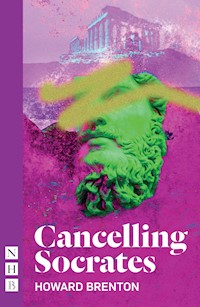
'They say Pericles caught democracy from you in bed.' Today, Socrates is revered as the founding father of Western philosophy. But in 399 BC Athens, he was a pain in the neck. The plague is over, democracy is (just about) restored, and everyone would like to get back to normal. How hard is it for one ageing firebrand to stop asking questions? It's time to shut him up... Based on eyewitness accounts, Howard Brenton's Cancelling Socrates is a provocative and witty play about an uncompromising voice in dangerous times. It was premiered at Jermyn Street Theatre, London, in June 2022, directed by the venue's Artistic Director Tom Littler.
Sie lesen das E-Book in den Legimi-Apps auf:
Seitenzahl: 71
Veröffentlichungsjahr: 2022
Das E-Book (TTS) können Sie hören im Abo „Legimi Premium” in Legimi-Apps auf:
Ähnliche












Howard Brenton
CANCELLING SOCRATES
NICK HERN BOOKS
London
www.nickhernbooks.co.uk
Contents
Original Production Details
Characters
Cancelling Socrates
About the Author
Copyright and Performing Rights Information
Cancelling Socrates was first performed at the Jermyn Street Theatre, London, on 2 June 2022, with the following cast:
EUTHYPHRO
Robert Mountford
SOCRATES
Jonathan Hyde
XANTHIPPE
Hannah Morrish
ASPASIA
Sophie Ward
GAOLER
Robert Mountford
Director
Tom Littler
Set & Costume Designer
Isabella van Braeckel
Lighting Designer
William Reynolds
Sound Co-Designer
Max Pappenheim
Sound Co-Designer
Ali Taie
Assistant Director
Becca Chadder
Movement Associate
Phoebe Hyder
Production Manager
Lucy Mewis-McKerrow
Stage Manager
Lisa Cochrane
Production & Rehearsal Photographer
Steve Gregson
Graphic Designer
Ciaran Walsh
PR
David Burns
Characters
SOCRATES, seventy
EUTHYPHRO, thirty-five
ASPASIA, seventy
XANTHIPPE, thirty
GAOLER, thirty-five
A DAEMON
Euthyphro doubles up as the Gaoler, Xanthippe as a Daemon
Place
Athens.
Time
April to May, 399 BC.
This ebook was created before the end of rehearsals and so may differ slightly from the play as performed.
Scene One: The Funnel Web
The Agora, Athens. Late April, 399 BC.
Crowded.
EUTHYPHRO, smoothed, respectably dressed, his hair well cut and oiled. He is relaxed, smiling and greeting people.
EUTHYPHRO. Yes yes, thank you for asking, he’s quite recovered, my wife too, thank you –
Turns and listens to someone else.
Absolutely, looking forward to it –
Listens, smiling, then shares laughter.
Oh, the flute player with the blue – she will? Well – more water with my wine this time, I think –
Laughter. Then someone of superior rank addresses him. He adopts serious concern.
But I sent a messenger to you this morning, perhaps he didn’t – anyway, it is the best of news, my ship’s been sighted, it’ll be at Piraeus tomorrow. (Listens respectfully.) Yes, reported to look fully laden. (Listens.) Yes, sir, the future, certainly.
He pulls himself erect, very satisfied with these encounters.
(Aside.) Public face, public space. To see to be seen. Normally, as if in normal times. What is civilisation? The art of living in cities. The cultivation of the good between us. And I love it so, as do we all. It is a duty to see and to be seen. After what we have been through – plague, war, the – unfortunate politics – to bounce back to normal. And do what is right by the gods. The one thing we can all agree on, surely, is that religious duty is all.
Enter SOCRATES. He has straggly grey hair, is reputably dressed and is barefoot. He radiates energy.
EUTHYPHRO has not seen him.
SOCRATES. Euthyphro, my friend!
EUTHYPHRO. Oh no, no, no, please not, no –
SOCRATES. Is all well?
EUTHYPHRO (aside). This is the nightmare of public places, meeting the oddballs in one’s clan.
He turns, a beamingly false smile.
Socrates!
SOCRATES. My dear, so good to see you, and looking so sleek.
EUTHYPHRO. And you, Socrates, looking so –
SOCRATES. – Still alive?
EUTHYPHRO. Absolutely!
SOCRATES. But I could be a corpse walking around, any signs of life a rhetorical trick.
EUTHYPHRO. Ha! – No, you’re one of the fittest men I know, despite your –
A gesture meaning ‘the way you dress’. SOCRATES shoots up a finger.
SOCRATES. Interesting! Can we prove we are alive? And not, say, ghosts in Hades, doomed to re-enact memories of life? Not alive at all, merely talking to ourselves?
EUTHYPHRO. Socrates, forgive me, at this moment I can’t get into a philosophical, er –
SOCRATES. Tangle? No, no, I twitch, I twitch.
SOCRATES claps his hands, laughs and they embrace.
I heard your little son was sick?
EUTHYPHRO. It was just a chest infection not the – . His mother had a touch of it too, but they are both well.
SOCRATES. Great to hear it. May youth forever bloom.
EUTHYPHRO. Ha! Yes.
SOCRATES is beaming at him.
(Aside.) Oh gods, gods –
But he beams back.
SOCRATES. So why are you outside the magistrates’ court, nothing serious I hope, on this beautiful day?
EUTHYPHRO. I have come to make a charge of murder.
SOCRATES. My dear! Against whom?
EUTHYPHRO. My father.
SOCRATES is shocked.
SOCRATES. You are accusing your own father of murder?
EUTHYPHRO. It’s very painful. But to do justice is a religious duty. And justice lies with the gods, who would dispute that?
SOCRATES. No one in their senses. But – whom did your father kill? A relative – it must be, you wouldn’t prosecute him for killing a stranger.
EUTHYPHRO. Why should it make a difference if he’s killed a relative or a stranger?
SOCRATES. Only human nature – never mind. But I’m agog, tell, tell!
EUTHYPHRO. I had a steward, he visited my father’s estate on Naxos. A good administrator, knew how to crack the whip, but – he got drunk, flew into a rage and killed one of my father’s slaves. My father had my steward beaten up, bound and thrown in a ditch.
SOCRATES. Ah. And called for the local justices?
EUTHYPHRO. No, he called for a priest to come and give religious advice.
SOCRATES. Religious advice?
EUTHYPHRO. Yes. Do the gods see slaves as being human?
SOCRATES. That is a question.
EUTHYPHRO. My father wanted to be told ‘yes’, then he could prosecute my steward.
SOCRATES. I can see that.
EUTHYPHRO. Unfortunately the priest didn’t arrive until the morning. My man was left in the ditch and died during the night.
SOCRATES. That was callous of your father.
EUTHYPHRO. More than callous, murderous.
SOCRATES. What’s your family say about all this?
EUTHYPHRO. Well, they say at worst he murdered a murderer, but it was an accident and anyway my man deserved it. I’m afraid they are being very abusive, they call me a sanctimonious prick. Among other things.
SOCRATES (musing). Sanctimonious – pretending to be very holy or pious, affecting sanctity or righteousness. But if you are pious, if you are acting with sanctity, if you are righteous – they’re just calling you names. Maybe it should be an admirable thing, to be sanctimonious.
EUTHYPHRO. You’re right! Piety is easily slandered.
SOCRATES. But, Euthyphro – accusing your own father?
EUTHYPHRO. Justice –
SOCRATES. – is a religious duty and lies with the gods, yes, you’ve said. I see you’re much wiser than I in these matters, so, my friend, teach me. Justice is a matter of what is holy and unholy?
EUTHYPHRO. As every citizen knows, surely.
SOCRATES. Mm. (A beat.) The pious and the impious.
SOCRATES pauses for a moment, thinking.
The holy and the unholy, what would you say they are?
EUTHYPHRO. Well, I’d say what I’m doing now, prosecuting a wrongdoer, that’s holy. And not to do so – that would be unholy. That is the law! It is not unholy to turn on your father, if he has done wrong. After all Zeus put his father Chronos in shackles. And Chronos castrated his father Uranus for eating his children.
SOCRATES. Yes, a long line of fathers doing the right thing. I don’t know, when people tell me these stories about the gods, I get itchy. I can’t bring myself to believe them. But, as a religious man, you believe the stories?
EUTHYPHRO. Of course. They are the acts of the gods.
SOCRATES. And, of course, the gods are holy.
EUTHYPHRO. Obviously, they are the gods –
SOCRATES. And it’s obvious too that they love what is holy.
EUTHYPHRO. Yes –
SOCRATES. So – (He pauses.) Is what is holy loved by the gods because it is holy, or is it holy because it is loved by the gods?
Sudden caution from EUTHYPHRO. Dangerous ground.
EUTHYPHRO. I – that’s too twisty for me, I don’t follow –
SOCRATES. Yes, forgive me, my dear, there’s a tangle here, a bit of a ball of string that’s got knotted up and we philosophers do love knots. It’s the problem of what is a quality in a thing or action.
EUTHYPHRO. Is it?
SOCRATES. Bear with me. (A beat.) Right! Go! When a thing is carried – when a cup of wine, say, is carried across a room – the cup has the innate quality of carriedness.
EUTHYPHRO. Yeeeees –
SOCRATES. And the act of carrying the cup, has – well, the innate quality of carrying something?
EUTHYPHRO. Yes, I suppose so –
SOCRATES. Good! We’re getting somewhere.
EUTHYPHRO. Are we?
SOCRATES. What is carried is being carried. It is an absolute quality.
EUTHYPHRO. Yes.
SOCRATES. Of the cup.
EUTHYPHRO. Yes.
SOCRATES. And the act of carrying the cup, has the innate quality of carrying something.
EUTHYPHRO. Yes.
SOCRATES. Care to summarise?




