


6,99 €
Mehr erfahren.
- Herausgeber: THP Ireland
- Kategorie: Fantasy und Science-Fiction
- Sprache: Englisch
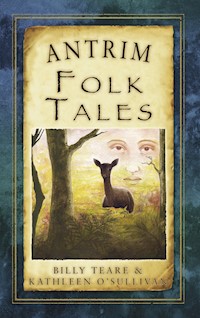
County Antrim, home to the Giant's Causeway, has a rich heritage of myths and legends which is uniquely captured in this collection of traditional tales from across the county. Featured here are stories of well-known figures from Irish folklore, including Conal Cearnach, with his association to Dunseverick Castle, and Deirdre of the Sorrows, whose mournful plight is linked to the rock at Ballycastle, known as Carraig Usnach. Here you will also find tales of lesser-known Antrim characters such as the heroic outlaw Naoise O'Haughan and local lad Cosh-a-Day, along with fantastical accounts of mythical creatures, including the mermaid of Portmuck, the banshee of Shane's Castle, and the ghostly goings-on in Belfast. These stories bring to life the county's varied landscape, from its lofty mountains to its fertile lowlands and dramatic coastline.
Das E-Book können Sie in Legimi-Apps oder einer beliebigen App lesen, die das folgende Format unterstützen:
Veröffentlichungsjahr: 2013
Ähnliche














With love to my daughters, Lee and Grace, her partner Damon
And my grandson Robbie.
Future health and happiness to Grace.
– Billy
With love to my beautiful sons – my heart’s branches – and to Michael. To my bravest, one and only sister Mary, for her support in every word that was written (and of course her family too).
To my brothers, their wives and families.
– Kathleen
CONTENTS
Title Page
Dedication
Foreword
Acknowledgements
1 The Widow, the Farmer and the One-Horned Cow
2 Martha Clark and Johnny Brady
3 Two Rathlin Tales
4 Tales from the Humes and Teares
5 Fair Days
6 Myth and Legend
7 Cosh-a-Day: A Local Lad
8 Around the Coast and into the Glens
9 Baystes from Sea and Land, that Were and Were Not
10 A Rare Breed
11 Devils, Witches, the Rope and the Half-Dead
Bibliography
Glossary
About the Authors
Copyright
FOREWORD
Any reader approaching a book entitled Antrim Folk Tales will do so with certain expectations. For a start the term ‘folk tale’ raises particular expectations as to the kinds of stories (with certain characters, settings, etc.) that might be expected to be found amongst its pages and likewise as to the kinds of stories that might be excluded.
Furthermore, this is a book of Antrim folk tales. But what is it that makes any particular story an Antrim story? Or, if it comes to that, what makes any story definable as belonging to a specific region or place? We know that stories travel, spreading virally like memes. They respect no human-imposed borders and it is common for different versions of the same story to be found in all corners of the world. So are we talking here about well-travelled tales that have references to features of the Antrim landscape, place names, inhabitants, and so on? Or might we expect stories that are specific to Antrim, stories that are to be found nowhere else?
And then there are expectations around literary style, the authorial voice in which the stories are told. In the hundred years immediately following the publication of Kinder und Hausmärchen by the Brothers Grimm in 1812, there existed what the American fairy tale scholar Jack Zipes has called ‘The Golden Age of Folk and Fairy Tales’, during which antiquarians, folklorists, philologists, and early anthropologists collected, transcribed, edited, translated and published anthologies of folk tales from across the world. And these enthusiasts and hobby scholars developed a particular style of writing, often intoned by the romanticism of the age, which has since become associated with such stories.
The significance of Antrim Folk Tales by Billy Teare and Kathleen O’Sullivan is that it so often defies and challenges those expectations. Here you will certainly find folk tales from this beautiful corner of Ireland, retellings of stories that have been told and retold for generations, and stories that have featured in other folk tale collections. You will also find tales that belong to the wider cannon of Irish Mythology – stories of Oisin, The Children of Lir, Deirdre of the Sorrows, Fionn MacCumhail and the ancient Kings of Ireland. But you will also find items of local history and lore, family stories, personal memories, reminiscences, fragments and even the odd joke here and there. It reminds us that folk tales are not defined by scholars and students of folklore. They are, very simply, the stories that people choose to tell, remember and retell time and again and they come in all forms, shapes and sizes, but collectively express not only who we are, but also why, what and how we are. The richness and variety of stories included here help us understand this. Sometimes they are stories that are set locally or feature Antrim characters from past and present, but sometimes not. Either way there are stories that are (or have been) told by the people of County Antrim and, most importantly, enjoyed by them.
Billy Teare and Kathleen O’Sullivan are well-known internationally for their performances of folk tales and songs and Billy has been a professional for thirty years. I first saw Billy perform in the early 1990s when I visited Northern Ireland for the first time to meet a thriving and vibrant community of storytellers. For those who are familiar with Billy’s performance work you will immediately recognise his voice in these pages. Gone is the formality of the literary and florid style of the Victorian folktale collectors and in comes the energy of the modern, oral voice that brings a delicious freshness to old texts.
For me, as a student of the contemporary storytelling scene, this anthology provides fresh insights into how a storyteller today gathers and develops their repertoire. Storytellers have always been magpies and honest thieves, taking material from wherever it can be found and reinventing it with a fresh relevance for new audiences. In the twenty-first century many of us no longer spend most of our lives in the same town or village. We are world travellers and what we all carry with us, as we travel, is our identity – our history, our way of speaking, our way of socialising, even our way of walking into a room and introducing ourselves to strangers. And as we do so we exchange our stories and take new ones back home with us. I hope this collection of Antrim folk tales will also travel and be appreciated by readers from all over – some of whom will be familiar with the landscape and culture that is evoked here and others who will be encountering Antrim for the first time. Old and new friends alike, please enjoy!
Mike Wilson
Falmouth, Cornwall
September 2013
ACKNOWLEDGEMENTS
Our first acknowledgment should be that ‘folk tales’ do not belong to anyone or any place. Shared versions of the same stories and their themes can be found wherever ‘folk’ exist. So, in this book we are not offering definitive versions, merely a gathering of stories by Billy, a contemporary professional storyteller from Antrim, who learns stories in the oral tradition, telling them around the world in modern settings. His use of traditional, modern and original stories, told in the present day, reflect the repertoire that he has developed and which appeal to him. By no means mainstream, or aimed at a mass commercial connection, they are hugely varied, from the silly and personal to some edgy/difficult subject matters. Compiled by myself (Kathleen), the stories are set in and against an Antrim backdrop, telling of some of the old and prevailing beliefs, customs, superstitions, lore and locations; they also represent the current health of storytelling in the county. We hope you enjoy travelling with us.
Billy would like to acknowledge the debt owed to his good friend Robert Henry, who died on Christmas Day 2012, and to Robert’s wife Lorraine. They were responsible for introducing him to sites in Antrim that held mythical, spiritual and metaphysical meaning, along with local lore. And tribute goes to the Scottish author and composer R.J. Stewart, for his work on Celtic myth and tradition. Also to the talent and inspiration of Robin Williamson, who kick-started it all for Billy. The mutual support between storyteller John Campbell from Armagh, and Billy, acting as chauffeur to him on long car journeys to storytelling gigs, must be acknowledged. Thanks also to the wonderful Scottish storyteller Stanley Robertson; both Stanley and John are late and greatly missed.
Billy’s wider family have been an invaluable source, in particular Lily Hume, David Hume, Bill Millar, Wilson Logan, Aunt Nessie, Reta McMaw, and the late Marcus Stevens.
Grateful thanks to all individuals for their help, especially folklorist Linda-May Ballard; author Philip Robinson; Cathie Stevenson and the staff at Larne Library; Revd Roger Thompson of St Patrick’s Church at Cairncastle (and his congregation); Sharon at Ballymoney Museum; and Larne heritage officer Jenny Caldwell.
Thanks to all the unnamed people who compile information on heritage for Northern Ireland councils; those who provide PR material on site and in brochure form; local historical societies; parish record and ordnance survey keepers; and those who archive newspaper articles.
Thanks to the staff at the Ulster Folk & Transport Museum, Cultra, and staff at the Linen Hall Library, Belfast.
Thanks to the one and only Mr Packie Manus Byrne, and all other ‘inspired muses’ and friends far and near. Health, wealth, wisdom and happiness to you all.
Thanks to Professor Mike Wilson (a scholar and a gent) and his family; to the mighty Joe Mahon; and to The History Press, in particular Beth Amphlett. And, last but not least, great thanks to my mum and dad (God be good to them) for steeping me in the tradition; my sister, Mary, for listening to and reading my stories; and to my family for supporting my research and writing.
Kathleen O’Sullivan, 2013
ONE
THE WIDOW,THE FARMER AND THE ONE-HORNED COW
A poor old widow lived on a tiny farm, with not a bean to her name. This lady had three daughters, and let us just say that these girls were not beating the fellas off with sticks. One of them was so wide, you could not get her in through the door. In today’s parlance she would be known as a nutritional over achiever. One of them was so thin, if she turned sideways in a room, you could not see her. And the third one was … just … wrong. The widow thought the only hope she had of getting rid of them would be if each of them had money or a piece of land.
It was a Friday evening and the start of a mammoth baking session. The widow and her girls set to work, between the scullery and the wooden bakehouse. A lot of chat went on between the women when they were in their domain. Sometimes, they found other chores to do, like making, mending and darning in the house. Mostly, they made plain potato and wheaten bread for the week and sometimes scones and pancakes, cooked on a griddle, on the Primus stove. The baking made a wonderful smell.
A bit away was a large, stone-walled farm. A lovely place in its time, but let go to ruin by the old farmer that owned it. He bothered about nothing but the next bottle, and spent most nights gambling away at cards until the early hours. He was in as bad repair and as decrepit as his surroundings.
Sometimes on Friday evenings, when his neighbours were baking, the old farmer would be reminded how good it might be to have home-cooked food, and he would herple over to stand and breathe in the lovely smell of the bread. So he was standing there this one evening and the widow was walking towards the scullery and noticed the hungry cratur standing there. It gave her an idea.
The next morning she took him a couple of rashers and some sparbled fadge. Over the breakfast, she had him considering why he should trouble himself looking after this big house and farm when she and the daughters could take it over and run it like clockwork. She told him he would be lifted and laid, and have all his meals given to him, and receive some of the money they would make whenever he needed it. As he sat eating the widow’s good food like a gorb, the considering did not take too long. He thought he was getting a gye guid bargain if he was fed like this regular and had four women around to look after him, and he agreed to the widow’s proposition.
The widow was as good as her word and, with the daughters, had the house tidy and the farm making money. She brought her twelve head of cattle with her and attended to the farmer, giving him board and lodging. She found early on that he was always hungry and more than ready for oaten bread and milk. After a couple of years, he was eating so much that the largest of the daughters had slimmed down a good bit and the thin one was near invisible. The third girl was … just the same.
Even though he was maybe getting more than his fair share and restored to the best of health, the ungrateful old lad started to return to his old ways and, before long, was up all night drinking and squandering any money the widow was making. Shortly, the old man’s ways became a matter of disagreement between him and the widow, and when she refused to give him any more money to drink or lose, he suggested she had stolen his farm from him. He would not hear of her labours in getting the place in order, or of her feeding, clothing and looking after him all the long while. As often happens in such cases of dispute, the two of them ended up battling it out in the court and she won.
You may be sure that the old man was not best pleased, and along with his gambling cronies he plotted to take back the farm. The plan they came up with was to use the widow’s fear of ‘blinking’.
There were (and in some places still are) very few farmers in Antrim who would risk the anger of those who practise the black arts, or those capable of blinking. For blinking was a curse, and caused harm to people or their livestock.
As the name implies, a blink can be performed easily enough, in the blink of an eye, or in a gaze. Other methods are known to involve a small loop, made from the hair of a cow’s tail, which is placed over the gate pier of a farm where there are cattle that a blinker intends to hex. In no time the animals would be suffering, or unable to produce milk. Salt blessings were said to be used in prevention and there were spell breakers too, known to provide the cure.
The widow believed in blinking and well the old man knew it, and he started to drop heavy hints, here and there, that he was capable of the blink himself. At first she took it for drunken bletherings, but on the morning she went to the byre and one of the cows was missing, she was not so sure. (It was friends of the old farmer from his card table who had taken the beast and hidden it.)
The widow ran straight to the old man, and the exchange of insults and bickering, guldering, yapping and gurning between the two of them was unheard of. You would imagine that under such a volley of ammunition as she had, the old lad would have cracked, but no. He resolutely maintained that the cow had been ‘taken’, and if she wanted it back he would have to perform a ritual to ensure its safe return. As you may expect, such an act would not come cheap and the widow asked him to name his price. He took great advantage and demanded milk, every kind of bread, broth, meat, and his bed and pillows plumped and made comfy, that he could lie down and be rested for his task. Even before he took his slumbers, he said that a good bottle of Bushmills should be waiting when he awoke, to enliven his endeavours.
Refreshed from his sleep, he sat the widow and her daughters at the kitchen table, a cloth over the window to create a good dark atmosphere, and he had them holding hands, all for show, to make them believe he was communicating with spirits in the other world. In the widow’s opinion, he was communicating far too liberally with the spirits in the bottle at his elbow. Between swigs, he was rolling his eyes and talking a brave lot of gobbledygook. The whiskey and antics had him in a lather of sweat, adding to the illusion that he was in some type of trance. He was so good at the play-acting that he had the hair standing up on the head and neck of the widow and her daughters.
As all this was going on at the table, with the window blocked by the cloth, the lads who had hidden the cow snuck it back into the byre. But this was only part of the old man’s plan. He had asked his card-playing buddies to cut a horn off the cow.
With his ‘magic’ worked, and knowing the cow would be back in the byre, the old lad was gasping and groaning and getting on as if exhausted. In a hoarse rasp, he told the widow to go with him to see if the animal was restored. Out they went and, sure enough, the cow was there. But of course, the first thing she noted was the missing horn. He shook his head, telling the widow that sometimes a part of the animal was kept by the beings in the other world, as a souvenir, as it were. Well the widow started up with a tirade that made any previous exchanges seem like a lullaby. She was not happy that the horn was missing off her best cow. It would fetch very little at market and she told the old man to get charming again, as soon as he liked, and restore the animal to the way it was.
Now the old fella was ready to put the rest of his plan in action. He told her that of course he could get the horn back on the cow, but again, he would have to ask a price. And he named his price: the return of his farm. He had a few conditions as well, starting with a request for another bottle. The man told the widow that in order to work this charm, she was not to utter another word until the deed was complete. She duly fell silent.
When he was halfway through the bottle, he got the widow and the daughters to hold hands with him and stand around the cow. Then, as before, he chanted and flailed his arms, and came out with a whole lot of nonsense. He went around behind the women, shouting for ‘one horn’. Then he went around them again, shouting for ‘two horns’. When he was going around for the third time, the widow stopped him in his tracks, to argue it was only one horn they were after. With that, he said she had spoken out of turn, when he had asked her specifically NOT to speak until he had finished. He said it was now impossible for him to return the horn, but she would have to honour her side of the bargain and give him back his farm.
SPARBLED FADGE RECIPE
500g dry mashed potatoes
100g plain flour
100g maize meal (polenta)
Pinch salt
Flour (for rolling)
Put the potatoes, flour, maize and salt in a bowl and mix to a dough. Turn out onto a floured surface and knead for two minutes. Roll out to a 1cm thick circle and cut into triangles. Smear a pan very lightly with oil (use kitchen paper) and cook the fadge on a low heat for about three minutes each side. Serve immediately or fry with bacon and butter later.
http://www.bbc.co.uk/northernireland/magazine/food/recipe_49_1.shtml
This story is based on an Antrim folk tale collected by Michael J. Murphy in 1957.
Archive material, texts and interviews from bygone days illustrate how deeply held beliefs about blinking were. For example, in an old BBC Northern Ireland radio show, the late Susan Hay, of Ballycarry, an aficionado on folklore, spoke of the ‘witching’ of cows that would prevent the milk churning to make butter. She conceded that some of the problems may have been due to mismanagement, but still thought it best to observe the etiquette, if entering a farmhouse or byre when churning was in progress, of saying, ‘I wish you luck on your cows.’ Not only was this a common courtesy, but a visitor not saying it might be under suspicion of wishing otherwise, or placing the blink.
TWO
MARTHA CLARK AND JOHNNY BRADY
No one remembers when ‘once’ was, or precisely what time it was upon, but that is when this all started, one person telling the next person, telling the next and so on, year in, year out, and that is enough to let you know that what happened was a brave time ago – upon someone’s time.
There was a neat wee woman called Martha Clark and she lived in a neat wee porter lodge at the foot of the Lady Hill, which belonged to a big estate, Redhall. You will maybe know that that’s down near Ballycarry.
Martha was not married. She was a shepherdess and she owned a few sheep – twenty in all – and she used to keep the sheep penned out the back of the porter lodge. Now, the thing about Martha was, she was a wee bit deaf.
One morning when she got up and looked out of her window, she saw that every one of the sheep was gone. There was not a sheep to be seen. When she went out, she discovered that the gate had broken, so all the sheep had got out that way. Now, she had a good idea where they had gone to, so she set off, along the Magheramourne road, until she came to the Burnside Loaning. She went along the loaning, passed the oul’ wa’s, and she saw a man ploughing a field. This man’s name was Johnny Brady.
It so happened that Johnny was a wee bit deaf too. It was never known how Martha lost her hearing, but the way Johnny lost his hearing was legendary. It seems at one time he had been one of the best poachers about Ballycarry. He used to do most of his poaching around the lands belonging to Redhall. Redhall was owned at that time by a man called Pottir and he did not like poachers one bit.
Pottir had lookouts and gamekeepers keeping an eye out for poor Johnny day and night, and every time they caught him, they’d take his weapon and rounds and his catch, and they would send him on his way, with a boot up the backside for good luck. It got that bad that Johnny could not afford to buy cartridges, so he started to make his own. In fact, he more or less built his own shotgun too, and it was said that because his gun was crudely made and in those days there was no ear protection, this is what had made him go a bit deaf.
A poacher’s day starts early, but Pottir himself would never be up out of his bed until about nine or ten, so he did not often see Johnny. When he did, he did not recognise him, as Johnny would disguise himself as one of the gamekeepers. Johnny took great delight in having sport at the landowner’s expense. One morning, he saw Pottir coming towards him. So he broke his gun and hid it down the back of his trousers.
Johnny cupped his ear and Pottir bellowed, ‘Well, my man, what are you doing up at this time of the morning?’
Johnny said to Pottir, ‘Indeed sir, I was going to ask you the same.’
Pottir answered, ‘If it’s any of your business, I am out to get an appetite for my breakfast.’
Johnny said, ‘Indeed sir, I’m out to get a breakfast for me appetite.’ And he sauntered off to do just that, with a smile on his face.
Another morning, a game warden caught Johnny red-handed, poaching trout by the Burnside Burn. He had two trout in a pail. But, he told the warden that the fish were his own pets and he was just letting them have a swim.
‘Nonsense!’ shouted the game warden.
‘It’s true,’ said Johnny. ‘Surely it’s not against the law for me to let my pets swim here, is it? You see, I put them in for a swim and when I whistle they come back to me.’
‘I’ve got to see this,’ said the game warden.
So Johnny tossed both trout into the river.
‘Okay, now let’s hear you whistle for your trout to come back to you.’
‘Trout?’ said Johnny, once he’d got rid of the evidence. ‘What trout?’ And he took off like a hare, leaving the game warden on his knees, staring into the river.
Johnny had great craic at the expense of the keepers of the game. One morning, when he had bagged himself a brace of pheasant (that’s two), he ran straight into a warden. The warden asked, ‘You, my man, have you got pheasant in that bag?’
‘I have,’ says Johnny, ‘and if you can tell me how many I have, I’ll let you have them both.’
Too silly to heed the broad hint, and after much brow furrowing, the warden guessed, ‘Three?’
‘No, just the one,’ said Johnny, and continued on his way.
It was later, on that very same morning, that Martha Clark saw Johnny ploughing and asked, ‘Johnny, have you seen my sheep?’
Johnny did not catch what she had said. He thought she was asking him what he was doing, so he just pointed at the furrow the plough was making. Martha looked at where Johnny was pointing and assumed he was telling her where her sheep had gone. So she said, ‘Thanks very much Johnny.’ And she climbed over the fence, set off up the field and over a wee hill into a small valley … and there were all her sheep. Martha counted them: two, four, six, eight … the whole lot, all twenty of them, were there, but one wee lamb had a broken leg.
She said, ‘Oh, you poor wee cratur you.’ She gathered the lamb in her arms, cradled it, and carried it back down the field. Of course, all the sheep knew her well and followed after her. So when they got back down to where Johnny was standing, Martha was thinking to herself, ‘it was awful kind of Johnny to tell me where me sheep went, so I think I’ll give him this wee lamb as a present. It’s got a broken leg, but he could fix it up with a splint.’
She said, ‘Johnny, I’m going to give you this wee lamb as a gift.’
Of course, Johnny did not hear what she had said. All he saw was, there stood Martha, with a lamb cradled in her arms, and the lamb had a broken leg. He thought that she was accusing him of breaking the lamb’s leg.
Johnny said, ‘That’s absolutely nothing to do with me. I never broke that lamb’s leg. Go on, take it away out of here.’
Martha could see Johnny was not best pleased, but because she did not hear what he said, she thought he was cross and saying that he did not want the lamb, but he wanted one of the bigger sheep. She said, ‘Indeed you are not having one of the bigger sheep; you’ll take this wee lamb, or nothing at all.’
Johnny insisted, ‘I had nothing to do with breaking that lamb’s leg, you can clear off. Take it away out of here.’
And they started to bicker, neither hearing what the other was saying. A whole row started, and the noise of the two of them shouting and bellowing at each other eventually attracted the neighbours, who came out and gathered around to see what was going on.
It wasn’t long before the local peeler came up from Whitehead on his pushbike. When he heard the row, he got off his bike. ‘What’s going on here?’ he asked, making his way through the crowd to where Johnny and Martha stood yelling and gurning and ranting at each other. ‘Look,’ the policeman said, ‘if you don’t stop this rowing right away, I’ll take the both of you into custody and you’ll be up before the judge in the morning and you’ll be done for breach of the peace.’
But of course Johnny and Martha never heard a thing he said, and carried on exchanging insults. So he arrested the pair of them and took them both down to the police station in Larne. Martha carried her wee lamb with her.
The next morning, they were up before the judge. At that time, it was a judge called Jackson. He was known to the criminal fraternity of Larne as Santa Claus Jackson, because he was full of good will and always saw the best in people. But, in the strangest turn of fate, Judge Jackson, the wise, learned, always lenient man, was also just a wee bit deaf. Not only a wee bit deaf, but a bit short-sighted as well. It did not matter what was presented in court, he just judged the case on the facts, as he thought best.
This morning, Judge Jackson had Johnny and Martha, with the lamb cradled in her arms, standing before him. Each of them was explaining to him their side of events. He did not hear a word of it. What he saw in front of him was a man and a woman, and the woman was holding, in her arms, what looked to him like a baby. He got it into his head that this must be a couple looking for a divorce. Eventually he said, ‘Tell me this, how many years have you been married?’
Martha did not hear what he’d said properly and just caught the words ‘how many’. She thought the judge was asking how many sheep she owned and answered, ‘Twenty your honour.’




