


6,99 €
Mehr erfahren.
- Herausgeber: Corvus
- Kategorie: Abenteuer, Thriller, Horror
- Sprache: Englisch
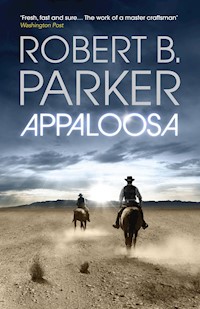
New Mexico Territory, 1882: two itinerant lawmen walk their horses down the long, shale-scattered slope into the frontier town of Appaloosa. Below them, lies rancher Randall Braggs' new fiefdom. Ever since he gunned down Appaloosa's marshal, Braggs and his men have owned the town, stealing, beating, murdering with impunity - living off it like coyotes feeding off a dead buffalo carcass. Summoned by Appaloosa's oppressed aldermen, Virgil Cole and Everett Hitch are here to restore the rule of law. They've done it before, they know what to do only too well: shoot quick, shoot clean, reload. But they aren't the only new arrivals in town. The enigmatic Mrs Allison French has stepped off the train with only a dollar to her name, a keen sense of survival and a good eye for a strong man. Finding one isn't going to a problem - Appaloosa is full of them: Cole, Bragg, Hitch. The problem is that Allie French isn't afraid to hedge her bets... and that Virgil Cole's heart isn't as steady as his gun hand. Appaloosa is an intelligent, emotionally profound novel, told in bone-clean prose wryly leavened with whip-sharp dialogue. It's deeply satisfying on four levels: one, it's a well-told historical adventure and a modern re-interpretation of a classic theme; two, it's an ode to unassailable friendship; three, it's a subtle love story between two profoundly flawed people; and four, the way Parker writes, you'd swear the pages turn themselves.
Das E-Book können Sie in Legimi-Apps oder einer beliebigen App lesen, die das folgende Format unterstützen:
Veröffentlichungsjahr: 2010
Ähnliche



Copyright
First published in Great Britain in 2009 by Corvus, an imprint of Grove Atlantic Ltd.
First published in the United States of America in 2005 by Penguin.
Copyright © Robert B. Parker 2005. All rights reserved.
The moral right of Robert B. Parker to be identified as the author of this work has been asserted in accordance with the Copyright, Designs and Patents act of 1988.
All rights reserved. No part of this publication may be reproduced, stored in a retrieval system, or transmitted in any form or by any means, electronic, mechanical, photocopying, recording, or otherwise, without the prior permission of both the copyright owner and the above publisher of this book.
This is a work of fiction. All characters, organizations, and events portrayed in this novel are either products of the author’s imagination or are used fictitiously.
Corvus
An imprint of Grove Atlantic Ltd
Ormond House
26-27 Boswell Street
London WC1N 3JZ
www.corvus-books.co.uk
First eBook Edition: January 2010
ISBN: 978-1-84887-343-8
Contents
Cover
Copyright
PROLOGUE
Chapter 1
Chapter 2
Chapter 3
Chapter 4
Chapter 5
Chapter 6
Chapter 7
Chapter 8
Chapter 9
Chapter 10
Chapter 11
Chapter 12
Chapter 13
Chapter 14
Chapter 15
Chapter 16
Chapter 17
Chapter 18
Chapter 19
Chapter 20
Chapter 21
Chapter 22
Chapter 23
Chapter 24
Chapter 25
Chapter 26
Chapter 27
Chapter 28
Chapter 29
Chapter 30
Chapter 31
Chapter 32
Chapter 33
Chapter 34
Chapter 35
Chapter 36
Chapter 37
Chapter 38
Chapter 39
Chapter 40
Chapter 41
Chapter 42
Chapter 43
Chapter 44
Chapter 45
Chapter 46
Chapter 47
Chapter 48
Chapter 49
Chapter 50
Chapter 51
Chapter 52
Chapter 53
Chapter 54
Chapter 55
Chapter 56
Chapter 57
Chapter 58
Chapter 59
Again, and always, for Joan
PROLOGUE
The Boston House Saloon was the best in Appaloosa. It had a long, teak bar with a big, gilt-framed mirror behind it. At night, the room was lit by coal oil lamps on a chandelier that could be lowered and raised on a chain and pulley. It was late afternoon, and the place was empty except for the bartender and three off-shift copper miners drinking beer. The bartender was Willis McDonough. McDonough was a fat man who always wore white shirts fresh from the Chinaman. He moved easily and with great dignity up and down the bar. He was polishing glasses with a clean towel when the two men came into the saloon and ordered two glasses of whiskey.
One of the men, the shorter one, had a small face with a narrow mouth and prominent front teeth, which he tried to conceal with a big, sweeping moustache. He carried a gun cross draw in a cheap holster. He wasn’t a miner, and he wasn’t a cowboy. The other man was taller, with a thick body and long, black hair that looked oily. He too had a gun. It was stuck into his right-hand pants pocket, with its dark walnut butt showing.
Between them, they drank a bottle of whiskey. They spoke only to each other. They paid no attention to McDonough or the three miners. When the whiskey was gone, they turned to leave.
“That’ll be three dollars,” McDonough said.
Both men turned and stared silently at McDonough for a moment. McDonough looked back at them and felt uncomfortable. They both had guns. Looking at them, he realized, as if they had told him, that they would shoot him if he persisted. He didn’t wish to die for three dollars. He shrugged. “On the house, gentlemen.”
Neither one showed any reaction. They turned and left the bar. McDonough’s heart felt shaky in his chest.
THEY HAD JUSTcome from seeing a stereopticon show about Venice, Italy. Now they walked up Second Street, lit mostly by the moon and a little by the light that spilled out of the barrooms. She put her arm through his. She could feel how strong he was. It would be so exciting if they could ever go to Venice—or anyplace, really, as long as they were together. Coming toward them on the board sidewalk were three men. From the way they walked, she could tell they were drunk. She wanted to cross the street, but he said no. He didn’t cross the street for anyone. They met by the livery stable. One of the men asked them where they were going. He was a tall man, she remembered, with narrow shoulders and a walleye. His beard was scraggly, as if he had trouble growing one.
“We’re going home,” her husband said, “if you’ll kindly step out of the way.”
“Good-looking lady you got,” the walleyed man said.
“My wife,” her husband said, and she could hear the warning in his voice.
“She fuck as good as she looks?” the walleyed man said.
Her husband hit him very hard, and he staggered backward. One of his friends, a short, thick man with no hat, drew his gun and shot her husband in the chest. She screamed. Her husband collapsed in a heap. The tall man got his balance back and dragged her away from her husband and into the livery stable. The two other men followed. They forced her onto the floor and began to take off her clothes. She struggled as hard as she could. Then she was naked and one of them was on her. She felt as if she was surrounded by a vast, empty space in which her own screams echoed like those of someone else. Then she closed her eyes and set her jaw and waited.
JACK BELLhad worked all the tough towns. He’d been a city marshal in cattle-trail towns and worked the wild mining towns like Tombstone and Silver City. He’d scouted for the army and rode shotgun for Wells Fargo. He’d once arrested John Wesley Hardin. When Clayton Johansson’s wife described the men who shot her husband and raped her, Bell was pretty sure who did it. With two deputies, he rode out to the Circle RB ranch to talk with Randall Bragg, who owned the ranch and for whom the suspects worked. They met in the open area of hard, trampled dirt between the ranch house and the barn. Most of his hands stood near Bragg. All of them were armed.
“Randall,” Bell said. “I’m afraid I need to bring three of your boys back into town with me.”
Bragg was a spare man, wearing a black duster and a high-crowned black hat. He held a Winchester rifle. Bell could see that the hammer was back.
“Can’t spare ’em, Jack,” he said.
His voice was deep, but it had a hard sound to it, as if it were forced out through his nose.
“It’s serious legal business, Randall. I got to take them in.”
“No.”
Bell looked at Bragg and the cowboys ranged behind him. He looked over his shoulder at one of the deputies, and nodded at the walleyed man standing with his two friends near one end of the group.
“Cut those three out,” he said.
The deputy looked uncertain. Bell’s hand rested gently on his gun’s butt.
“Do what I tell you,” Bell said.
The deputy moved his horse forward and pitched suddenly off the horse as a shot was fired from the barn. Bell knew it was a Winchester; he’d heard enough of them. He turned his horse toward the shot and pulled his gun free, and a bullet hit him in the face and knocked him backward out of the saddle. The second deputy sat, frozen, in his saddle. He looked at the deputy and Bell sprawled in the dirt. He glanced at the barn and then at Bragg. Bragg, still holding the Winchester, smiled.
“Time to see what you’re made of,” he said to the deputy. “Ain’t it.”
The deputy pulled his horse sharply around and headed out at a gallop. No one in town knew where he went.
1
It was a long time ago, now, and there were many gunfights to follow, but I remember as well, perhaps, as I remember anything, the first time I saw Virgil Cole shoot. Time slowed down for him. He fought with an odd stateliness. Always steady and never fast, but always faster than the man he was fighting.
Like my father, I’d been West Point, and I was good at soldiering. But soldiering didn’t allow too much for expansion of the soul. So after five years in the Indian Wars, I turned in my commission and rode away to see how far I could expand it. To keep from starving to death while I was expanding it, I shot buffalo for the railroad, and rode beside the driver on Wells Fargo coaches with an eight-gauge shotgun, and scouted now and then for the Army. I sat lookout for a while in a gambling parlor in Durango. I did a short turn as a bouncer in a whorehouse in Canon City. I got in a fight in Tres Piedras, and killed the man and had to move on pretty quick. I tried to find a little gold in the mountains in Colorado and didn’t, and came down out of the San Juan Mountains, looking for something else to do. Along the way, I read a lot of books and fucked a lot of women, all of whom I liked. Now, with thirty dollars’ worth of gold in my pocket, on a dark bay gelding named Sugar that I’d won playing poker in Esmeralda, I came on into Trinidad in the midafternoon on a summer day with the sun warm on my back.
It wasn’t much of a town then. Two streets north and south. Three streets crossing east and west. Twelve blocks in all. It was one of those towns that existed mostly for people passing through. Cowboys who brought cattle to the railhead from the East Colorado grasslands. Soldiers on the way to Fort Carson. Hide hunters, teamsters, and miners occasionally, coming down to resupply. A few people trying to farm. People like me, moving from place to place because they didn’t know what else to do.
As I passed the Rattlesnake Saloon on my left, the swinging doors burst open and a big man in a buckskin shirt came through them faster, surely, than he would have wished, stumbled across the boardwalk, trying to catch his balance, and fell forward into the street. There was blood on one side of his face. Sugar shied a little, and I pulled him up. The man in the street had gotten himself onto all fours when the saloon doors opened more gently and a tall man came out wearing a black suit. The suit’s coat was pushed back on the right side to expose a big, bone-handled Colt. I could see the badge pinned to his white shirt. Very dignified and deliberate, he stepped off the boardwalk into the street and stopped maybe six feet from the man in the buckskin shirt, and waited. Behind him, five or six other men pushed out of the saloon and stood on the boardwalk. He didn’t seem to see them, but I noticed that he had turned slightly, so that he could look at the man in the street and the men on the boardwalk.
The man in the street was on his feet now. He was a big man, fat but strong-looking, with a black beard and long hair. His buckskin shirt looked as if he’d worn it since the buck was killed. On his belt, he wore a bowie knife and a big Army Colt in a flap holster. He smelled like a man who skinned buffalo. Some of the street dust had caked onto the blood on the left side of his face. He faced the man in the black suit.
“Goddamn you, Cole,” he said. “You got no business hitting me with that gun.”
“Time for you to come on with me, Bear,” Cole said. “Until you cool down.”
His voice was surprisingly light and soft.
“I ain’t going with anybody,” Bear said. “I paid that whore three dollars for an hour, and she fucked me once and said she was through.”
“Bear,” Cole said, “I would guess that you are only good for one an hour.”
“Don’t you rag me, Cole. Next time I see that sow, I’m going to gut her.”
“No.”
Cole’s voice didn’t get less soft, but something came into it that made the “no” crackle like summer lightning. Bear almost swayed for a moment. Then he steadied himself, and his eyes shifted to the other men on the boardwalk.
Somebody said, “We’re with you, Bear.”
Somebody else said, “Don’t let him run you.”
Bear turned his gaze back to Cole.
“I ain’t coming with you,” Bear said.
Cole didn’t move. Nobody spoke. The light wind that had followed me out of the mountains drifted along the street, kicking up tiny swirls of dust and hay and dried manure. The force of his motionless silence was hard to explain. But I could see it pushing at Bear. The men on the boardwalk began to spread out a little. They were all hide skinners, probably come into town with Bear. Been sleeping on the ground with him, cutting buffalo with him. Eating bad food and drinking lousy whiskey with him. They couldn’t back away from him now. One of the men slid the hammer loop off his Colt. I took the eight-gauge from under my right leg. Cole saw me, I knew. Already, I could tell that he saw everything. If he thought I was with the skinners, the increase in odds didn’t appear to bother him. I had no money on this one. But I didn’t think Bear should gut a woman, whore or otherwise, and I didn’t think one man should go against seven.
“Marshal,” I said. “I’m backing you in this.”
I said it softly, but it was so still that it almost echoed. Cole didn’t stop looking at Bear, but he made a barely visible nod. Bear still watched Cole. The men on the boardwalk glanced at me when I spoke, and spread a little farther. I cocked both barrels on the eight-gauge and rested the butt against my right hip. Then I moved Sugar a little closer so that I was nearly beside Cole. Again, the silence arched over us, made more intense somehow by the sound of the easy wind.
Bear said, “Fuck you, Marshal,” and went for his gun.
I brought the shotgun to my shoulder. Cole seemed in no hurry. Carefully, he drew the Colt, thumbed back the hammer, aimed at the middle of Bear’s big body, and shot him in the center of the chest. He recocked the Colt as he turned a half-turn so that the big, bone-handled Colt was steady on Bear’s supporters. Bear sagged and fell over, his gun half out of the holster.
Sugar didn’t mind gunfire. Sudden movement scared him, but noise had no effect. He held rock-still where I had set him, so that both barrels of the shotgun were steady toward the men on the boardwalk.
“You men go about your business now,” Cole said. Nobody did anything.
“I won’t tell you again,” Cole said.
At the far right edge of the group, the right shoulder of the man who’d loosened his Colt made a kind of involuntary twitch and then froze. Everything teetered. Then the man turned and walked away, and the rest of the group followed him. Cole carefully let the hammer down on his Colt. He opened the cylinder, extracted the spent shell, put in a fresh one from his belt, closed the cylinder, and put the Colt carefully back in its holster. Then he looked up at me and nodded.
“Come see me in my office when you can,” he said.
Then he turned and walked away without a glance at the corpse. I stayed there for a time, watching as some people came out into the street and looked at Bear and stood around, and finally a man in a white coat came along with a wagon, and four of us helped him put Bear in the back, and he drove off. I tied Sugar to the rail, took the shotgun with me, and went on in and had a couple of whiskeys in the Rattlesnake, and a plate of beans and bacon. Some people stared at me, but no one said anything and, feeling warmer inside, I went on down to the jail and sat in the front room where Cole kept his office, and we talked. He asked me my name and I told him.
“Everett Hitch,” he said.
Like he was tasting it.
He asked me had I done much gun work, and said I had done some, but no law officering. And he asked me what I had done, and I told him.
“West Point,” Cole said—not impressed, just recording it, like he did, and filing it.
“You didn’t like soldier boyin’?” he said.
I told Cole that I liked some of it. I liked the men, and sometimes, on mounted patrol, I liked the space, and how far you could see, and the way it seemed like possibility was rolling out ahead of us. But most of the time, I said, it was sort of crampsome.
“Nothin’ can cramp you,” Cole said, “if you don’t let it.”
And I told him I thought that was right, which was why I quit soldiering and rode off to see what possibilities there might be. He nodded at that. I don’t know if it meant he understood, or if it meant he approved, or if he was registering again. And filing.
“You quick with a handgun?” Cole asked.
I said I could shoot, but what I was really good with was the eight-gauge. Cole smiled.
“If she could pick it up,” Cole said, “my Aunt Liza could be good with an eight-gauge.”
I agreed that it was hard to miss with an eight-gauge.
“You ever hear of me?” Cole said.
I said I had. Cole took out a bottle of pretty good whiskey and two glasses, and poured us a drink. And we drank that drink and a couple more.
“I need somebody to back me up,” Cole said. “You and the eight-gauge want the job?”
“Sure,” I said.
Which is how, fifteen years ago, I got to be a peace officer and Virgil Cole’s deputy. Which was why I was with him now, still carrying the eight-gauge, walking the horses down a long, shale-scattered slope toward Appaloosa.
2
They’re living off us like coyotes live off a buffalo carcass, you know?”
“Everything eats meat likes a dead buffalo,” Cole said.
We sat at a round table in the saloon at the Boston House Hotel in Appaloosa. Cole sat back, out of the light a little, his face shadowed.
“They buy supplies in Olson’s store and don’t pay for them. They take whatever women they feel like. They use horses from the livery and don’t bring them back. They eat a meal, drink a bottle of whiskey, whatever, and leave without paying.”
The speaker was a white-haired man with bright blue eyes. His name was Abner Raines.
“You in charge?” Cole said,
“Three of us,” Raines said, “Board of Aldermen.”
He nodded at the two men with him. “I own this place. Olson runs the store and the livery stable. Earl here owns a couple of saloons.”
Phil Olson was much younger than Raines, and portly, with smooth, pink skin and blond hair. Earl May was bald and heavy-set and wore glasses.
“And we got no law officers,” Raines said. “Marshal’s dead with one of the deputies. The other ones run off.”
“These people cattlemen?” I said. “Don’t seem like good cattle country.”
“It ain’t,” Raines said. “Most of the money in Appaloosa comes from the copper mine.”
“So what do they do?” I said.
“Bragg’s got some water up around his place, but they ain’t raising many cows. Mostly they steal them. And pretty much everything else.”
“How many hands,” Cole said.
“With Bragg? Fifteen, maybe twenty.”
“Gun hands?”
“They all carry guns,” May said.
“They any good with them?” Cole said. “Anybody can carry them.”
“Good enough for us,” Raines said. “We’re all miners and shopkeepers.”
“And we’re not,” Cole said.
“That’s for certain sure,” Olson said. “I heard after you and Hitch came in and sat on Gin Springs one summer, babies could play in the streets.”
“That’s why we sent for you,” Raines said. “We’re ready to pay your price.”
Cole looked at me.
“You game?” he said.
I shrugged.
“It’s what we do,” I said.
A smile like the flash of a spark spread across Cole’s face.
“It is,” he said, “ain’t it.”
The smile went as fast as it had come, and Cole turned his somber, shadowy face to the three aldermen.
“Money’s all right,” Cole said.
“Then you’ll do it?”
“Sure.”
The dining room smelled of cooking and tobacco and the lamp oil that kept it bright. The room was nearly full of men. The sound of cutlery and men’s voices sounded civilized and normal.
“What do we have to do?” May asked.
“Tell him, Hitch.”
“Who makes the laws in this town?” I said.
“The laws?” Raines said. “I guess we do: me and Earl and, ah, Phil. There’s a town meeting twice a year. But between times, we do it.”
“Cole and me’ll do the gun work,” I said. “But we’re going to button the town up like a nun’s corset. And we need you to make laws, so we can enforce them.”
“We got laws,” Raines said.
“You’re gonna have more. We need a lot of laws to make it all legal.”
“Well, sure, I mean, you tell us what you need,” Raines said, “and if it seems reasonable, we’ll put them right in the bylaws.”
Cole said, “No.”
“No what?” Raines said.
“No,” Cole said. “You do what we say or we move on. You solve your problem some other way.”
“Christ,” May said. “That would mean you was running the town.”
“It would,” Cole said.
“We can’t have that,” May said.
Cole didn’t say anything.
“I mean, you’re asking us, so to speak,” Raines said, “to turn the town over to you.”
Cole didn’t say anything.
“Far as I can see,” I said, “you’re gonna turn it over anyway. Us or Bragg.”
“But what if you ask for laws that we think are wrong?” May said.
Cole was entirely still.
Then he said, “We’ll give you a list.”
“A list.”
“A list of rules,” Cole said. “You agree, we have a deal. You don’t, we ride on.”
They all thought about it. The door in the hotel lobby opened, and it stirred the air in the dining room. The lamp flames moved in the stir, making the shadows shift in the room. The door closed. The flames steadied. The shadows quieted.
“Sounds fair,” Raines said after a while, as if he couldn’t think of anything else to say.
“We’ll bring you the list in the morning,” Cole said.
“I’ll be here,” Raines said.
3
We’d had a list of rules printed up five towns ago, and in the morning, Cole took them down to the hotel and gave them to Raines in his office. The laws were Draconian. The paper had a lot of aforesaids and wherebys in it, but, if you prune the thing to its essence, what it said was that what Cole said was law. Raines frowned as he read it and moistened his lips. Then he read it again. He looked at Cole. Then he looked at the paper again. The door of Raines’s office opened suddenly and a round-faced little waitress came in. Her face was flushed.
“Mr. Raines,” she said.
Her voice sounded foreign. Swedish maybe. She seemed short of breath.
“Not now, Tilda,” Raines said.
“Trouble in the bar, Mr. Raines.”
“Can’t Willis handle it?”
“It’s Mr. Bragg’s men.”
“Jesus God,” Raines said.
He looked at us.
“Space for your signature down there at the bottom,” Cole said. “On the right.”
Raines looked at us and at the paper. Cole never moved. “There’s four of them,” Tilda said. “They have guns.” Raines’s mouth trembled very slightly, and I thought he was going to say something. But instead, he clamped his jaw, took out a pen, and signed the sheet. Cole picked it up, looked at the signature, waved it a minute to dry the ink, then folded it and put it inside his shirt. With no change of expression, he nodded toward the door and I went out. The bar was to the right of the lobby. You could enter it from the lobby, but most people went in through the street entrance on the opposite side. It was the kind of thing I’d learned to notice without even thinking about it. Always know where you are, Cole used to say.
I went straight through the lobby to the street, and turned right and walked to the corner and went in through the swinging mahogany doors of the saloon. The late-afternoon sun, slanting through the doorway, made the smoky air look sort of blue. I let the doors swing shut behind me and moved to the left of the door while my eyes adjusted.
The center of the room had cleared, tables had been pushed aside, and most of the people in the saloon were standing against the walls. Four men, all wearing guns, were drinking whiskey at the bar. Behind the bar, the strapping, red-faced bartender stood stiffly, not looking at anything. There was a big, brass spittoon in the center of the cleared space, and two of the men at the bar were trying to piss in it from that distance. Neither was having much success. Cole came into the saloon through the lobby door, and watched for a moment.
“Button them up,” he said in his light, clear voice.
One of the men faltered in his stream and looked at Cole.
“Who the fuck are you?” he said.
“Virgil Cole.”
“Virgil Cole? No shit? Hey, Chalk,” he said to his partner in piss. “Virgil Cole wants us to stop.”
Chalk turned toward Virgil, his equipment still fully exposed, like his partner’s.
“Step a little closer, Virgil Cole,” he said. “And I’ll piss in your pocket.”
Chalk was a skinny guy with a hard little potbelly that pushed out over his gun belt. He had a meager, shabby beard, and it looked, from where I stood, like he needed to trim his fingernails. His pal was tall and thick and had long hair like Bill Hickok, except Hickok’s was clean.
“I am the new city marshal,” Cole said. “Put it away or lose it.”
“Hey, Bronc,” Chalk said. “They got a new marshal.”
The other two men, who’d been leaning on the bar, straightened a little and moved slightly apart.
“Didn’t they have another marshal, ’while ago?” Bronc said.
“They did.”
“Keep using them fuckers up, don’t they?” Bronc said.
“Got no use for them anyway,” Chalk said.
Cole didn’t seem to mind the small talk. He seemed entirely relaxed, almost friendly, as he stood just inside the doorway from the lobby.
“Put them ugly little contraptions away,” he said. “I’m going to walk you down to the jail, and I don’t want to scare the horses.”
No one stirred in the room. It was like one of those high-plains days in the summer, when it’s hot and still and a storm is coming and you feel the tension of its coming long before it gets there. Both men buttoned up their pants. It’s easier to be dangerous with your breeding equipment stowed.
“You ain’t walking us nowhere, Virgil Cole,” Bronc said.




