


99,99 €
Mehr erfahren.
- Herausgeber: John Wiley & Sons
- Kategorie: Wissenschaft und neue Technologien
- Serie: Statistics in Practice
- Sprache: Englisch
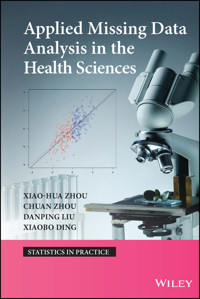
Applied Missing Data Analysis in the Health Sciences
A modern and practical guide to the essential concepts and ideas for analyzing data with missing observations in the field of biostatistics
With an emphasis on hands-on applications, Applied Missing Data Analysis in the Health Sciences outlines the various statistical methods for the analysis of missing data. The authors acknowledge the limitations of established techniques and provide newly-developed methods with concrete applications in areas such as causal inference.
Organized by types of data, chapter coverage begins with an overall introduction to the existence and limitations of missing data and continues into techniques for missing data inference, including likelihood-based, weighted GEE, multiple imputation, and Bayesian methods. The book subsequently covers cross-sectional, longitudinal, hierarchical, survival data. In addition, Applied Missing Data Analysis in the Health Sciences features:
- Multiple data sets that can be replicated using SAS®, Stata®, R, and WinBUGS software packages
- Numerous examples of case studies to illustrate real-world scenarios and demonstrate applications of discussed methodologies
- Detailed appendices to guide readers through the use of the presented data in various software environments
Applied Missing Data Analysis in the Health Sciences is an excellent textbook for upper-undergraduate and graduate-level biostatistics courses as well as an ideal resource for health science researchers and applied statisticians.
Sie lesen das E-Book in den Legimi-Apps auf:
Seitenzahl: 377
Veröffentlichungsjahr: 2014
Ähnliche


















CONTENTS
Cover
Wiley Series in Statistics in Practice
Title Page
Copyright
Dedication
List of Figures
List of Tables
Preface
Chapter 1: Missing Data Concepts and Motivating Examples
1.1 Overview of the Missing Data Problem
1.2 Patterns and Mechanisms of Missing Data
1.3 Data Examples
Chapter 2: Overview of Methods for Dealing with Missing Data
2.1 Methods that Remove Observations
2.2 Methods that Utilize all Available Data
2.3 Methods that Impute Missing Values
2.4 Bayesian Methods
Chapter 3: Design Considerations in the Presence of Missing Data
3.1 Design Factors Related to Missing Data
3.2 Strategies for Limiting Missing Data in the Design of Clinical Trials
3.3 Strategies for Limiting Missing Data in the Conduct of Clinical Trials
3.4 Minimize the Impact of Missing Data
Chapter 4: Cross-sectional Data Methods
4.1 Overview of General Methods
4.2 Data Examples
4.3 Maximum Likelihood Approach
4.4 Bayesian Methods
4.5 Multiple Imputation
4.6 Imputing Estimating Equations
4.7 Inverse Probability Weighting
4.8 Doubly Robust Estimators
4.9 Code Used in This Chapter
Chapter 5: Longitudinal Data Methods
5.1 Overview
5.2 Examples
5.3 Longitudinal Regression Models for Complete Data
5.4 Missing Data Settings and Simple Methods
5.5 Likelihood Approach
5.6 Inverse Probability Weighted GEE with MAR Dropout
5.7 Extension to Nonmonotone Missingness
5.8 Multiple Imputation
5.9 Bayesian Inference
5.10 Other Approaches
Appendix 5.A: Technical Details of the Approximation Methods for GLMM and Computer Code for the Examples
Chapter 6: Survival Analysis under Ignorable Missingness
6.1 Overview
6.2 Introduction
6.3 Enhanced Complete-Case Analysis
6.4 Weighted Methods
6.5 Imputation Methods
6.6 Nonparametric Maximum Likelihood Estimation
6.7 Transformation Model
6.8 Data Example: Pathways Study
6.9 Concluding Remarks
Chapter 7: Nonignorable Missingness
7.1 Introduction
7.2 Cross-Sectional Data: Selection Model
7.3 Longitudinal Data with Dropout
7.4 Bayesian Analysis for Generalized Linear Models with Nonignorably Missing Covariates
7.5 Multiple Imputation
7.6 Inverse Probability Weighted Methods
Chapter 8: Analysis of Randomized Clinical Trials with Noncompliance
8.1 Overview
8.2 Examples
8.3 Some Common but Naive Methods
8.4 Notations, Assumptions, and Causal Definitions
8.5 Method of Instrumental Variables
8.6 Moment-based Method
8.7 Maximum Likelihood and Bayesian Methods
8.8 Noncompliance and Missing Outcome Data
8.9 Analysis of the Two Examples
8.10 Other Methods for Dealing with both Noncompliance and Missing Data
Appendix 8.A: Multivariate Delta Method
Bibliography
Index
End User License Agreement
List of Tables
Table 1.1
Table 1.2
Table 4.1
Table 4.2
Table 4.3
Table 4.4
Table 4.5
Table 4.6
Table 4.7
Table 5.1
Table 5.2
Table 5.3
Table 5.4
Table 5.5
Table 5.6
Table 5.7
Table 5.8
Table 5.9
Table 5.10
Table 5.11
Table 5.12
Table 5.13
Table 5.14
Table 5.15
Table 6.1
Table 8.1
Table 8.2
List of Illustrations
Figure 1.1
Figure 4.1
Figure 5.1
Figure 5.2
Figure 5.3
Guide
Cover
Table of Contents
Preface
Chapter 1
Pages
ii
iii
iv
v
xv
xvi
xvii
xviii
xix
xx
1
2
3
4
5
6
7
8
9
10
11
12
13
14
15
16
17
18
19
20
21
22
23
24
25
26
27
28
29
30
31
32
33
34
35
36
37
38
39
40
41
42
43
44
45
46
47
48
49
50
51
52
53
54
55
56
57
58
59
60
61
62
63
64
65
66
67
68
69
70
71
72
73
74
75
76
77
78
79
80
81
82
83
84
85
86
87
88
89
90
91
92
93
94
95
96
97
98
99
100
101
102
103
104
105
106
107
108
109
110
111
112
113
114
115
116
117
118
119
120
121
122
123
124
125
126
127
128
129
130
131
132
133
134
135
136
137
138
139
140
141
142
143
144
145
146
147
148
149
150
151
152
153
154
155
156
157
158
159
160
161
162
163
164
165
166
167
168
169
170
171
172
173
174
175
176
177
178
179
180
181
182
183
184
185
186
187
188
189
190
191
192
193
194
195
196
197
198
199
200
201
202
203
204
205
206
207
208
209
210
211
212
213
214
215
216
217
218
219
220
221
222
223
224
225
226
227
228
229
230
Applied Missing Data Analysis in Health Sciences
Xiao-Hua Zhou
University of Washington
Chuan Zhou
University of Washington
Danping Liu
National Institutes of Health
Xiaobo Ding
Chinese Academy of Sciences
Copyright 2014 by John Wiley & Sons, Inc. All rights reserved.
Published by John Wiley & Sons, Inc., Hoboken, New Jersey.
Published simultaneously in Canada.
No part of this publication may be reproduced, stored in a retrieval system, or transmitted in any form or by any means, electronic, mechanical, photocopying, recording, scanning, or otherwise, except as permitted under Section 107 or 108 of the 1976 United States Copyright Act, without either the prior written permission of the Publisher, or authorization through payment of the appropriate percopy fee to the Copyright Clearance Center, Inc., 222 Rosewood Drive, Danvers, MA 01923, (978) 750-8400, fax (978) 646-8600, or on the web at www.copyright.com. Requests to the Publisher for permission should be addressed to the Permissions Department, JohnWiley & Sons, Inc., 111 River Street, Hoboken, NJ 07030, (201) 748-6011, fax (201) 748-6008.
Limit of Liability/Disclaimer of Warranty: While the publisher and author have used their best efforts in preparing this book, they make no representations or warranties with respect to the accuracy or completeness of the contents of this book and specifically disclaim any implied warranties of merchantability or fitness for a particular purpose. No warranty may be created or extended by sales representatives or written sales materials. The advice and strategies contained herin may not be suitable for your situation. You should consult with a professional where appropriate. Neither the publisher nor author shall be liable for any loss of profit or any other commercial damages, including but not limited to special, incidental, consequential, or other damages.
For general information on our other products and services please contact our Customer Care Department with the U.S. at 877-762-2974, outside the U.S. at 317-572-3993 or fax 317-572-4002.
Wiley also publishes its books in a variety of electronic formats. Some content that appears in print, however, may not be available in electronic format.
Library of Congress Cataloging-in-Publication Data:
Zhou, Xiao-Hua, author.
Applied missing data analysis in the health sciences / Xiao-Hua Zhou, Chuan Zhou, Danping Liu, Xiaobo Ding.
p.; cm.
Includes bibliographical references and index.
ISBN 978-0-470-52381-0 (cloth)
I. Zhou, Chuan, 1972-author. II. Liu, Danping, 1981-author. III. Ding, Xiaobo, author. IV. Title.
[DNLM: 1. Data Interpretation, Statistical. 2. Biomedical Research–methods. 3. Models, Statistical. 4. Research Design. WA 950]
R853.S7
610.72′4–dc23
2013047830
Dedication
To Yea-Jae, Yi,
Tingting, and Shuqin
List of Figures
1.1
Example 1.6 to explain the missing mechanisms, MCAR, MAR, and MNAR
4.1
Scatter plot of height versus weight
5.1
Forty individuals and mean trajectories
5.2
Diagnostic plot for the imputed
hachin
,
education
,
mmse2
, and
apoee4
5.3
Illustration of the imputation procedures
Preface
With a strong practical emphasis on health science applications, this book describes statistical methods and models for the analysis of data with missing values. We attempt to write so that researchers with experience in applied data analysis, but less technical knowledge than a statistician, should be able to understand and implement most of the methods described. For those with a stronger background in statistics, we provide more technical details as to not detract from the flow of rest of the chapter. We have also tried to choose examples that are relevant to most health science researchers who work in a variety of disciplines.
In all fields of study, missing data are a common problem since, for any data collection process, there are so many things that could go wrong that missing values are all too likely. Thus, when attempts are made to answer the scientific questions of interest, researchers ask the all-too-common question: what do we do with the missing data?
The statistical literature to answer this question is well developed, but overly technical and complicated for researchers who are not experts in statistics and methodology. Therefore, researchers may recognize the existence of missing data, but fail to respond for two reasons: first, they may not understand the consequences of ignoring missing data and how it can impact the validity of their results; second, there is a lack of understanding of the statistical methods for missing data and how to apply them in their own research. Therefore, the purpose of this book is to provide health science researchers with the means of understanding the importance of missing data in their own personal research and the ability to use these methods given the available software.
This book is organized into eight chapters. Chapter 1 introduces concepts on the missing data mechanism and some real-world examples. Chapter 2 gives an overview of methods for dealing with missing data. Chapter 3 describes some design strategies for minimizing the impact of missing data. Chapters 4 and 5 introduce methods for dealing with missing data problems in cross-sectional and longitudinal studies, respectively. Chapter 6 deals exclusively with missing data problems in survival analysis. Whereas Chapters 3–6 deal with ignorable missing data problems, Chapter 7 presents methods for dealing with nonignorable missing data problems. Finally, Chapter 8 discusses methods for dealing with missing data in causal inferences.
As we worked through examples in the book, we chose to provide software code in the text of the chapters as we want to encourage application of these methods after an understanding of the basic theory. We chose to include R code in the text as many of the methods can be implemented in R; in addition, R is also a publicly available software environment (see xix www.r-project.org). Since many researchers also use Stata in addition to R, we include code for some selected examples. All the analysis data sets, together with R and Stata codes used in this book, can be downloaded from http://faculty.washington.edu/azhou/.
X.H. Zhou, C. Zhou, D. Liu, and X. Ding
Seattle, Washington
March, 2014
Chapter 2Overview of Methods for Dealing with Missing Data
Regardless of the existence of missing data, the end result of any analysis is to make valid and efficient inferences about the population of interest. Neyman and Pearson 1933 established valid criteria for evaluating any statistical procedure. These criteria include having a small bias, where bias refers to the difference between the average sample estimate and its true value, and a small variance associated with the average sample estimate (efficiency). Bias and variance can be combined in a single measure called the mean square error (MSE) so that the bias, variance, and MSE describe the behavior of the estimate. Using these criteria, we discuss the various missing data methods that are available, each with its own strengths and limitations. This chapter provides a brief overview of the existing approaches and classifies them according to whether they remove observations with missing data, utilize all available data, or impute missing data. An excellent overview of missing data methods is provided by Schafer and Graham 2002.
Lesen Sie weiter in der vollständigen Ausgabe!
Lesen Sie weiter in der vollständigen Ausgabe!
Lesen Sie weiter in der vollständigen Ausgabe!
Lesen Sie weiter in der vollständigen Ausgabe!
Lesen Sie weiter in der vollständigen Ausgabe!
Lesen Sie weiter in der vollständigen Ausgabe!
Lesen Sie weiter in der vollständigen Ausgabe!
Lesen Sie weiter in der vollständigen Ausgabe!
Lesen Sie weiter in der vollständigen Ausgabe!
Lesen Sie weiter in der vollständigen Ausgabe!




