


Erhalten Sie Zugang zu diesem und mehr als 300000 Büchern ab EUR 5,99 monatlich.
- Herausgeber: South Street Press
- Kategorie: Gesellschafts- und Liebesromane
- Sprache: Englisch
Ibrahim, a freelance journalist from Arabia, has always been deeply aware of his rich Arabian heritage and history but has become disillusioned and disheartened by the seemingly incessant onslaught of Western suspicion, abuse and adverse media attention thrust upon his people. To Ibrahim and his family, it seems as if Western paranoia and prejudice against the Arab has become set in stone. It is to escape this climate of hostility that Ibrahim decides to take his wife, two sons and three daughters on a holiday away from the heat of the Middle Eastern summer and visit an old journalist friend, Mark, a staunch Englishman who has retired to New Zealand. There, they could assimilate a new culture, meet new people with new ideas, and see a land seldom visited by their fellow Arabs and which has therefore remained untouched by the long tentacles of the Islamic extremist. In the weeks that follow, Ibrahim discusses with his old friend the ticklish questions of Western misconception, misunderstanding and the perceived inequalities of his race. Together they are able to dispel the myths and identify the areas of ignorance that prevail in the West and which do so much damage to the image of the Arab. Above all, Ibrahim is able to nurture within his young teenage offspring the seeds of a brighter future, one within which peace and reconciliation between the worlds of Islam and the West are of paramount importance.
Sie lesen das E-Book in den Legimi-Apps auf:
Seitenzahl: 167
Veröffentlichungsjahr: 2008
Das E-Book (TTS) können Sie hören im Abo „Legimi Premium” in Legimi-Apps auf:
Ähnliche




















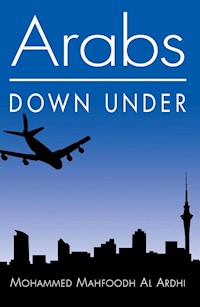
Arabs Down Under
Mohammed Mahfoodh Al Ardhi
ARABSDOWNUNDER
Published by South Street Press 8 Southern Court South Street Reading Berkshire RG1 4QS UK
www.southstreetpress.co.ukSouth Street Press is an imprint of Garnet Publishing Limited
Copyright © Mohammed Mahfoodh Al Ardhi 2008
All rights reserved. No part of this book may be reproduced in any form or by any electronic or mechanical means, including information storage and retrieval systems, without permission in writing from the publisher, except by a reviewer who may quote brief passages in a review.
First EditionTypeset by PHi, IndiaJacket design by David RoseCover illustration used with permission of Stephen Finn/Fotolia.com
Prologue
It was not ‘unto China’ but New Zealand that Ibrahim took his family. It was in the New Zealand winter, July 2007 that he chose to take a break from the excessive summer heat of his home in the Middle East. He had been contemplating making a trip ‘Down Under’ for many years but the pressure of life and the growing up of his family had denied him that opportunity until now. It was hot in Europe with heavier than usual rains and flooding in the United Kingdom so it was a logical choice to travel to the Southern, rather than remain in the Northern Hemisphere, besides which, he had an old friend, Mark, in New Zealand whom he had not met in many years. This was as good a time as any to reacquaint himself and retrace those intervening years of absence.
Ibrahim was a freelance journalist covering much of the background to the geopolitical situation in the Middle East and much of his investigative reporting had centred upon the fractured peace and political turmoil in Iraq. He had been well educated as a lad as his father had sent him to England for all his secondary education and to the United States to complete his university qualifications in journalism. That was many years ago; he was now in his mid-forties and channelling his own children through their advanced schooling years. He had two sons and three daughters.
It was of increasing concern to him that with all the anti-Israeli and anti-American ill-feeling among his Arab nationals, the tarnished image of his people was beginning to stick very firmly and unfavourably in the psyche of the West. It was unjustifiable, in his view, that his children were growing up in a world which did not respect the Arab, his religion or his culture. In fact, Western public opinion was now so generally opposed to the activities of political extremists across the globe, regardless of their ethnicity or political agenda, that the whole of the Arab race was immediately being put under the microscope, indeed many in the West had become totally paranoid. Was he, as a dedicated Muslim and responsible father, going to stand by and watch the insidious psychological destruction and malignity of his people?
Mark, his old friend in New Zealand, was a true Englishman. He was a steadfast Anglican and loyalist supporter of the British monarchy. At the age of about 18, Mark had thought to follow his father and train to become a clergyman. However, upon the best counselling of the day, he was advised to complete his studies in English and the Arts and travel the world. At 19 he began to implement that advice; he migrated of his own choice to New Zealand, leaving behind in England the whole of his family, to start a life anew in a former colonial outpost the other side of the world. Mark was now 66 and retired. Having travelled the world extensively as a highly skilled journalist and correspondent for a leading news agency, he had never married but retained his commitment to his faith. Education, journalism and travel had been the combined catalyst that had brought Ibrahim and Mark together as colleagues thirty years earlier and their friendship had stood the test of time since. They were on an intellectual plateau of understanding that permitted an uninhibited freedom of thought and speech that was seemingly only enjoyed by those who had lived a life among the global community. Certainly both shared the view that many of those less fortunate themselves, through a lack of education and life experience, had built up within themselves mental walls of prejudice so impenetrable that even faced with the truth their bias presented immovable barriers of ignorance and indifference. To heal the wounds of the past and plan for the future, hope remained in the wider education of the youth of the present.
1 Queenstown – Extremism and Fundamentalism
It was 18°C in the region. Storms and sleet-bearing clouds, then periodic falls of snow had blocked roads, stranded vehicles and holidaymakers, brought down power lines, temporarily closed the airport and finally had forced the postponement of the Winter Festival. Within a week of this, a large anti-cyclone had drifted across the Tasman Sea and embraced the whole of the South Island of New Zealand. The isobars had become wider, the winds had dropped, the lingering cloud had vanished and brilliant sunshine had appeared to the joy of all. With mid-day temperatures now stable at about 4°C, the flight touched down at 1500hrs, right on schedule, at Queenstown. It was Saturday, 7th July 2007, in the middle of the antipodean winter.
Disembarking was a closely knit Muslim family of seven, from the Arabian Peninsula. Temperatures in their homeland of the Middle East were about 40°C, a far cry from those they experienced now. As they emerged from within the Terminal they were clearly well prepared as layer upon layer of thick clothing, plus their traditional wear, was all too obvious and, needless to say, necessary. However, the glorious sunshine which prevailed not only would have given them the finest alpine views of the Southern Alps of New Zealand on descent but also softened the blow of reality, of extreme cold, that soon would follow.
“Ibrahim, how wonderful to see you again: welcome to New Zealand!”
“We are delighted to be here, Mark, after all these years. Let me introduce the family: my wife, Mona; my oldest lad, 17, Khamis; my youngest son, 13, Juma; my oldest daughter, Zamzam; then Rabab; and lastly my youngest, Farah.” They all smiled excitedly with the joy of once again being on firm ground, stretching their legs and breathing the fresh air of a completely new country with new people.
“Well I am delighted to have you all here safe and sound. You do realise, I hope, that you have arrived at the last bus stop on the planet?”
With the pleasantries over, two Toyota 4WD Prado vehicles, equipped with tyre chains and roof-mounted storage boxes, were signed over to Ibrahim by Tony and Helen, the young proprietors of a small overland 4WD rental company based in Christchurch. As it was the last fortnight of the winter school holidays in New Zealand it had been necessary to source these vehicles in Christchurch and pre-position them in Queenstown. All 4WD rental vehicles locally were fully committed with families and an active skiing season that was well underway. Certainly it was absolutely essential, at this time of the year, to have 4WD capability with snow and ice an every day feature on the roads. Coupled with this factor, Ibrahim and Mark would be doing all the driving and a preference for larger vehicles was thought desirable for the group. Once settled into their hotel, in the heart of the town, in Duke Street, it was possible to begin planning the programme of their intended stay of some 17 days which would see them finally depart from Auckland at the top of the North Island. It was to be an action packed, totally comprehensive but enjoyable break for everyone. Above all it was to be that rare opportunity to re-energise mind, body and soul in the crystal clear air of this unique and somewhat isolated island nation in the South West Pacific Ocean.
***
“Ibby,” Mark, now relaxed, reverted to Ibrahim’s nick-name of old, “you are just so fortunate to arrive here in such fantastic weather. Surely this good fortune must be the hand of Providence?”
“You mean the hand of Allah?”
“Of course, Ibby: what is more wonderful is that the weather forecast for at least the next two weeks will bring more of the same; it is indeed a generous ‘hand’ and definitely very welcome. I don’t want to be driving on black ice! That is the ice you cannot see. It will be melted by about 10 o’clock each morning. We need to be off the roads by 4 as the ice will reform smartly after the sun disappears.”
“Yes, have no worries, Mark. We will keep to short days on the road whenever possible. Now I have been thinking of our options for the next few days while we are here. We will reserve a whole day, as you suggest, to make the round trip to Milford Sound if road conditions permit but what young Juma and some of the girls really want to do right now is to test their skills on the snow slopes.”
“We have six great ski-fields in close proximity to Queenstown, Ibby. Some of the best skiers come from all over the world to be here. Apart from our Australian skiers, who seem to take up permanent winter residence here, we do attract those enthusiasts from the northern hemisphere who just cannot get enough of our winter skiing. I was delighted to learn that you will be getting young Khamis to undertake his tertiary education in Toronto. We have many Canadians here right now, also skiing.”
“Yes, we thought that a Canadian education would broaden his mind and give him some mental independence from the colleges and universities in the United States or Europe. It will be very interesting to see how he develops. So where are your ski fields, exactly?”
“Perhaps firstly, Coronet Peak; I personally recommend this one as it is just a 20 minute drive away. It has the advantage of exceptionally commanding alpine views of the whole of the Queenstown area with a backdrop of the Remarkables to be seen in the distance and Lake Wakatipu in the foreground. Then the Remarkables itself has a good ski field with Cardrona, Treble Cone, Snow Park, and Waiorau Snow Farm making up the others; they are all excellent.”
“We will opt for Coronet Peak, Mark.”
So it was, on the first available day, the family moved off in the two vehicles to Coronet Peak. The older lad, Khamis, and two of the girls joined Mark in one vehicle and the others remained with Ibby. As Mark had not been to Queenstown for many years, the very years he was covering news stories for his news agency in Europe and the Middle and Far East, Khamis was put to the test on day one in this, a foreign country where driving was on the opposite side of the road to which he was accustomed; he became the ‘navigator’. He was too young to be ‘codriver’ but if he was given the chance, which legally he could not be, he would have been behind the wheel in an instant! Such is youth. With the tracery of roads, rivers and ranges of mountains reduced to scale in maps on his lap, the environment around him had come to life. This little activity each day thereafter became the ‘norm’ for the whole of the journey. After all, Mark was retired and two heads were definitely better than one and certainly, when one of the heads was a very talented and bright 17 year old, the route finding was going to be simplified, surely? With the daily routine established, Khamis silently slipped a CD into the dash-board music system and within seconds the soft tones of a recital from the Qur’an drifted through the cabin.
“Mark, you don’t think we are all terrorists do you?” It was an alarmingly straightforward question put directly with the concerned innocence of youth.
“Khamis, if I thought you were a terrorist I wouldn’t be sitting beside you now, would I?”
“No, I guess not, but the whole world thinks we are terrorists,” he pleaded.
“If you were in a taxi,” began Mark slowly, “driving around Manhattan and you saw a green man on the corner, then turned into another street and saw another green man, then one more on another footpath, would you conclude that the whole of Manhattan was full of green men?”
Khamis thought. “No, of course not! I have only seen three green men.”
“Then, if you hear of only three terrorist attacks, then the whole world is not full of terrorists, is it? You can only account for three, not millions.”
“Yes, but … …,”
“I know your concerns, Khamis. Now let me be more specific. When I was your age, during the pre-Israel era, we feared the cruelty and cunning of the Irgun and Haganah. These were Jewish guerrilla movements; terrorists in fact. Now you personally know and hear of Hamas and Fatah. Both these began as anti-Israeli guerrilla organizations, terrorists, but of very recent times they have matured somewhat and taken on much more of a political role. Essentially, Khamis, terrorism is the systematic and organised use of violence and intimidation to force a government to buckle under pressure and accept certain demands.”
“So why do we have names like ‘extremist’ and ‘militant’; are these the same as terrorists?”
“Essentially, yes. Just like tea has many flavours, tea is tea! In the press we use a number of words to give the emphasis we need in describing an event. When you look at a news-clip on Al-Jazeera you don’t split hairs on the categorisation or definition of an individual. You look at the damage that has been done, and then label the perpetrator! Followers of Al-Qaeda were seen initially as ‘extremists’ but soon we reshaped our thinking and saw them as the deadly global ‘terrorist’ organisation. Following the 11th September attacks of 2001, you will recall the bomb attack on the USS Cole, the blasts in Tunis, Bali, Mombassa, Riyadh, Casablanca, Istanbul and Madrid. The list goes on with bombings in London and the failed car bombs in London and Glasgow. We attribute all of these, rightly or wrongly, to Al-Qaeda.”
“Our Islamic belief also denounces all forms of terrorism, Mark.”
“Yes, I appreciate that and also there is no place in your Islamic society for suicide bombers as well.”
“I understand why we have suicide bombers, Mark. They are ‘extremists’ in the full sense of the word. I know their behaviour too stems almost invariably from desperation and a sense of hopelessness in their cause. They are emotionally, and often in revenge, driven to do what they do.” Khamis paused thoughtfully and continued, “Yes, Mark, I agree, there is no place for this in our Islam. What I cannot understand is what you call fundamentalism?”
“Well, for a moment think of the Taliban then we can put a face on who are the fundamentalists. The Taliban are unremittingly fundamentalists. These people have a strict interpretation, in their view, of the literal meaning of your Qur’an. However, the very word Taliban means students and this was the name given to a handful of young lads who were sickened by the excesses of their local warlords in Afghanistan. They were never accepted by mainstream Muslims as their understanding was never of the traditional Islamic values.”
“Ah, now this is becoming clearer.”
After a few moments in silence and deep thought, Mark responded: “Simply put, Khamis, fundamentalism is the unquestioning faith in your traditional Islamic teachings but more importantly, this must be seen to be coupled with a dynamic political force.”
“I see!”
“What you will be interested to know my young Khamis is that ‘fundamentalism’ has just as many roots in Christianity as it does in Islam.”
“I didn’t know that!”
“Few do; let me briefly explain.”
Mark went on again, slowly, but methodically to outline to Khamis that a religious movement arose in the USA about 1919 which opposed all theories of evolution and anthropology, teaching that God transcends all the laws of nature, and that He manifests Himself by exceptional and extraordinary activities. Belief in the literal meaning of the Scriptures was an essential tenet. Mark also recalled that in 1925 a professor of science was convicted of violating the State laws of Tennessee by teaching evolution, and the incident aroused interest and controversy far beyond the religious circles of the USA.
“Now what I would like you to do, Khamis is talk to your father and come up with what you understand to be the list of fundamentals of your Islamic faith. Do you think you could do that for me?”
“Yes, sure.”
With that thought spinning around in his head, it was a quiet Khamis who began the day. In fact he opted not to join his younger brother and sisters who were determined to get the best out of the snow conditions and the planned skiing activities, albeit this adventure was completely new to them.
***
It had been a successful day with twists and tumbles in the snow coupled with some spirited sessions with the ski instructor. Although completely alien a sport, it was important that they were exposed to this activity if for no other reason than they could speak knowledgably one day to their friends in the West. As for Khamis, he did speak to his father and as he made ready for bed he drew out a pencil and pad and wrote down the fundamentals of his faith. These emerged as the Five Pillars of Islam: the belief of shahada, that there is no other God but Allah and that Mohammed was his Prophet; prayer; fasting; almsgiving; and the Hajj – the pilgrimage to Mecca. He also wrote down the six articles of his faith, iman: belief in Allah; His messengers like Moses, Jesus and Mohammed; Holy books; angels; the Day of Judgement and Destiny. He was determined to rush to Mark and tell him in the morning!
2 Lake Wakatipu – Nationalism and Democracy
“It is our second largest lake in the South Island. Our largest you will see tomorrow when we head off to Milford Sound.”
Mark was speaking to the family as they stood and absorbed spectacular and breathtaking, endless views of the lake. Spell-bound, silent and even semi-stunned by their view of Lake Wakatipu and its surrounding mountains and valleys beneath, they snapped away with their cameras. They were on the Look Out veranda outside the top of the Skyline Gondola which had vertically transported them into this almost entirely new world; a world above the busy streets of Queenstown below.
“There are various apocryphal accounts of how the town was named,” continued Mark. “The most popular suggestion was that a local gold digger exclaimed that the town was fit for Queen Victoria; hence Queenstown. With all the noise from the bars and pubs, last night, however, you probably think the place is the Las Vegas of New Zealand, some indeed have called this beautiful spot, the Vegas by the Lake.”
“Clearly they had a perceived fixation on the commerce-oriented tourism the town now exudes,” added Ibrahim somewhat cynically.




