


25,99 €
Mehr erfahren.
- Herausgeber: John Wiley & Sons
- Kategorie: Wissenschaft und neue Technologien
- Serie: RGS-IBG Book Series
- Sprache: Englisch
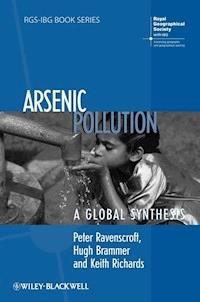
Arsenic Pollution summarizes the most current research on the distribution and causes of arsenic pollution, its impact on health and agriculture, and solutions by way of water supply, treatment, and water resource management.
- Provides the first global and interdisciplinary account of arsenic pollution occurrences
- Integrates geochemistry, hydrology, agriculture, and water supply and treatment for the first time
- Options are highlighted for developing alternative water sources and methods for arsenic testing and removal
- Appeals to specialists in one discipline seeking an overview of the work being done in other disciplines
Sie lesen das E-Book in den Legimi-Apps auf:
Seitenzahl: 970
Veröffentlichungsjahr: 2011
Ähnliche



















Contents
List of Figures
List of Tables
Series Editors’ Preface
Acknowledgements
Preface
List of Abbreviations
Glossary
Chapter One Introduction
1.1 Background
1.2 The Nature of Arsenic Pollution
1.3 History of Natural Arsenic Contamination
1.4 Arsenic Pollution
1.5 Risk, Perception and Social Impacts
1.6 Water-supply Mitigation
1.7 Structure and Scope of the Book
NOTES
Chapter Two Hydrogeochemistry of Arsenic
2.1 Introduction
2.2 The Chemistry of Normal and Arsenic-rich Groundwaters
2.3 Adsorption and Desorption of Arsenic
2.4 The Role of Sulphur in Strongly Reducing Groundwater
2.5 Arsenic and Microbial Activity
2.6 Arsenic Mobilisation Mechanisms
2.7 Associations of Arsenic with other Trace Elements
2.8 Arsenic Pollution and Mining
2.9 Summary
Annexe 2.1 Analysis of Arsenic in Natural Waters
NOTES
Chapter Three The Hydrogeology of Arsenic
3.1 Introduction
3.2 Arsenic in Rocks and Sediments
3.3 Arsenic in River Water and Sediment
3.4 Geo-environmental Associations of Arsenic in Groundwater
3.5 Geochemical Processes in their Geological Context
3.6 Behaviour of Arsenic in Aquifers
3.7 Case Histories of Arsenic-affected Aquifers
3.8 Implications of Long-term Pumping of Arsenic Contaminated Groundwater
3.9 Summary and Conclusions
NOTES
Chapter Four Soils and Agriculture
4.1 Introduction
4.2 Arsenic in Soils
4.3 Irrigation with Arsenic-contaminated Water
4.4 Arsenic Uptake by Plants
4.5 Options for Arsenic Management
4.6 Research and Development Needs
NOTES
Chapter Five Health Effects of Arsenic in Drinking Water and Food
5.1 Introduction
5.2 A Short History of the Health Effects of Chronic Arsenic Poisoning
5.3 Toxicity of Arsenic Compounds
5.4 Environmental Exposure to Arsenic
5.5 Acute Arsenic Poisoning
5.6 Dermatological Manifestations
5.7 Carcinogenic Effects
5.8 Systemic Non-carcinogenic Effects
5.9 Social and Psychological Effects
5.10 Effect of Other Toxic and Trace Elements
5.11 Geographical Differences in Health Effects
5.12 Case History of Arsenic Exposure in Murshidabad District, West Bengal
5.13 Diagnosis and Treatment of Arsenicosis
5.14 Removing Exposure to Arsenic
5.15 Summary and Recommendations
NOTES
Chapter Six Water-supply Mitigation
6.1 Introduction
6.2 Approaches to Water-supply Mitigation
6.3 Surveys of Arsenic Affected Areas
6.4 Exploiting Safe Groundwater Sources
6.5 Developing Surface-water Sources
6.6 Arsenic in Water Distribution Networks
6.7 Socio-economic Aspects of Mitigation
6.8 Policy and Planning Initiatives
6.9 Monitoring and Evaluation of Water-supply Mitigation Programmes
6.10 Summary
Annexe 6.1 Arsenic Survey Procedures
NOTES
Chapter Seven Removing Arsenic from Drinking Water
7.1 Introduction
7.2 Water Quality Issues
7.3 Methods of Arsenic Removal
7.4 Aquifer Clean-up
7.5 Disposing of Waste from Treatment Processes
7.6 Examples and Operational Experience of Arsenic Removal Technologies
7.7 Costs of Arsenic Removal
7.8 Guidance for Selecting Treatment Methods and Technologies
7.9 Case Study of Water Treatment Requirements in Bangladesh
7.10 Future Needs
NOTES
Chapter Eight Arsenic in Asia
8.1 Introduction
8.2 South Asia
8.3 Southeast Asia
8.4 China
8.5 East Asia
8.6 Western, Central and Northern Asia
8.7 Suspect Terrain and Research Needs
Annexe 8.1 The British Geological Survey Court Case
NOTES
Chapter Nine Arsenic in North America and Europe
9.1 Introduction
9.2 United States of America and Canada
9.3 Mexico
9.4 Europe
9.5 Suspect Terrain and Research Needs
NOTES
Chapter Ten Arsenic in South and Central America, Africa, Australasia and Oceania
10.1 Introduction
10.2 South and Central America
10.3 Africa
10.4 Australasia
10.5 Arsenic in the Ocean Basins
10.6 Suspect Terrain and Research Needs
NOTES
Chapter Eleven Synthesis, Conclusions and Recommendations
11.1 Scale and Impact of Arsenic Pollution
11.2 Chemistry, Cause and Prediction
11.3 Agricultural Impacts, Prospects and Needs
11.4 Water-supply Mitigation
11.5 Sustainability Issues
11.6 Geographical Perspectives
11.7 The Politics of Arsenic Pollution and Mitigation
11.8 Ten Priority Actions
NOTES
References
Index
RGS-IBG Book Series
Published
Arsenic Pollution: A Global Synthesis
Peter Ravenscroft, Hugh Brammer and Keith Richards
Resistance, Space, and Political Identities: the Making ofCounter-Global Networks
David Featherstone
Mental Health and Social Space: Towards InclusionaryGeographies?
Hester Parr
Climate and Society in Colonial Mexico: A Study in Vulnerability
Georgina H. Endfield
Geochemical Sediments and Landscapes
Edited by David J. Nash and Sue J. McLaren
Driving Spaces: A Cultural-Historical Geographyof England’s M1 Motorway
Peter Merriman
Badlands of the Republic: Space, Politics and Urban Policy
Mustafa Dikeç
Geomorphology of Upland Peat: Erosion,Form and Landscape Change
Martin Evans and Jeff Warburton
Spaces of Colonialism: Delhi’s Urban Governmentalities
Stephen Legg
People/States/Territories
Rhys Jones
Publics and the City
Kurt Iveson
After the Three Italies: Wealth, Inequality and Industrial Change
Mick Dunford and Lidia Greco
Putting Workfare in Place
Peter Sunley, Ron Martin and Corinne Nativel
Domicile and Diaspora
Alison Blunt
Geographies and Moralities
Edited by Roger Lee and David M. Smith
Military Geographies
Rachel Woodward
A New Deal for Transport?
Edited by Iain Docherty and Jon Shaw
Geographies of British Modernity
Edited by David Gilbert, David Matless and Brian Short
Lost Geographies of Power
John Allen
Globalizing South China
Carolyn L. Cartier
Geomorphological Processes and Landscape Change:Britain in the Last 1000 Years
Edited by David L. Higgitt and E. Mark Lee
Forthcoming
Aerial Geographies: Mobilities, Subjects, Spaces
Peter Adey
Politicizing Consumption: Making the Global Self in anUnequal World
Clive Barnett, Nick Clarke, Paul Cloke and Alice Malpass
Living Through Decline: Surviving in the Places of thePost-Industrial Economy
Huw Beynon and Ray Hudson
Swept-up Lives? Re-envisaging ‘the Homeless City’
Paul Cloke, Sarah Johnsen and Jon May
Complex Locations: Women’s Geographical Workin the UK 1850–1970
Avril Maddrell
In the Nature of Landscape: Cultural Geography on theNorfolk Broads
David Matless
Transnational Learning: Knowledge, Developmental and the North-South Divide
Colin McFarlane
Value Chain Struggles: Institutions and Governance in thePlantation Districts of South India
Jeffrey Neilson and Bill Pritchard
Domesticating Neo-Liberalism: Social Exclusion and Spacesof Economic Practice in Post Socialism
Adrian Smith, Alison Stenning, Alena Rochovská and Dariusz Swiątek
Queer Visibilities: Space, Identity and Interaction inCape Town
Andy Tucker
State, Science and the Skies: Governmentalities of the BritishAtmosphere
Mark Whitehead
This edition first published 2009
© 2009 Peter Ravenscroft, Hugh Brammer and Keith Richards
Blackwell Publishing was acquired by John Wiley & Sons in February 2007. Blackwell’s publishing program has been merged with Wiley’s global Scientific, Technical, and Medical business to form Wiley-Blackwell.
Registered Office
John Wiley & Sons Ltd, The Atrium, Southern Gate, Chichester, West Sussex, PO19 8SQ, United Kingdom
Editorial Offices
350 Main Street, Malden, MA 02148-5020, USA
9600 Garsington Road, Oxford, OX4 2DQ, UK
The Atrium, Southern Gate, Chichester, West Sussex, PO19 8SQ, UK
For details of our global editorial offices, for customer services, and for information about how to apply for permission to reuse the copyright material in this book please see our website at www.wiley.com/wiley-blackwell.
The right of Peter Ravenscroft, Hugh Brammer and Keith Richards to be identified as the authors of this work has been asserted in accordance with the Copyright, Designs and Patents Act 1988.
All rights reserved. No part of this publication may be reproduced, stored in a retrieval system, or transmitted, in any form or by any means, electronic, mechanical, photocopying, recording or otherwise, except as permitted by the UK Copyright, Designs and Patents Act 1988, without the prior permission of the publisher.
Wiley also publishes its books in a variety of electronic formats. Some content that appears in print may not be available in electronic books.
Designations used by companies to distinguish their products are often claimed as trademarks. All brand names and product names used in this book are trade names, service marks, trademarks or registered trademarks of their respective owners. The publisher is not associated with any product or vendor mentioned in this book. This publication is designed to provide accurate and authoritative information in regard to the subject matter covered. It is sold on the understanding that the publisher is not engaged in rendering professional services. If professional advice or other expert assistance is required, the services of a competent professional should be sought.
Library of Congress Cataloging-in-Publication Data
Ravenscroft, Peter.
Arsenic pollution: a global synthesis / Peter Ravenscroft, Hugh Brammer, and Keith Richards.
p. cm.
Includes bibliographical references and index.
ISBN 978-1-4051-8602-5 (hardcover: alk. paper)—ISBN 978-1-4051-8601-8 (pbk.: alk. paper) 1. Arsenic compounds—Environmental aspects. 2. Arsenic wastes—Environmental aspects. I. Brammer, H. II. Richards, K. S. III. Title.
TD196.A77R38 2009
363.738′49–dc22
2008013330
Figures
1.1Global distribution of arsenic contamination.2.1Inorganic arsenic species in water.2.2Adsorption of arsenic onto ferrihydrite and goethite.2.3Adsorption of arsenic onto magnetite.2.4Adsorption of arsenic onto aluminium oxide and clay minerals.2.5Influence of phosphate on adsorption of arsenic onto ferrihydrite.2.6Influence of dissolved organic carbon on adsorption of arsenic onto ferrihydrite and goethite.2.7Arsenic and sulphate reduction in the Mahomet Buried Valley Aquifer.2.8Adsorption of arsenic on sulphide minerals.2.9Microbial mechanisms of arsenic mobilisation.2.10Relationships between As and Mn, Fe, SO4, PO4 and NH4 in a shallow arsenic-contaminated aquifer in West Bengal.2.11Correlation of sedimentary iron and arsenic in Bangladesh and Vietnam.2.12Geochemical profiles from an arsenic-affected aquifer in Bangladesh.2.13Simple model of arsenic pollution in the Bengal Basin.2.14The kinetic arsenic model.2.15Geographical distribution of arsenic contamination by mobilisation mechanism.2.16Arsenic and pH at mining sites.3.1Relation of sediment yield, sand composition and weathering rates to arsenic occurrence in alluvial basins.3.2Relation of river water chemistry and sand composition to arsenic occurrence in alluvial basins.3.3Pumping-induced changes in water chemistry in the Basin-and-Range aquifers, Arizona.3.4Effect of purging on arsenic concentrations in monitoring wells at a landfill in the USA.3.5Temporal trends of arsenic in groundwater in Bangladesh.3.6Hydrogeochemical profiles of the Joypur, Ardivok and Moyna (JAM) aquifer, West Bengal.3.7Conceptual model of flow in the shallow aquifers of the Bengal Basin.3.8Hydrogeological section through the Central Oklahoma Aquifer.3.9Hydrogeochemical processes in the Malcantone catchment, Switzerland.3.10Schematic hydrogeological section through the lower Bengal Basin.4.1Variation of arsenic with depth beneath two irrigated paddy soils in Bangladesh.4.2Distribution of the arsenic hazard from groundwater irrigation in Bangladesh.4.3Symptoms of straighthead disease in Bangladesh.5.1Structure of some toxicologically important arsenic compounds.5.2Contributions of food and water to arsenic exposure in West Bengal.5.3Symptoms of arsenicosis in West Bengal.5.4Prevalence of keratosis and hyperpigmentation in West Bengal.5.5Prevalence of skin lesions in Inner Mongolia and Xinjiang provinces, China.5.6Dose–response relationships for lung and bladder cancer by gender in Taiwan.5.7Latency of cancer and heart disease in northern Chile.6.1Example of arsenic awareness information from Bangladesh.6.2Improved dug well in West Bengal, India.6.3Distribution of arsenic contaminated wells in relation to the extent of the Wisconsinan glacial advance, upper mid-west USA.6.4Arsenic risk in bedrock wells in New England.6.5Schematic design of a slow sand filter with roughing filter.6.6Household filters for treating surface water in Bangladesh.7.1Effect of pH and ferric iron dose on arsenic removal by coagulation-filtration.7.2Water quality influences of arsenic removal on ferric iron.7.3Schematic designs of iron and arsenic removal plants used for urban and rural supplies in Bangladesh.7.4Schematic design of a vertical greensand pressure filter.7.5Principles of in situ iron, manganese and arsenic removal.7.6Schematic design of the Kanchan household filter from Nepal.7.7Example of a household adsorption system used in the USA.7.8Schematic design of the Pal-Trockner arsenic removal plant.7.9Design of the Bengal Engineering College arsenic removal plant.7.10Arsenic adsorption plant in the UK.7.11Arsenic and iron concentrations at an in situ arsenic removal plant at Paderborn, Germany.7.12US Environmental Protection Agency cost estimates for centralised arsenic treatment.7.13Screening tool to select arsenic removal processes.8.1Occurrences of arsenic contamination of groundwater in Asia.8.2Major landforms and rivers in Bangladesh.8.3Hydrogeological section through Bangladesh.8.4Hydrogeological section through West Bengal.8.5Distribution of arsenic by district in West Bengal.8.6Distribution of arsenic in wells <150 m deep in Bangladesh.8.7Depth distribution of arsenic in wells in Bangladesh.8.8Conceptual model of arsenic occurrence in the Bengal Basin.8.9Geomorphology and arsenic occurrence on the Ganga Plains.8.10Distribution of arsenic contamination on the Nepal Terai.8.11Arsenic concentration in groundwater in the Hanoi area, Vietnam.8.12Evolution of contaminated groundwater at Hat Yai, Thailand.8.13Hydrochemistry of groundwater in the Huhhot Basin of Inner Mongolia, China.8.14Hydrogeology and chemical zoning of groundwater in the Datong Basin, Shanxi Province, China.8.15Hydrochemistry of groundwater in the Datong Basin, Shanxi Province, China.9.1Distribution of arsenic in groundwater in the USA.9.2Arsenic in the Basin-and-Range Province, Arizona.9.3Water quality zones and arsenic distribution in the Middle Rio Grande Basin, New Mexico.9.4Relation of pH to arsenic in the Middle Rio Grande Basin, New Mexico.9.5Relation between chloride and arsenic in groundwater in the southern Carson Desert, Nevada.9.6Distribution of arsenic in the Albuquerque water distribution system in 2005.9.7Cross-section through the Mahomet Buried Valley Aquifer.9.8Relationships between As, TOC, NH4 and HCO3 in the Mahomet Buried Valley Aquifer.9.9Hydrogeological cross-sections through drift deposits in Michigan.9.10Distribution of arsenic concentration in wells in eastern New England.9.11Relation between arsenic and pH in New England.9.12Hydrogeological section through Algoma Township, Wisconsin.9.13Relation between arsenic concentrations, the sulphide cemented horizon and the water table in eastern Wisconsin.9.14Relation of arsenic to sulphate, and bicarbonate in Fairbanks, Alaska.9.15Hydrostratigraphic section through the Zimapán aquifer system, Mexico.9.16Locations of occurrences of arsenic in groundwater in Europe.9.17Distribution of arsenic in groundwater in Hungary.9.18Relations of arsenic, iron and humic acid in groundwater in the Duna–Tisza interfluve, Hungary.9.19Distribution of arsenic-contaminated water wells in Finland.9.20Distribution of arsenic in glacial till in Finland.9.21Relationship between arsenic and pH in groundwater in Finland.9.22Distribution of arsenic in the Triassic sandstone aquifer of northern Bavaria, Germany.9.23Hydrogeological map and distribution of arsenic in the Madrid Basin, Spain.9.24Arsenic, pH and ion-exchange in groundwater from the Madrid Basin, Spain.9.25Relationships between arsenic, temperature, chloride, sulphate and pH in volcanic groundwaters in southern Italy.10.1Occurrences of arsenic in Central and South America.10.2Hydrogeological section through the Sali River basin, southwest Tucuman.10.3Correlation of arsenic with pH and fluoride in Tucuman Province, Argentina.10.4Depth distribution of arsenic, fluoride, total dissolved solids and pH in Tucuman Province, Argentina.10.5Profile of arsenic concentrations along the Rio Loa, Chile.10.6Occurrences of arsenic in Africa.10.7Occurrences of arsenic in Australasia.10.8Conceptual model of arsenic mobilisation on the Swan Coastal Plain, Perth, Australia.10.9Sand mineral associations in South America.11.1Global distribution of population affected by arsenic contamination.11.2Sustainability of groundwater irrigation.Tables
1.1Publications concerning arsenic by decade.1.2Locations of natural arsenic contamination of surface and groundwaters.2.1Important arsenic minerals.2.2Generalised chemical characteristics of arsenic-rich groundwaters.2.3Sorption-related properties of some common geological materials.2.4Arsenate adsorption on various minerals under the influence of phosphate.2.5Association of arsenic with other trace elements of health concern.2.6Concentrations of arsenic and other chemicals at selected mining sites.2.7Summary of arsenic mobilisation processes.A2.1Major techniques for laboratory arsenic analysis.3.1Typical arsenic concentrations in rocks and unconsolidated sediments.3.2Drainage basin characteristics and arsenic occurrence in alluvial basins.3.3Arsenic mobilisation and climate.3.4Arsenic mobilisation and morpho-tectonic setting.3.5Important occurrences of groundwater arsenic related to geology and climate.3.6Chemistry of arsenic-contaminated groundwater in different lithologies.3.7Experimentally determined arsenic distribution coefficients for selected minerals.3.8Factors influencing the migration of arsenic-rich plumes in aquifers.3.9Simplified lithostratigraphy of the Joypur, Ardivok and Moyna aquifer, West Bengal.3.10Mean arsenic and iron concentrations of lithostratigraphic units in the Joypur, Ardivok and Moyna aquifer, West Bengal.4.1Soil properties within typical soil associations of four physiographic regions in Bangladesh.4.2Effect of concentration and time on arsenic loading of soils from irrigation water.4.3Arsenic contents of aman and boro rice in Bangladesh.4.4International comparison of arsenic in uncooked rice grain.4.5Arsenic concentrations of selected crop and food items in West Bengal and Bangladesh.4.6Mean concentrations of arsenic in irrigation water, topsoil and rice in five upazilas of Bangladesh.4.7Total and available arsenic transfer coefficients for selected crops.5.1Acute toxicity of arsenic in laboratory animals.5.2Time-weighted exposure equivalents in drinking water.5.3History of USA standards for arsenic in drinking water.5.4Arsenic concentrations in common foodstuffs in the USA.5.5Exposure outcomes of cooking rice.5.6Average arsenic concentrations in raw and cooked rice and gruel in Bangladesh.5.7Arsenical skin manifestations by total daily intake in West Bengal.5.8Total dietary intake of arsenic in Region Lagunera, Mexico.5.9Effect of cooking on arsenic content of food in northern Chile.5.10Total dietary intake of arsenic in a village in northern Chile.5.11Association between skin lesions and arsenic in drinking water in Araihazar, Bangladesh.5.12Standard mortality ratios for various cancers in Taiwan, Chile and Argentina.5.13Dose–response relationship for microvascular disease in Taiwan.5.14Prevalence of respiratory illness in West Bengal.5.15Dose–response relation for cardiovascular disease and cerebral infarction in Taiwan.5.16Global distribution of arsenical health impacts.5.17Arsenic exposure profile in Sagarpara GP, West Bengal.5.18Diagnostic criteria for chronic arsenicosis.5.19Saha’s classification of arsenicosis symptoms.5.20Condition of skin lesions 5 years after removal from high-arsenic in drinking water in West Bengal.5.21Increased bladder and lung cancers in Region II of Chile.6.1Relation of cancer risk to arsenic mitigation planning in Bangladesh.6.2Comparison of laboratory and field kit testing in Araihazar.6.3Water quality from alternative water sources in Bangladesh.6.4Performance of arsenic mitigation technologies surveyed in the Risk Assessment of Arsenic Mitigation Options study.6.5Median disease burden associated arsenic mitigation options.6.6Indicative costs of water-supply options in Bangladesh.7.1Characteristic source-water quality and potential issues in water treatment.7.2Influence of speciation, chlorination and pH on arsenic adsorption on activated alumina.7.3Performance of 18 community arsenic removal plants in West Bengal.7.4Comparison of four arsenic removal systems in Canada.7.5Arsenic treatment costs at the Stadtoldendorf Waterworks, Germany.7.6US Environmental Protection Agency cost estimates for centralised arsenic treatment.7.7US Environmental Protection Agency cost estimates for point-of-use arsenic treatment.7.8Estimated costs of community arsenic treatment systems in Bangladesh.7.9Maximum achievable arsenic removal.7.10Arsenic removal systems related to raw water quality and demand.7.11Effectiveness of point-of-use treatment at private wells in southeast Michigan, USA.7.12Hypothetical groundwater treatment requirements for Bangladesh.8.1Case histories of arsenic occurrence in Asia.8.2First survey of arsenic in water supplies in India.8.3Simplified relationship between landforms, stratigraphy and aquifers in Bangladesh.8.4Status of arsenic contamination in West Bengal.8.5Percentage of tubewells in Bangladesh according to arsenic concentration category.8.6Arsenic occurrence related to physiographic unit in Bangladesh.8.7Arsenic mitigation options installed in Bangladesh.8.8Arsenic mitigation in Bangladesh by agency.8.9Geomorphological surfaces of the Ganga Plains.8.10Comparison of arsenic surveys on the Ganga Plains of India.8.11Groundwater quality surveillance in the Kathmandu Valley.8.12Summary of arsenic surveys in northeast India.8.13Depth distribution of arsenic in Sindh province.8.14Arsenic in private wells near Hanoi.8.15Relation of arsenic in groundwater to geology in Cambodia.8.16Arsenic survey of four townships in southern Myanmar.8.17Arsenic contamination of groundwater in China.8.18Prevalence of arsenicosis in China related to arsenic dose in drinking water.8.19Average groundwater chemistry at Shanyin, Shanxi Province, China.8.20Arsenic concentration and well depth in Xinjiang Province.8.21Average well-age and depth as a function of arsenic concentration in northeastern Taiwan.8.22Comparison of high- and low-arsenic groundwater from Kumamoto, Japan.9.1Case histories of arsenic occurrence in North America.9.2Average chemistry in selected water quality zones of the Middle Rio Grande Basin.9.3Arsenic occurrence in glacial drift in Relation to Provenance in mid-west USA9.4Relation of arsenic concentrations to lithology in New England.9.5Representative water analyses from the St Peter Sandstone, Wisconsin.9.6Hydrostratigraphy of the Willamette Basin, Oregon.9.7Arsenic concentration in groundwater around Fairbanks, Alaska.9.8Chemical analyses of selected wells in the Zimapán aquifer system.9.9Case histories of arsenic occurrence in Europe.9.10Analysis of mortality in the arsenic-affected area of Hungary.9.11Average groundwater quality on the Great Hungarian Plain.9.12Arsenic concentrations in As-affected regions of Hungary, Romania and Slovakia.9.13Arsenic in drift and bedrock wells in Finland.10.1Occurrences of arsenic contamination in South and Central America, Africa and Australasia.10.2Summary of arsenic surveys on the Chaco–Pampean plains of Argentina.10.3Exceedances of toxic trace elements in groundwater of La Pampa Province, Argentina.10.4Average composition of groundwater from the Chaco–Pampean plains.10.5Trace elements in loess and volcanic glass in Cordoba Province, Argentina.10.6Average concentration of arsenic in water supplies in three cities of Region II, Chile.10.7Comparison of three coagulation-filtration plants in Chile.11.1Summary of estimated peak arsenic exposure in drinking water by country.11.2Most severely arsenic affected countries.11.3Geology–climate–process matrix.11.4Comparison of community water-supply options in Bangladesh.Series Editors’ Preface
The RGS-IBG Book Series only publishes work of the highest international standing. Its emphasis is on distinctive new developments in human and physical geography, although it is also open to contributions from cognate disciplines whose interests overlap with those of geographers. The Series places strong emphasis on theoretically-informed and empirically-strong texts. Reflecting the vibrant and diverse theoretical and empirical agendas that characterize the contemporary discipline, contributions are expected to inform, challenge and stimulate the reader. Overall, the RGS-IBG Book Series seeks to promote scholarly publications that leave an intellectual mark and change the way readers think about particular issues, methods or theories.
For details on how to submit a proposal please visit:
www.rgsbookseries.com
Kevin Ward
University of Manchester, UK
Joanna Bullard
Loughborough University, UK
RGS-IBG Book Series Editors
Acknowledgements
Many persons have assisted in the preparation of this book through discussions and the supply of information, and are listed in alphabetical order below: Bill Adams (Department of Geography, Cambridge) for discussion, support and encouragement; Feroze Ahmed (Bangladesh University of Engineering and Technology) for reviewing Chapter 7; Kazi Matin Ahmed (Dhaka University) for discussions regarding Bangladesh, and reviewing Chapter 8; David Banks of Holymoor Consultancy for clarifications regarding arsenic in Norway; Bob Bredberg regarding the geology of Madoc, Ontario; Robert Brinkman (ex-FAO) for discussion of many subjects, especially regarding soils and agriculture; Dipankar Chakraborti, Amir Hossain and Bashkar Das (Jadavpur University, Kolkata) for hospitality, discussions and guiding one of the authors on a tour of the Technology Park Project; Chris Daughney of GNS Science for information on groundwater quality monitoring in New Zealand; Wole Gbadebo (University of Agriculture, Abeokuta) and Othniel Habila (UNICEF) for access to information on arsenic testing in Nigeria; Meera Hira-Smith (University of California, Berkeley) for arranging a visit to Project Well in West Bengal and discussions regarding dug wells; Guy Howard (DFID) for access to information and discussion concerning the RAAMO study in Bangladesh; Richard Johnston (UNICEF) for access to information concerning arsenic in Burkina Faso; K. Kestutis (Geological Survey of Lithuania) for providing data on As concentrations in Lithuania; Craig Meisner (Cornell University), G. Pannaulah (CIMMYT) and Richard Loeppert (Texas A&M University) for discussions regarding agriculture in Bangladesh and photographs of diseased rice plants; I.T. Mbotake (University of Buea) regarding arsenic in Cameroon; John McArthur (University College London) for many valuable discussions, especially regarding geochemistry, Bangladesh and West Bengal, and reviewing chapters 2 and 3; the NGO Forum for Water Supply (Bangladesh), especially M.A. Hasnat, for arsenic education materials; Ross Nickson (UNICEF) for information on arsenic in India, many helpful discussions, and for reviewing Chapter 6; Kirk Nordstrom (US Geological Survey) for information regarding Fairbanks, Alaska and other discussions; Ryuji Ogata (JICA) for data on deep wells in Bangladesh; Roberto Oyarzun (Madrid University) for information on river and sediment chemistry in Chile; Stanislav Rapant (Geological Survey, Bratislava) regarding arsenic pollution in Slovakia; V.K. Saxena (National Geophysical research Institute) for information on geothermal waters in India; Arup Sengupta (Lehigh University) and S. Sarkar, D. Ghosh and Samir Bag (Bengal Engineering College, Kolkata) for assistance in visiting arsenic removal plants in West Bengal; Allan Smith (University of California, Berkeley) for helpful comments regarding the health effects of arsenic; Ondra Sracek, for many valuable discussions and reviewing sections on South and Central America; Philip Stickler and Ian Agnew (Department of Geography, Cambridge) for their diligence in drafting the figures; Rafaella Vivona (IRSA) from providing information regarding arsenic in Italy; Rob Ward (Environment Agency) for information on arsenic in England and Wales; Richard Wilson (Harvard University) or helpful discussions; Scott Wilkinson (University of Canterbury) for access to his thesis on arsenic in New Zealand; Severn-Trent Services Ltd for photographs of arsenic removal plants in the UK; and any others we have overlooked.
The authors organised an international interdisciplinary meeting on Arsenic: the Geography of a Global Problem, on 29 August 2007 during the Annual Conference of the Royal Geographical Society/Institute of British Geographers at the RGS in London. Presentations at the conference are at: http://www.geog.cam.ac.uk/research/projects/arsenic/symposium/. Contributors came from several affected countries and concerned research groups, and included: George Adamson, K Matin Ahmed, Feroze Ahmed, Nupur Bose, William Burgess, Johanna Buschmann, Vicenta Devesa, Ashok Ghosh, M. Manzurul Hassan, Meera M Hira-Smith, Mohammad Hoque, Guy Howard, Jiin-Shuh Jean, John M. McArthur, Andrew Meharg, Debapriya Mondal, Bibhash Nath, Ross Nickson, David Polya, Mahmuder Rahman, Sudhanshu Sinha, Allan H. Smith, Ondra Sracek, Farhana Sultana, Richard Wilson and Yan Zheng. We are grateful for their involvement in an event designed to heighten interest in and concern for the arsenic contamination problem, and to Clarissa Brocklehurst, Ross Nickson and Oluwafemi Odediran for arranging a UNICEF meeting at the RGS on 30th August to follow up issues raised during the conference. Presentations and discussion over these two days contributed significantly to our thinking about the content of the book.
Finally, we are especially grateful to Downing College, Cambridge, and particularly to Dr Susan Lintott, for supporting this whole project and making possible the financial arrangements for its successful prosecution and conclusion.
Preface
Readers may be surprised to learn that the most severe effect of human impact on environmental systems is not climate change. But that is what this book sets out to show.
One similarity between global warming and the arsenic crisis is that in both, human actions accentuate risks associated with otherwise natural phenomena. Another is that the consequences affect the global poor most severely. Indeed, this dimension is already obvious from the history of the arsenic crisis. Nearly 50 million people in south and east Asia have, for some decades, drunk water contaminated with arsenic at levels above the old WHO standard of 50 ppb. Many already have clinical symptoms of arsenicosis, leading to this being referred to as history’s largest mass poisoning. By contrast, the USA has diverse sources and types of arsenic contamination in water supplies, but little evidence that this has a significant effect, because of better water treatment and better general health in the population.
What is less widely understood is the latency of the effects of chronic arsenic poisoning. Even if a solution to the problem of water supply quality is found soon, many who have been drinking contaminated water will still suffer cancer in spite of switching to clean water. Furthermore, arsenic ingestion is often estimated from water intake alone, although it is increasingly apparent that an additional loading arises from arsenic in food, especially from paddy rice grown with contaminated irrigation water. Soils thus irrigated may accumulate arsenic to phytotoxic levels, creating a problem of latent effects on crop yields.
That we find ourselves in this position reflects badly on both environmental science and the development process. Water becomes naturally contaminated by arsenic in several ways, and we must understand how this arises under different geological, geomorphological and geographical circumstances. The environmental sciences have not always successfully anticipated this sensitivity to specific circumstances, and one consequence of emphasis on climate change is a global focus that tends to avoid the issue of such sensitivity, and its potential meaning for regionally vulnerable populations. Questions that transcend disciplinary boundaries also still offer challenges; the reductive dissolution of arsenic might have been understood sooner had groundwater chemists talked at an earlier stage to marine geochemists. These shortcomings meant that science was unprepared for the consequences when development agencies sought to solve the problem of enteric disease caused by polluted surface water supplies, by providing shallow tube wells. These wells tapped aquifers in which precisely that process of reductive dissolution had elevated the dissolved arsenic concentrations to unhealthy levels.
Since these events, and the belated recognition of the consequential mass poisoning, research in the field has burgeoned, and it is now timely to synthesise the knowledge gained. In doing so, we examine the geochemistry of arsenic and its mobilisation, and the geomorphologies and geologies that define the geography of these processes. We suggest simple tools to identify areas where high levels of arsenic in groundwater might be expected, but have yet to be identified. We assess the risks for crop production and food contamination, and review the health and social effects, observed and potential. We then consider mitigation options, through water-supply substitution and point-of-use treatment; and their additional risks (e.g., drawdown of arsenic into overexploited deeper aquifers, and disposal of arsenic wastes generated by treatment procedures). And we examine these issues not only in general, but also as geographies, characterised by spatial diversity and multiple knowledge bases.
One of us, Hugh Brammer, not only contributed to the book, but also supported the research and the linked conference (see Acknowledgements, p. xxi) financially. His desire to do so arose from his experience in Bangladesh working on soils, agriculture and disaster preparedness, and his belief in the capacity of geography to facilitate better understanding of both the mobilisation of arsenic, and the cultural context of the management of its effects and their mitigation.
We hope this book will be valued as a synthesis of current knowledge about arsenic contamination and the crisis it has caused, and about what needs to be done to accelerate mitigation. We hope it will help to disseminate information and spread realisation of the nature and scale of the problem to a wider range of professionals and publics so that pressure to act on these issues will grow. We also offer it as an example of the practical value of geography in helping to tackle environmental and development problems with multidisciplinary dimensions and regionally differentiated consequences.
Keith Richards
Vice-President (Research), RGS-IBG (2004-2007)
18 August 2008
Department of Geography, University of Cambridge
Abbreviations
AA activated alumina AD alkali desorption AAS atomic absorption spectrometry; with variants, the generally preferred analytical method for analysis of arsenic in water. ADI average daily intake AMD acid mine drainage ARP arsenic removal plant As(III) trivalent arsenic, normally referring to the arsenite ion in solution As(V) pentavalent arsenic, normally referring to the arsenate ion in solution a.s.l above sea level ASM arsenical skin manifestation ASV anodic stripping voltammetry; an analytical technique for measuring ions in solution BFD Blackfoot Disease; a serious peripheral vascular disease common in Taiwan b.g.l below ground level BGS British Geological Survey BMI body mass index BP before present (years); used in radiometric dating to mean years before 1950. BV bed volumes; normally referring to the volume treatment medium in arsenic removal plants. CI confidence interval (normally 95% or 99%) CLD chronic lung disease CVD cardiovascular disease DALY disabily adjusted life years DCH Dhaka Community Hospital DMAIII dimethylarsinous acid DMAV dimethylarsinic acid DO dissolved oxygen DOC dissolved organic carbon DOM dissolved organic matter (similar to DOC) DPHE Department of Public Health Engineering (Bangladesh) DTW deep tubewell. This term has different meanings for irrigation and water supply. In irrigation in Bangladesh and India it is a high-capacity (50–60 L/s) motorised well equipped with a vertical-turbine or submersible pump. For water supply, however, it does refer to the depth of the well DWS drinking water standard EC electrical or electrolytic conductivity; a simple and reliable measure of the TDS content of water Eh a measure (normally in millivolts) of the oxidising (positive values) or reducing (negative values) potential of a water FAO Food and Agriculture Organization (of the United Nations) GAC granulated activated carbon GF-AAS graphite furnace atomic absorption spectrometry GV (WHO) guideline value (for drinking water) ha hectare HACRE Hidroarsenicismo Cronico Regional Endemico (chronic endemic regional hydroarsenicism). This term is applied to the characteristic symptoms of arsenic poisoning in Cordoba Province of Argentina. HH household ICP inductively coupled plasma (spectrometry). An analytical method suitable for analysis of arsenic and a broad spectrum of other elements IHD ischaemic heart disease, related to poor heart circulation IRP iron-removal plant Kd distribution coefficient; a measure of partitioning of contaminants between the solid and liquid phases LGM Last Glacial Maximum; the peak of the final Pleistocene glaciation between 18,000 and 30,000 years ago, when sea level fell to about 120–130 m below its present level MDI maximum daily intake MIT Massachusetts Institute of Technology MMAIII monomethylarsonous acid MMAV monomethylarsonic acid MCL maximum contaminant/concentration level MRL minimal risk level NCPF non-cirrhotic portal fibrosis (a liver disease) NOAEL no observed adverse effect level NOM natural organic matter OR odds ratio. Statistical term used by epidemiologists, similar to the ‘prevalence odds ratio’ and ‘risk ratio’. OR is used in casecontrol studies; it is the ratio of the odds of exposure in the affected group to the odds of exposure in the control group. An odds ratio of 2 means that people in the studied group are twice as likely to be afflicted as in the control group. PAHO Pan American Health Organisation PHED Public Health Engineering Directorate (West Bengal, India) POU point of use (treatment system). ppb parts per billion; a unit of concentration equivalent to μg/L in dilute solutions. ppm parts per million; a unit of concentration equivalent to mg/L in dilute solutions. PSF pond sand filter QFR quartz:feldspar:rock fragments ratio; normally describing sand composition RD reductive dissolution Rf retardation factor; a measure of how much the movement of a contaminant is retarded compared with the water in which it is dissolved RSSCT rapid small scale column testing (in water treatment studies) RWH rainwater harvesting SMR standardised mortality ratio. SMR is calculated after adjusting the age distribution of the group studied to fit that of an international standard age-distribution to ensure unbiased comparisons between different regions of the world SO sulphide oxidation SOES School of Environmental Studies, at Jadavpur University in Kolkata SSAAB South and Southeast Asian Arsenic Belt SSF slow sand filter STW shallow tubewell. The term is used in Bangladesh and India to describe a medium capacity (10–15 L/s) motorised irrigation wells equipped with a surface-mounted centrifugal pump. TCLP toxicity characteristic leaching procedure; a US Environmental Protection Agency test for assessing the pollution of waste prior to disposal TDS total dissolved solids (in water) TTC thermo-tolerant coliforms UP Uttar Pradesh (India) WHO World Health OrganizationGlossary
Arsenicosis A term describing the characteristic clinical effects of chronic arsenic poisoning Arteriosclerosis Medical term referring to hardening and/or narrowing of the arteries Authigenic A mineral or crystal formed in a sediment after its deposition Block This term has special meaning in West Bengal, an administrative unit equivalent to the Bangladeshi term upazila Bowen’s disease A pre-cancerous form of skin lesion Framboidal Adjective derived from the French word for raspberry, usually applied to describe a form of authigenic pyrite Hepatic Concerning the liver Hyperpigmentation Darkening of the skin Hypopigmentation Lightening of the skin Ischaemia Restriction in blood supply with resultant damage of tissue Keratosis Skin disease producing painful corn-like growths or nodules Melanosis Darkening of the skin (opp. Leucomelanosis) Myocardial infarction Heart attack Palaeosol An ancient, normally buried, soil horizon Raynaud’s syndrome A debilitating condition that causes periods of severely restricted blood flow to the fingers and toes, and sometimes the nose or ears Renal Concerning the kidneys Transmissivity The result of multiplying the permeability of an aquifer by its thickness – its water transmitting capacity Upazila An administrative unit in Bangladesh, a subdivision of a district, and roughly equivalent to a countyLesen Sie weiter in der vollständigen Ausgabe!
Lesen Sie weiter in der vollständigen Ausgabe!
Lesen Sie weiter in der vollständigen Ausgabe!
Lesen Sie weiter in der vollständigen Ausgabe!
Lesen Sie weiter in der vollständigen Ausgabe!
Lesen Sie weiter in der vollständigen Ausgabe!
Lesen Sie weiter in der vollständigen Ausgabe!
Lesen Sie weiter in der vollständigen Ausgabe!
Lesen Sie weiter in der vollständigen Ausgabe!
Lesen Sie weiter in der vollständigen Ausgabe!
Lesen Sie weiter in der vollständigen Ausgabe!
Lesen Sie weiter in der vollständigen Ausgabe!
Lesen Sie weiter in der vollständigen Ausgabe!




