


1,99 €
Mehr erfahren.
- Herausgeber: Quickie Classics
- Kategorie: Poesie und Drama
- Sprache: Englisch
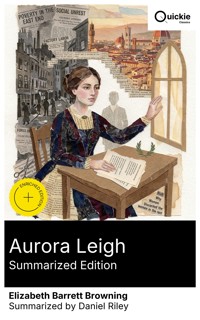
Aurora Leigh (1856) is Elizabeth Barrett Browning's novel-in-verse, a nine-book Künstlerroman tracing a woman poet from Anglo-Italian childhood to artistic authority. In supple blank verse, it fuses epic ambition with the Victorian social problem novel: debates with Romney Leigh intersect the ordeal of Marian Erle, exposing poverty, sexual coercion, and the limits of philanthropy. Allusive to Milton and Dante yet alert to journalism and the city, the poem makes modern life the true field of epic. Browning—erudite, politically engaged, and writing from Casa Guidi in Florence after her elopement with Robert Browning—conceived the work as a "poem of the age." Her abolitionism, concern for labor and women's rights, experience of exile and illness, and admiration from figures like Ruskin shaped its insistence that female authorship and public reform belong together. Recommended to readers of Victorian literature, poetry, and feminist criticism, Aurora Leigh offers a masterclass in how form carries social argument. Its hybrid design suits seminars on epic and the novel, while its portraits of work, love, and responsibility speak urgently to artists and citizens now. Quickie Classics summarizes timeless works with precision, preserving the author's voice and keeping the prose clear, fast, and readable—distilled, never diluted. Enriched Edition extras: Introduction · Synopsis · Historical Context · Author Biography · Brief Analysis · 4 Reflection Q&As · Editorial Footnotes.
Das E-Book können Sie in Legimi-Apps oder einer beliebigen App lesen, die das folgende Format unterstützen:
Veröffentlichungsjahr: 2026
Ähnliche





Aurora Leigh (Summarized Edition)
Table of Contents
Introduction
Aurora Leigh stages the collision between a woman’s artistic vocation and the demands of a society intent on defining her purpose. Elizabeth Barrett Browning frames that collision as a life story, tracing how ambition, affection, and conscience bear on a young writer coming of age. Intimate yet wide-angled, the poem offers a portrait of an aspiring poet and a survey of a bustling nineteenth-century world. This introduction sketches the book’s scope, style, and questions without giving away outcomes, inviting readers into a work that reimagines what poetry and the novel can do together. Neither sentimental romance nor aloof epic, it poses choices about art, duty, and love through one voice.
Published in 1856, in the high Victorian period, Aurora Leigh is a verse novel in nine books, written in unrhymed iambic pentameter. Its action moves between Italy and England, with significant scenes in London, and it uses the conventions of a Bildungsroman to chart artistic formation. Barrett Browning, already renowned as a lyric and political poet, brought epic scale to contemporary social life, uniting domestic interiors, city streets, and intellectual debates within a single first-person narrative. The book’s blend of poetic line and novelistic breadth was striking to its first readers and remains distinctive, offering a story told with the density and music of blank verse.
The premise is straightforward yet capacious. Aurora, orphaned young, passes from an early childhood in Italy to an adolescence in England under a strict aunt, and she resolves to become a poet. As she enters adulthood, she confronts expectations that define women’s usefulness in family and society, even as London’s literary marketplace beckons and unsettles. A cousin devoted to sweeping social reform presses a competing ideal of service, drawing Aurora into arguments about what truly helps the world. A working woman from the city’s margins becomes central to those questions, anchoring the poem’s ethical stakes without requiring readers to know later turns of the plot.
Reading Aurora Leigh means inhabiting a mind in motion. The poem’s first-person voice thinks, revises, and contends as it narrates, producing a texture of candor, wit, and self-correction that feels startlingly modern. Long, supple lines carry vivid descriptions of rooms, streets, and skies, then pivot to sharp judgments about art, money, and morality. The blank verse invites a steady gait while allowing quickened bursts of feeling and thought. Characterization emerges through dialogue and debate as much as through scene, so readers encounter not only what happens but how a poet reasons about it, testing values against experience without neatly closing every question.
Several themes organize the poem’s energy. Women’s education and the right to professional authorship shape Aurora’s training and choices, while the responsibilities of love and kinship place pressure on autonomy. The conflict between artistic creation and organized philanthropy frames a larger question about what literature can or should do in an unequal society. Class mobility, the visibility of urban poverty, and the authority claimed by critics and patrons enter the story as lived realities, not abstractions. National belonging is also refracted through movement between Italy and England, giving the work a cosmopolitan horizon that enlarges, without resolving, its ethical debates.
For contemporary readers, Aurora Leigh matters because it articulates dilemmas that persist: how to balance vocation and relationship, how to value art in the face of urgent social need, how to write responsibly about lives different from one’s own. Its depiction of a woman building a career in a competitive culture, negotiating gatekeepers and publics, speaks across time. The poem’s attention to cities, labor, and precarity feels recognizable, while its insistence that private feeling and public argument coexist in one voice models an integrated way of thinking. The work invites engagement rather than consensus, rewarding slow reading with evolving insight.
Approached today, the book offers the pleasures of narrative momentum and the satisfactions of intellectual argument in verse. Readers will find an education in how a poet sees the world: closely, critically, and with sympathy for imperfect choices. The nine-book structure allows pauses—natural places to reflect before continuing—while the language remains accessible to anyone willing to hear its rhythms. Without presuming outcomes, this introduction recommends meeting Aurora Leigh as both story and inquiry, a work that refuses to separate art from life. Its enduring achievement is to make a woman’s creative self-fashioning the measure of a changing age.
Synopsis
Elizabeth Barrett Browning’s Aurora Leigh, first published in 1856, is a verse-novel narrated by its heroine, charting her formation as a poet alongside the social and moral pressures of Victorian life. The work moves between Italy, England, and France, combining a personal Künstlerroman with a critique of philanthropy, class hierarchy, and women’s restricted roles. Its narrative begins with Aurora’s recollection of origins, but its concerns widen to ask what literature can do in a modern, industrial society. Through a sustained first-person voice, the poem stages debates about art and action, love and vocation, while following events that test convictions without announcing easy resolutions.
Aurora recalls an Italian childhood shaped by contrasting inheritances: an English father devoted to learning and an Italian mother whose early death leaves a lasting absence. Tutored at home among books and landscapes, she develops an inward life oriented toward reading and self-scrutiny. After her father dies, guardians send her to England, where a stern aunt enforces conventional lessons in piety, language, and decorum. In the attic’s makeshift library, Aurora educates herself beyond prescribed limits, encountering poets and philosophers who become companions. Feeling the pull of vocation, she resolves to become a poet, even as domestic authority tries to train her toward dependence.
Adulthood brings a decisive test when her cousin Romney Leigh, heir to the family estate and committed to large-scale social reform, proposes marriage. He imagines an alliance organized around his philanthropic projects, with Aurora assisting as helpmate and conscience. She refuses, valuing artistic independence and criticizing any program that treats women as instruments rather than agents. Their debate crystallizes central questions of the poem: whether art ought to serve immediate change, whether love can honor vocation, and whether privilege can truly renounce itself. The refusal estranges them, setting Aurora on a path that will measure her ideals against the world’s demands.
Determined to live by writing, Aurora relocates to London. She encounters the trade’s practical limits: reviews done for pay, editors’ tastes, and the pressure to dilute ambition. The city’s squalor and dynamism enter her verse, widening her canvases beyond private sentiment. In this period she befriends Marian Erle, a young working woman whose integrity and vulnerability sharpen Aurora’s awareness of class and gendered precarity. Success arrives gradually but without ease, and the poet learns to distrust both fashionable acclaim and aloof aestheticism. London’s streets, garrets, and parlors become the poem’s modern epic terrain, testing how an artist can speak truthfully yet be heard.
Romney pursues reform more directly, experimenting with projects intended to transform property relations and local welfare. He also announces an unorthodox engagement to Marian, hoping to challenge social prejudice by honoring her worth. The plan unsettles the county and divides acquaintances; motives become muddied as influence and desire intermingle. On the proposed wedding day, a sudden crisis derails the ceremony and spreads scandal, further estranging Romney from his community and widening the rift between him and Aurora. The episode complicates earlier certainties, exposing the costs of idealism and the vulnerability of those it aims to uplift, while leaving key facts contested in the moment.
Shaken by events and seeking renewal, Aurora leaves England for the Continent. In Paris she unexpectedly encounters Marian again, now living in hardship and caring for a child. Refusing judgment, Aurora offers protection and companionship, and together they travel to Italy. Among Italian streets, studios, and ruins, the poet’s vision clarifies: art must address the living city, not only the past, and must keep faith with human suffering. She drafts ambitious work and examines love’s claims alongside duty to truth. The friendship with Marian proves formative, pressing Aurora to consider how empathy can reshape both aesthetics and personal allegiance.
News reaches them of setbacks at Leigh Hall, where Romney’s philanthropic ventures meet resistance and unintended outcomes. When Aurora and Romney meet again, both have been tempered by experience. Their conversations revisit old arguments about poetry’s purpose and practical reform, but with new humility and urgency. Each acknowledges that earlier stances omitted crucial realities: the limits of systems, the perils of isolation, and the need to engage persons rather than abstractions. The Italian setting, with its light and history, mirrors a clearing of vision. Without resolving everything, the encounter deepens the poem’s inquiry into how conscience, love, and art might cooperate.
Alongside these debates, Marian’s steadfastness reframes what dignity and protection require, challenging myths of rescue and respectability. Aurora’s feelings grow more complex, as she learns to distinguish vanity from vocation and to imagine love that expands, rather than constrains, creative power. Visions of the Tuscan landscape open a metaphorical horizon where spiritual and civic responsibilities can be seen together. The narrative gathers its strands toward mutual recognition among the characters, not by erasing difference but by clarifying what each can offer. The poem prepares its close by suggesting that right relations may begin in truthful speech and sustained, practical sympathy.
Without disclosing final turns, it is fair to say that Aurora Leigh culminates in a vision that binds aesthetic integrity to social responsibility and imagines a modern epic rooted in the city, in labor, and in women’s authorship. Its enduring significance lies in how it makes a female artist the architect of a comprehensive moral and political imagination, and in how it complicates the opposition between private love and public duty. Readers find in it both a portrait of an era and an argument for art that faces the present. The closing emphasis is hope tempered by hard-won clarity.
Historical Context
Elizabeth Barrett Browning published Aurora Leigh in London in 1856, while residing in Florence. The verse-novel, written in blank verse, situates itself amid the mid-Victorian world of Britain and Italy. These decades saw accelerating urbanization, imperial confidence, and fervent debates about morality and reform. Institutions shaping literary life included circulating libraries and an influential periodical press, alongside the expanding railway that connected readers and markets. The Great Exhibition of 1851 had recently displayed industrial power and cultural aspiration in Hyde Park. Framing its story within such modernity, the poem declares allegiance to contemporary experience and scrutinizes how art should answer the pressures of its age.
Industrial capitalism had transformed British cities by mid-century. Factories and migrant labor produced wealth and stark poverty, especially in London and northern towns. The Poor Law Amendment Act of 1834 centralized relief in workhouses, provoking controversy over deterrent aid. Philanthropy expanded through organizations such as the Ragged School Union (1844), which offered basic education to destitute children, and public health reform accelerated after the 1848 Public Health Act. Debates about the "Condition of England" pressed writers to confront slums, exploitation, and social responsibility. Aurora Leigh incorporates this urban landscape and tests whether poetry can represent, and ethically engage with, the industrial city.
Women’s education and legal status were key Victorian controversies. Universities remained closed to women, though pioneering institutions opened: Queen’s College, London (1848), and Bedford College (1849) trained female teachers and scholars. Under common-law coverture, a married woman’s property typically passed to her husband, limiting economic independence. Many unmarried, educated women sought work as governesses, a precarious profession documented by reformers. The 1851 census heightened talk of "surplus women," emphasizing demographic and vocational pressures. These realities inform the poem’s portrayal of a woman pursuing authorship as a vocation, challenging the doctrine of separate spheres and arguing for women’s intellectual labor in public culture.




