


40,99 €
Mehr erfahren.
- Herausgeber: John Wiley & Sons
- Kategorie: Wissenschaft und neue Technologien
- Serie: Bible
- Sprache: Englisch
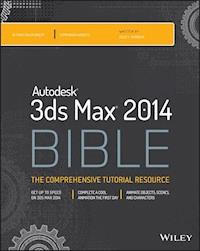
A complete reference covering the newest version of 3ds Max software Autodesk 3ds Max is the popular 3D modeling, animation, rendering, and compositing software preferred by game developers and graphic designers in film and television. This comprehensive reference not only introduces beginners to this pricey and complex software, but also serves as a reference for experienced users. Packed with expert advice from popular author Kelly Murdock, it begins with a Quick Start tutorial to get you up and running, then continues with more than 150 step-by-step tutorials, advanced coverage, and plenty of tips and timesavers. * 3ds Max is professional modeling and animation software used in the film, television, and game development industries; this complete guide gets beginners started and teaches experienced users how to take advantage of the program's newest capabilities * Covers all the basics as well as advanced topics including crowd simulation, particle systems, rigid body dynamics, state sets, compositing, radiosity, network rendering, and MAXScript * Features more than 150 step-by-step tutorials and complete references detailing all primitives, modifiers, materials, maps, and controllers * Companion website includes examples from the book, unique models and textures that you can customize, before-and-after examples from the tutorials, and bonus Quick Starts from previous editions Autodesk 3ds Max 2014 Bible is the one book you need to succeed with this all-new version of 3ds Max.
Sie lesen das E-Book in den Legimi-Apps auf:
Seitenzahl: 1808
Veröffentlichungsjahr: 2013
Ähnliche
















Autodesk 3ds Max 2014 Bible®
Table of Contents
Preface
Part I: Getting Started with Autodesk 3ds Max 2014
Quick Start: Adding a Crowd to the City Center
Planning the Production
Setting Up the Scene
Tutorial: Loading the Clock Tower
Tutorial: Adding a ground plane and some trees
Adding Materials and Lights
Tutorial: Adding materials
Tutorial: Adding a Sun & Sky system
Tutorial: Rendering a test preview
Adding the Crowds
Tutorial: Adding people
Tutorial: Rendering the final animation
Summary
Chapter 1: Exploring the Interface
Learning the Interface Elements
Using the Menus
Using the Toolbars
Docking and floating toolbars
Using tooltips and flyouts
Using the Quick Access toolbar
Learning the main toolbar
Using the Modeling Ribbon
Using the Viewports
Using the Command Panel
Working with rollouts
Increasing the Command Panel's width
Tutorial: Rearranging the interface for lefties
Using the Lower Interface Bar Controls
Interacting with the Interface
Gaining quick access with the right-click quad menus
Using Caddy controls
Understanding the button color cues
Using drag-and-drop features
Controlling spinners
Understanding modeless and persistent dialog boxes
Using Workspaces
Getting Help
Using the Search Command feature
Using the InfoCenter toolbar
Viewing the Essential Skills Movies
Using the online reference guides
Using the rest of the Help menu
Summary
Chapter 2: Controlling and Configuring the Viewports
Understanding 3D Space
Learning Axonometric versus Perspective
Learning orthographic and isometric views
Discovering the viewports in 3ds Max
Using the Navigation Gizmos
Working with the ViewCube
Using the SteeringWheels
Tutorial: Navigating the active viewport
Controlling Viewports with a Scroll Wheel Mouse
Using the Viewport Navigation Controls
Zooming a view
Panning a view
Walking through a view
Rotating a view
Maximizing the active viewport
Controlling camera and spotlight views
Setting the navigation controls to match Maya
Changing the Viewport Display
Undoing and saving viewport changes
Disabling and refreshing viewports
Setting the viewport visual style
Viewing stylized scenes
Enhancing the Viewport
Changing the viewport layout
Displaying Safe Frames
Using clipping planes
Tutorial: Viewing the interior of a tooth with clipping planes
Locating mesh problems with xView
Displaying Materials, Lighting, and Shadows in the Viewport
Viewing materials in the viewports
Displaying lighting and shadows in the viewports
Working with Viewport Backgrounds
Changing the viewport background
Loading viewport background images
Loading viewport background animations
Tutorial: Loading reference images for modeling
Setting Viewport Visual Style and Appearance
Using the Rendering levels
Viewing transparency
Other rendering options
Setting the Field of View
Grabbing a viewport image
Configuring viewport lighting and shadows
Configuring the Viewport Background
Altering the Viewport Layout
Using Safe Frames
Setting Display Performance
Defining Regions
Viewing Statistics
Configuring the ViewCube and SteeringWheels
Summary
Chapter 3: Working with Files, Importing, and Exporting
Working with 3ds Max Scene Files
Using the Application Button
Using the Welcome Screen
Starting new
Saving files
Archiving files
Opening files
Setting a Project Folder
Merging and replacing objects
Using Mesh Inspector
Getting out
Importing and Exporting
Importing supported formats
Import preference
Exporting supported formats
Moving files to other Suite packages
Manually moving files to and from Maya with FBX
Using the OBJ format
Exporting to the DWF format
Exporting utilities
Tutorial: Importing vector drawings from Illustrator
Using the File Utilities
Using the Asset Browser utility
Finding files with the Max File Finder utility
Collecting files with the Resource Collector utility
Accessing File Information
Displaying scene information
Viewing file properties
Viewing files
Summary
Chapter 4: Setting Preferences
Setting General Preferences
Undo Levels and the Reference Coordinate System
Loading Plug-Ins and Sub-Material settings
Scene Selection settings
Spinner, Rollout, and Vertex Normal settings
User Interface Display settings
Layer settings
Real-World Texture Coordinates setting
Setting File Preferences
Handling files
Backing up files
Tutorial: Setting up Auto Backup
Maintaining log files
Configuring Paths
Configuring user paths
Configuring system paths
Setting viewport preferences
Viewport parameter options
Enabling ghosting
Choosing and configuring display drivers
Setting Interaction Mode
Setting Gamma and Look-Up Table (LUT) Preferences
Setting screen gamma
Propagating gamma settings
Setting bitmap gamma
Setting Rendering and Radiosity Preferences
Changing rendering quality
Using Local and Global Advanced Lighting Settings
Setting Animation Preferences
Setting Inverse Kinematics Preferences
Setting Gizmo Preferences
Accessing mental ray Preferences
Setting Global Container Preferences
Setting Help Preferences
Summary
Part II: Manipulating Objects
Chapter 5: Creating and Editing Primitive Objects
Selecting System Units
Using Custom and Generic units
Handling mismatched units
Rescaling world units
Creating Primitive Objects
Using the Objects menu
Using the Create panel
Naming and renaming objects
Assigning colors
Using the Color Clipboard
Using different creation methods
Using the Keyboard Entry rollout for precise dimensions
Altering object parameters
Recovering from mistakes and deleting objects
Tutorial: Exploring the Platonic solids
Exploring the Primitive Object Types
Starting with the Standard Primitives
Extended Primitives
Modifying object parameters
Tutorial: Filling a treasure chest with gems
Using Architecture Primitives
Using AEC Objects
Tutorial: Adding stairs to a clock tower building
Using Modeling Helpers
Using Dummy and Point objects
Measuring coordinate distances
Tutorial: Testing the Pythagorean Theorem
Summary
Chapter 6: Selecting Objects and Using Layers
Selecting Objects
Selection filters
Select buttons
Selecting with the Edit menu
Selecting multiple objects
Using the Paint Selection Region tool
Tutorial: Selecting objects
Using named selection sets
Editing named selection sets
Locking selection sets
Isolating the current selection
Selecting objects in other interfaces
Setting Object Properties
Hiding and Freezing Objects
Using the Display Floater dialog box
Using the Display panel
Tutorial: Hidden toothbrushes
Using Layers
Using the Layer Manager
Using the layer list
Tutorial: Dividing a scene into layers
Using the Scene Explorer
Selecting and filtering objects
Finding objects
Editing in the Scene Explorer
Setting Object Properties
Viewing object information
Hiding and freezing objects
Setting Display Properties
Setting rendering controls
Enabling Motion Blur
Using the Advanced Lighting and mental ray panels
Using the User-Defined panel
Summary
Chapter 7: Transforming Objects, Pivoting, Aligning, and Snapping
Translating, Rotating, and Scaling Objects
Translating objects
Rotating objects
Scaling objects
Using the transform buttons
Working with the Transformation Tools
Working with the Transform Gizmos
Using the interactive gizmos
Using the Transform Toolbox
Using the Transform Type-In dialog box
Using the Status Bar Type-In fields
Understanding the Transform Managers
Tutorial: Landing a spaceship in port
Using Pivot Points
Positioning pivot points
Aligning pivot points
Using the Working Pivot
Transform adjustments
Using the Reset XForm utility
Tutorial: A bee buzzing about a flower
Using the Align Commands
Aligning objects
Using the Quick Align tool
Aligning normals
Tutorial: Aligning a kissing couple
Aligning to a view
Using Grids
The Home Grid
Creating and activating new grids
Using AutoGrid
Tutorial: Creating a spyglass
Using Snap Options
Tutorial: Creating a 2D outline of an object
Setting snap points
Setting snap options
Using the Snaps toolbar
Tutorial: Creating a lattice for a methane molecule
Summary
Chapter 8: Cloning Objects and Creating Object Arrays
Cloning Objects
Using the Clone command
Using the Shift-clone method
Tutorial: Cloning ducks
Using Quick Clone
Understanding Cloning Options
Working with copies, instances, and references
Tutorial: Creating instanced doughnuts
Tutorial: Working with referenced apples
Mirroring Objects
Using the Mirror command
Tutorial: Mirroring a robot's leg
Cloning over Time
Using the Snapshot command
Tutorial: Creating a path through a maze
Spacing Cloned Objects
Using the Spacing tool
Tutorial: Stacking a row of dominoes
Using the Clone and Align Tool
Lesen Sie weiter in der vollständigen Ausgabe!
Lesen Sie weiter in der vollständigen Ausgabe!
Lesen Sie weiter in der vollständigen Ausgabe!
Lesen Sie weiter in der vollständigen Ausgabe!
Lesen Sie weiter in der vollständigen Ausgabe!
Lesen Sie weiter in der vollständigen Ausgabe!
Lesen Sie weiter in der vollständigen Ausgabe!
Lesen Sie weiter in der vollständigen Ausgabe!
Lesen Sie weiter in der vollständigen Ausgabe!
Lesen Sie weiter in der vollständigen Ausgabe!
Lesen Sie weiter in der vollständigen Ausgabe!
Lesen Sie weiter in der vollständigen Ausgabe!
Lesen Sie weiter in der vollständigen Ausgabe!
Lesen Sie weiter in der vollständigen Ausgabe!
Lesen Sie weiter in der vollständigen Ausgabe!
Lesen Sie weiter in der vollständigen Ausgabe!
Lesen Sie weiter in der vollständigen Ausgabe!
Lesen Sie weiter in der vollständigen Ausgabe!
Lesen Sie weiter in der vollständigen Ausgabe!
Lesen Sie weiter in der vollständigen Ausgabe!
Lesen Sie weiter in der vollständigen Ausgabe!
Lesen Sie weiter in der vollständigen Ausgabe!
Lesen Sie weiter in der vollständigen Ausgabe!
Lesen Sie weiter in der vollständigen Ausgabe!
Lesen Sie weiter in der vollständigen Ausgabe!
Lesen Sie weiter in der vollständigen Ausgabe!
Lesen Sie weiter in der vollständigen Ausgabe!
Lesen Sie weiter in der vollständigen Ausgabe!
Lesen Sie weiter in der vollständigen Ausgabe!
Lesen Sie weiter in der vollständigen Ausgabe!
Lesen Sie weiter in der vollständigen Ausgabe!
Lesen Sie weiter in der vollständigen Ausgabe!
Lesen Sie weiter in der vollständigen Ausgabe!
Lesen Sie weiter in der vollständigen Ausgabe!
Lesen Sie weiter in der vollständigen Ausgabe!
Lesen Sie weiter in der vollständigen Ausgabe!
Lesen Sie weiter in der vollständigen Ausgabe!
Lesen Sie weiter in der vollständigen Ausgabe!
Lesen Sie weiter in der vollständigen Ausgabe!
Lesen Sie weiter in der vollständigen Ausgabe!
Lesen Sie weiter in der vollständigen Ausgabe!
Lesen Sie weiter in der vollständigen Ausgabe!
Lesen Sie weiter in der vollständigen Ausgabe!
Lesen Sie weiter in der vollständigen Ausgabe!
Lesen Sie weiter in der vollständigen Ausgabe!
Lesen Sie weiter in der vollständigen Ausgabe!
Lesen Sie weiter in der vollständigen Ausgabe!
Lesen Sie weiter in der vollständigen Ausgabe!
Lesen Sie weiter in der vollständigen Ausgabe!
Lesen Sie weiter in der vollständigen Ausgabe!
Lesen Sie weiter in der vollständigen Ausgabe!
Lesen Sie weiter in der vollständigen Ausgabe!
Lesen Sie weiter in der vollständigen Ausgabe!
Lesen Sie weiter in der vollständigen Ausgabe!
Lesen Sie weiter in der vollständigen Ausgabe!
Lesen Sie weiter in der vollständigen Ausgabe!
Lesen Sie weiter in der vollständigen Ausgabe!
Lesen Sie weiter in der vollständigen Ausgabe!
Lesen Sie weiter in der vollständigen Ausgabe!
Lesen Sie weiter in der vollständigen Ausgabe!
Lesen Sie weiter in der vollständigen Ausgabe!
Lesen Sie weiter in der vollständigen Ausgabe!
Lesen Sie weiter in der vollständigen Ausgabe!
Lesen Sie weiter in der vollständigen Ausgabe!
Lesen Sie weiter in der vollständigen Ausgabe!
Lesen Sie weiter in der vollständigen Ausgabe!




