



11,49 €
Mehr erfahren.
- Herausgeber: Atlantic Books
- Kategorie: Gesellschafts- und Liebesromane
- Sprache: Englisch
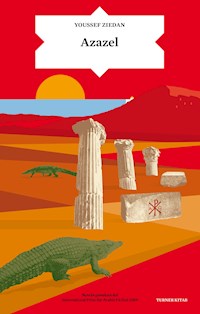
In this haunting and controversial novel, Youssef Ziedan confronts issues as vital today as they were nearly two millennia ago. Set in the 5th century AD, Azazeel is the exquisitely crafted tale of a Coptic monk's journey from Upper Egypt to Alexandria and then Syria during a time of massive upheaval in the early Church. Winner of the Arab Booker Prize, Azazeel highlights how the history of our civilization has been warped by greed and avarice since its very beginnings and how one man's beliefs are challenged not only by the malice of the devil, but by the corruption with the early Church. In sparse and often sparkling prose that reflects the arid beauty of the Syrian landscape, Azazeel is a novel that forces us to re-think many of our long-held beliefs and invites us to rediscover a lost history.
Das E-Book können Sie in Legimi-Apps oder einer beliebigen App lesen, die das folgende Format unterstützen:
Veröffentlichungsjahr: 2012
Ähnliche



















Azazeel
First published in Great Britain in hardback in 2012 by Atlantic Books, an imprint of Atlantic Books Ltd.
Copyright © Youssef Ziedan, 2009 Translation copyright © Jonathan Wright, 2012 Translator’s Introduction © Jonathan Wright, 2012
The moral right of Youssef Ziedan to be identified as the author of this work has been asserted by him in accordance with the Copyright, Designs and Patents Act of 1988.
The moral right of Jonathan Wright to be recognized as the translator of this work has been asserted by him in accordance with the Copyright, Designs and Patents Act of 1988.
All rights reserved. No part of this publication may be reproduced, stored in a retrieval system or transmitted in any form or by any means, electronic, mechanical, photocopying, recording or otherwise, without the prior permission of both the copyright owner and the above publisher of this book.
This novel is entirely a work of fiction. The names, characters and incidents portrayed in it are the work of the author’s imagination and not to be construed as real. Any resemblance to actual persons, living or dead, events or localities, is entirely coincidental.
1 3 5 7 9 10 8 6 4 2
A CIP catalogue record for this book is available from the British Library.
Hardback ISBN: 9781848874275 Export and Airside Trade paperback ISBN: 9781848874282 eISBN: 9780857897732
Printed in Great Britain
Atlantic Books An imprint of Atlantic Books Ltd Ormond House 26–27 Boswell Street London WC1N 3JZ
www.atlantic-books.co.uk
Every man has his devil, even me, but God helped me against him and he turned Muslim.
A saying of the Prophet Muhammad,
Contents
Translator’s Introduction
SCROLL ONE
SCROLL TWO
SCROLL THREE
SCROLL FOUR
SCROLL FIVE
SCROLL SIX
SCROLL SEVEN
SCROLL EIGHT
SCROLL NINE
SCROLL TEN
SCROLL ELEVEN
SCROLL TWELVE
SCROLL THIRTEEN
SCROLL FOURTEEN
SCROLL FIFTEEN
SCROLL SIXTEEN
SCROLL SEVENTEEN
SCROLL EIGHTEEN
SCROLL NINETEEN
SCROLL TWENTY
SCROLL TWENTY-ONE
SCROLL TWENTY-TWO
SCROLL TWENTY-THREE
SCROLL TWENTY-FOUR
SCROLL TWENTY-FIVE
SCROLL TWENTY-SIX
SCROLL TWENTY-SEVEN
SCROLL TWENTY-EIGHT
SCROLL TWENTY-NINE
SCROLL THIRTY
A Note on the Text
Translator’s Introduction
This book, which by my last will and testament, should be published only after my death, contains as faithful a translation as possible of a collection of parchment manuscripts discovered ten years ago in the archaeological ruins which abound to the northwest of the Syrian city of Aleppo. These are the ruins which stretch for two miles along the sides of the old road linking Aleppo and Antioch, ancient cities with origins dating back to prehistoric times. This paved road is thought to be the last stage along the famous Silk Road, which in distant times started in the farthest reaches of Asia and ran its course to the Mediterranean coast. These manuscripts, with their writings in old Syriac or Aramaic, have survived in exceptionally good condition, although they were written in the first half of the fifth century of the Christian era, or, to be precise, 1,555 years before our time.
The late Venerable Father William Cazary, who supervised the archaeological excavations there and who died tragically and unexpectedly in the middle of May 1997, thought it likely that the secret of the survival of these manuscripts lay in the quality of the parchment, on which the words were written in black ink of the best quality available in that remote period, as well as the fact that they were stored in the tightly sealed wooden box in which the Egyptian-born monk Hypa deposited them, preserving a record of a remarkable career, an unintended history of the events of his troubled life and the vicissitudes of the turbulent age in which he lived.
Father Cazary thought that the wooden box, which was embellished with delicate copper ornamentation, had not been opened throughout the intervening centuries, which suggests that he, may God forgive him, did not examine the contents of the box carefully, perhaps because he was wary of unrolling the parchments before they received chemical treatment, for fear they would crumble between his fingers. So he did not notice in the margins of the manuscripts the occasional notes and comments written in Arabic in fine Naskhi script in about the fifth century of the Hijra era. It seems to me that these were written by an Arab monk who belonged to the Church of Edessa, which adopted Nestorianism as its dogma and whose followers are known to this day as Nestorians. This unknown monk did not want to reveal his name. (I have included some of his significant notes and comments in the margins of my translation, while others I have omitted because of their dangerous nature. The last thing this anonymous monk wrote, on the back of the last parchment, was: ‘I will rebury this treasure, because it is not yet time for it to appear.’)
I spent seven years translating this text from Syriac to Arabic, but I then regretted my work on this story of Hypa the monk and I was reluctant to have it published in my lifetime, especially as I was already feeble from old age anyway and my time was drawing to a close. The whole story consists of thirty parchment scrolls, written on both sides in a thick Syriac script in the old tradition of writing Syriac which specialists know as Estrangela, the oldest and classical form of the alphabet. I have tried hard to find any information about the original author, the Egyptian monk Hypa, beyond the facts that he relates about himself in his story, but I have found no trace of him in any of the old historical sources. Modern references are devoid of any mention of him, as though he never existed, or rather he exists only through this autobiography which we possess. I have, however, confirmed the authenticity of all the ecclesiastical characters and the accuracy of all the historical events which he mentions in this extraordinary document, which he wrote in an elegant hand without excessive indulgence in the flourishes encouraged by old Syriac writing in Estrangela, a naturally decorative style.
The clarity of the script has enabled me in most instances to read the text with ease, so I have translated it into Arabic without worrying that the original might be defective or garbled, as is the case with most writings which have survived from this early period. I must not omit here to thank the venerable scholar, the abbot of the Syrian monastery in Cyprus, for the important observations he made on my translation and for corrections to some old ecclesiastical expressions with which I was not familiar.
I am not confident that this translation of mine has succeeded in matching the Syriac text in beauty or splendour. Not only was Syriac exceptional from this early date for the abundance of its literature and the sophistication of its writing styles, but Hypa’s language and diction are a model of clarity and eloquence. Many long nights I spent pondering his incisive and expressive phrasing and the succession of creative images which he conjures, all of which confirm his poetic talent, his linguistic sensitivity and his mastery of the secrets of the Syriac language in which he wrote.
I have numbered the chapters of this story in line with the sequence of the scrolls, which naturally vary in size, and I have given the scrolls titles of my own devising to make it easier for the reader of this translation, which marks the first publication of this text. For the same reason I have used in my translation the modern names for the cities which Hypa the monk mentions in his story. So when he talks about the city of Panopolis in the heart of Upper Egypt, I have translated the name from the Greek to Akhmim, the name by which it is known today. The Syrian town of Germanikeia I have rendered by the modern name of Marash, and the Scetis Desert by Wadi Natroun, the name by which it is now known, and so on for the other towns and places which appear in the original text, unless the old names of these places have acquired a significance which the new names might not convey, such as Nicaea, which now lies within Turkey. Although it is now known by the Turkish name Iznik, I have preferred to call it by its old name because of its special importance as the site of church councils. For it was in this city in the year ad 325 that the First Ecumenical Council took place and the Egyptian priest Arius was condemned as a heretic, excommunicated and exiled. As for places which occur in the story and which are not well known, I have included both their old and new names, to prevent confusion.
After the Coptic months and years which the writer mentions I have put the equivalent months and years according to the Christian calendar used today. In a few instances I have added essential observations in brief and some of the Arabic comments which I found in the margins. I then appended to the story some photographs relevant to the events it relates.
Alexandria, 4 April 2004
SCROLL ONE
Starting to Write
Mercy, my Lord. Mercy and forgiveness, our Father in Heaven. Have mercy on me and forgive me, for as you know I am weak. My merciful Lord, my hands tremble in fear and dread. My heart and soul tremble at the vicissitudes and turmoil of this age. Yours alone is the glory, my merciful Lord. You know that I obtained these scrolls many years ago, on the shores of the Dead Sea, to write on them my poems and my orations to You in my times of seclusion, that Your name may be glorified among those on earth, as it is in heaven. I had intended to record on them my supplications, which bring me nearer to You and which may after me become prayers recited by monks and godly hermits in all times and all places. Yet when the time came to make this record, I was about to write such things which had never before come to my mind and which could have led me to the ways of woe and evil. My Lord, do You hear me? I am Your faithful servant, the perplexed, Hypa the monk, Hypa the physician, Hypa the stranger as people call me in my land of exile. And You alone, my Lord, know my true name, You and those in my first country, which witnessed my birth. Would that I had never been born, or that I had perished in my childhood without sin, to be assured of Your forgiveness and Your mercy.
Have mercy on me, O merciful one, for I am fearful of what I am about, but I am under duress, for You know in Your farthest heavens how I am beset by the entreaties of my enemy and Yours, the accursed Azazeel, who does not cease demanding that I record all that I have witnessed in my life. And what worth does my life have anyway, that I should record what I have witnessed in it? So save me, O my merciful Lord, from his insinuations and from my own iniquity. My Lord, I still await from You Your signs, which have not come. I have bided my time for Your forgiveness, but so far I have not doubted. If You wish, O You of sublime might and glory, to provide me with a sign, then I accept Your command and obey. If You leave me to myself, then I am lost, for my spirit has been put to the rack, buffeted between the temptations of the accursed Azazeel and the torments of my longings after the departure of Martha, who helped to overthrow the inner regimen of my life.
I will kneel to You tonight, O Lord, and pray, then sleep, for You have created me prone to dreams for some secret reason. I will sleep a sleep full of dreams, and in my sleep send me from the bounty of Your grace a sign to light my way, inasmuch as in my waking hours Your glad tidings have remained beyond my reach. If by your sign, my Lord, you bid me refrain from writing, then I shall refrain. But if You leave me to myself, then I shall write. For, my Lord, I am but a feather tossed upon the wind, snatched up by a feeble hand intent on dipping the quill in the inkwell to record everything that has befallen me, and everything that has happened and will happen with the Rebel of Rebels, Azazeel, to Your frail servant, and to Martha. Mercy, mercy, mercy.
In the name of God on high,1 I hereby start to write my life as it has been and as it is, describing what happens around me and the terrors that burn within me. I begin my chronicle (and I do not know how or when it will end) on the night of the 27th day of the month of Thout (September) in the year 147 of the Martyrs, that is the year 431 of the birth of Jesus the Messiah, the inauspicious year in which the Venerable Bishop Nestorius was excommunicated and deposed, and in which the foundations of the Faith were shaken. I may recount the transgressions and torments that came to pass between me and the beautiful Martha, and the doings of Azazeel, the insidious and accursed. I will also narrate some of my dealings with the abbot of this monastery in which I live, and where I have not found peace of mind. In the course of my story I will tell of events I have lived through since leaving my original country near the town of Aswan in southern Egypt on the banks of the Nile. The people of my village believed the Nile flows from between the fingers of their god as the water falls from the sky. In my childhood I believed the same myth, until I learnt what I learnt in Naga Hammadi, Akhmim and later in Alexandria, and realized that the Nile is a river like other rivers and that all other things, like everything elsewhere, differ only to the extent that we make them different by shrouding them in delusion, conjecture and dogma.
Where should I begin my narrative? The beginnings are intertwined, teeming in my head. Perhaps, as my old teacher Syrianus used to say, beginnings are merely delusions we believe in, for the beginning and the ending exist only along a straight line, and there are no straight lines except in our imagination or on the scraps of paper where we trace our delusions. In life and in all creation, however, everything is circular, returning to where it began, interwoven with whatever is connected. There is in reality no beginning and no ending, only an unbroken succession. In the universe the connections never break, the weft never unravels, and the branching never ceases, nor the filling and the emptying. Any one thing is successively connected, its circle expanding to mesh with something else, and from the two of them a new circle branches off, meshing in turn with other circles. Life is full when the circle is complete, and drains away when we end in death, to return to whence we began. How confused I am, what is this I am writing? All the circles turn in my head and only moments of sleep bring them to a stop. Then my dreams start to turn, and in those dreams, as when I am awake, the memories teem and wrench within me. The memories are like overlapping eddies, circle after circle. If I yield to them and put them in writing, then where should I begin?
I will begin with the present, from this very moment, from my sitting here in my room, which is no more than two yards long and two yards wide. There are Egyptian tombs that are larger. Its walls are of the stone with which people build in these parts. They bring it from nearby quarries. The stone was white but today it has lost its colour.
My room has a feeble wooden door which does not shut tight. It opens to the outside where there is the long corridor passing by the rooms of the other monks. There is nothing here around me but a wooden board on which I sleep, covered with three layers of wool and linen, the soft bedding and the blanket, although I am accustomed to sleep seated, in the manner of Egyptian monks.
In the left corner, facing the door, stands a small low table with an inkstand on top and the old lamp with its pathetic wick and its dancing flame. Under the table are blank pieces of white parchment and pieces of pale parchment from which the writing has been washed off. Next to the table is a bag containing scraps of dry bread, a jar of water, a bottle of oil for the lamp and some folded books. Above them I have hung on the wall a picture of the Virgin Mary, in relief on wood, because it gives me comfort to look at the face of the Virgin, the Mother.
In the corner of the room alongside the door there sits a wooden trunk decorated with copper engraving, which a rich man from Tyre gave me full of dates after I treated his chronic diarrhoea and took no fee for my services, reviving the tradition of the eminent physician Hippocrates, who taught mankind medicine inasmuch as he dared to write it down in books. I wonder if it was Azazeel who prompted him to write.
If I finish tonight what I am starting, I will put what I have written in this trunk, along with the proscribed gospels and other forbidden books, and bury it under the loose marble slab at the monastery gate. I will fill up around it and cover the slab in soil. I will have left something of myself here, before I finally depart, when I end the forty days of seclusion which I begin today as I start this writing, about which I have said nothing to anyone.
My room lies on the upper floor of the building and is one of twenty-four similar rooms where the monks of this monastery live. Some of the rooms are locked up, some are storerooms for grain and one is for prayer. The ground floor of this building contains the monastery kitchen, the refectory and the large reception room. Twenty-two monks live in the monastery, as well as twenty novices who serve the place until they take their vows as monks. The large monastery church has a temporary priest who is not a monk but was originally the priest of the small church which stands among the houses scattered at the foot of the monastery hill. He has been serving the monastery church since the old monastic priest passed away some years ago, pending the ordination of another priest from among the monks. The ordination would take place in the Antioch church, to which this monastery is subordinate. The ordinary priests have wives in whose arms they sleep, while we monks sleep alone and on most nights we sleep seated, or do not sleep at all because we are busy with prayers and singing long hymns of praise.
The abbot lives in a separate room, which has at the corners four old Roman columns which used to stand in the large courtyard in front of the large monastery church. When they joined up the columns with thin walls, the columns became the corners of the large room. Next to his room is the small church where we usually pray. The big church has two doors, one on the monastery side and the other overlooking the hill outside the wall, as though it were two churches, one for the monks on most days and the other for the faithful and the parishioners who come on Sundays and holy days to attend mass. Those who come later do not find space inside and have to squeeze in outside the dilapidated wall, around the outer door.
My room is the little circle of my tangible world, surrounded by a bigger circle which is this monastery, which I have loved from the first day I came inside years ago, where I have stayed ever since and where I was blessed with the peace of mind which I had long sought before coming here, until the events that I will relate took place.
I came to the monastery from Jerusalem, Salem, Yerushalayim, Urusalim, Ilya, al-Quds, the House of the Lord. Many names has this holy city borne, this city surrounded by wilderness on all sides. I lived there several years before I came here, fulfilling the will of the Lord and following the guidance and advice of Nestorius, although he, God help him today, had first invited me to go with him to Antioch and live there till the end of my life. Then something came up and instead he urged me to come here. In his own hand he wrote me a letter of recommendation to the abbot, and destiny led me into events which I have witnessed or suffered, events which I would never have expected. Under my rough pillow I still keep the letter Nestorius sent with me to the abbot. The abbot gave it back to me when I asked him for it, a year after I came here from Jerusalem. Jerusalem, how far away you seem now, how my days there seem like a dream that shone in the firmament of my dull life and then went out.
Why has everything gone dark? The light of faith which used to shine inside me, the peace of mind which kept me company in my loneliness, like a candle in the night, my serenity within the walls of this gentle room, even the daylight sun, I see them today extinguished and abandoned.
Will these cares depart my soul? Will joyful news come to me after that which came to us from Ephesus, where the priests and bishops beleaguered the blessed Bishop Nestorius and toiled until they brought him down? Time has brought me down, care and anxiety have overcome me. What will become of deposed Bishop Nestorius, whom I knew in the days when he was a priest? We met in Jerusalem when he came on pilgrimage with the delegation from Antioch, four years before he was consecrated Bishop of Constantinople. We met at a time which now seems distant, after long years have passed, and in the meantime the places, the cities have come to seem remote, impossibly remote.
Were we really in Jerusalem?
SCROLL TWO
The House of the Lord
I well remember how in the middle of the day I entered Jerusalem from the dilapidated part of its high walls, the part which in former times included the great gate known as the Zion Gate, and set down my travelling stick there, after long wanderings among the villages of Judaea and Samaria.
I entered Jerusalem at about the age of thirty, my body and soul exhausted by travel on earth and in the heavens and by roaming through the pages of books. I entered it with unsteady steps, close to collapse, in the dog days of Abib (July), and at the door to the great church I fell in a swoon. Some of the pilgrims carried me inside for the priest of the Church of the Resurrection to attend to me. He laughed when I told him I was a physician and a monk, and when I recovered from my fainting fit he joked with me, saying, I knew you were a monk from the cap on your head, but from your fainting I could not tell you were a physician! Then he asked me my name and I told him it was Hypa.
Have you come on pilgrimage, or do you intend to reside amongst us, holy monk?
On pilgrimage first, then let the will of the Lord be done.
I spent days in Jerusalem as a pilgrim after three years touring the Holy Places, in line with the advice of St Chariton the Monk, who worshipped incessantly in a desolate cave near the Dead Sea. When he bade me farewell, Chariton said, My son, do not enter Jerusalem as soon as you reach the land of Palestine. Enter only when your heart is ready for pilgrimage and your spirit is prepared, because pilgrimage is just a journey of preparation, and travel is just a revelation of the sacred element hidden in the essence of the spirit.
On my wanderings I had passed by the places where the disciples of Jesus the Messiah once lived and where the Apostles began their mission. I spent months following in the footsteps of Jesus, as described in the Gospels and other books, starting with the town of Cana near Nazareth, where the Messiah performed the first of his miracles, when he changed water into wine for the wedding guests to drink, as it says in the Gospels. In Nazareth I found no vestige of his presence and no building left to speak of his time. I was puzzled, and I went out of my way to the other villages mentioned in the Torah, the Gospels, the canonical holy books and the non-canonical books which we have recently come to call the Apocrypha. On my journeys many doubts plagued me and I suffered terrors in my sleep, until three years of wandering had passed and that clear night came when I saw Jesus the Messiah in a vivid dream. His light filled the heavens, and in Aramaic he said to me, If you are seeking me, you who are perplexed and astray, set aside your self, and leave the dead, and come up to see me in Jerusalem, that you might live. Jesus was addressing me in my visions, from up on his Cross, and there was no one around me in the wilderness.
Lesen Sie weiter in der vollständigen Ausgabe!
Lesen Sie weiter in der vollständigen Ausgabe!
Lesen Sie weiter in der vollständigen Ausgabe!
Lesen Sie weiter in der vollständigen Ausgabe!
Lesen Sie weiter in der vollständigen Ausgabe!
Lesen Sie weiter in der vollständigen Ausgabe!
Lesen Sie weiter in der vollständigen Ausgabe!
Lesen Sie weiter in der vollständigen Ausgabe!
Lesen Sie weiter in der vollständigen Ausgabe!
Lesen Sie weiter in der vollständigen Ausgabe!
Lesen Sie weiter in der vollständigen Ausgabe!
Lesen Sie weiter in der vollständigen Ausgabe!
Lesen Sie weiter in der vollständigen Ausgabe!
Lesen Sie weiter in der vollständigen Ausgabe!
Lesen Sie weiter in der vollständigen Ausgabe!
Lesen Sie weiter in der vollständigen Ausgabe!
Lesen Sie weiter in der vollständigen Ausgabe!
Lesen Sie weiter in der vollständigen Ausgabe!
Lesen Sie weiter in der vollständigen Ausgabe!
Lesen Sie weiter in der vollständigen Ausgabe!
Lesen Sie weiter in der vollständigen Ausgabe!
Lesen Sie weiter in der vollständigen Ausgabe!
Lesen Sie weiter in der vollständigen Ausgabe!
Lesen Sie weiter in der vollständigen Ausgabe!
Lesen Sie weiter in der vollständigen Ausgabe!
Lesen Sie weiter in der vollständigen Ausgabe!
Lesen Sie weiter in der vollständigen Ausgabe!
Lesen Sie weiter in der vollständigen Ausgabe!
Lesen Sie weiter in der vollständigen Ausgabe!
Lesen Sie weiter in der vollständigen Ausgabe!
Lesen Sie weiter in der vollständigen Ausgabe!




