


Erhalten Sie Zugang zu diesem und mehr als 300000 Büchern ab EUR 5,99 monatlich.
- Herausgeber: Nick Hern Books
- Kategorie: Poesie und Drama
- Serie: NHB Modern Plays
- Sprache: Englisch
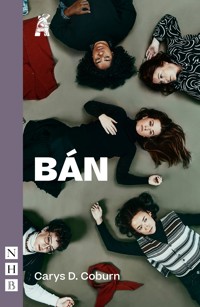
1980s Ireland. Five sisters, bound together under their mother's watchful eye, spend their lives longing for escape, power and the one local eligible bachelor. Dark, raucous and with a tender heart, BÁN is a reworking of Lorca's The House of Bernarda Alba. Carys D. Coburn's play was nominated for the prestigious Susan Smith Blackburn Prize, and premiered at the Abbey Theatre, Dublin, in 2025.
Sie lesen das E-Book in den Legimi-Apps auf:
Seitenzahl: 127
Veröffentlichungsjahr: 2025
Das E-Book (TTS) können Sie hören im Abo „Legimi Premium” in Legimi-Apps auf:
Ähnliche



Carys D. Coburn
BÁN
NICK HERN BOOKS
London
www.nickhernbooks.co.uk
Contents
Original Production Details
Introduction
Epigraphs
Characters
Note on Play
BÁN
About the Author
Copyright and Performing Rights Information
BÁN was first performed at the Abbey Theatre, Dublin on 30 September 2025, with the following cast:
BERNADETTE
Bríd Ní Neachtain
FRANCES
Yvonne Gidden
MARY ELIZABETH
Niamh McCann
MARY LOUISE
Bláithín Mac Gabhann
ANNIE
Malua Ní Chléirigh
MARY ROSE
Bebhinn Hunt-Sheridan
EDELE
Liadán Dunlea
Director
Claire O’Reilly
Set & Costume Designer
Sarah Bacon
Lighting Designer
Lee Curran
Composer & Sound Designer
Jenny O’Malley
Dramaturg
Ruth McGowan
Voice Director
Cathal Quinn
Movement Director
Gabrielle Moleta
Fight Director
Ciarán O’Grady
Hair & Make-Up
Tee Elliott
Casting Director
Barry Coyle
Assistant Director
Úna Nolan
Senior Producer
Craig Flaherty
Producer
Cally Shine
Production Manager
Andy Keogh
Production Coordinator
Justin Murphy
Assistant Producer
Aoife McCollum
Company Manager
Danny Erskine
Company Stage Manager
Clive Welsh
Deputy Stage Manager
Roxzan Bowes
Assistant Stage Manager
Aidan Doheny
Head of Costume & Costume Hire
Donna Geraghty
Costume Supervisor
Yvonne Kelly
Props Master
Eimer Murphy
Props Supervisor
Adam O'Connell
Head of Lighting & Sound
Kevin McFadden
Lighting Operations Manager
Simon Burke
Sound Operations Manager
Morgan Dunne
Sound Supervisor
Derek Conaghy
Marketing
Muireann Kane, John Tierney
Publicity
Mia O’Reilly
Digital Engagement
Eva Louise O’Beirne
Publicity Image
Patricio Cassinoni
Irish Sign Language Interpreters
Caoimhe Coburn Gray, Vanessa O’Connell
Artistic Director/Co-Director
Caitríona McLaughlin
Executive Director/Co-Director
Mark O’Brien
Why Adapt? Why Lorca? Why Bernarda? Why ‘BÁN’?
If you play a lot of video games, you probably know what reskinning is. It’s when you take a game that already exists and make it look different – different colour scheme, different character sprites, different names for attacks, items, equipment – without substantially altering its fundamental logic. Fans do it for fun. I want to play Skyrim, but I want all the dragons to be Thomas the Tank Engine. Corporations do it for profit. Why make a new game when we could just do Skyrim in Space?
You can approach adapting a play this way. You can replace every drat with a fuck, every rouble with a euro, every noble with a financier, you can transpose from ancient Athens to present-day Drumshanbo. It can be fun, and sometimes these transpositions generate moments of surprise that bring something into focus in the parent work. Oh! I never saw that that way. But frequently, I think, superficial changes generate only superficial insights.
In music there’s a term for a piece that mirrors the harmonic or melodic structure of another – it’s called a contrafact. Miles Davis’s ‘Tune-Up’, despite its name, falls and then rises; John Coltrane’s ‘Countdown’, despite its name, rises and then falls. ‘Tune-Up’ cycles between three keys, and it takes four bars to do so each time; ‘Countdown’ accelerates the cycle, makes it denser and wilder, the harmony changing three times for each of ‘Tune-Up’s three changes. But somehow, magically, almost like Coltrane planned it, every phrase of ‘Countdown’ ends in the same key as each phrase in ‘Tune-Up’. Miles Davis shows us a rainbow of three stripes – John Coltrane interposes clouds of notes between us and that rainbow, but every so often they’re swept away and it shines through.
I prefer contrafacts to reskins in adaptation. You could call it the Cordelia approach, more faithful to the parent in defiance. Or the Beethoven approach – when classical language doesn’t fit any more you take it apart at the seams, quilt it into a jacket or a blanket, some reconstellated shape that can serve you some other way. The challenge is to treat the original as a dare rather than a target. Can I go faster here without falling? Can I open this gap wider without making it uncrossable? Can I connect these points without short-circuiting the flow of energy and blowing the whole thing up?
Literalising the idea of the parent work, imagine how an adult and child cross rocks on a beach. Where the elder picks their way, the younger jumps. Where the elder looks ahead, the younger plunges in. For neither is the route practical – for both, the pleasure is in the traversal of terrain that challenges you. But the child’s pleasures are other, wilder.
Lorca’s plays, rich landscapes of contradictions and provocations, lyricism alongside realism alongside soap opera alongside politics, invite this kind of traversal. They’re karst, so no two people crossing the riven surface take the same route. There is a contrived point to make here about karst being a landscape common to Ireland and Andalusia, with El Torcal de Antequera about as far from Lorca’s birthplace as the Burren is from Cork. But I distrust the idea that origins are explanations, that landscape is destiny, that blood and soil are siblings. The key thing with karst is how it makes you move. The number of possible paths is the factorial of the number of islands. The question is not what can this play say, it’s what can’t it?
For example: it is deeply strange to me that the lyrical Lorca is canonised and the political Lorca is marginalised. Yes, okay, The Moon gets a lovely monologue in Blood Wedding – a play about the irreconcilable demands of passion and property. Famously, Fred scanned the papers for stories of duende, human interest with teeth, desire leading to death or vice versa. But if duende is just intensity of feeling why not invent it? Why does pure shining emotion need footnotes, accreditation in smeary newsprint?
Unless the smears are the points. He wanted the adversity, the perversity, the banal given from which something radically other blooms, falters, dies. Roses growing in middens. Passion drives a Lorca play, but it rarely wins. That fact has a political charge. It says something about the weight of history, the difficulty of becoming otherwise. I’m being etymologically literal when I say passion rather than desire, because a passion is a desire that hurts. Passion is the want that calls our sense of self into question – who am I, if I want this?
If I try to say what THE Lorca mood or gesture is, the quandary his characters face time and time again, I land on a question: How to be fully human in a world that doesn’t want you to be? How to live a life where you don’t just recite your assigned lines, where you are more than a cog in the machine of the family or the town or the state? Yerma feels dated if you stage it as a quest, if Yerma ‘just’ wants a child because children are wonderful, motherhood is wonderful, so she’s chasing them as fast as she can. But if mother is the only alternative to wife, and wife is unbearable, then we’re in a rich paradox – to escape one womanhood, I dive into another. There is a choice, but there is no good choice. That’s the Lorca I wanted to adapt.
When I started working on my version of The House of Bernarda Alba, I had been reading a lot about the family. Not kinship, and not blood – kinship doesn’t require blood, and the family denies blood as often as not. The family is a set of laws, some enforced by the state and some by its members. Fathers aren’t guardians automatically even if they’re named on the birth cert. Don’t mention your brother’s hairline. When the family is working everyone knows their place, their duties and entitlements, what they own or owe. This has never happened. A stable family is nearly a contradiction in terms, because all too easily it tips over into too many people inheriting too little or too few people managing too much. This applies whether it’s a house or attention, wealth or love, at issue.
Think of those staples of the nineteenth-century novel: the wealthy widow or widower in search of a suitable heir, and the orphan in search of a suitable family. It’s comic in Oliver Twist and Nicholas Nickleby; ironised in Bleak House and Great Expectations. The wealthy widow or widower’s predicament unites the two problems of family; no primary line, too many secondary claimants. Scarcity and excess side by side, neither serving anyone. A productive paradox – that the family, like an empire, must sustain itself by dispersing itself. We need a child to inherit; they might die, so better have some spares; oh shit, we have all these spare children, better marry off the daughters and put the sons to work; oh shit, our sons are getting people pregnant faster than we can marry off our daughters, better declare some of these children illegitimate; oh shit, we’re giving away more in dowries than we’re gaining in property, better lower the wages in the factory or lengthen the hours or steal our neighbour’s land and force them to work for us…
No wonder family drama looms so large for playwrights. Family is a machine that is supposed to produce stability, continuity, love, and instead it gives us chaos, estrangement, abuse. We can’t survive without the support of our family, but it’s not enough to sustain us by itself. The people who are supposed to love us hurt us, or do love us but in every way except the way we need. The ironies are as painful as they are rich.
Lorca’s plays have a holy trinity at their heart: family, land, purity. You can’t continue the family without the land; you can’t inherit the land unless you’re pure; you can only be pure if you belong to the family. Passion is the force that derails this circular train, makes it jump its tracks. Force is required to return it to its orderly procession – force isn’t necessarily violence, force can be offered money or looming starvation, but in Lorca it is often violence. This too tells a truth, that we don’t live this way by choice. We will be punished if we don’t.
Lorca, in writing about this kind of rural land politics, was writing about the world of his parents. When I write about Ireland in the eighties I am doing the same. I don’t live there, but it casts a long shadow in my life. The last line of Lorca’s The House of Bernarda Alba is ‘She died pure’. Bernarda’s family name, ‘Alba’, means dawn via a root that means white. I find that connection rich.
My mother is not white, but she was raised thinking she was. Religious orders decreed it better for children to grow up with stable (white) married (white) parents, whatever they were like, even if it came at the cost of any connection to their heritage. The state deemed it fit that married women give birth in hospitals whose sheets were cleaned by unmarried women in laundries. And the Association of Mixed Race Irish’s shadow report to the UN’s Committee on the Elimination of Racial Discrimination marshalls the evidence that mixed-race children were dispreferred for adoption, by the agencies notionally caring for them if not prospective parents. Meaning they were more likely to spend their early lives in institutions, more likely to lack the family networks of care that could keep people out of those institutions in adult life. The Irish family is white and nuclear by fiat, not in fact. This too is force. As is lying – sorry, we have no records pertaining to your birth family. No, we don’t know why you look so different from your siblings. So not only does it take force to keep the (white) family on track, it takes force to found it in the first place.
The image of those clean sheets, cleaned by prisoners, is particularly hard for me to shake. Maybe it’s because the image and its production tell such different stories. Behind purity, brutality. Maybe because I was born in the Rotunda. If I’m cycling to work nearby or to visit my mother, I pass the Sean McDermott Street Laundry. It’s less than five minutes from hospital to laundry on a bike. It was still open the year I was born, so the question looms. And, writing this, I realise one of the central images of BÁN is bloodied sheets. An attempt to harmonise appearance and essence, perhaps. BÁN was written as a companion to Absent The Wrong, the other play in this collection, which delves into all of this history. BÁN isn’t as explicit in dealing with it, but its roots are as firmly planted in it. It concerns itself with a single household rather than the state, whose occupants don’t want to be there but are terrified to leave. Absent The Wrong is about all the reasons the characters in BÁN had to be terrified; BÁN keeps a tight focus on how terror makes us treat one another.
I read The House of Bernarda Alba as a kind of gothic drama. BÁN certainly is. One way of thinking about the gothic is that it is preoccupied with the impossibility of purity, the high cost incurred in pursuit of it, often paid in blood. It is a genre where our present hopes and dreams founder on the past. Debts incurred prior to our birth upstage all our projects, our very best intentions. The good suffer in spite of their goodness; the bad suffer irrespective of their badness. We can scrub ourselves raw but we will still not be clean, or not for long – some wrong will be disinterred, thrust into our hands, leaving us muddied or bloodied. Sometimes this is literal. The second act of Lorca’s play ends with dogs digging up a murdered baby, and the people of the town lynching its unmarried mother. His Bernarda calls for the mob to put burning coal in the place of her sin. I will leave you to find out how I handled this in the context of eighties Ireland, saying only that precedents and echoes were not hard to find.
Sometimes a lot of emphasis is put on the supernatural’s role in the gothic, but a more abstracted definition would say that ghosts and monsters are just one tool for mortifying the understanding. It looks to the gothic protagonist like the rules of reality are being broken; in a happy gothic ending they realise that they were wrong, that those ghostly voices were just servants behind the wall; in an unhappy gothic ending, arguably more in the spirit of the project, it turns out that what you believed to be the rules weren’t broken because they never obtained in the first place.
Every character in BÁN makes at least one bad decision. Most of them are made during the play, but a few big ones pre-exist the action. If the world were fair, then the bad results of those decisions would be proportional to the error. But the sisters’ bad decisions domino into their mother’s, so that all unknowing they tip themselves into a downward spiral they can’t escape. There’s a lot of talk from everyone about getting square, making things right at last, as if by saying it is so they can make it so. But a gothic world isn’t transactional. There can be no return to a tit-for-tat universe for them, because these characters never lived there.




